Check engine light on: how drivers choose an auto repair or collision shop through AI
Drivers now ask AI what a repair should cost, whether the dealer is worth it and which shop won't rip them off. Here's what AI tells them, and how auto repair and collision shops get named.
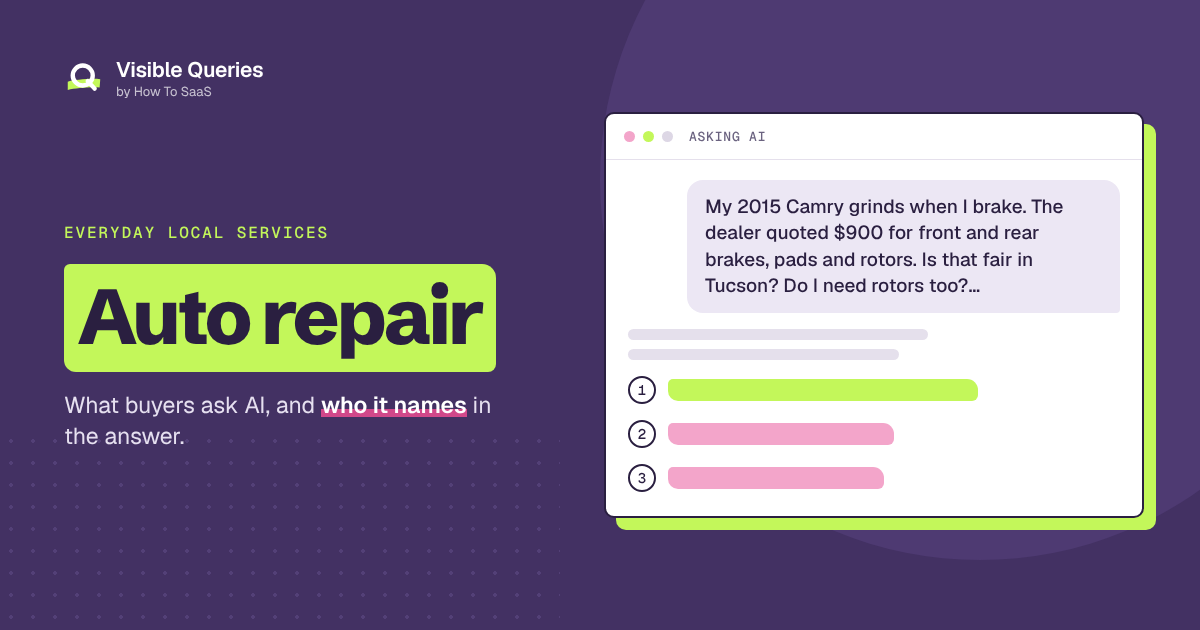
A teacher in Tucson hears a grinding noise every time they brake. Their 2015 Camry has 140,000 miles on it. The dealership quoted $900 for "brakes all around." A coworker said that sounds high. On their lunch break they ask ChatGPT:
"My 2015 Camry grinds when I brake. The dealer quoted $900 for front and rear brakes, pads and rotors. Is that fair in Tucson? Do I need rotors too? Is an independent shop as good as the dealer, and which shops near midtown Tucson are honest?"
AI explains what grinding usually means, typical price ranges for pads and rotors on that kind of car, why rotors are sometimes replaced and sometimes resurfaced, what affects labor rates, and how dealers and independent shops compare. It suggests asking for an itemized quote and the old parts. Then it names three independent shops. One of them does the job that afternoon for less than the dealer quoted.
Auto repair has a trust problem, and drivers know it. Most people can't judge whether a repair is needed or fairly priced. That makes them anxious, and anxious people research. AI is now the first stop for many of them, and it's often the one deciding which shop sounds honest.
Our everyday local services guide covers the journey across auto shops, car washes and pet care. This one goes through the questions that decide repair and collision jobs, what AI usually says, and what shops can publish so AI names them.
Here are the questions at a glance:
| The question | What gets you named |
|---|---|
| "What's wrong with my car?" | Plain guides to common symptoms |
| "How much should this repair cost?" | Price ranges for your common jobs |
| "Dealer or independent shop?" | An honest comparison, including warranty work |
| "How do I know a mechanic isn't ripping me off?" | Your estimates, approvals, photos and warranty |
| "Who's open Saturday?" | Hours, same-day policy and loaners, the same everywhere |
"What's wrong with my car?"
What AI usually says: It lists likely causes for the symptom: grinding brakes, a check engine light, a squeal, a shake at highway speed, a burning smell. It often says which ones are urgent and which can wait.
Why it matters: This is the first question, and it shapes everything after. If AI quotes your explanation, you're already the expert in the driver's mind.
What to publish: Short, plain guides to common symptoms, what they usually mean, how urgent they are and how you diagnose them. Write them for the cars you see most. "Why does my Subaru's check engine light flash?" is a better page than "Engine diagnostics."
"How much should this repair cost?"
This is the defining question for auto repair.
What AI usually says: Price ranges for common repairs, with what moves the price: parts quality (OEM vs aftermarket), labor rates, the make and model, and whether extra work is needed. It often advises getting a second opinion on large quotes.
What to publish: Price ranges for the repairs you do most, by vehicle type, plus your labor rate, diagnostic fee and whether it's applied to the repair. Shops that publish real ranges look honest, and that's the main thing drivers are trying to find out.
"Dealer or independent shop?"
What AI usually says: It explains that dealers have factory training and parts and handle warranty and recall work, while independents are often less expensive and more personal. It usually adds that routine maintenance at an independent shop doesn't void a new car warranty, as long as the work is done properly and documented.
What to publish: An honest comparison, with the makes you specialize in, your technicians' certifications, the diagnostic equipment you use and the parts you install. If you specialize in European cars, hybrids, diesel trucks or a specific brand, say so on its own page.
"How do I know a mechanic isn't ripping me off?"
What AI usually says: It recommends checking certifications and reviews, asking for written estimates, requesting old parts back, getting approval before extra work, and looking for warranties on parts and labor.
What to publish: Answer the checklist directly. Explain how you estimate, how you ask for approval, whether customers get photos or video of the problem, your warranty on parts and labor, and your certifications. Digital inspections with photos are a strong trust signal, so describe them.
"Who's open Saturday? Can I get in today?"
What AI usually says: It names shops based on what it knows about hours and availability, which is often out of date.
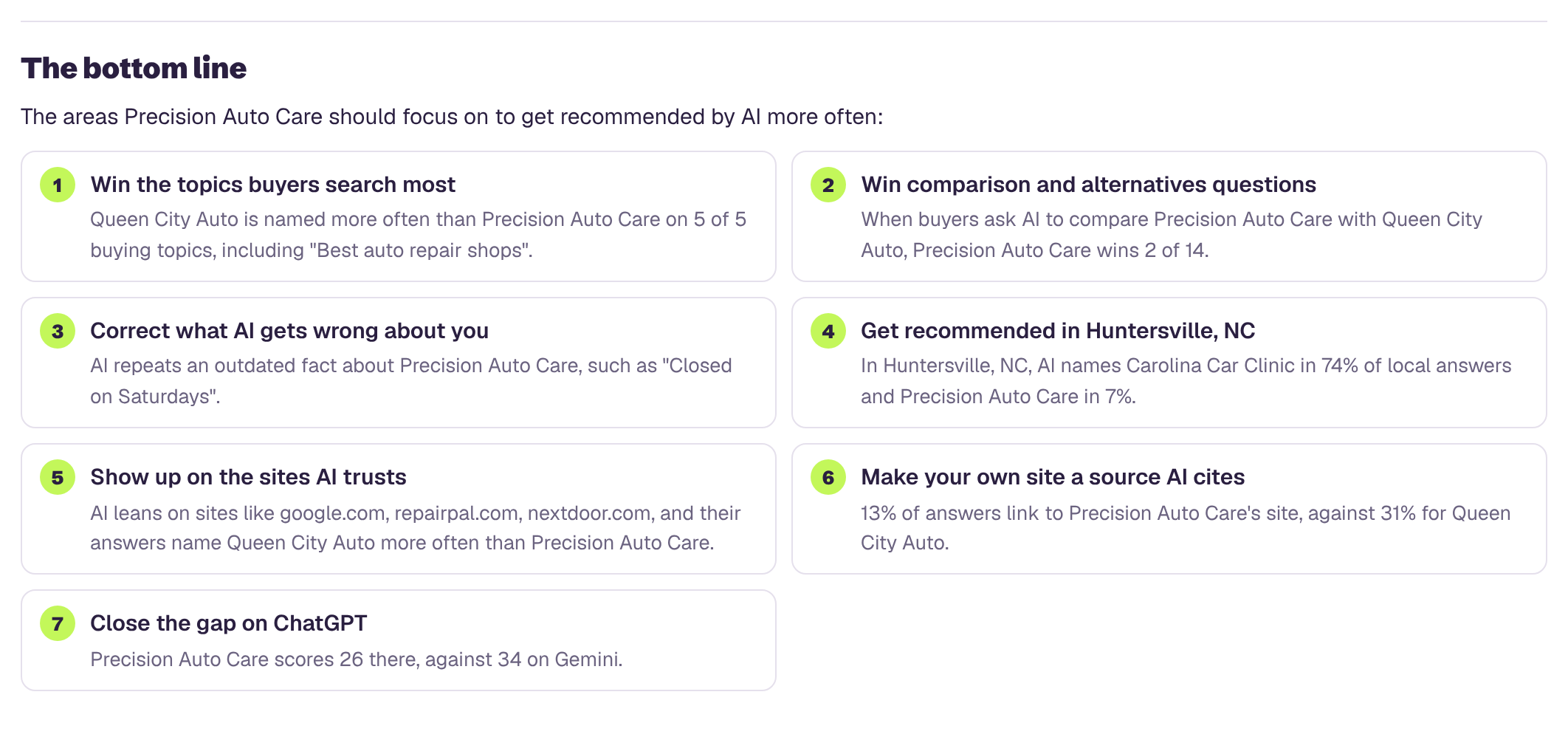
Why it matters: Hours are a simple fact, but getting them wrong costs real customers. Here's how a wrong fact like that shows up in the report:
What to publish: Hours, appointment and walk-in policies, same-day service, loaner cars, shuttles and waiting room details, all in text on your site, and kept consistent across your listings.
Collision repair: different questions, same trust problem
After an accident, drivers ask different things:
- "Do I have to use the shop my insurance recommends?" AI usually explains that in many places drivers can choose their own shop, and that insurer-recommended shops are often part of a direct repair program.
- "How long will my car be in the shop?" AI gives ranges and explains parts delays and supplements.
- "OEM or aftermarket parts?" AI explains the difference and what insurance usually pays for.
- "Will my car be the same after?" AI talks about frame straightening, paint matching and certifications.
What to publish: A clear guide to the claims process, how you work with insurers, whether you're certified by specific manufacturers, your parts policy, your timeline, rental car coordination and your warranty. Drivers in this moment are stressed and confused, and the shop that explains it calmly gets the car.
Fleet, commercial and specialty work
Businesses with vans, trucks and fleets ask AI for "fleet maintenance near me" or "diesel truck repair for a landscaping company." EV and hybrid owners ask whether independent shops can work on their cars. Classic car owners look for specialists. If you do any of this, give it a page. These are high-value customers with fewer good options.
What the sample report shows
Here's what a Visible Queries report looks like for Precision Auto Care, the sample independent repair shop in the Charlotte area from our guide. The questions are different for repair shops, but the patterns are the same.
Under the score, the report breaks visibility into the numbers that matter most:

The gap is clearest side by side:
If you only fix three things
- Publish price ranges and your labor rate. For the repairs and vehicles you see most.
- Answer the "don't rip me off" checklist. Estimates, approvals, photos, old parts, warranties and certifications.
- Keep hours and availability correct everywhere. Including Saturdays, same-day service and loaners.
Drivers are asking AI whether they're being ripped off. The shop AI names will be the one that makes honesty easy to see.
Part of our guide: Why AI visibility matters for everyday local services
See what AI tells drivers about your shop
Enter your website and get a free AI visibility report. It takes a few minutes, and you'll see:
- Your AI visibility score, overall and for ChatGPT, Gemini, Claude, Perplexity and Google's AI Overviews and AI Mode
- Which shops AI recommends instead of you, and how often
- Your visibility in every town you serve, and the competitor AI names most in each one
- What AI gets wrong about you, and what to fix first
- Your biggest gaps: the buyer questions where AI leaves you out, and who it recommends instead
- A downloadable PDF you can share with your team