See if AI puts your software on the shortlist.
Buyers ask AI for the best tool in your category before they ever book a demo. See whether you make the list, who AI picks instead, and what it says when buyers compare you.
How buyers choose now
A controller at a 400-person company has been told to cut the time it takes to close the books. Before, she would have searched Google, opened three G2 grids and booked demos with whoever ranked first. Now she asks ChatGPT which accounts payable tools work best with NetSuite for a company her size, and gets a shortlist of four products with a line on each.
That shortlist decides which vendors get the demo. Buyers carry it into every later step: they ask AI to compare the names on it, to list the complaints about each one, and to draft the business case for their CFO.
For software companies the hard part is that AI's picture of your product is often a year or two old. Features you shipped, integrations you added and pricing you changed may not be in the answer, while a competitor's old launch post still is.
What we hear from software companiesThe problems that keep coming up, and what your report shows for each one.
You rank on Google but miss the AI shortlist
Years of SEO got you to page one. AI answers don't list ten blue links, they name a handful of products, and the ones they name are often not the ones that rank.
Your report showsHow often AI names you when buyers ask for the best tool in your category, on each AI platform, next to the products it names instead.
AI describes the product you sold two years ago
Old pricing, missing integrations and features you've since shipped keep showing up in answers, and buyers rule you out on facts that are no longer true.
Your report showsFacts AI gets wrong about your pricing, integrations and features, so you know exactly what to correct.
You lose the head-to-head before the demo
Buyers ask AI to compare you with your biggest competitor. If the answer leans the other way, you never hear about the deal.
Your report showsWho AI favors when buyers compare you head to head, and what it says about each side.
Every person in the buying group asks something different
The user asks about features, IT asks about security and SSO, finance asks about cost and ROI. You have to win all of those answers.
Your report showsQuestions from each buyer role and stage, and which product AI favors in each.
What software buyers ask AIYour report asks the kinds of questions your buyers really ask, worded for your business, your competitors and the places you serve.
Researching
The buyer is figuring out the problem and the kinds of tools that solve it.
- “How do mid-size companies automate accounts payable?”
- “Do we need a dedicated AP tool or can our ERP handle it?”
- “What does AP automation software typically cost?”
Comparing
The buyer wants a shortlist and the differences between the names on it.
- “What's the best accounts payable software for a 50-person finance team?”
- “Which AP tools integrate best with NetSuite?”
- “Is [your product] or [competitor] better for a growing team?”
Choosing
The buyer is checking risk and building the case to buy.
- “What do users complain about with [your product]?”
- “Is [your product] SOC 2 compliant and does it support SSO?”
- “How long does it take to implement [your product]?”
Where AI gets its answersThe sources AI leans on most when software buyers ask about software. Your report shows which ones it cites for you and for your competitors.
- Review sitesG2, Capterra and TrustRadius. AI leans on them for “best” and “vs” questions and for what users complain about.
- “Best of” lists and comparison postsRoundups, including competitors' own comparison pages, are often the first sources AI cites for a shortlist.
- Your own website and docsPricing, integration and security pages with clear facts are what AI uses to describe you correctly.
- Reddit and communitiesThreads from people who use the product shape what AI says about ease of use, support and switching.
- YouTube and analyst coverageDemos, reviews and analyst mentions feed AI's sense of who the category leaders are.
What your report showsScreenshots come from a sample report for a made-up accounts payable software company. Your report is built from your own website, buyers and competitors.
Your AI visibility score
One number out of 100 that shows how often AI recommends your product when buyers ask about your category, with a score for each AI platform.
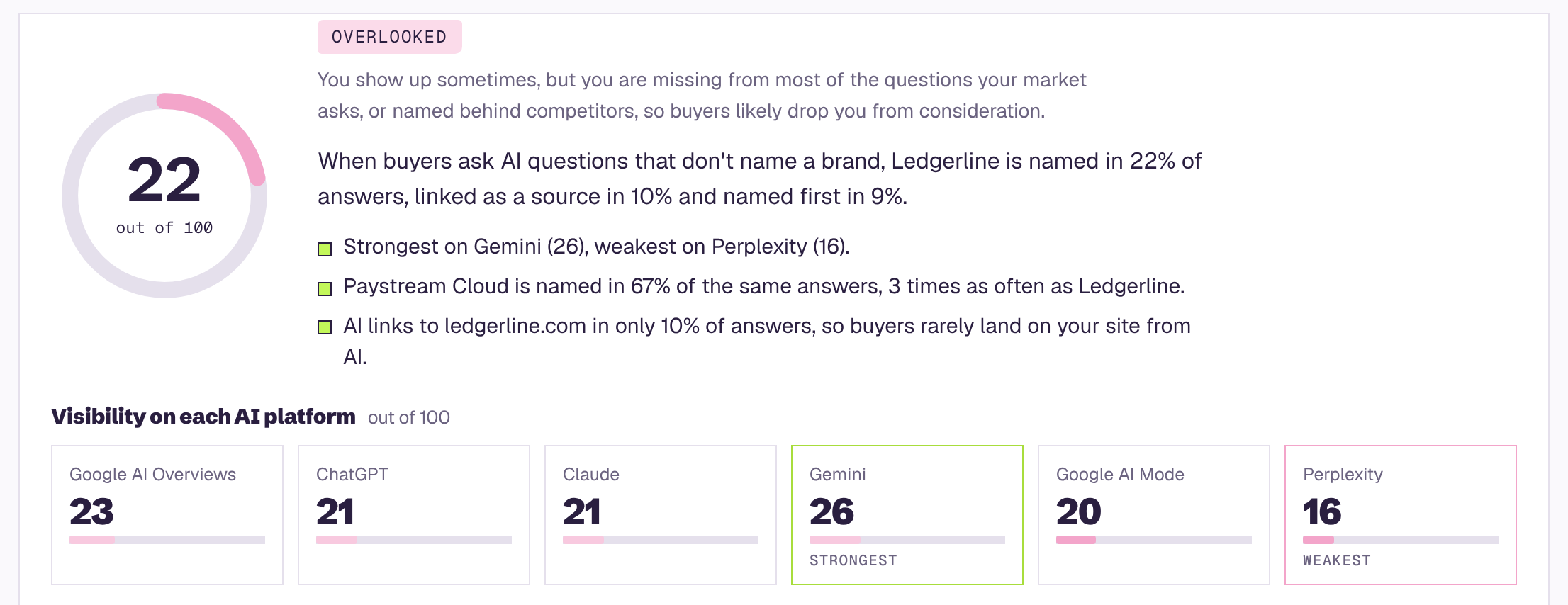
How you show up in answers
How often AI names you, links to your site, puts you first, and gets your pricing, integrations and features right.

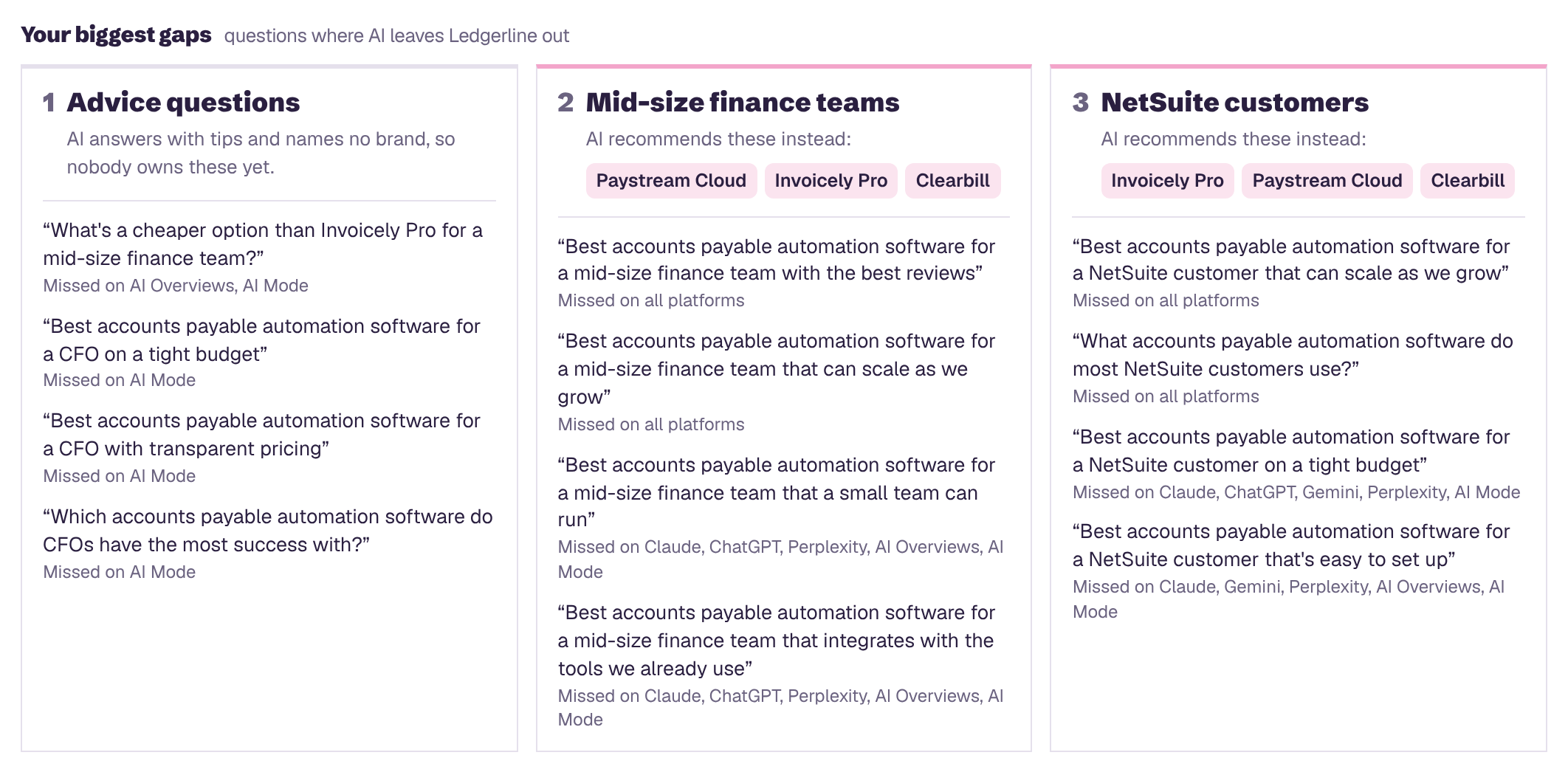
Who AI recommends instead
The buyer questions where AI leaves you out, the competitors it recommends instead, and real example questions.
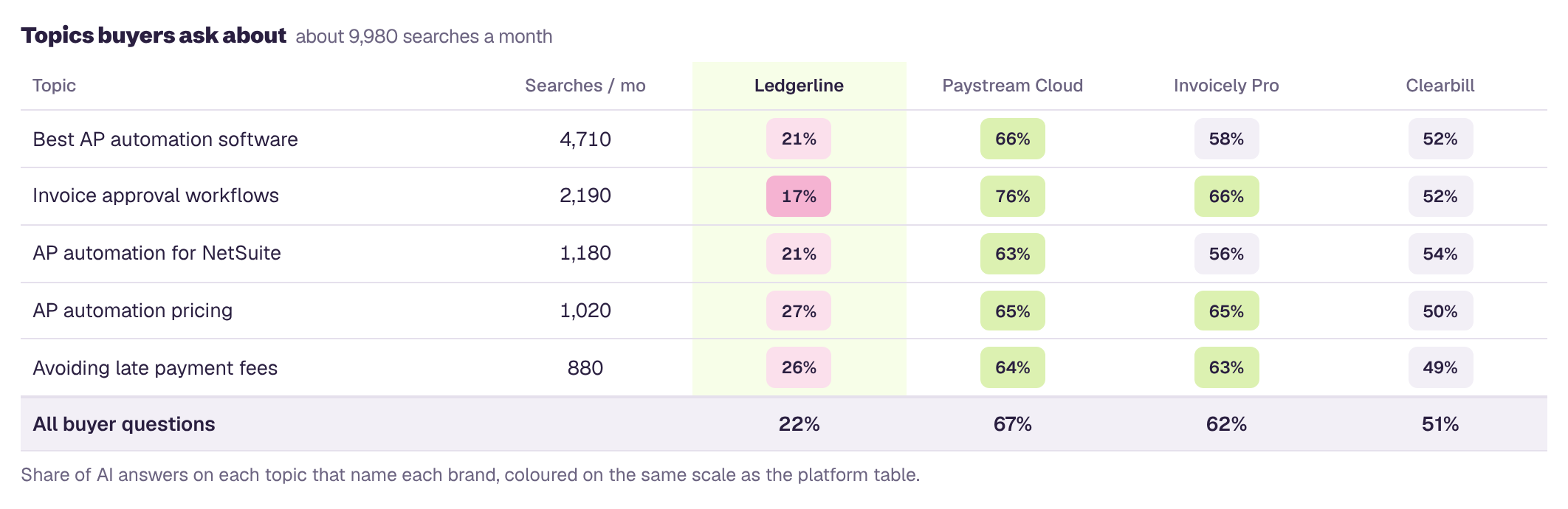
Topics buyers ask about
The topics behind buyer questions, from “what is” to “which should I pick”, how often each is searched, and which products AI names for each one.
What it's worth
The pipeline going to competitors in AI answers each year, and what closing the gap is worth.
The bottom line
The few areas to focus on first, in plain language.
Ready to share with your team
A 2-page PDF summary, so everyone sees exactly where you stand against competitors.
Questions
How is this different from tracking our Google rankings?
Rankings show where your pages sit in a list. AI answers name a few products and explain why. You can rank well and still be missing from the answer, and the report shows exactly where that happens.
Which AI platforms does the report check?
ChatGPT, Claude, Gemini, Perplexity, Google AI Overviews and Google AI Mode, the places software buyers now ask what to buy.
Do I need to set anything up?
No. Enter your website and the report reads your site, works out your product, buyers and competitors, and asks the questions your buyers ask.
Does it cover head-to-head comparisons?
Yes. The report asks AI to compare you with your competitors and shows who it favors and what it says about each.
See what AI tells software buyers about you.
Get one free score, side by side with your competitors. Just enter your URL.