Check if AI recommends a company before you invest.
Buyers now shortlist vendors inside AI answers. Before you invest, see whether the target makes that shortlist, which competitors AI favors, and how much pipeline that is worth.
More buyers ask an AI assistant which vendors to consider before they contact anyone. A company that isn't on that shortlist loses deals it never hears about, which a pipeline report won't show.
02
It's an outside-in read you can get today
You don't need data-room access or management's time. From a URL you see how often the market's AI tools recommend the company and its competitors, topic by topic.
03
Gaps are fixable, which makes them a lever
Missing from comparison answers or saddled with wrong facts is usually a content, review and PR problem, not a product problem. That makes it a practical item for a post-close plan.
Questions you can answerYour report is built from the company's own website, buyers and competitors, and answers these in plain language.
“Does AI name this company when buyers ask for the best option?”
“Which competitors win the category in AI answers?”
“How much pipeline goes to competitors in AI answers?”
“Is the brand strong enough to grow inbound after we close?”
How investors use it
1
Add it to diligence
Run the check on the target from just its URL. No access to the company's systems, and nothing for management to set up.
2
Compare it to the category
See the target's share of voice next to every competitor AI names, topic by topic and by AI platform.
3
Find the growth lever
Gaps in AI answers point to inbound demand the company is missing today, a clear place to create value after close.
Real situations
When investors run a check
Commercial due diligence
The situation
You're building a view of the target's market position and want an independent signal next to customer calls and management's pitch.
Look at
The headline score and score per platform, share of voice against named competitors, and who wins head-to-head comparisons.
Then
Compare what AI says with what management says about positioning. Note where the two disagree and ask about it in the next management session.
Choosing between two targets
The situation
Two companies in the same category look similar on paper.
Look at
Run both. Compare the scores, share of voice and first-mention rate side by side.
Then
Use the difference in how AI recommends each one as a tie-breaker on brand strength, and as a measure of how much work one would need after close.
Sizing the upside
The situation
You want to know how much inbound demand the company is leaving to competitors.
Look at
The revenue section: the pipeline going to competitors in AI answers each year, and what closing the gap is worth.
Then
Use the gap as a value-creation line in the investment case, and add the biggest topic gaps to the 100-day plan.
Portfolio review and value creation
The situation
You hold several companies and want to see which ones are losing ground in AI answers.
Look at
Each portfolio company's score and the competitors AI favors, plus the estimated search demand behind the topics they miss.
Then
Prioritize the companies with the biggest gaps and the most demand at stake, and re-check monthly to track progress.
What you'll seeScreenshots come from a sample report for Brightlane, a made-up real estate CRM.
01
A clear read on brand strength
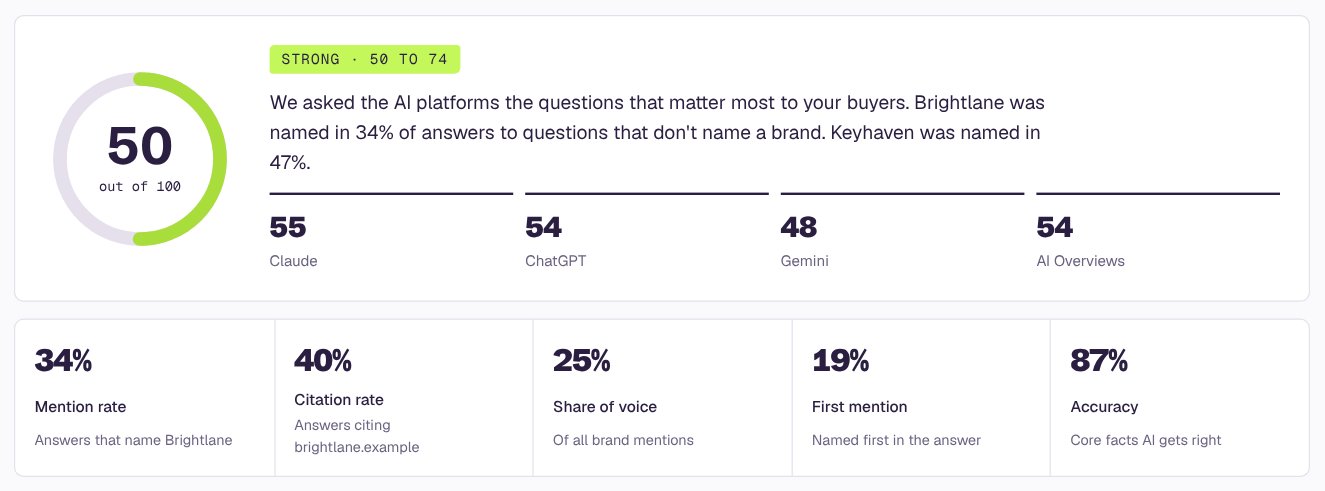
One number out of 100 for how often AI recommends the company, with a score for each AI platform.
02
The competitive picture
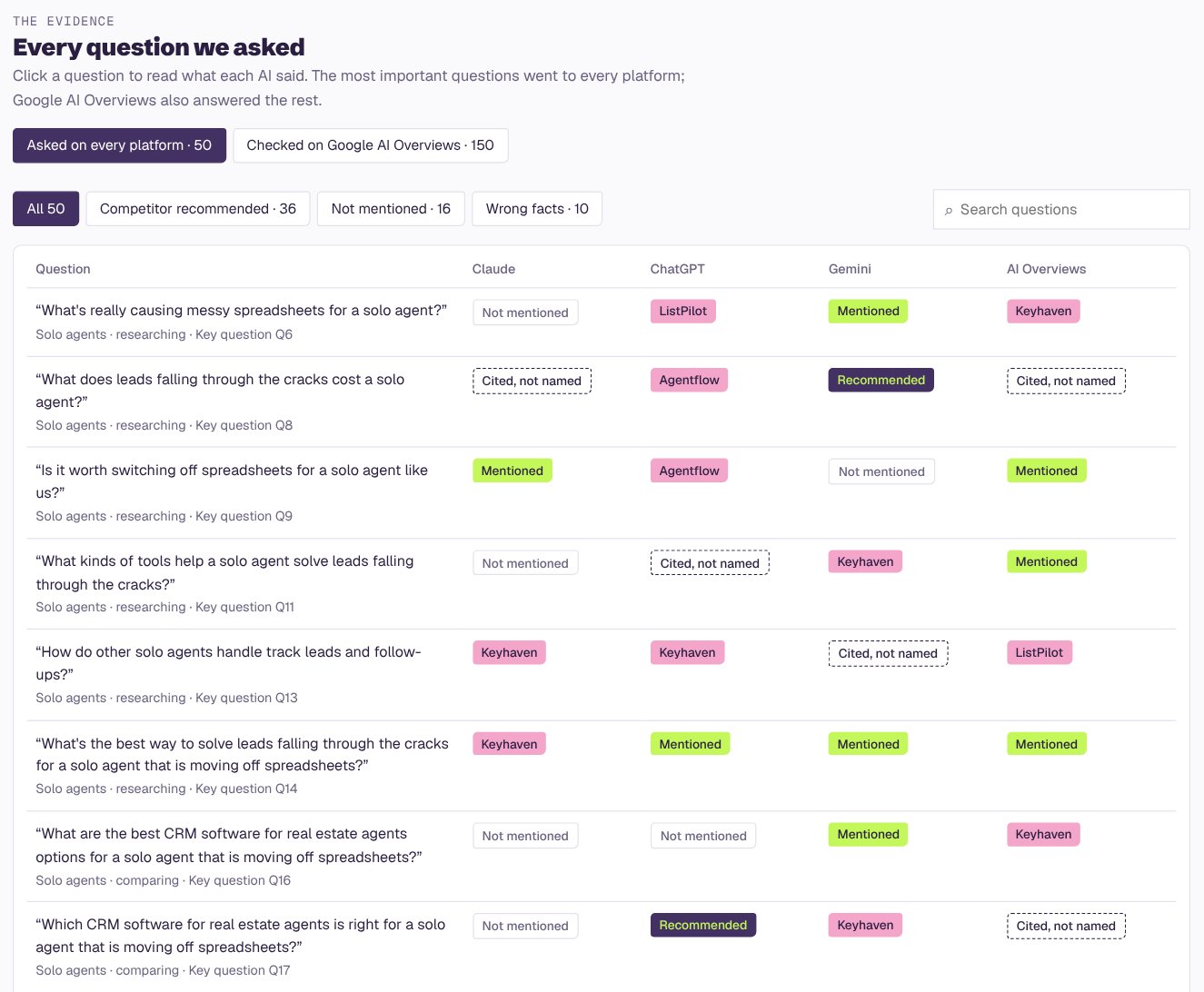
How often AI names the company and each competitor on every platform, and who wins when buyers compare them head to head.
03
Where the demand is
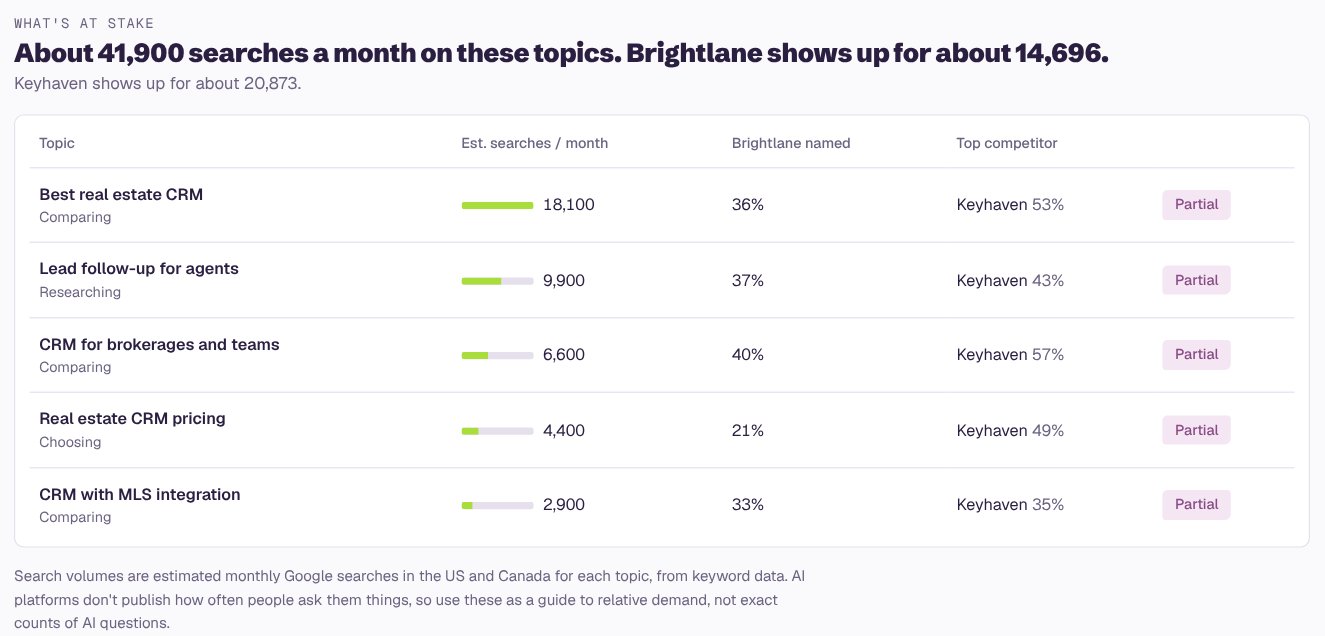
Estimated monthly searches for the company's topics, and which brand AI names for each one.
04
The size of the opportunity
For B2B companies, the pipeline going to competitors in AI answers each year, and what closing the gap is worth.
How to read the reportWhat a strong and a weak result look like, in plain terms.
✓ Good signs
Named on unbranded category questions across several AI platforms
Wins most head-to-head comparisons against named competitors
AI links to the company's own site as a source
AI gets the company's core facts right
! Warning signs
Only appears when the question names the company
A smaller competitor is recommended first more often
Recurring warnings about support, reliability or pricing
Visible on one platform and missing on the others
Questions
Does the target company know I ran a check?
No. The check reads the public website and asks AI platforms questions the way a buyer would. Nothing is installed and nothing is sent to the company. The report goes to your work email.
Do I need access to the company's systems or data?
No. Just the URL. You confirm the company's buyers and competitors before the check runs, so you can correct anything the site doesn't make clear.
Is it a replacement for customer calls or a market study?
No. It's one outside-in signal on brand strength and demand capture. It works best next to customer references and management interviews.
Which markets does it cover?
The United States and Canada, in English.
Can I check the same company again later?
Yes, once per domain every 30 days. That makes it easy to track a portfolio company month by month after close.