Know where your brand shows up in AI, and where it doesn't.
Your buyers ask AI before they visit your site, and those visits never show in your analytics. See the questions where AI names you, the ones where it names a competitor, and what to work on first.
FreeJust a URL, no setupScore in a few minutes
CMOsDemand generationContent and SEOBrand and commsProduct marketingGrowth teams
Why AI visibility belongs on your dashboard
01
Buyers decide before they click
When AI answers the question, buyers often read the shortlist and move on. You can lose the deal without a single visit, so traffic and rankings tell only part of the story.
02
Ranking on Google isn't the same as being recommended
AI builds answers from many sources, including reviews, directories, articles and your own site. Pages that rank well can still be left out of the answer.
03
Leadership will ask
Executives are trying AI tools themselves and asking where the brand shows up. A clear score, set against competitors, gives you an answer and a plan.
Questions you can answerYour report is built from the company's own website, buyers and competitors, and answers these in plain language.
“How often does AI recommend us compared to our competitors?”
“Which AI platforms leave us out of the answer?”
“Which topics have the most search demand that we're missing?”
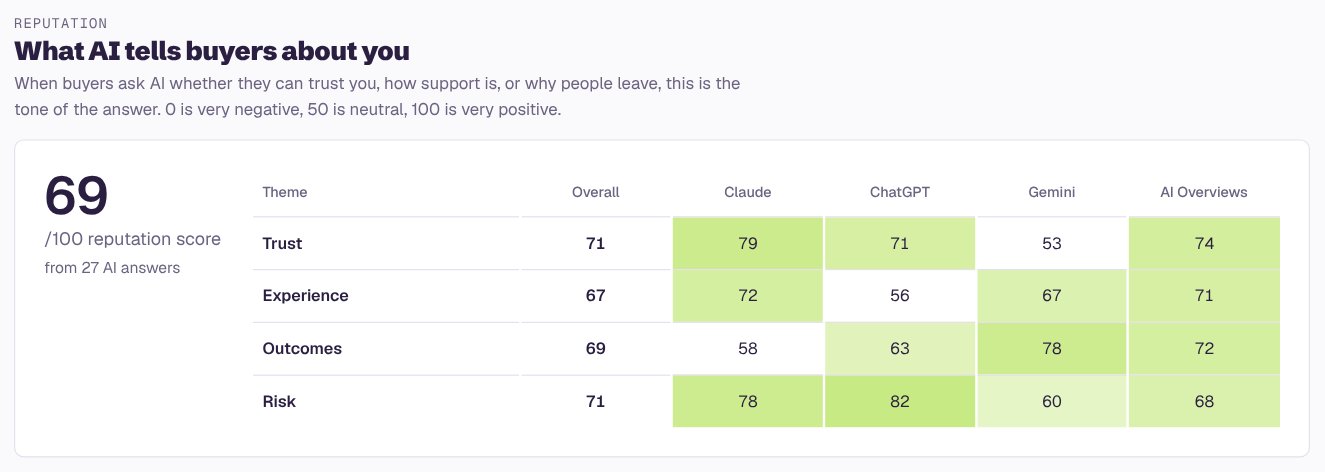
“Is AI getting our pricing, features and positioning right?”
How marketers use it
1
Get your baseline
Enter your URL and confirm your buyers and competitors. Your score is on screen in a few minutes.
2
Find the gaps that matter
See the topics and questions where competitors win, ranked by how much demand sits behind them.
3
Report it upward
Share the PDF with leadership and re-check monthly to show how your share of voice is moving.
Real situations
When marketers run a check
Planning next quarter's content
The situation
You have more content ideas than capacity and need to choose.
Look at
The topics and questions competitors win, the AI platforms where you drop out, and the estimated search demand behind each topic.
Then
Rank topics by demand and by how far behind you are. Write the comparison, alternative and buying-guide pages AI is missing for your brand first.
Responding to a competitor
The situation
A competitor has launched, rebranded or started showing up everywhere.
Look at
Their share of voice next to yours on each platform, the topics they lead, and the sites AI cites when it recommends them.
Then
Go after the sources that put them in answers, such as review sites, roundups and directories, and answer the comparison questions directly on your own site.
Fixing what AI gets wrong
The situation
Sales hears prospects repeat wrong pricing or old positioning.
Look at
The accuracy number: the share of answers about you that get your core facts right.
Then
Correct the facts on your site and the third-party profiles AI reads, then re-check to see which answers changed.
Reporting to leadership
The situation
The CEO wants to know if the company is “visible in AI”.
Look at
The headline score, score per platform and share of voice against your main competitors.
Then
Share the PDF, agree on one or two numbers to move, and re-check monthly to show the trend.
What you'll seeScreenshots come from a sample report for Brightlane, a made-up real estate CRM.
01
How you show up in answers
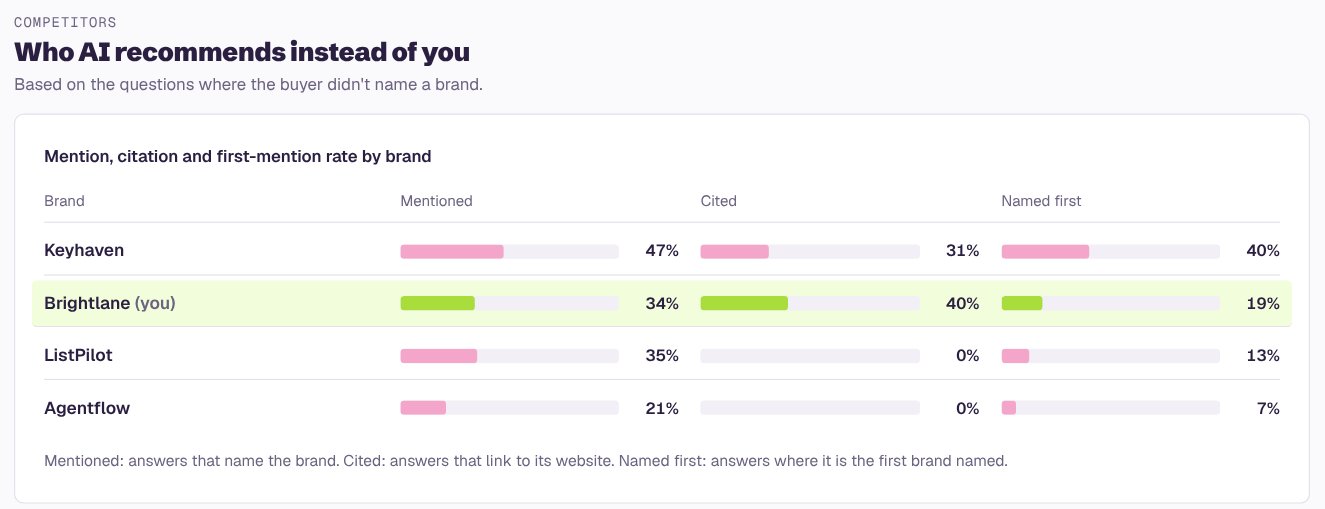
How often AI names you, links to your site, names you first and gets your facts right, plus your share of voice.
02
Where you drop out
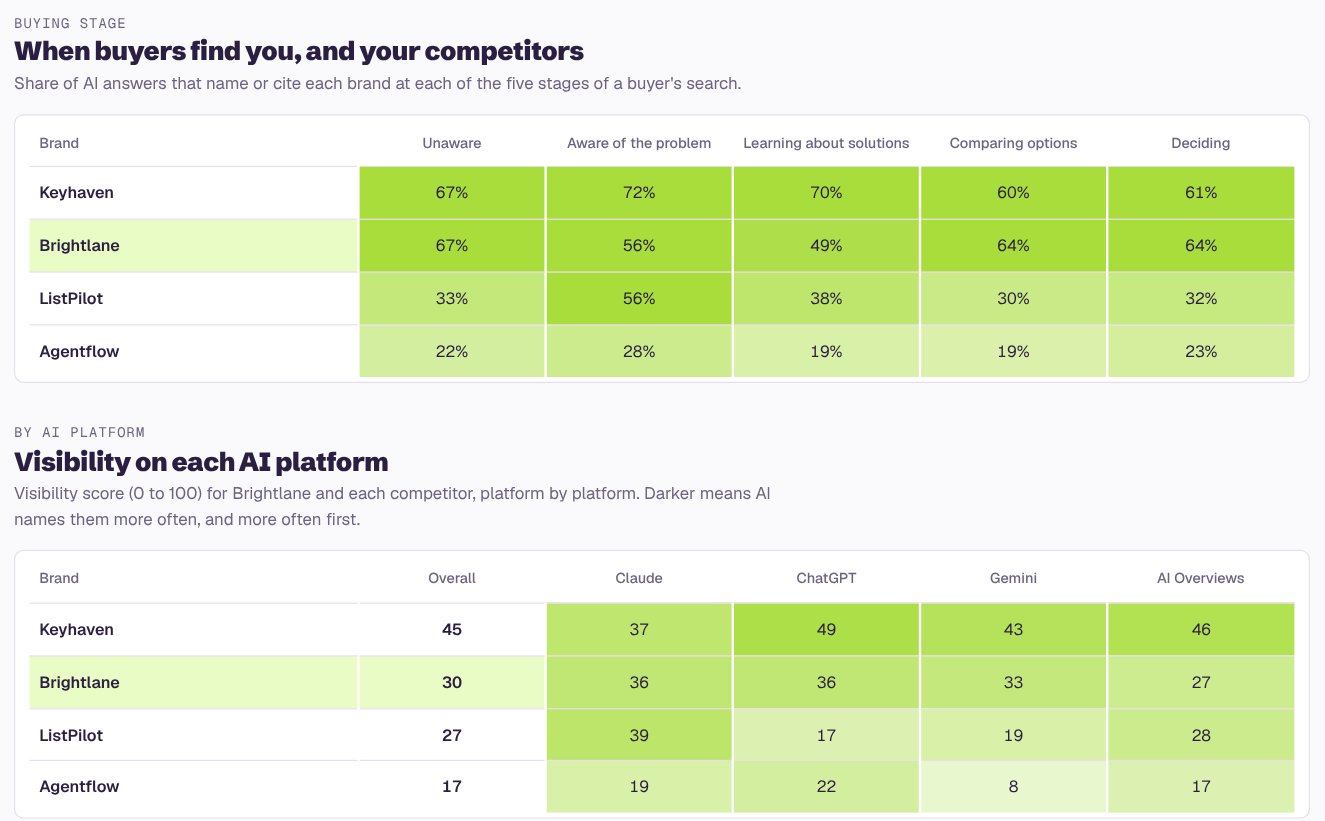
How often AI names you and every competitor on each AI platform, from ChatGPT and Gemini to Perplexity and Google's AI Mode.
03
Where the demand is
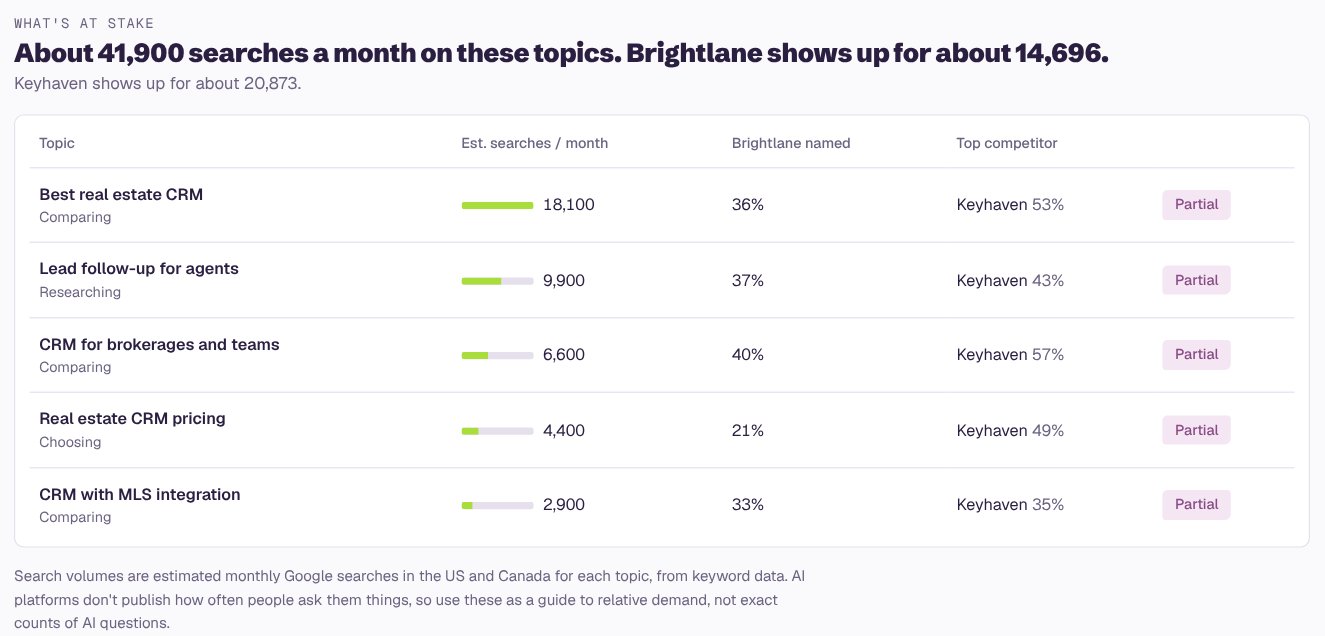
Estimated monthly searches per topic and who AI names for each, so you can put your effort where buyers are actually asking.
04
Your biggest gaps
The buyer questions where AI leaves you out, grouped by theme, with the competitors it recommends instead and real example questions.
How to read the reportWhat a strong and a weak result look like, in plain terms.
✓ Good signs
Named on early research questions, not only at the decision stage
AI cites your own pages as sources
Share of voice rising from one check to the next
Positioning and pricing described the way you describe them
! Warning signs
Strong in Google results but missing from AI answers
Competitors named first on the highest-demand topics
AI describes an old product or the wrong buyer
Only one AI platform mentions you
Questions
How is this different from SEO tools?
SEO tools measure rankings and clicks. This measures whether AI assistants name and recommend you when buyers ask questions, which often happens without any click.
Where does the search demand number come from?
It's estimated monthly Google searches for each topic. AI platforms don't publish how often people ask questions, so we use search demand as a stand-in and always label it as an estimate.
Can I track progress over time?
Yes. You can check the same domain once every 30 days, and each report shows the same numbers so you can compare them.
Do I need to install anything?
No. Just enter your URL and confirm your buyers and competitors.
How exactly is the score worked out?
The methodology page explains every step, from the questions we ask to how each answer is graded and weighted.