Where AI gets its answers: the sources behind AI recommendations in 13 industries
We asked an AI assistant 260 buyer questions across 13 industries and logged every source it cited. "Best of" lists, review sites and business websites did most of the work, and the mix changes a lot by industry and by city.
When a buyer asks an AI assistant who to hire or what to buy, the answer usually comes with links. Those links are the closest thing we have to a window into how the assistant made up its mind. They show which pages it read before it decided who to recommend.
We wanted to know what those pages are. So we asked an AI assistant, with live web search turned on, 260 shortlist questions a real buyer might ask:
"Who's the best personal injury lawyer in Toronto?"
"What's the best CRM for a 10-person B2B startup?"
"Can you recommend a reliable plumber in Vancouver?"
That's 20 questions in each of 13 industries, from software and industrial suppliers to dentists, restaurants and real estate agents. Questions about local businesses were spread across 10 cities in the US and Canada. Then we recorded and classified every one of the 1,353 sources the assistant cited.
This is what we found, and what it means for any business that wants AI to recommend it.
The short version
- Every answer named specific businesses. All 260 answers named at least one business, with about 12 on average. That held even when the assistant said there was no single best choice, which it did in 70% of answers.
- "Best of" lists and blog posts were the biggest source. Lists like "The 10 best plumbers in Dallas," comparison articles and buying guides made up 40% of all sources cited.
- Business websites and review sites came next, at 22% each. Directories were 7%. News outlets and professional rankings were 3% each.
- About three quarters of the sources were written by someone other than the business. A business's own website is one voice among many, and usually not the loudest.
- One review site dominated local questions. Yelp was cited in 114 of 260 answers, more than the next 11 sites combined. It appeared in 62% of answers to questions that named a city, and in none of the answers to national questions.
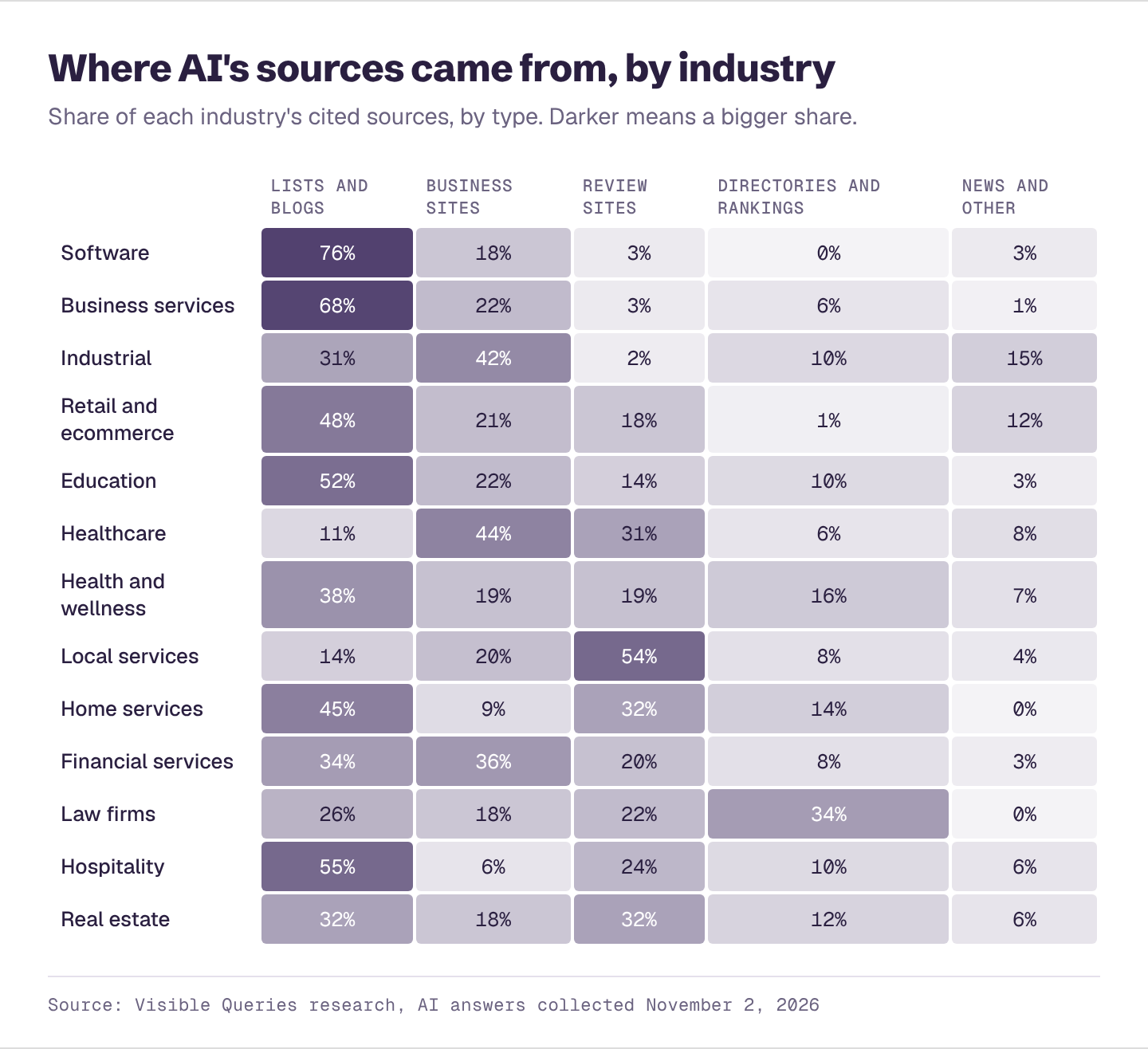
- The mix changes completely by industry. Business websites were 44% of sources for healthcare questions and 6% for hospitality. For software, 76% of sources were comparison articles and lists.
Three answers, three very different sets of sources
Before the totals, it helps to see what this looks like in a single answer.
"Can you recommend a reliable plumber in Vancouver?" The assistant named seven plumbing companies. Every one of its four cited sources was a Yelp page. No plumbing company's own website was cited, and no "best of" list either.
"Who's the best personal injury lawyer in Toronto?" The assistant named eight firms. Its sources were a "best of" article in a local lifestyle magazine, Doyle's Guide (a Canadian legal ranking), a legal directory's list and Yelp.
"What's the best CRM for a 10-person B2B startup?" The assistant named eight products. Its sources were three comparison articles, a technology publication and the websites of three software companies.
Same assistant, same kind of question, three different worlds. A plumber in Vancouver is judged almost entirely by Yelp. A Toronto law firm is judged by rankings and lists. A CRM company is judged by comparison articles and, to a lesser extent, by its own website. If you want to know how AI decides about your business, you have to look at the sources for your kind of business.
Where the answers came from, overall
The assistant cited 5.2 sources per answer on average. Here's how those 1,353 sources broke down.
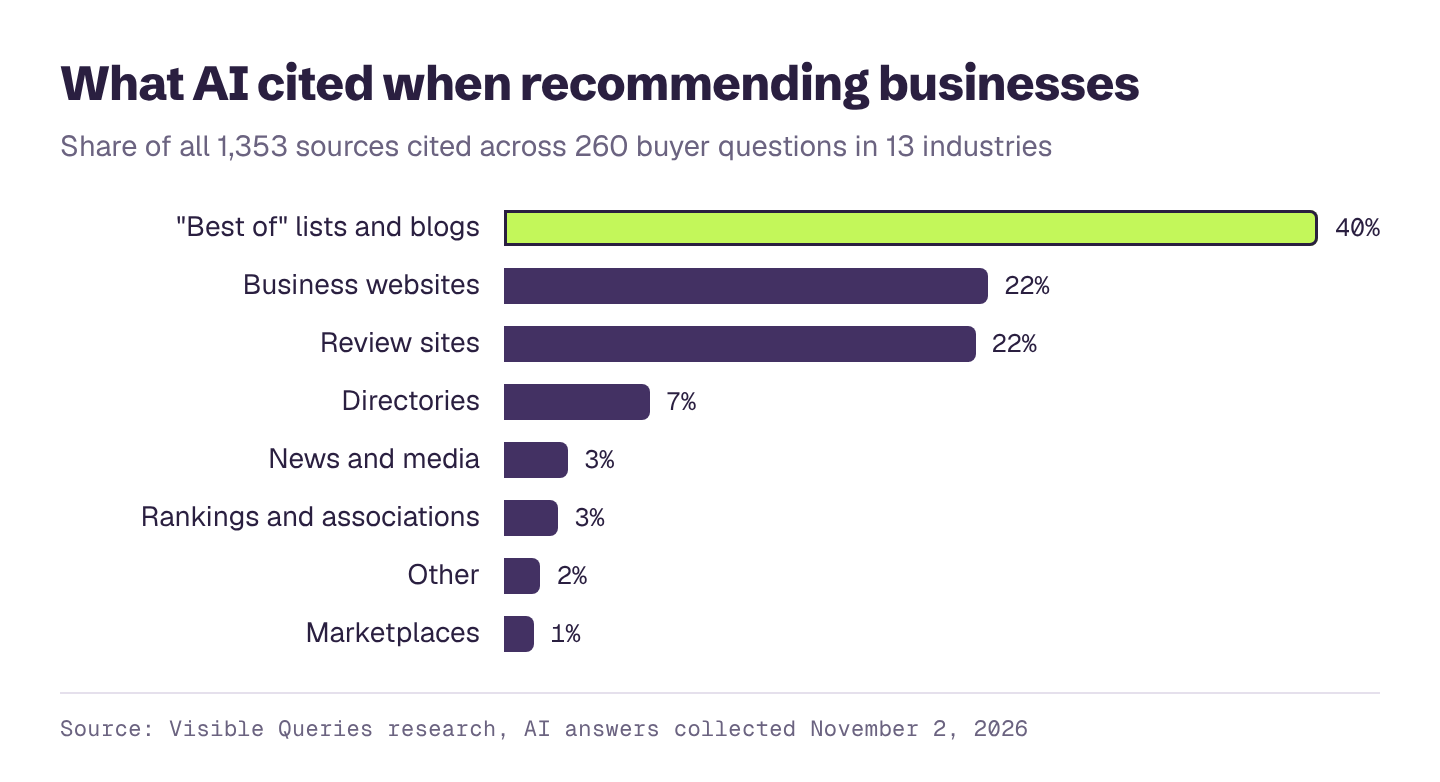
Two things stand out.
First, most of what shapes an AI recommendation is written by someone else. Lists, reviews, directories, rankings and news together made up about three quarters of the sources. That doesn't mean a business's own website doesn't matter. It was still cited in 122 of the 260 answers. But it's rarely the only thing the assistant reads, and it's often outweighed.
Second, "best of" lists carry enormous weight. Many of them are published by small marketing sites or local lifestyle publications, and few buyers would think of them as authorities. But they're written in exactly the shape an AI assistant is looking for: a question ("best roofers in Calgary"), followed by a short list of names with a reason for each. When an assistant searches for an answer, those pages are often the closest match to what it needs to write.
Where the answers came from, by industry
The overall numbers hide big differences. This table shows each industry's mix of sources.
Software: comparison content wins
For software questions, 76% of sources were comparison articles and "best tools" lists. Software companies' own websites were 18%. Review platforms like G2 barely registered, appearing in just 2 of 20 answers.
That makes software the most list-driven industry in our study. If you sell software, the articles that compare you with your competitors are doing most of the work of deciding whether AI recommends you. Being included in them, and described accurately, is a priority.
Business services: guides and agency lists
For business services like marketing agencies, bookkeeping firms and IT providers, 68% of sources were lists and guides, and 22% were the firms' own websites. Agency directories like Clutch appeared occasionally. For local business services, such as commercial cleaning or event planning in a particular city, Yelp showed up too.
Industrial: your own website and trade sources
Industrial was the one industry where businesses' own websites were the largest source, at 42%. Trade publications, supplier directories and industry rankings filled much of the rest. For questions like "Who supplies MRO parts for manufacturing plants?", the assistant often went straight to suppliers' own sites. A clear, specific website, with your product lines, capabilities and service area spelled out, pays off here more than anywhere.
Retail and ecommerce: shopping guides
For retail questions, 48% of sources were shopping guides and "best of" lists, and 21% were retailers' own sites. Review sites (mostly Yelp, for questions about local stores) made up 18%. National questions, like where to buy running shoes online, leaned almost entirely on buying guides.
Education: lists, school sites and Yelp
Education answers drew 52% of their sources from lists and rankings articles, 22% from schools' and programs' own sites, and 14% from review sites. Yelp appeared for local questions about daycares, private schools and driving schools. Niche and U.S. News appeared for school and university questions.
Healthcare: practices' own sites and review sites
Healthcare was the industry where practices' own websites mattered most among local businesses, at 44% of sources. Review sites made up another 31%, led by Yelp, with Healthgrades, Zocdoc, WebMD and RateMDs also cited. For a dental clinic or a physical therapy practice, both your website and your review profiles are in play.
Health and wellness: lists, Yelp and ClassPass
For gyms, yoga and Pilates studios, massage therapists and med spas, lists made up 38% of sources, and websites and reviews 19% each. The class booking marketplace ClassPass appeared in 5 of 20 answers, the only industry where a booking marketplace showed up often.
Local services: Yelp, above all
For salons, auto repair, dog groomers, photographers and the like, review sites made up 54% of all sources, almost all of it Yelp. Yelp was cited in 18 of the 20 local services answers. No other industry leaned on a single site this heavily.
Home services: lists, reviews and directories
For HVAC, plumbing, roofing, electrical and other home services, lists made up 45% of sources, review sites 32% and directories 14%. Contractors' own websites were just 9%. Yelp was cited in 18 of 20 answers, with Expertise.com, Houzz and Angi also appearing. For a home services company, being on the right lists and review sites matters far more than anything on its own site.
Financial services: firms' sites, lists and reviews
For financial advisors, accountants, mortgage brokers and insurance brokers, the split was more even: firms' own websites 36%, lists 34% and review sites 20%. Expertise.com and WalletHub appeared, along with Yelp.
Law firms: rankings carry unusual weight
Law was the only industry where professional rankings and legal directories were the biggest group, at 34% of sources. Best Lawyers, Super Lawyers and Doyle's Guide were cited alongside Avvo and Justia. These are long-established sources lawyers already know, and they turn out to be sources AI reads too.
Hospitality: lists and Tripadvisor
For hotels, restaurants, wedding venues and caterers, 55% of sources were "best of" lists, many from local lifestyle and travel publications. Review sites made up 24%, led by Tripadvisor and Yelp. Hotels' and restaurants' own websites were just 6%, the lowest of any industry.
Real estate: lists and reviews in equal measure
Real estate answers drew 32% of sources from lists and 32% from review sites, mostly Yelp, with agent rating sites like RankMyAgent appearing too. Agents' and brokerages' own sites made up 18%.
The sites AI cited most
Across all 260 answers, here are the sites cited most often, counting each site once per answer.
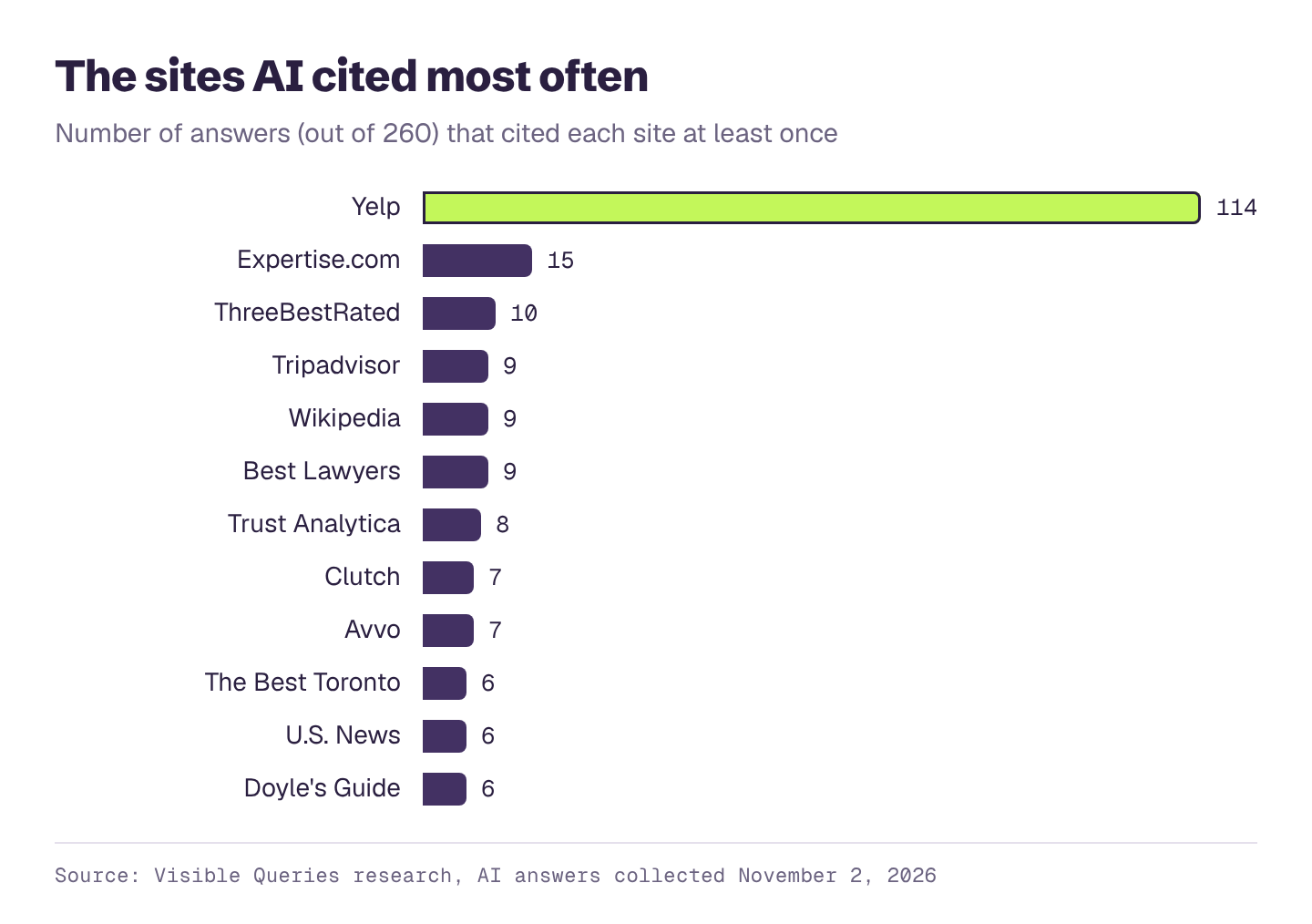
Yelp's lead is striking, but the rest of the list is just as telling. Several of the most-cited sites are "best of" directories like Expertise.com, ThreeBestRated and The Best Toronto, which publish ranked lists of local businesses city by city. Most businesses never think about them. AI reads them constantly.
National questions vs city questions
The type of question changes the sources completely.
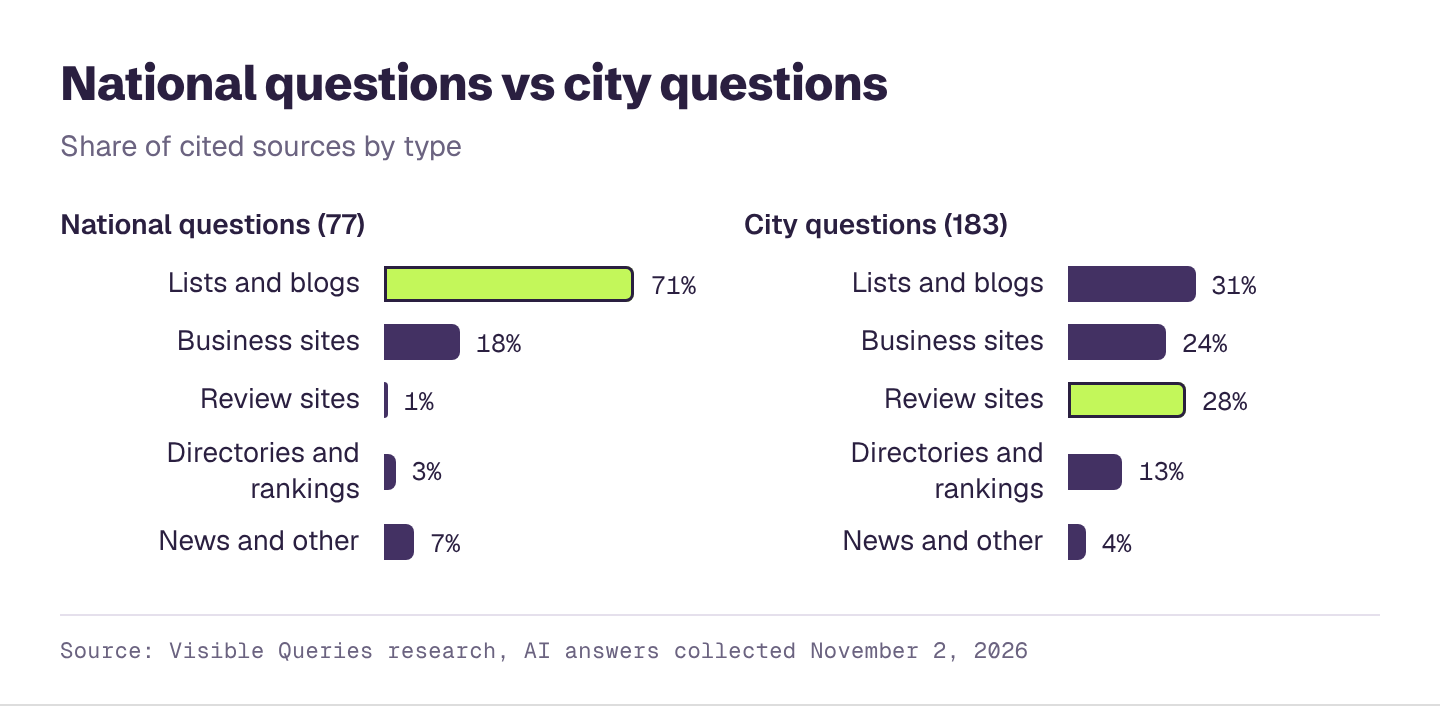
For the 77 national questions, like "best payroll software for a 50-employee company" or "best online MBA programs," 71% of sources were lists and comparison articles. Review sites were almost absent.
For the 183 questions that named a city, the picture flipped. Review sites became one of the biggest sources, and lists dropped to about 30%. If your buyers search locally, review sites are part of your AI visibility. If they don't, comparison content is.
Yelp, city by city
Yelp's role wasn't the same in every city. It was cited more often in US cities than in Canadian ones.
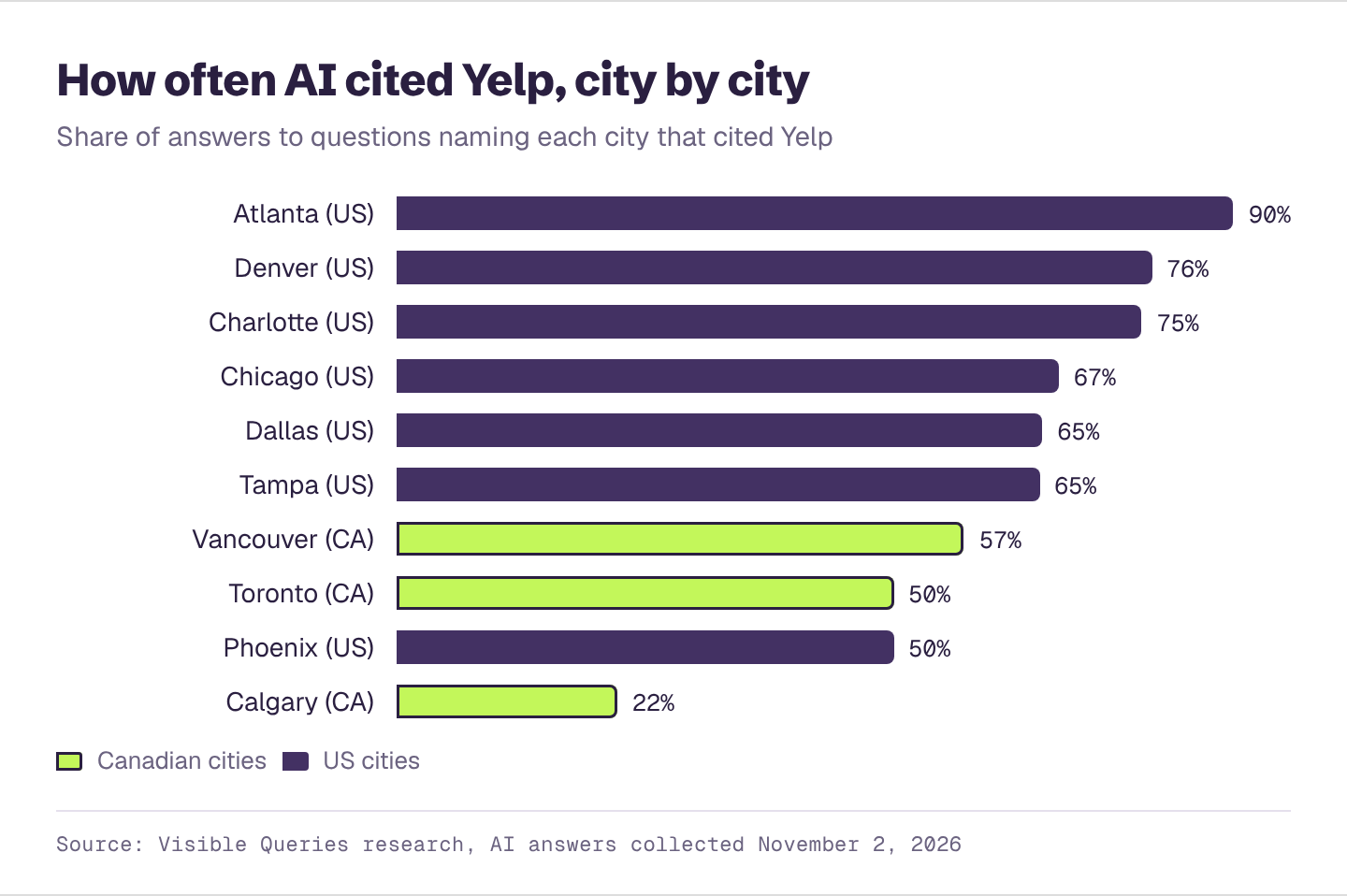
Across the seven US cities, Yelp appeared in 69% of answers to city questions. Across the three Canadian cities, it appeared in 49%, and in Calgary in just 2 of 9. In Canadian answers, local "best of" sites and Canadian directories took up more of the space. For Canadian businesses, Yelp still matters, but it isn't the whole story.
"There's no single best", then a list anyway
One more pattern stood out. In 70% of answers, the assistant said there was no single best choice, or that it couldn't vouch for any particular business. Then, in every case, it named businesses anyway.
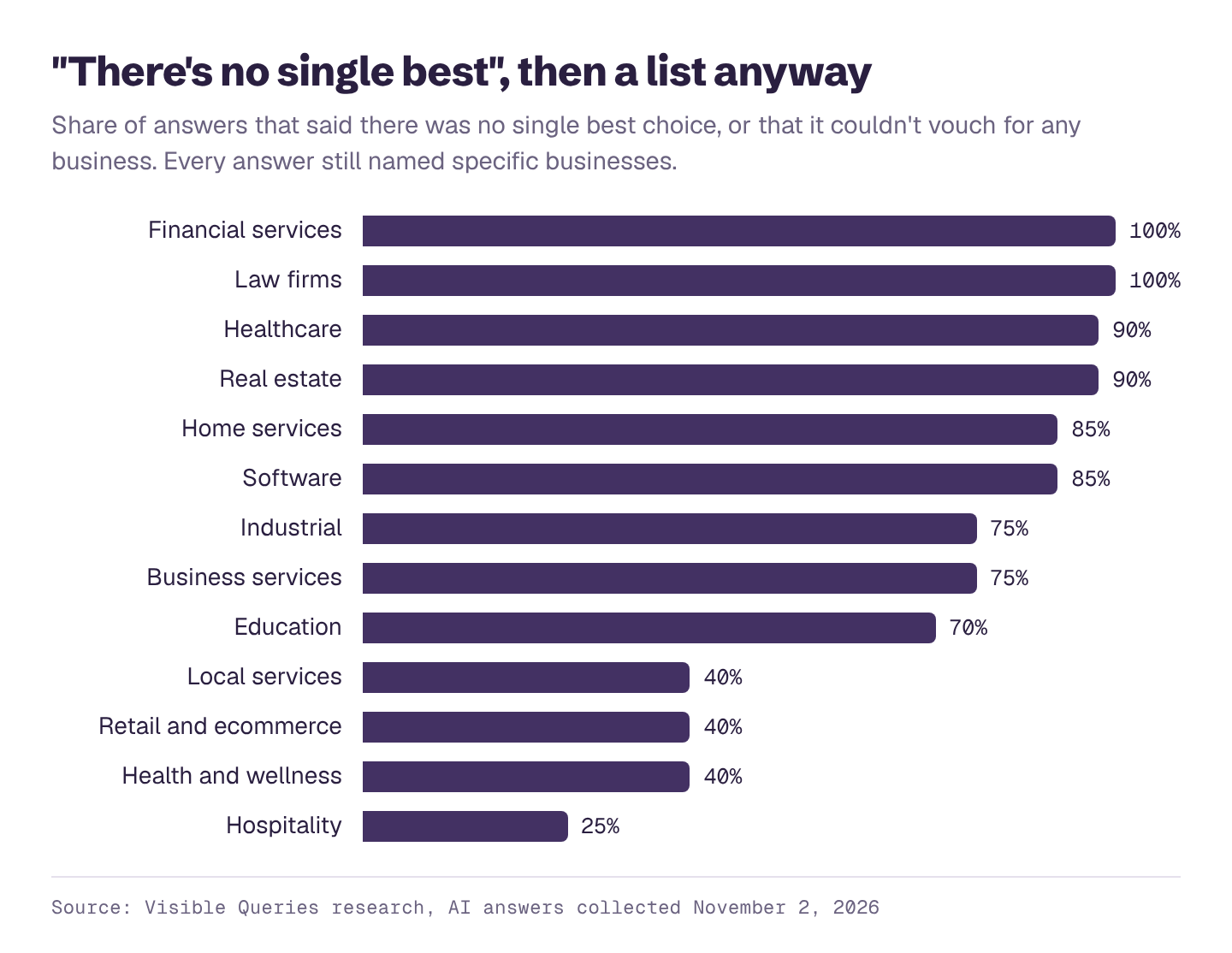
The assistant hedged in every financial services and law answer, and in 90% of healthcare and real estate answers. It hedged least for hospitality, where recommending a restaurant or hotel carries less risk.
For businesses, the hedge doesn't change much. The buyer still walks away with a short list of names. It does mean AI is careful about how it describes the businesses it names, which makes accurate, specific information about you, in the sources it reads, all the more important.
What this means for your business
- Find out which sources matter in your industry. The industry sections above are a starting point. Then ask AI the questions your buyers ask and look at the links in the answers. Our guide on how to check your AI visibility yourself walks through it.
- Get onto the lists. "Best of" lists and comparison articles were the single biggest source. Many accept submissions or can be contacted. Make sure the ones that already mention you describe you correctly. Here's how to get onto the sources AI cites.
- Treat review sites as part of your website. For local businesses especially, your Yelp, Tripadvisor, Healthgrades, Avvo or Houzz listing may be read more often by AI than your homepage. See which review sites AI trusts for your industry.
- Don't neglect your own site. It was still 22% of all sources, and the biggest source in industrial and a leading one in healthcare and financial services. Our AI visibility checklist for your website covers what to have on it.
- Check what the sources say about you. If a list or directory has an old address, a wrong service or an outdated description, that error can end up in AI answers. Here's how to fix wrong information AI says about your business.
How we did this
We wrote 260 buyer questions, 20 in each of 13 industries, phrased the way a buyer would ask for a recommendation. Questions about local businesses were spread across 10 cities: Toronto, Vancouver, Calgary, Dallas, Phoenix, Atlanta, Chicago, Denver, Tampa and Charlotte. National questions, like those about software or online stores, named no city.
We asked each question in a fresh conversation with a leading AI assistant, with live web search turned on and the location set to the question's city. Answers were collected on November 2, 2026. We recorded every source each answer linked to and classified it by type. A business's own site was counted as a business website, and "best of" lists and blog posts published by third parties were counted as lists. Counts of sites count each site once per answer.
AI answers change over time and differ between assistants, which use different search technology. These results are a snapshot of one assistant on one day. The pattern, more than any single number, is the point.
See which sources shape what AI says about you
Enter your website and get a free AI visibility report. It takes a few minutes, and you'll see:
- Your AI visibility score, overall and for each AI platform
- Who AI recommends instead of you, and how often
- Which topics you win and lose, and how often each one is searched
- What AI gets wrong about you, and what to fix first
- A downloadable PDF you can share with your team