How to get onto the sources AI cites
AI recommendations are built mostly from pages other people write: "best of" lists, review sites, directories and rankings. Here's how to find the ones that matter in your industry and get your business onto them.
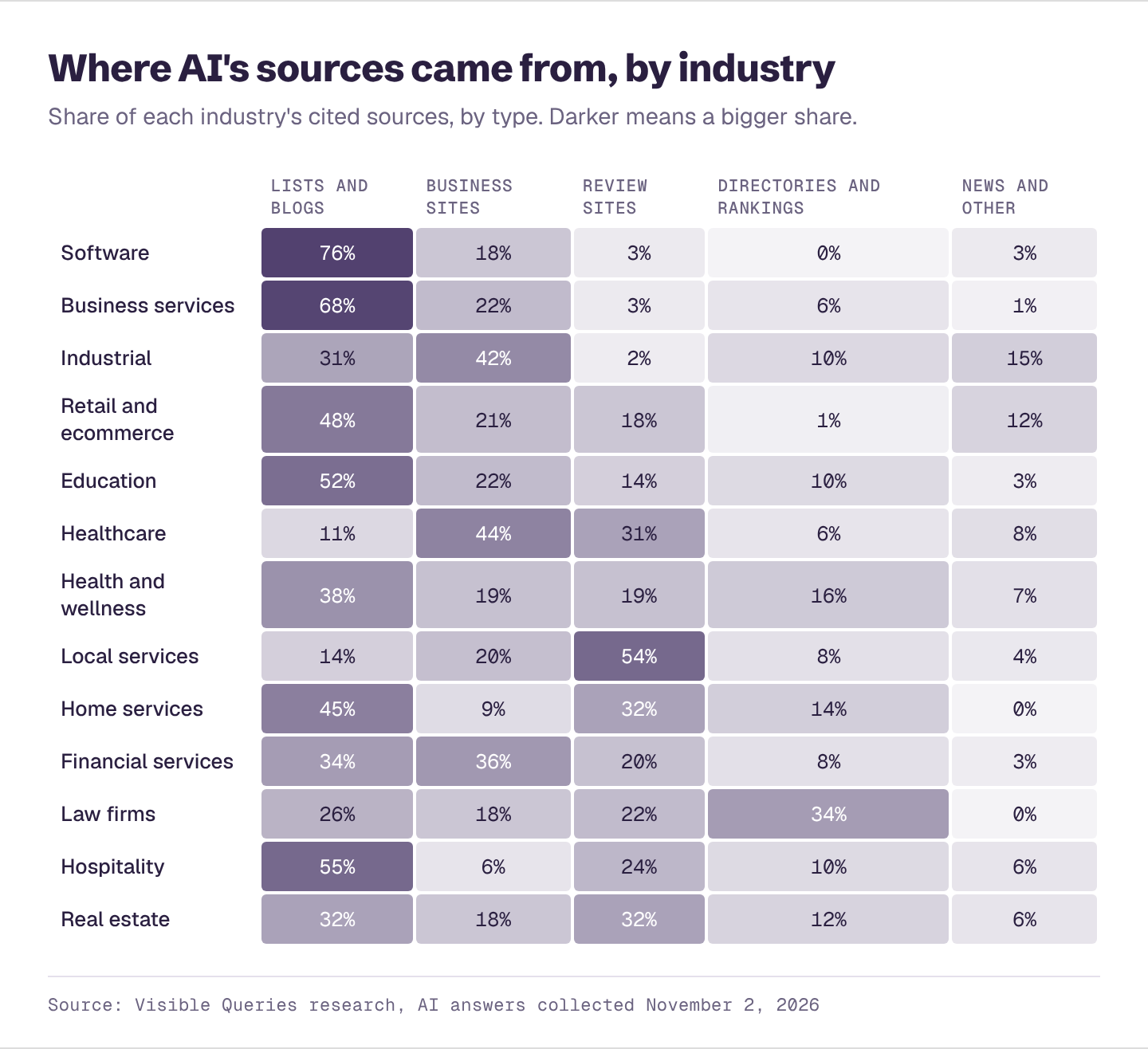
When an AI assistant recommends a business, it usually isn't working from the business's own website alone. In our study of where AI gets its answers, about three quarters of the sources an AI assistant cited for buyer recommendations were written by someone other than the business: "best of" lists, review sites, directories, rankings and news.
That's good news, in a way. It means AI visibility isn't only about your own marketing. It's about being present, accurately, in the places AI already reads. This guide walks through how to find those places for your business and get onto them.
Step 1: Find the sources that matter for you
Start with the questions your buyers ask. Pick five to ten that matter most, like "Who's the best family dentist in Calgary?" or "What's the best inventory software for a small warehouse?", and ask them to the AI assistants your buyers use, with web search turned on. Write down every source linked in the answers.
After a handful of questions, a pattern appears. The same few sites show up again and again. Those are your targets.
To give you a head start, here's how the kinds of sources varied by industry in our study:
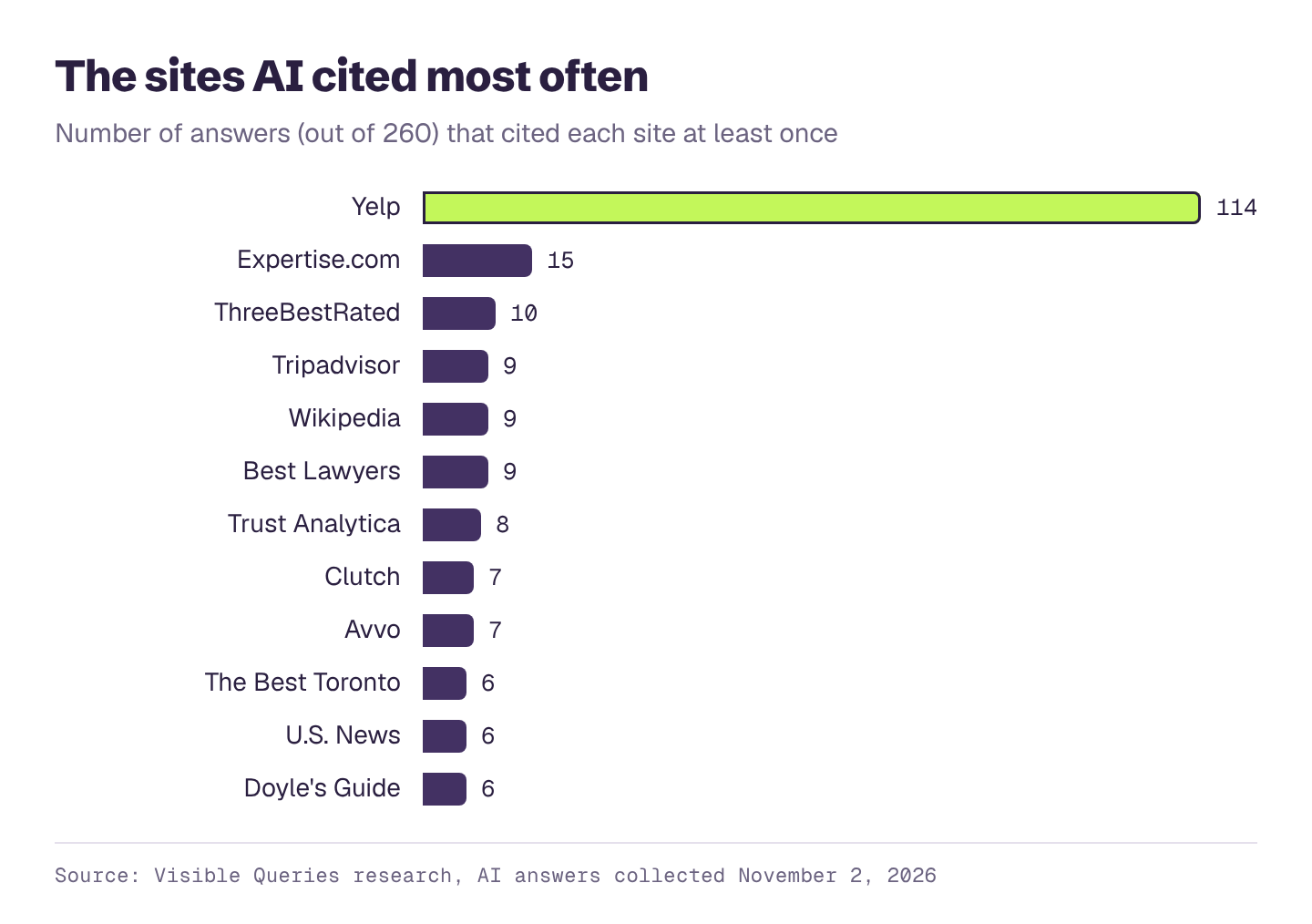
And here are the individual sites that showed up most:
| Industry | Sources that showed up most |
|---|---|
| Local services | Yelp, local "best of" lists, WeddingWire for event vendors |
| Home services | "Best of" lists, Yelp, Expertise.com, Houzz, Angi |
| Healthcare | Practices' own sites, Yelp, Healthgrades, Zocdoc, RateMDs |
| Health and wellness | "Best of" lists, Yelp, ClassPass |
| Law firms | Best Lawyers, Avvo, Yelp, Super Lawyers, Doyle's Guide, Justia |
| Financial services | Firms' own sites, "best of" lists, Yelp, Expertise.com |
| Real estate | "Best of" lists, Yelp, agent rating sites |
| Hospitality | "Best of" lists, Tripadvisor, Yelp, OpenTable, Expedia |
| Education | "Best of" lists, Yelp, Niche, U.S. News |
| Software | Comparison articles and "best tools" lists |
| Business services | Comparison articles and agency guides, Clutch |
| Industrial | Suppliers' own sites, trade publications, industry directories |
| Retail and ecommerce | Shopping guides and comparison articles |
Your own list will be more specific, but this tells you which kinds of sources to look for.
Step 2: Sort them into four groups
Each kind of source takes a different approach. Sort your list into these groups.
- Listings you can claim: review sites and directories where any business can create or claim a profile. Yelp, Tripadvisor, Healthgrades, Avvo, Houzz, Angi, Clutch, Zocdoc and most industry directories work this way.
- Lists someone else writes: "best of" articles, comparison posts and buying guides published by other sites. You can't edit them, but you can often get onto them.
- Rankings and awards: professional rankings and recognition programs, like Best Lawyers, Super Lawyers or U.S. News. These usually have their own nomination or research process.
- News and trade media: local news, magazines and trade publications.
Step 3: Claim and complete your listings
This is the fastest win, because you control it.
- Claim every listing that showed up in your answers. Then claim the main ones for your industry from the table above, even if they didn't show up yet.
- Fill in every field. Services, service area, hours, photos, prices where the site allows them, credentials, and a description that says plainly what you do and who for.
- Match your details exactly. Use the same business name, address, phone number and website everywhere. Small differences make it harder for an assistant to tell that two listings are the same business, and easier for it to repeat an old detail.
- Remove duplicates and closed locations. Old listings are a common source of wrong facts in AI answers.
- Keep reviews coming. Ask happy customers to review you on the sites that matter in your industry. Reviews that mention the specific service and what went well give an assistant something useful to say. Never buy or fake reviews: it breaks most sites' rules and can get your listing removed.
Step 4: Get onto the lists other people write
"Best of" lists and comparison articles were the single largest source in our study, so they're worth real effort.
- Find the lists that already rank for your buyers' questions. Search the same questions you asked AI, and look at the lists that come up, plus the ones AI linked to.
- Check how each list is made. Many local "best of" sites have a submission form or an editorial process. Some accept business nominations; some evaluate based on reviews and ratings on other sites. A few charge for inclusion, which is worth knowing before you decide where to spend time.
- Contact the author or editor. A short, polite note explaining what you do, who you serve and what makes you different, with a link to your reviews, works better than a pitch. If you're already on the list but described wrongly, ask for a correction.
- For software and B2B services, focus on comparison content. Make sure the people who write "best tools" and "top agencies" articles in your category know you exist. Offer accurate information, screenshots or a demo, and make sure your own site has a clear comparison page that explains how you differ from the alternatives.
- Make it easy to describe you. Have a one- or two-sentence description of your business ready that a writer could paste in. If it's specific, an assistant reading the list will repeat it.
Step 5: Pursue the rankings and media that matter
These take longer, but they carry weight.
- Professional rankings. If your industry has established rankings, like legal guides for lawyers or school rankings for education, learn how their research or nomination process works and take part.
- Industry awards and associations. Membership pages and award listings are cited sources in some industries, and they're good proof on your own site too.
- Local and trade media. A story in local news or a trade publication about your work, a project or your expertise is a source AI may cite, and it tends to stay online for years.
Step 6: Connect it back to your website
Your website should point to all of this, and agree with it.
- Link to your profiles on the review sites that matter.
- Mention awards, rankings and press, with links.
- Make sure the facts on your site match your listings exactly.
- Publish the details AI looks for: what you do, where, for whom, what it costs. Our AI visibility checklist for your website has the full list.
Step 7: Check again
After a few weeks, ask the same questions you started with. Look at whether you appear in the answers, how you're described, and whether the sources you worked on are now among the links. Answers vary from run to run, so ask each question more than once. Our study on how stable AI recommendations are explains why.
The goal is to become one of the names that shows up every time, not just once. That comes from being present, and described the same way, across the sources AI reads.
See which sources AI uses when buyers ask about you
Enter your website and get a free AI visibility report. It takes a few minutes, and you'll see:
- Which topics you win and lose, and how often each one is searched
- Who AI recommends instead of you, and how often
- Your AI visibility score, overall and for each AI platform
- What AI gets wrong about you, and what to fix first
- A downloadable PDF you can share with your team