How to get your business recommended by AI: ChatGPT, Gemini, Claude, Perplexity and Google
A practical guide to getting named when buyers ask AI for the best option: what every AI platform reads, what to fix first, and how each platform differs. With data from our own reports.
A buyer opens ChatGPT and types:
"What's the best payroll software for a 40-person company in Ontario?"
A few seconds later they have a shortlist of four or five names, a sentence on each, and a suggestion for which one to try first. They may never visit a search results page at all.
Getting onto that shortlist is the whole game. This guide explains how AI assistants decide who to name, what you can do about it on every major platform, and where each platform differs. It's the hub for our step-by-step guides to ChatGPT, Google AI Overviews and AI Mode, Perplexity, Gemini and Claude.
The short version
- AI recommends businesses it reads about. For questions about who to hire or what to buy, AI assistants usually search the web first, then name the businesses that appear across the pages they read.
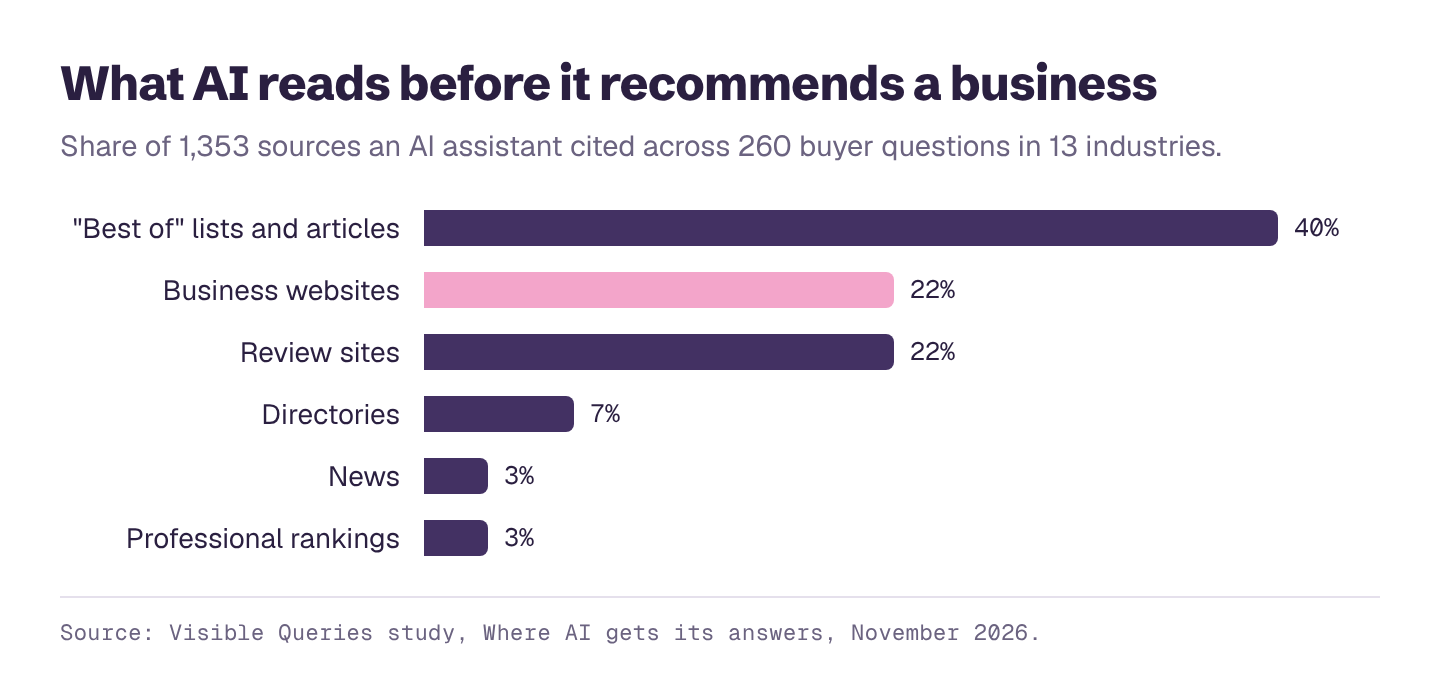
- Most of those pages aren't yours. In our study of 1,353 sources AI cited, "best of" lists and articles made up 40%, review sites 22% and business websites 22%. About three quarters were written by someone other than the business.
- Being asked about by name tells you nothing. In our reports, AI named the business in 97% of answers when the question used its name, and in 32% of answers to unbranded buyer questions.
- The platforms differ more than you'd think. Claude and Gemini named about 9 to 11 businesses per answer; ChatGPT and Google's AI Overviews named about 4. Perplexity linked to the business's own website in 31% of answers; Gemini did in 10%.
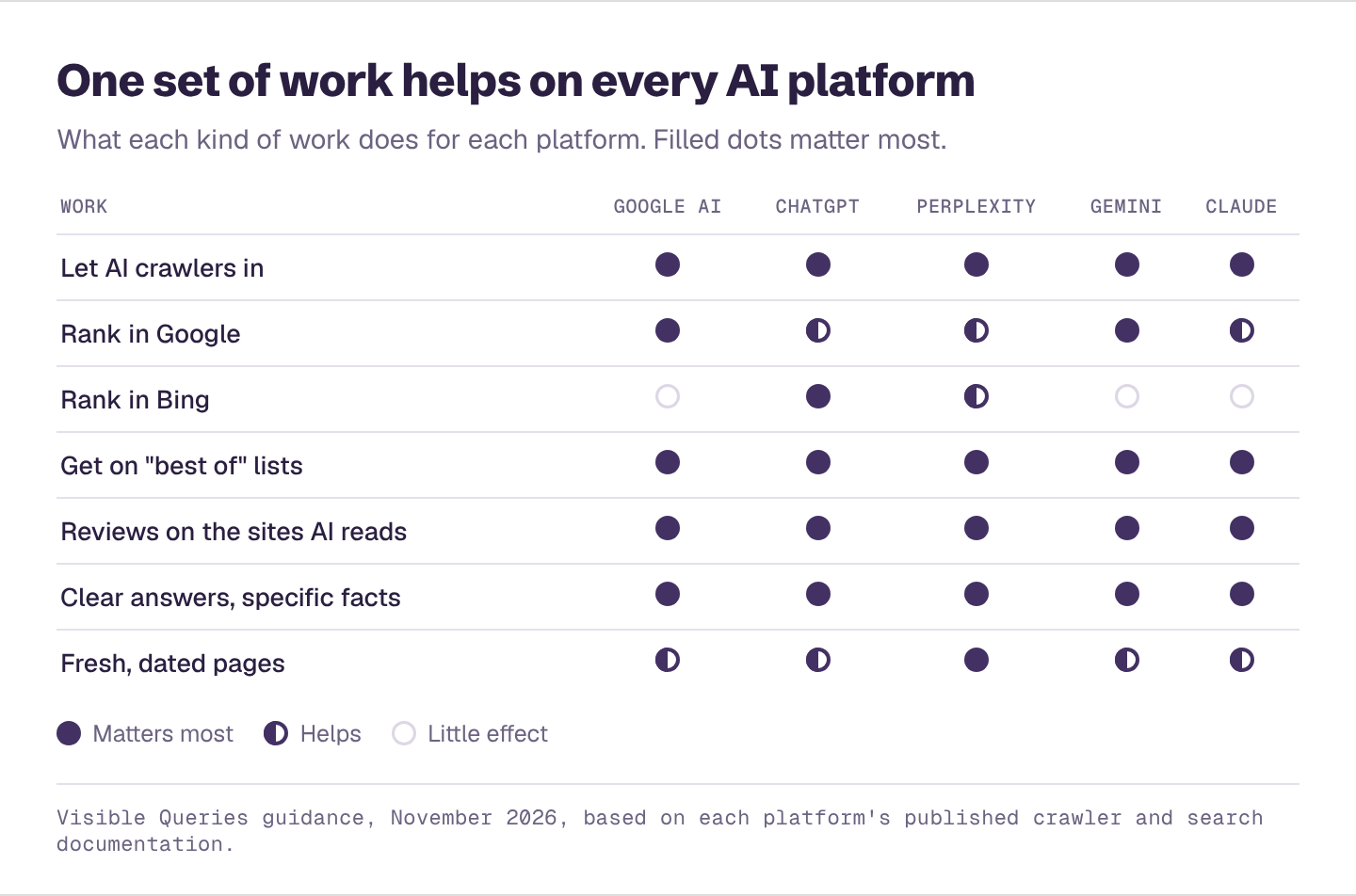
- One set of work helps everywhere. Let AI crawlers in, get onto the lists and review sites AI reads, publish clear and specific pages, and keep your facts consistent.
Not sure whether AI recommends you today? Check your AI visibility score for free. It takes a few minutes and only needs your website address.
How AI decides who to recommend
When someone asks an AI assistant a question about products or local businesses, three things usually happen:
- It searches. The assistant runs one or more web searches, using Google, Bing or its own index depending on the platform.
- It reads. It opens a handful of the results: lists, reviews, directories, articles and business websites.
- It writes a shortlist. It names the businesses that came up most often and most credibly across what it read, and explains why.
That means the work is less about "optimizing for AI" and more about being present, consistently and credibly, on the pages AI reads.
Branded questions don't count
Most people check their AI visibility by asking ChatGPT about their own company. It almost always knows who they are. That's not the question that matters.
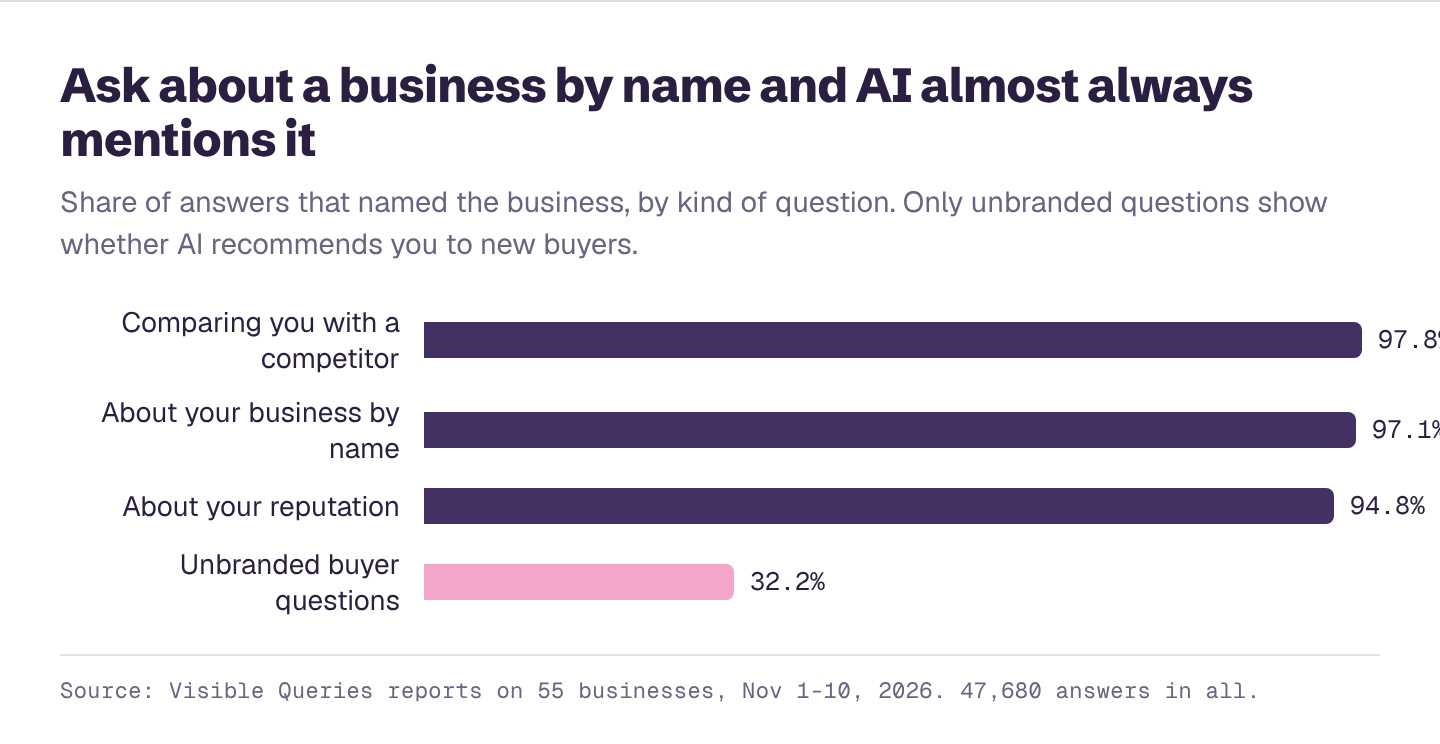
The questions that decide whether you win new buyers are unbranded: "best CRM for a small team", "emergency plumber in Austin", "accountant for a startup in Toronto". That's where the gap is, and it's where this guide focuses.
Every AI platform is a little different
Each assistant searches with a different engine, names a different number of businesses, and links to business websites at a different rate. Here's what we saw across our own reports.
| Platform | Named the business | Linked to its own site | Businesses named per answer |
|---|---|---|---|
| Gemini | 42.9% | 10.3% | 9.1 |
| Claude | 41.7% | 12.5% | 10.6 |
| Perplexity | 36.7% | 30.5% | 5.1 |
| Google AI Mode | 30.1% | 11.0% | 4.8 |
| ChatGPT | 29.4% | 21.2% | 4.4 |
| Google AI Overviews | 26.7% | 11.8% | 4.3 |
Answers to unbranded buyer questions in Visible Queries reports on 55 businesses, November 1 to 10, 2026. Most were software companies, so treat these as directional.
Two things stand out. ChatGPT and Google's AI Overviews give the shortest lists, so they're the hardest to get onto. And Perplexity and ChatGPT link to business websites far more often than the others, which makes your own pages matter more there.
Step 1: Let the AI crawlers in
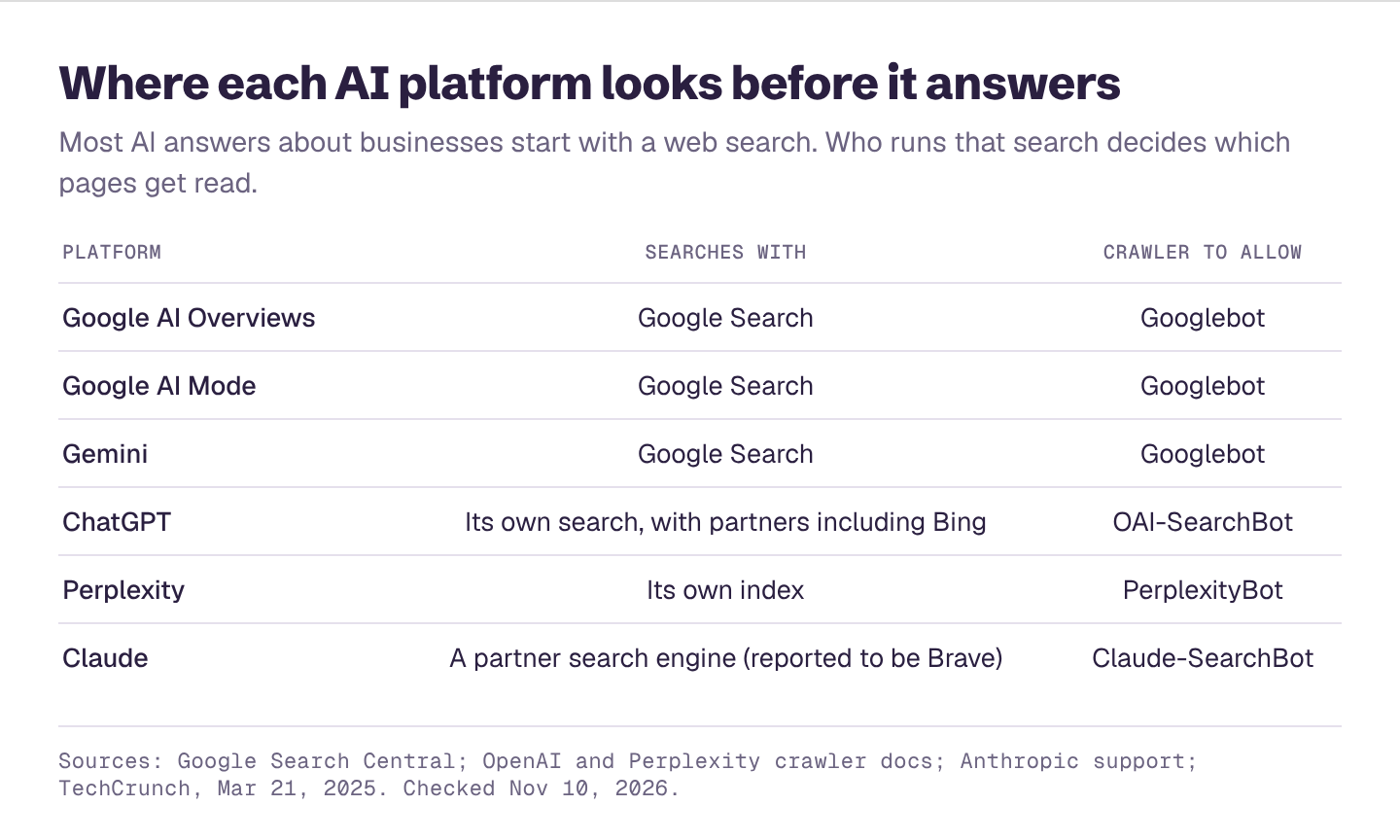
None of the rest matters if AI can't read your site. Check your robots.txt file (yoursite.com/robots.txt) and make sure you aren't blocking the crawlers AI platforms use for search:
| Crawler | Used for | What happens if you block it |
|---|---|---|
| Googlebot | Google Search, AI Overviews, AI Mode, Gemini | You drop out of Google entirely |
| OAI-SearchBot | ChatGPT search | OpenAI says you "will not be shown in ChatGPT search answers" |
| PerplexityBot | Perplexity search | Perplexity can't index your pages for its answers |
| Claude-SearchBot | Claude's search results | Anthropic says it uses it to improve search result quality |
| Bingbot | Bing, which also feeds other tools | You drop out of Bing |
Blocking training crawlers such as GPTBot or ClaudeBot is a separate choice. OpenAI says disallowing GPTBot only means your content "should not be used in training generative AI foundation models"; it doesn't remove you from ChatGPT search.
Step 2: Get onto the pages AI reads
This is the biggest lever on every platform. Run the questions your buyers ask, note which pages AI cites, and work your way onto them:
- "Best of" lists and comparison articles. Find the lists that come up for your category and city. Ask to be included, offer a quote or data, or pitch a correction if you're missing. Our guide on getting onto the sources AI cites walks through outreach.
- Review sites. For local questions, Yelp's search pages appeared in 62% of answers that named a city in our study. Law, healthcare, hospitality and wellness each have their own specialist sites too. See which review sites AI trusts for your industry, and our guide for local businesses.
- Directories and professional rankings. Keep your listings complete and identical everywhere: name, address, phone, services, prices.
- News and industry press. A mention in a trade publication or local paper is the kind of independent source AI leans on.
Step 3: Make your own pages easy to quote
Your own site is about a fifth of what AI reads, and the one part you fully control. In our study of what AI-cited websites have in common, most cited homepages showed reviews (90%), had structured data (81%), showed a phone number (79%), showed prices or linked to pricing (63%) and had an FAQ (62%).
Write so a machine can lift your answer without guessing:
- Answer first. Put a direct, one or two sentence answer at the top of each section, under a heading phrased the way buyers ask.
- Be specific. Prices, service areas, hours, who you serve, how long things take. Vague pages lose to specific ones.
- Use tables and lists for comparisons, plans and steps.
- Add a page per city or service if you serve several. Location pages were 21% of the business pages AI cited.
- Date your pages and keep them current. Fresh pages matter most on Perplexity, and wrong old facts cost you everywhere.
Our AI visibility website checklist goes through each item.
Step 4: Keep your facts consistent
When AI gets a fact about you wrong, it's usually because a source it read was wrong or out of date. In our check of 745 claims about 41 businesses, 11 had at least one plainly wrong fact, most often prices and hours.
Update your Google Business Profile, your directories and your own site at the same time whenever something changes. If AI is already repeating something wrong, our guide to fixing wrong information AI says about your business shows where to start.
Step 5: Measure, then re-check
AI answers change from run to run. In our stability test, about 60% of the names in a typical answer appeared every time the same question was asked; the rest came and went. So:
- Measure across many buyer questions, not one.
- Measure on every platform, since you can be strong on one and missing on another.
- Re-check monthly and look at the trend.
Platform guides
Each of these goes deeper on one platform:
- How to show up in ChatGPT
- How to rank in Google AI Overviews and AI Mode
- How to show up in Perplexity
- How to show up in Gemini
- How to show up in Claude
If you only do three things
- Check your robots.txt and make sure the AI search crawlers can read your site.
- Find the five lists and review sites AI cites most for your category, and get onto them.
- Measure where you stand on unbranded questions across every platform, so you know where to start. The free AI visibility checker does this from your website address.
See which AI platforms recommend you
Enter your website and get a free AI visibility report. It takes a few minutes, and you'll see:
- Your AI visibility score, overall and for ChatGPT, Gemini, Claude, Perplexity and Google's AI Overviews and AI Mode
- Who AI recommends instead of you, and how often
- Which topics you win and lose, and how often each one is searched
- What AI gets wrong about you, and what to fix first
- A downloadable PDF you can share with your team