Which review sites AI trusts, industry by industry
We logged every review site, directory and ranking an AI assistant cited across 260 buyer questions in 13 industries. Yelp led in most local industries, but law, hospitality and wellness each had their own go-to sources.
Every business owner knows reviews matter. What's less clear is which review sites matter when the one reading them is an AI assistant deciding who to recommend.
We looked at this using the answers from our study of where AI gets its answers: 260 buyer questions, 20 in each of 13 industries, asked to an AI assistant with live web search turned on. For this piece, we pulled out every review site, directory, professional ranking and booking marketplace the assistant cited, and counted how many answers in each industry cited each one.
The short version
- Review sites, directories and rankings showed up in 166 of 260 answers (64%). Together they made up about a third of all sources cited.
- Yelp was the most-cited review site in 11 of 13 industries, tied for first in law. It appeared in 18 of 20 answers for local services and home services, 15 of 20 for healthcare, and 14 of 20 for real estate.
- Law firms had their own set of sources. Best Lawyers appeared in as many law answers as Yelp, followed by Avvo, Super Lawyers, Doyle's Guide and Justia.
- Hospitality leaned on Tripadvisor, and wellness on ClassPass. Each industry had at least one specialist site alongside the general ones.
- Software and business services barely used review sites at all. They relied on comparison articles instead.
- The assistant read Yelp's search results, not business pages. 240 of the 242 Yelp links it cited were Yelp search pages like "Best HVAC in Dallas," not an individual business's Yelp page. Where you rank inside Yelp's own results is what the assistant sees.
- The local sources differ between the US and Canada. Avvo, Super Lawyers, Healthgrades, Angi and Houzz appeared only in US answers. Doyle's Guide, RateMDs, Medimap and Canadian agent rating sites appeared only in Canadian ones.
Local questions run on review sites
The single biggest factor in whether the assistant cited a review site wasn't the industry. It was whether the question named a city.
| Kind of question | Answers | Cited at least one review site, directory or ranking |
|---|---|---|
| Named a US city | 118 | 105 (89%) |
| Named a Canadian city | 65 | 52 (80%) |
| No city (national) | 77 | 9 (12%) |
When a buyer asks about a business near them, the assistant goes looking for a place that collects local businesses and opinions about them. When a buyer asks a national question, like which CRM to buy or which online retailer has the best returns policy, it reads comparison articles instead.
Almost every answer that cited a review site cited only one or two. Of the 166 answers that cited any, 82 cited exactly one site, 57 cited two, and just 27 cited three or more. That makes the one or two sites the assistant reaches for in your industry especially important.
How much review sites matter, by industry
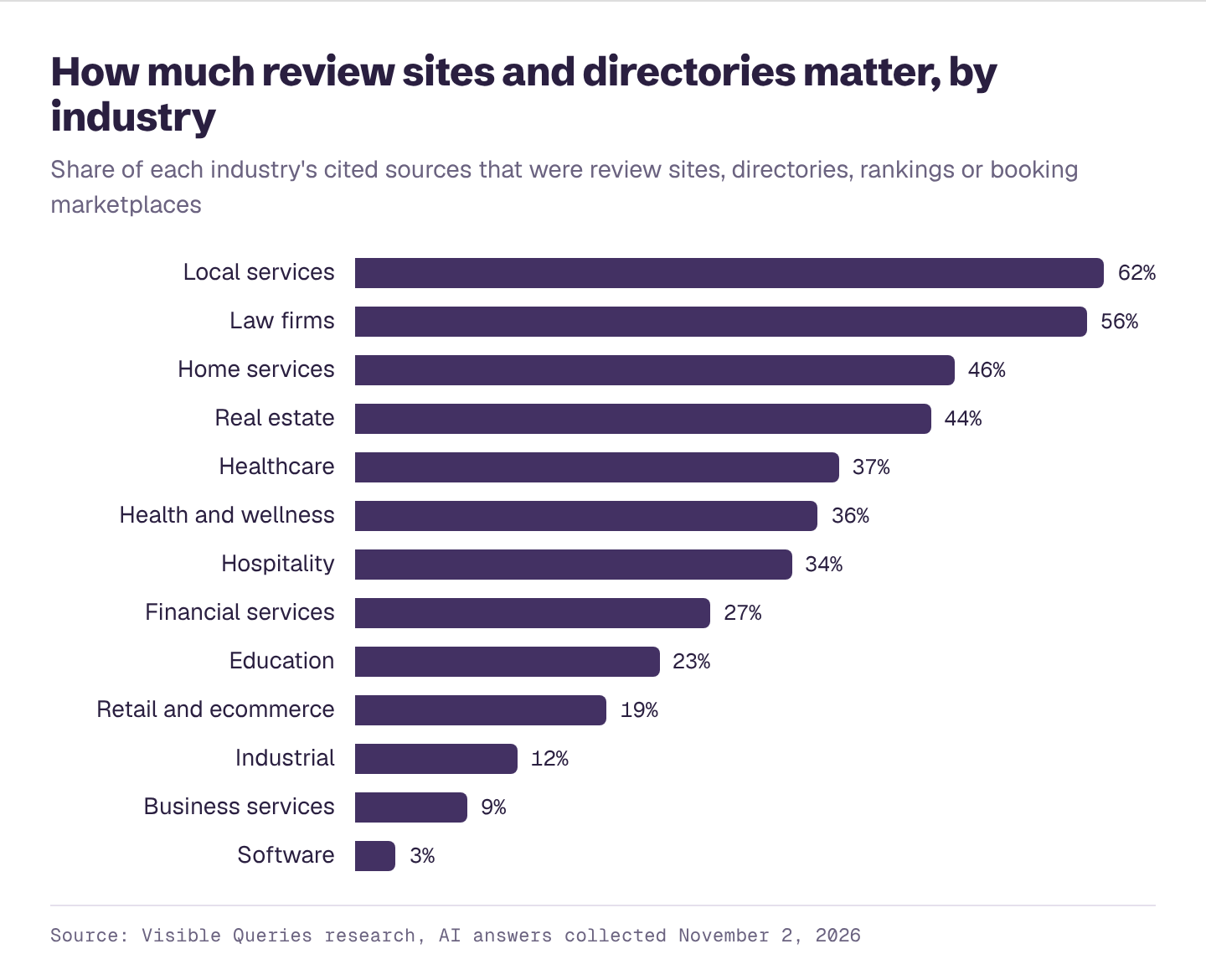
Here's the share of each industry's cited sources that were review sites, directories, rankings or marketplaces, and the sites cited most often. The number after each site is how many of that industry's 20 answers cited it.
| Industry | Share of sources | Most-cited review sites and directories |
|---|---|---|
| Local services | 62% | Yelp (18), WeddingWire (2) |
| Law firms | 56% | Yelp (9), Best Lawyers (9), Avvo (7), Super Lawyers (5), Doyle's Guide (4), Justia (4) |
| Home services | 46% | Yelp (18), ServiceAgent (4), Houzz (3), Angi (2) |
| Real estate | 44% | Yelp (14), Clutch (3), GoodFirms (3), RankMyAgent (2), Rate-My-Agent (2) |
| Healthcare | 37% | Yelp (15), Healthgrades (3), Zocdoc (2), WebMD (2), RateMDs (2) |
| Health and wellness | 36% | Yelp (13), ClassPass (5), Groupon (2) |
| Hospitality | 34% | Tripadvisor (8), Yelp (6), Expedia (3), OpenTable (2), U.S. News (2) |
| Financial services | 27% | Yelp (8), Clutch (2), Fee Only Network (2) |
| Education | 23% | Yelp (5), Niche (2), Winnie (2) |
| Retail and ecommerce | 19% | Yelp (4), Houzz (1) |
| Industrial | 12% | Scattered trade directories |
| Business services | 9% | Scattered agency directories |
| Software | 3% | G2 (2) |
What stands out
Yelp is the default for local businesses
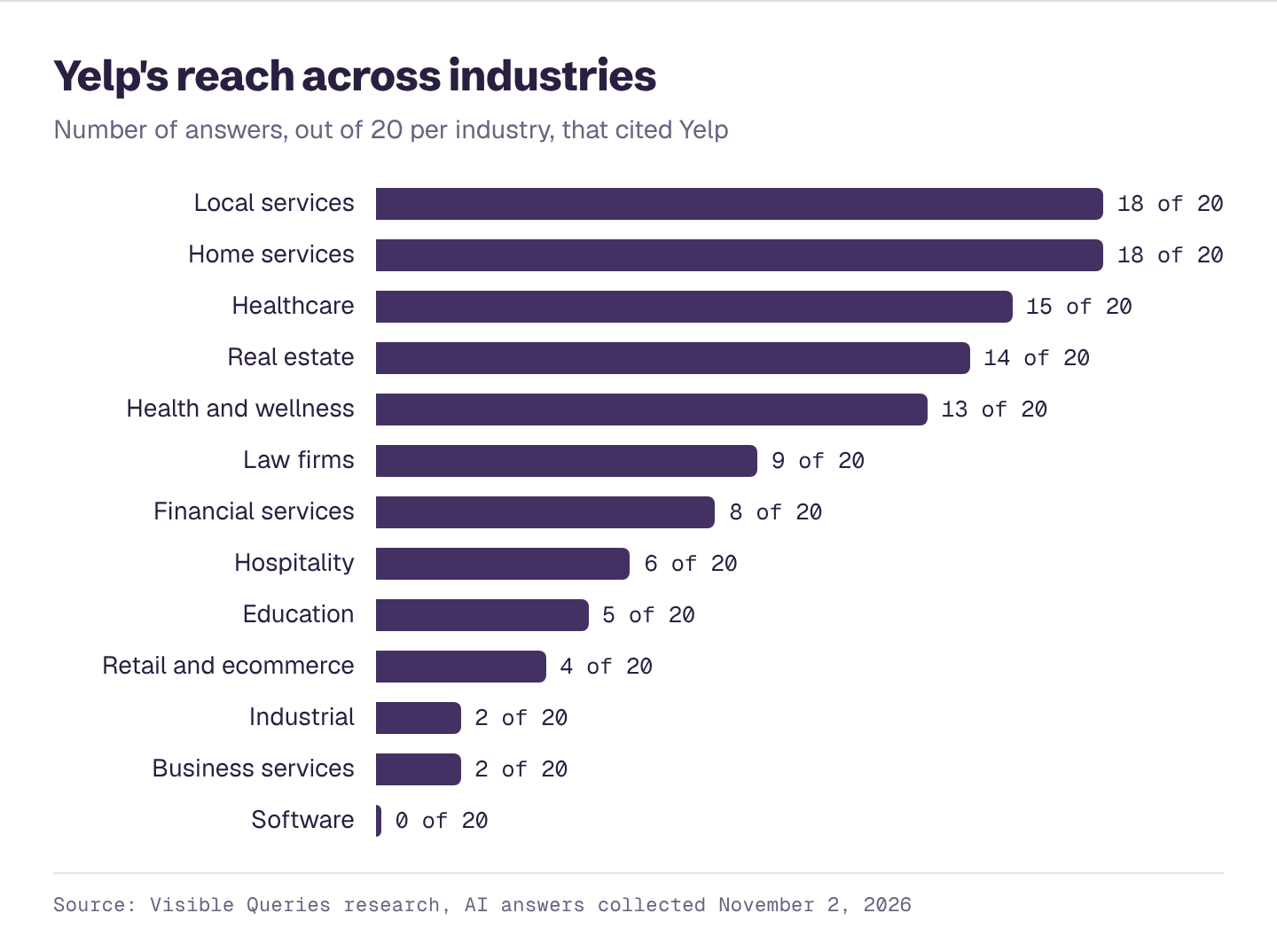
For questions about local businesses, Yelp was the review site the assistant reached for first, in almost every industry. That includes industries where buyers might not think of Yelp first, like healthcare, real estate and financial advice. A Yelp listing that's incomplete, out of date or thin on reviews is likely costing local businesses AI recommendations.
Yelp never appeared in answers to national questions, such as which software to buy or which online MBA to choose. Its weight is entirely local.
It was also stronger in some cities than others. Yelp appeared in 69% of answers about the seven US cities in our study and 49% of answers about the three Canadian ones. Our study of where AI gets its answers breaks this down city by city.
The assistant reads Yelp's rankings, not your Yelp page
This was the most surprising detail in the data. Of the 242 Yelp links the assistant cited, 240 were Yelp search results pages, such as "Best Hair Colorist in Toronto" or "Top 10 Best Plumbers in Dallas." Only one linked to an individual business's page.
That changes what a "good Yelp presence" means for AI visibility. The assistant isn't reading your profile in depth. It's reading the list Yelp shows for a search, and picking from the businesses near the top. So the things that move you up Yelp's own results matter: being in the right categories, having a steady flow of recent reviews, a strong rating, and reviews that mention the specific service a buyer is searching for.
A practical test: search Yelp for the phrase your buyers would use, in your city, and see where you land. If you're on page two of Yelp's results, you're probably not in the AI answer that reads page one.
Professional rankings matter in law
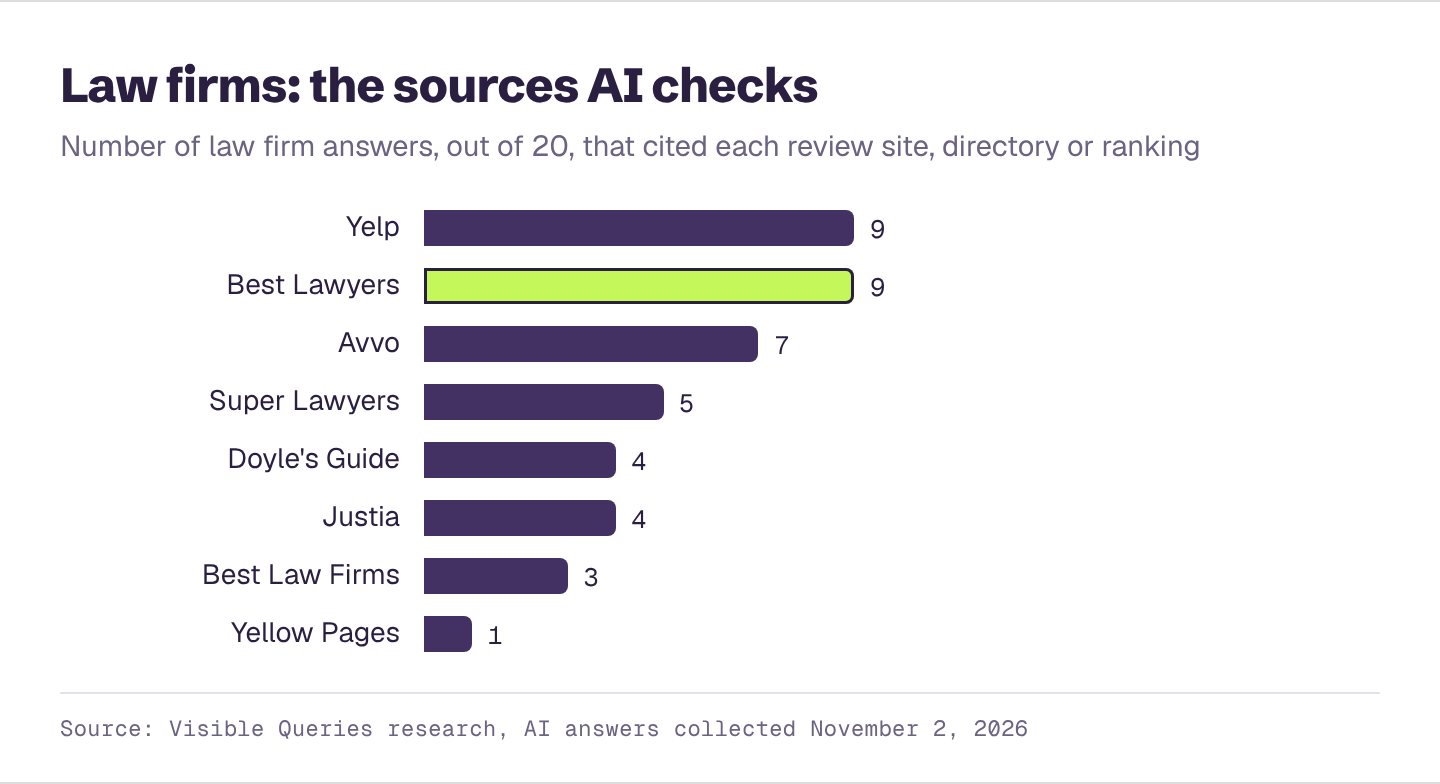
Law was the one industry where professional rankings competed with Yelp. Best Lawyers appeared in 9 of 20 answers, Super Lawyers in 5 and Doyle's Guide, a Canadian legal ranking, in 4, alongside lawyer directories Avvo and Justia. For law firms, recognition from these established guides does double duty: it's credibility with clients and a source AI cites.
Each industry has its specialists
- Hospitality: Tripadvisor led, with Expedia, OpenTable and U.S. News travel rankings also cited.
- Health and wellness: ClassPass, the class booking marketplace, appeared in 5 of 20 answers about gyms, yoga and Pilates studios.
- Healthcare: Healthgrades, Zocdoc, WebMD and RateMDs each appeared, though far less often than Yelp.
- Home services: Houzz and Angi were cited alongside Yelp, mostly for remodeling and contractor questions.
- Real estate: agent rating sites like RankMyAgent and Rate-My-Agent appeared alongside Yelp.
The US and Canada have different specialists
Yelp led in both countries. Beyond Yelp, the specialist sites split cleanly by border.
| US answers | Canadian answers | |
|---|---|---|
| Law | Avvo, Best Lawyers, Super Lawyers, Justia | Doyle's Guide, Best Lawyers, Best Law Firms |
| Healthcare | Healthgrades | RateMDs, Medimap |
| Home services | Angi, Houzz, ServiceAgent | (Yelp and local lists only) |
| Real estate | (Yelp and local lists only) | RankMyAgent, Rate-My-Agent |
| Hospitality | Tripadvisor | Tripadvisor, Expedia |
If you serve both countries, don't assume the review sites that work for your US locations will carry your Canadian ones, or the other way around. Ask the assistant your buyers' questions in each city and see which sites it links to.
Software and B2B services run on comparison content
For software, review sites made up just 3% of sources. G2 appeared in only 2 of 20 answers. The assistant built its software recommendations almost entirely from comparison articles and "best tools" lists. Business services and industrial questions looked similar. For these companies, being included and accurately described in comparison content matters more than review site ratings.
That doesn't make review platforms useless for software companies. Comparison articles often draw on G2 or Capterra ratings and quote customer reviews, so a strong profile there can feed the articles the assistant does read. But the profile itself was rarely the page the assistant cited.
For agencies and B2B service firms, Clutch was the one directory that showed up with any regularity, mostly for questions about agencies in a particular city, such as a marketing agency in Toronto or a web design firm in Denver.
A note on Google reviews
Google's own review pages never appeared as a cited link in these answers, and neither did Reddit. That reflects how this assistant searches, not what buyers value: Google reviews remain one of the most important trust signals for local businesses, and Google's own AI Overviews draw directly on Google's data. Different assistants use different search technology and weigh sources differently. The safest approach is to keep your profile strong on Google and on the sites that show up in the table for your industry.
Why AI leans on review sites for local businesses
A local business is hard for an AI assistant to judge from its own website. Every plumber says they're reliable, and every dentist says they're gentle. To recommend one over another, the assistant needs something that compares them, and review sites are built to do exactly that: they collect many businesses in one place, rank them, and add what customers said.
That also explains why the assistant cited Yelp's search pages instead of individual profiles. A search results page answers the buyer's question directly: here are the top-rated businesses for this service in this city. One page gives the assistant a ready-made shortlist with ratings and review snippets attached.
For national questions, there's no city to search and no local list to read. Comparison articles fill that role instead.
What this means for your business
- Claim and complete your listing on the sites for your industry. Start with the ones in the table. Fill in every field: services, hours, photos, prices where the site allows them.
- Keep details consistent everywhere. The same name, address, phone number and description across every site makes it easier for AI to match the listings to you, and harder for it to repeat an outdated detail.
- Check where you rank inside the review site, not just whether you're on it. Search Yelp, or the main site for your industry, for the phrase your buyers use in your city. The assistant reads the top of that list.
- Earn reviews that say something specific. A review that mentions the service, the city and what went well gives an assistant something to quote. "Great!" doesn't.
- In law and other credentialed fields, pursue the recognized rankings. They're cited directly.
- Ask AI and look at the links. The sites that matter most for you are the ones that show up when you ask the questions your buyers ask. Our guide on how to get onto the sources AI cites walks through what to do next.
How we did this
This analysis uses the 260 answers from our study of where AI gets its answers, collected on November 2, 2026, from a leading AI assistant with live web search turned on. Each question asked for a recommendation, such as "Who are the best estate planning attorneys in Denver?", and local questions were spread across 10 cities in the US and Canada.
We classified every cited source by type and grouped review sites, directories, professional rankings and booking marketplaces together for this piece. Counts show how many of each industry's 20 answers cited a site at least once, combining a site's US and Canadian domains (for example, yelp.com and yelp.ca). For the Yelp page analysis, we looked at the address of every Yelp link cited to see whether it pointed to a search results page or an individual business page.
See what AI says when buyers ask if you're any good
Enter your website and get a free AI visibility report. It takes a few minutes, and you'll see:
- What AI gets wrong about you, and what to fix first
- Who AI recommends instead of you, and how often
- Which topics you win and lose, and how often each one is searched
- A downloadable PDF you can share with your team