What the business websites AI cites have in common
We looked at the 265 business websites an AI assistant cited when recommending businesses in 13 industries: which pages it cited, and what was on their homepages.
In our study of where AI gets its answers, businesses' own websites made up 22% of everything an AI assistant cited when buyers asked who to hire or buy from. That makes a business's website one of the few sources it fully controls in an AI answer.
So which websites get cited, and what do they look like? We took every business website the assistant cited across those 260 buyer questions, 302 links to 265 different businesses, and looked at two things: which page the assistant cited, and what was on each business's homepage.
The short version
- The homepage was the page cited most often, at 42% of links. Location and city pages were next at 21%, then articles and blog posts at 17%.
- Dedicated service pages were cited far less than you might expect, at 5% of links.
- Most cited sites had the basics in place. Of the 219 homepages we could read, 90% mentioned reviews or testimonials, 81% had structured data, 79% showed a phone number and 66% showed a street address.
- Many showed prices and answered questions. 63% showed a price or linked to pricing on the homepage, and 62% had an FAQ section or link.
- Local and national questions cited completely different pages. For local questions, 77% of business links went to homepages and location pages. For national questions, 83% went to articles and comparison pages on a company's blog.
- Most recommended businesses weren't cited at all. The assistant named about 3,300 businesses across these answers, and linked to the business's own website for roughly 8% of them. For most businesses, the recommendation came from what other sites said.
Which pages AI cited
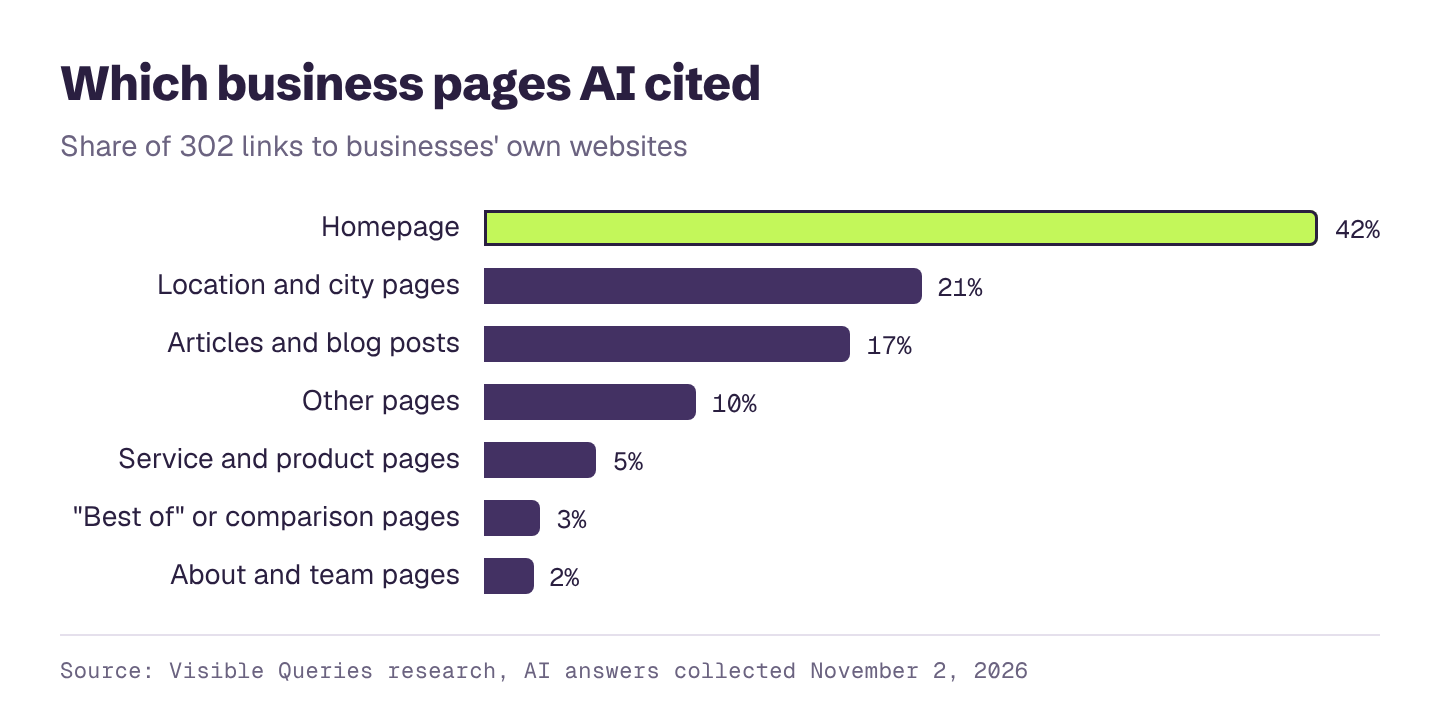
| Page type | Share of cited links |
|---|---|
| Homepage | 42% |
| Location and city pages | 21% |
| Articles and blog posts | 17% |
| Service and product pages | 5% |
| "Best of" or comparison pages on the business's own site | 3% |
| About and team pages | 2% |
| Other pages | 10% |
Location and city pages include pages for a specific office or neighborhood and service pages written for a specific city, such as a page about AC repair in Phoenix.
Three things are worth noticing.
The homepage carries a lot of weight. For a buyer's "who's the best" question, the assistant most often cited the business's front page. Whatever your homepage says about what you do, who you serve and where you are is often the version of you the assistant uses.
City-specific pages work for local businesses. About a fifth of citations went to pages built around a specific location. When a buyer asks about a city, a page that's clearly about that city is an easy match.
Articles get cited too. About one in six citations went to a business's own articles: guides, explainers and posts. Content that answers a buyer's question in depth gives the assistant a reason to cite you even when it's not citing your homepage.
Local and national questions cite different pages
The overall numbers hide two very different patterns. When we split the links by whether the buyer's question named a city, the page types barely overlapped.
| Page type | Local questions (242 links) | National questions (60 links) |
|---|---|---|
| Homepage | 51% | 5% |
| Location and city pages | 26% | 0% |
| Articles and blog posts | 4% | 70% |
| "Best of" or comparison pages | 0% | 13% |
| Service and product pages | 6% | 3% |
| Other pages | 13% | 8% |
For local businesses, the homepage and location pages are the page. When a buyer asked about a dentist in Toronto or a roofer in Denver, the assistant almost always cited the front page of a practice or contractor, or a page for a specific location. It rarely went deeper into the site.
For national companies, the blog is the page. When a buyer asked which CRM to use or which help desk software suits a growing company, the business pages the assistant cited were mostly articles: a software company's own "best email marketing platforms" or "best CRM for startups" post, for example. Several software companies had their own comparison articles cited in answers about their category, which put their framing of the market directly into the answer.
Business websites also showed up more often in local answers. At least one business's own site was cited in 95 of 183 local answers (52%), compared with 27 of 77 national answers (35%).
Being cited vs being recommended
Being named in an answer and having your website cited in it are not the same thing. Across all 260 answers, the assistant named about 3,300 businesses. It linked to the named business's own website for roughly 8% of them. Even for the first business named in each answer, the business's own site was cited only about one time in six.
So for most businesses that AI recommends, the recommendation is built from other sources: lists, review sites, directories and rankings. Your website still matters, because the assistant may read it without citing it, and because it's the source of the facts other sites repeat. But it is rarely the only thing standing between you and a recommendation. Our study of where AI gets its answers covers those other sources industry by industry.
What their homepages had
We read the homepage of each cited business and checked for common elements. We could read 219 of the 265.
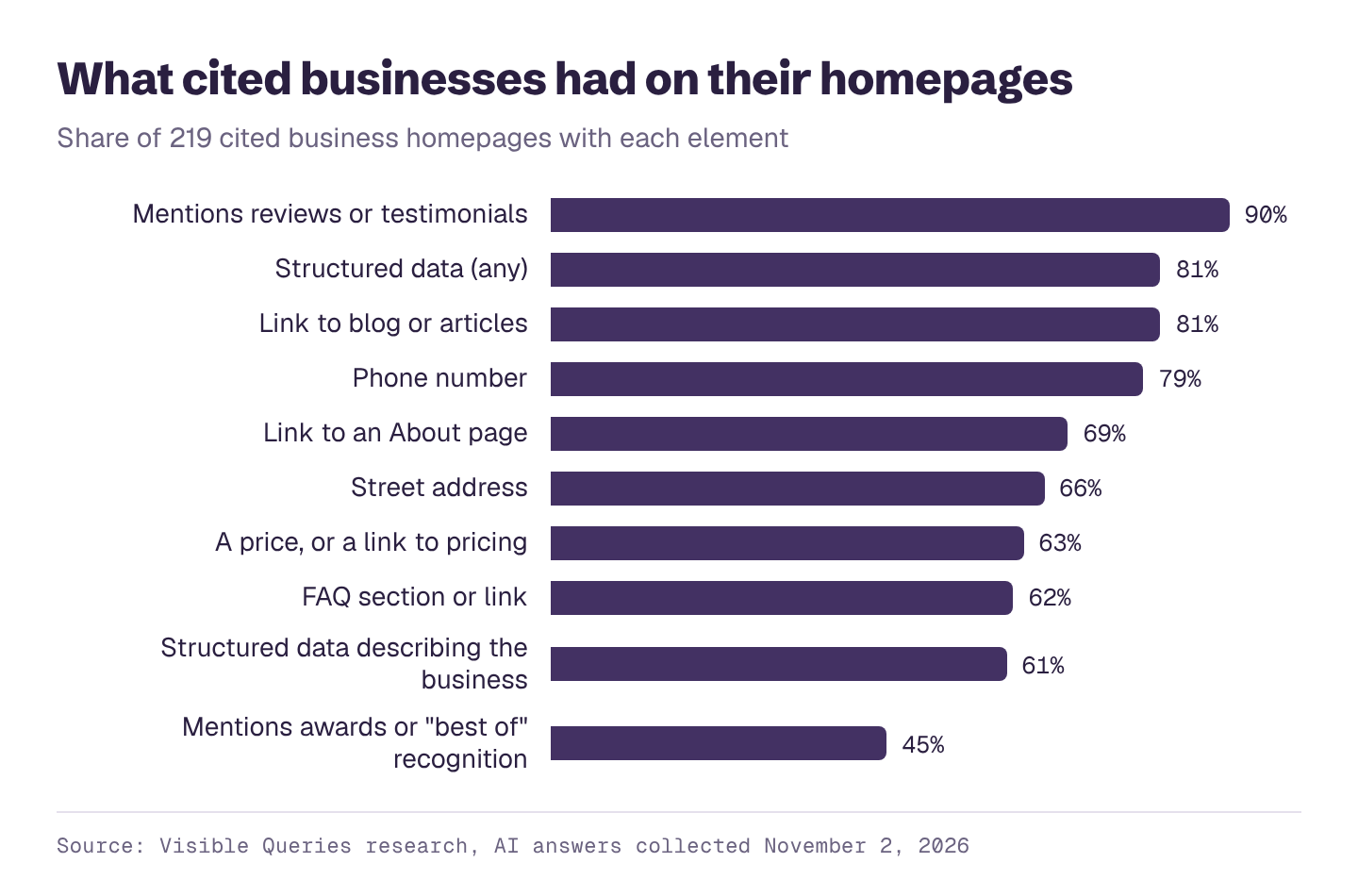
| Homepage element | Share of cited sites |
|---|---|
| Mentions reviews, ratings or testimonials | 90% |
| Structured data (any) | 81% |
| Link to a blog, news or articles section | 81% |
| Phone number | 79% |
| Link to an About page | 69% |
| Street address | 66% |
| A price, or a link to pricing | 63% |
| FAQ section or link | 62% |
| Structured data describing the business | 61% |
| Mentions awards or "best of" recognition | 45% |
Structured data is code that describes a page to machines. "Structured data describing the business" means it identifies the site as a business, such as a local business, a law firm or a dental practice, rather than only describing the page.
These are the websites of businesses AI chose to cite. We didn't compare them with sites that weren't cited, so this shows what cited sites tend to have, not what causes a citation. Still, the pattern is consistent with what we found elsewhere: AI answers lean on plain, specific facts, and these sites tend to state theirs clearly, on the homepage, in text.
A few details are worth calling out.
Reviews on the homepage were nearly universal. Nine in ten cited homepages mentioned reviews, ratings or testimonials. That doesn't mean a testimonial carousel earns a citation. But it does mean the assistant was usually reading sites that put evidence of quality right on the front page.
Prices were more common than many businesses would guess. Almost two thirds of cited homepages showed a price or linked to a pricing page. In our study of what AI tells buyers things cost, businesses' own pricing pages were the main source for price answers, so publishing prices pays off twice.
Structured data was common, but not universal. About four in five cited homepages had some structured data, and three in five had structured data that described the business itself. That leaves a fifth of cited sites with none, so structured data clearly isn't required to be cited. It's a helpful extra, not a gate.
Contact details were usually in plain text. Most cited homepages had a phone number and street address written out on the page, not only inside a map or an image. That makes them easy for an assistant to read and repeat, and in our study of how accurate AI is about businesses, contact details and locations were the facts it most often got right.
What this means for your website
- Treat your homepage as your AI summary. Say plainly what you do, who you do it for and where, near the top. It's the page AI cites most.
- If you're local, build pages for the places you serve. If you're a local or multi-location business, give each location or main city its own page with its address, hours and services.
- If you sell nationally, publish content that answers buyer questions. For national questions, 70% of cited business pages were articles. A clear, fair guide to the question your buyers ask, including how you compare with alternatives, is a page AI can cite.
- Put the basics on the page in text. Phone, address, prices, reviews and answers to common questions, in words rather than only images or widgets.
- Add structured data. Most cited sites had it. Your web developer or website platform can add it.
- Don't stop at your own site. Most recommendations were built from other sources. Make sure the lists, review sites and directories in your industry describe you the same way your site does. Our guide on how to get onto the sources AI cites explains how.
Our AI visibility checklist for your website covers each of these in detail.
How we did this
We started with the answers from our study of where AI gets its answers: 260 recommendation questions across 13 industries, asked to a leading AI assistant with live web search turned on, collected on November 2, 2026. Every cited link that pointed to a business's own website was included: 302 links to 265 businesses.
We grouped each link by page type based on its web address. Then we downloaded each business's homepage and checked its HTML for the elements in the table above, using simple pattern matching: for example, a phone number in a standard format, a street address, a structured data block, or words like "testimonials" and "reviews." We couldn't read 46 homepages, usually because the site blocked automated requests or didn't respond, and left them out of the homepage figures. Pattern matching is approximate, so treat these shares as indicators, not exact counts.
To compare being cited with being recommended, we matched each business named in an answer against the business websites cited in the same answer, using the business's name and web address. Name matching is approximate, so treat the 8% figure as a rough guide.
See whether AI reads and cites your website
Enter your website and get a free AI visibility report. It takes a few minutes, and you'll see:
- Your AI visibility score, overall and for each AI platform
- How often AI cites your website, not just mentions you
- Who AI recommends instead of you, and how often
- What AI gets wrong about you, and what to fix first
- A downloadable PDF you can share with your team