What AI tells buyers things cost, and where it gets the numbers
We asked an AI assistant what 16 common services cost in four cities. It gave a price every time, and 94% of its answers drew on businesses' own websites. The businesses that publish prices are setting buyers' expectations.
"How much does it cost?" is one of the first questions buyers ask, and more of them now ask it to an AI assistant before they ask a business. The number they get back shapes what they expect to pay, which quotes look reasonable and which providers seem worth calling.
We wanted to know what those answers look like and where the numbers come from. So we asked an AI assistant, with live web search turned on, what 16 common services cost in four cities: Toronto, Vancouver, Dallas and Chicago. The services ranged from an AC replacement and a new roof to a dental cleaning, an uncontested divorce, a massage, an oil change and a real estate agent's commission. That's 64 questions in all.
The short version
- The assistant gave a price every time. All 64 answers included a specific price range. None declined to estimate.
- The ranges were wide. In a typical answer, the top of the range was twice the bottom. In about a quarter of answers, it was three times or more.
- The numbers came mostly from businesses' own websites. 94% of answers cited at least one business's website, and business websites made up 59% of all the sources cited.
- About four in ten answers named specific businesses and their prices. In 27 of the 64 answers, the assistant didn't just give a range. It named particular businesses and what they charge.
- Local cost guides were the pages it trusted most. 68% of the business pages it cited were pricing pages or cost guides, and 61% had the city's name in the page address, like "AC replacement cost Chicago." Local businesses that wrote those guides became the source for their whole city's price answer.
AI always has an answer on price
Not one of the 64 answers said "it depends, call around." Each one gave a range, usually with an explanation of what moves the price up or down: the size of the job, the materials, the neighborhood, whether insurance is involved.
Some examples of what buyers were told:
| Question | City | Range given |
|---|---|---|
| Replace a central AC unit | Dallas | $5,000 to $9,000 |
| Replace a central AC unit | Toronto | $4,000 to $7,000 CAD |
| New asphalt roof | Chicago | $12,000 to $20,000 |
| Dental cleaning without insurance | Dallas | $75 to $250 |
| Dental cleaning without insurance | Vancouver | $200 to $400 CAD, with a checkup |
| Simple will drafted by a lawyer | Toronto | $400 to $800 CAD |
| Personal tax return by an accountant | Dallas | $175 to $800 |
| 60-minute massage | Chicago | $80 to $130 |
| Home inspection | Toronto | $400 to $700 CAD |
Here's how the main range compared across all four cities for six of the services.
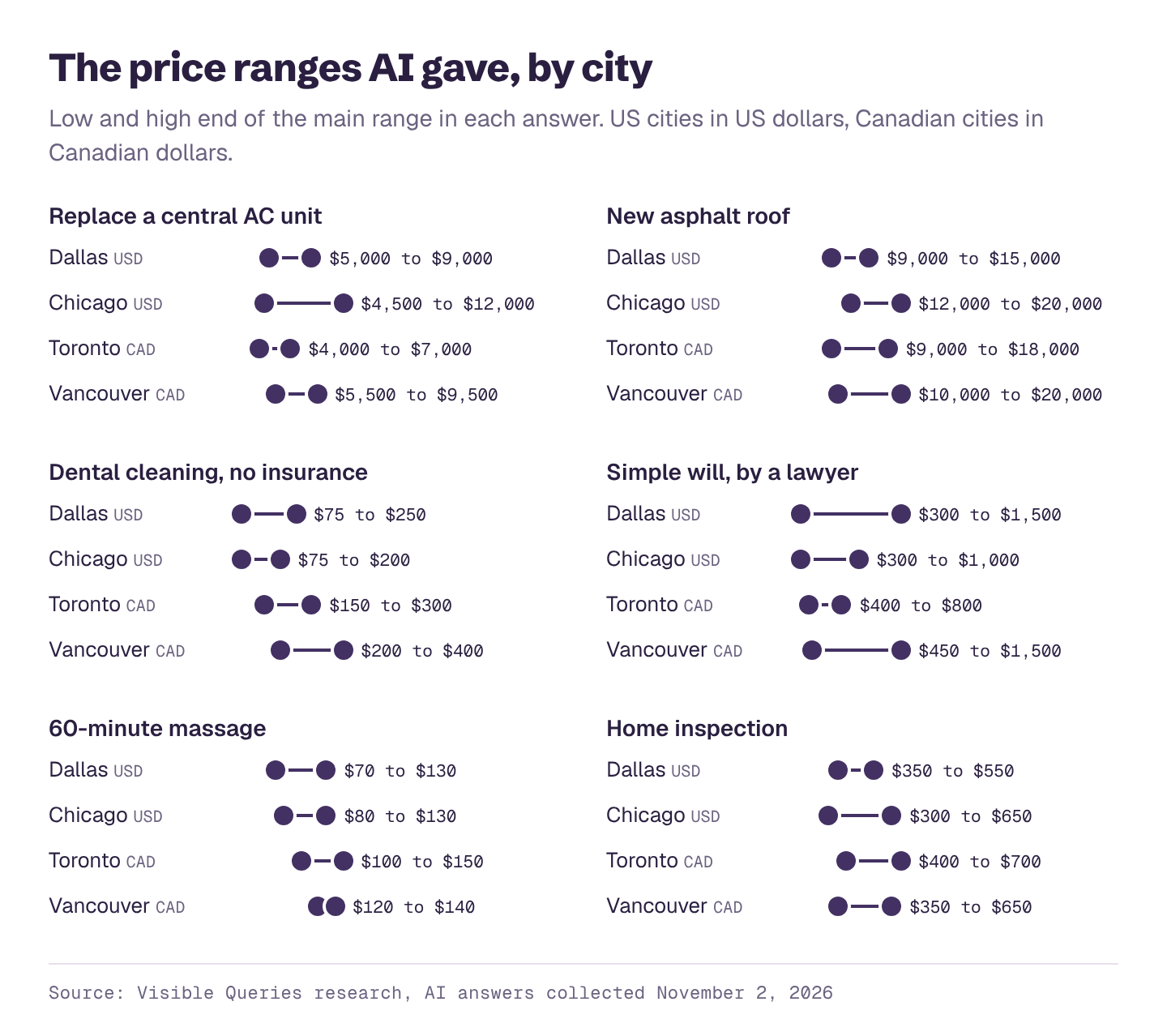
These ranges are what the assistant said, not prices we verified. The point isn't whether any one figure is right. It's that a buyer who asks gets a confident number, and that number becomes the yardstick for every quote they receive afterward.
The ranges are wide, and sometimes the question shifts
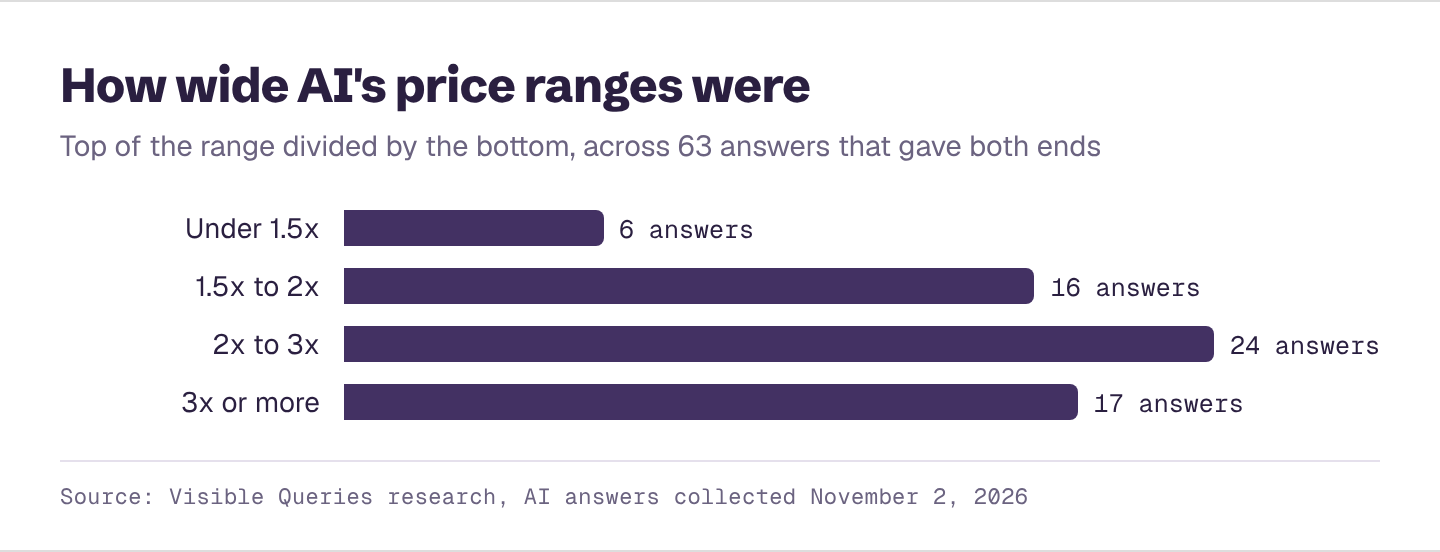
In a typical answer, the high end of the range was double the low end. For about a quarter of answers, it was three times or more. A Toronto wedding venue answer, for instance, spanned $3,000 to $20,000 for venue rental alone.
Wide ranges aren't wrong. Many of these services genuinely vary a lot. But they leave buyers with an anchor that may be far from what your business charges, in either direction. A buyer who was told "$75 to $250" and then hears a quote of $240 may feel overcharged, even if your price is fair for what's included.
Occasionally, the answer quietly changed the question. Asked what an uncontested divorce costs in Chicago, the assistant gave the cost of filing one without a lawyer, while its answers for other cities quoted lawyer-assisted divorces. A buyer comparing cities, or comparing a lawyer's quote with that answer, would be comparing two different things.
Service by service
The answers varied a lot by kind of service. A few patterns stood out.
Big home projects: confident, mid-width ranges
AC replacement and roofing answers were the most consistent. The top of the range was usually less than twice the bottom, and each answer broke the price down by system size, roof area or materials. Chicago's AC range ($4,500 to $12,000) was the exception, because the answer included high-efficiency heat pump systems at the top end.
Small repairs and professional fees: the widest ranges
The ranges for a leaking pipe repair, a simple will and a personal tax return were among the widest in the study, with tops three to five times the bottoms. In Dallas, a simple will ran from $300 to $1,500, and a personal tax return from $175 to $800. These are services where the job can be tiny or complex and buyers can't easily tell which theirs is. A business that explains what puts a job at the low or high end has a real chance to shape how buyers read their quote.
Memberships and venues: anything goes
Gym memberships and wedding venues produced the widest ranges of all. One gym answer for Chicago ran from $15 a month for a budget chain to $275 for a luxury club. A Vancouver wedding venue answer ran from $1,000 to $15,000 for the venue alone. When the range is that wide, the number tells a buyer almost nothing, and the businesses the assistant names as examples at each price point do most of the work.
Personal services: deals sites join in
Massage, haircut and color, oil change and gym answers were the ones that drew on Groupon, which was cited 16 times in all. That means discounted deal prices were sometimes part of what buyers were told was normal. If you run deals, it's worth knowing that the deal price may be shaping what buyers expect from your regular price, and your competitors'.
Real estate commissions: precise, but local
Commission answers were the narrowest in the study: 5.5% to 6% total in Dallas, 5% to 5.5% in Chicago, and 4% to 5% in Toronto. For Vancouver, the assistant worked through British Columbia's tiered commission formula and gave a dollar figure on an example $1 million sale. These answers leaned on brokerages' and agents' own explanations of how commission works locally.
Where the numbers come from
This is the most useful finding for businesses. Answers about price leaned on businesses' own websites far more than answers about who to hire.
| Source type | Share of sources in price answers | Share in recommendation answers |
|---|---|---|
| Business websites | 59% | 22% |
| "Best of" lists and blogs | 16% | 40% |
| Directories | 6% | 7% |
| Marketplaces | 6% | 1% |
| Review sites | 3% | 22% |
| Other | 10% | 8% |
Recommendation answers are from our study of where AI gets its answers, which asked who to hire or buy from in 13 industries.
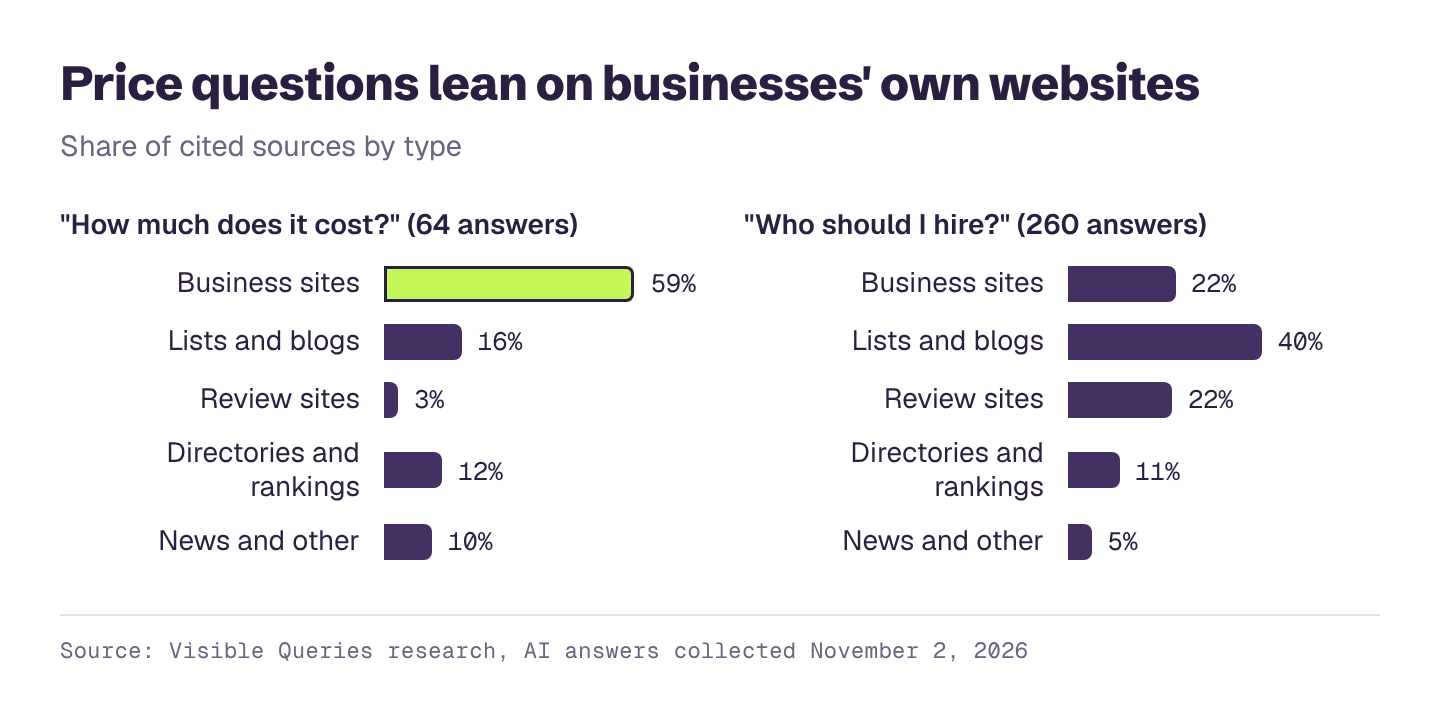
When a buyer asks what something costs, the assistant goes looking for businesses that publish their prices: service pages with price ranges, pricing guides, "what does it cost" articles on a provider's own blog. Those pages became the basis for the answer in 60 of the 64 cases.
In other words, the businesses that publish their prices are, in effect, writing the price answer for their whole market.
The pages it picked: local cost guides
We looked at every one of the 219 business pages cited in price answers. Two things stood out.
- Most were dedicated pricing pages or cost guides. 149 of them (68%) had words like "cost," "price," "pricing" or "rates" in the page address. These were pages written to answer exactly the question the buyer asked, such as a plumber's "How much does a plumber cost in Vancouver?" article or an HVAC company's "AC replacement cost in Chicago" guide.
- Most were about the buyer's city. 133 of them (61%) had the city's name in the page address. A national pricing page was far less likely to be cited than one written for the local market.
About a quarter of these pages were posts on a business's blog, and 33 had the current or previous year in the address, like "2026 pricing guide." The assistant seemed to favor pages that looked recent.
Outside business websites, the most-cited sources were Groupon (16 times), the home services cost guides on Angi (11) and its Canadian counterpart HomeStars (7), and legal information sites for divorce and will questions.
What this means for your business
- Publish your prices, or at least a range. If you don't, the assistant will still answer, using competitors' numbers. Publishing makes you a source for the answer, not just a subject of it.
- Explain what drives the price. The assistant's answers explained what moves a price up or down: size, materials, complexity, insurance. When your pricing page explains the same things, the assistant has your reasons to work with, not just a competitor's.
- Write a local cost guide. A page titled for the exact question, like "How much does a new roof cost in Calgary?", with your city's typical ranges and what moves them, is the kind of page the assistant cited most. Keep it dated and update it each year.
- Be specific about what's included. A number without context invites the wrong comparison. "Includes removal of the old unit and a 10-year parts warranty" helps a buyer, and an assistant, compare fairly.
- Check what AI says you charge. Ask the assistant what your service costs in your city, and what your business charges. In our accuracy study, prices were the facts AI got wrong most often, including telling buyers that businesses didn't publish prices when they did. See how accurate AI is about your business.
How we did this
We chose 16 common services across home services, healthcare, law, financial services, health and wellness, local services, hospitality and real estate, and asked what each costs in Toronto, Vancouver, Dallas and Chicago. Each of the 64 questions was asked in a fresh conversation with a leading AI assistant, with live web search turned on and its location set to the question's city. Answers were collected on November 2, 2026.
For each answer, we recorded the main price range it gave, whether it named specific businesses, and every source it cited, classified by type. Price ranges are reported as the assistant stated them; we did not check them against market data. For the analysis of cited pages, we looked at the address of every business page cited in a price answer to see whether it was a pricing page, a blog post, and whether it named the city.
Canadian answers were in Canadian dollars and US answers in US dollars, so we didn't compare price levels across the border. A few answers gave a figure in a different form from the others, such as a total commission in dollars instead of a percentage; we've noted those where they appear.
See what AI tells buyers about your business
Enter your website and get a free AI visibility report. It takes a few minutes, and you'll see:
- What AI gets wrong about you, and what to fix first
- Who AI recommends instead of you, and how often
- Your AI visibility score, overall and for each AI platform
- A downloadable PDF you can share with your team