How accurate is AI about your business? We checked 745 claims
We asked an AI assistant about 41 real businesses that it recommends, then checked every claim against each business's own website. Most of what it said held up. Prices and hours were where it went wrong, and one hotel got mistaken for an art supply store.
Being recommended by AI is only half the battle. The other half is what the assistant says about you once a buyer asks for details. If it quotes the wrong price, lists the wrong hours or gives the wrong phone number, the recommendation can cost you the customer it was supposed to win.
We wanted to know how often that happens. So we took 41 real businesses that an AI assistant had already recommended in our study of where AI gets its answers: dental clinics, law firms, financial advisors, roofers, Pilates studios, hotels and more, across cities in the US and Canada. We asked the assistant what a buyer would ask before calling: what services they offer, where they're located, their hours, how to contact them and what they charge. Then we checked every factual claim in each answer against the business's own website.
The short version
- Most of what AI said was right, or at least not wrong. Of 745 factual claims, 55% matched the business's website and 41% were things the website didn't address either way.
- But 44% of businesses had at least one problem. For 18 of the 41 businesses, the answer either stated something the website contradicts or told the buyer that information wasn't available when it was right there on the site.
- About a quarter of businesses had a plainly wrong fact. For 11 of the 41, the answer stated something incorrect: wrong hours, a wrong phone number or email, the wrong number of locations, an outdated rate or offer.
- Prices were the weakest spot. About 12% of claims about pricing were wrong or missed published prices, several times the rate for other kinds of facts.
- Most hours came from somewhere other than the business's website. Only 11 of 54 claims about hours could be confirmed on the business's own site. The answers drew on Yelp, LinkedIn, Facebook, MapQuest and the Better Business Bureau alongside the business's site.
- One business was mistaken for a different company entirely. Asked about a boutique hotel in Vancouver, the assistant described an art supply store with a similar name, including its address and phone number.
What we checked, and what we found
Each answer contained 18 factual claims on average. We sorted every claim into one of three groups:
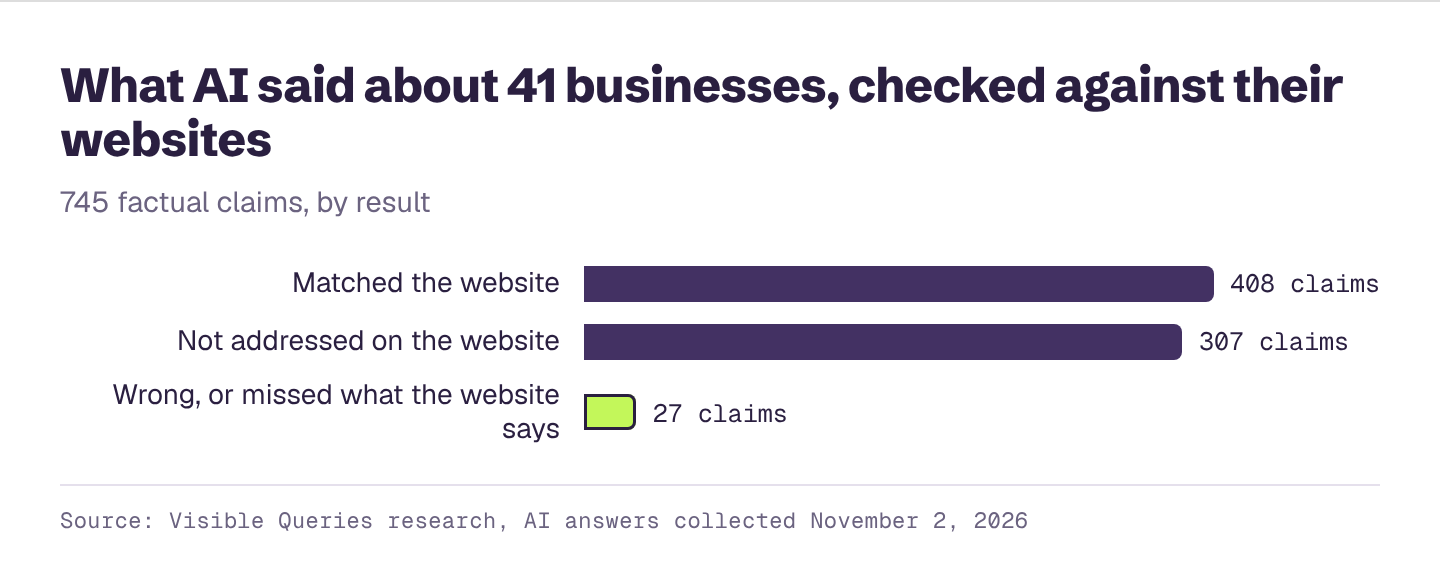
| Result | Claims | Share |
|---|---|---|
| Matched the business's website | 408 | 55% |
| Not addressed on the website | 307 | 41% |
| Contradicted by the website, or missed information the website gives | 27 | 4% |
| Flagged at first, then set aside after a closer look | 3 | under 1% |
The middle group is worth a moment. Four in ten claims couldn't be checked against the business's own site at all, because the site simply didn't say. Some of those claims came from review sites, directories or news articles, and many were probably accurate. But for a business, that's a lot of what AI tells buyers about you resting on sources you don't control.
Where the answers came from
The assistant cited the business's own website in 37 of the 41 answers. But it rarely relied on that alone. A typical answer cited six or seven sources, and the most common outside sources were the kind of business listings most owners set up once and forget:
| Source | Answers that cited it |
|---|---|
| The business's own website | 37 of 41 |
| Yelp | 23 |
| 14 | |
| 13 | |
| MapQuest | 9 |
| Better Business Bureau | 7 |
| ZoomInfo | 3 |
| Houzz | 3 |
That matters, because these listings are where outdated details tend to live. A Facebook page with last year's hours, a MapQuest listing with an old phone number or a LinkedIn page that still lists three offices can all end up in an answer, sitting right next to the correct details from your website.
Where AI got it wrong
The 27 problems fell into two kinds.
Wrong facts
In 18 claims across 11 businesses, the assistant stated something the website clearly contradicted. Examples, with the businesses left unnamed:
- Hours. A Pilates studio's answer gave different weekday and weekend hours than the ones on its website, in three separate claims.
- Contact details. A financial firm's answer gave a phone number that didn't match the site. A dietitian's answer gave a personal email address instead of the business address listed on her site. A roofer's answer said its About page listed a different phone number than the one it actually shows.
- Locations. A dental group's answer described it as one of three offices. Its website lists seven.
- Rates and offers. For an online bank, the answer quoted a higher interest rate than the one on the bank's site, and said a type of transfer was free when the site lists a fee. A med spa's answer described a new-patient discount that differed from the offer on its site. A Pilates studio's answer estimated class prices below its published rate.
- History. A law firm's answer gave a founding year that conflicted with the firm's own description of how long it has been in practice.
- The wrong business. For a boutique hotel, the assistant described a different business with a similar name: an art supply and framing store, with that store's address, phone number and website.
"Not published," when it was
In 9 claims across 9 businesses, the assistant told the buyer that something wasn't available, when the business's website states it plainly. Most of these were about price. A CPA firm's answer said it publishes no prices, while its site lists monthly plans. A roofing company, a kitchen remodeler, a nutritionist and a med spa all had prices on their websites that the answer said weren't there. One law firm's answer said its hours weren't published. They were.
This kind of miss is easy to overlook, but it matters. A buyer comparing three providers is more likely to call the one whose prices they can see. If AI tells them yours aren't available, it sends them to a competitor whose prices it found.
Which facts AI gets wrong most
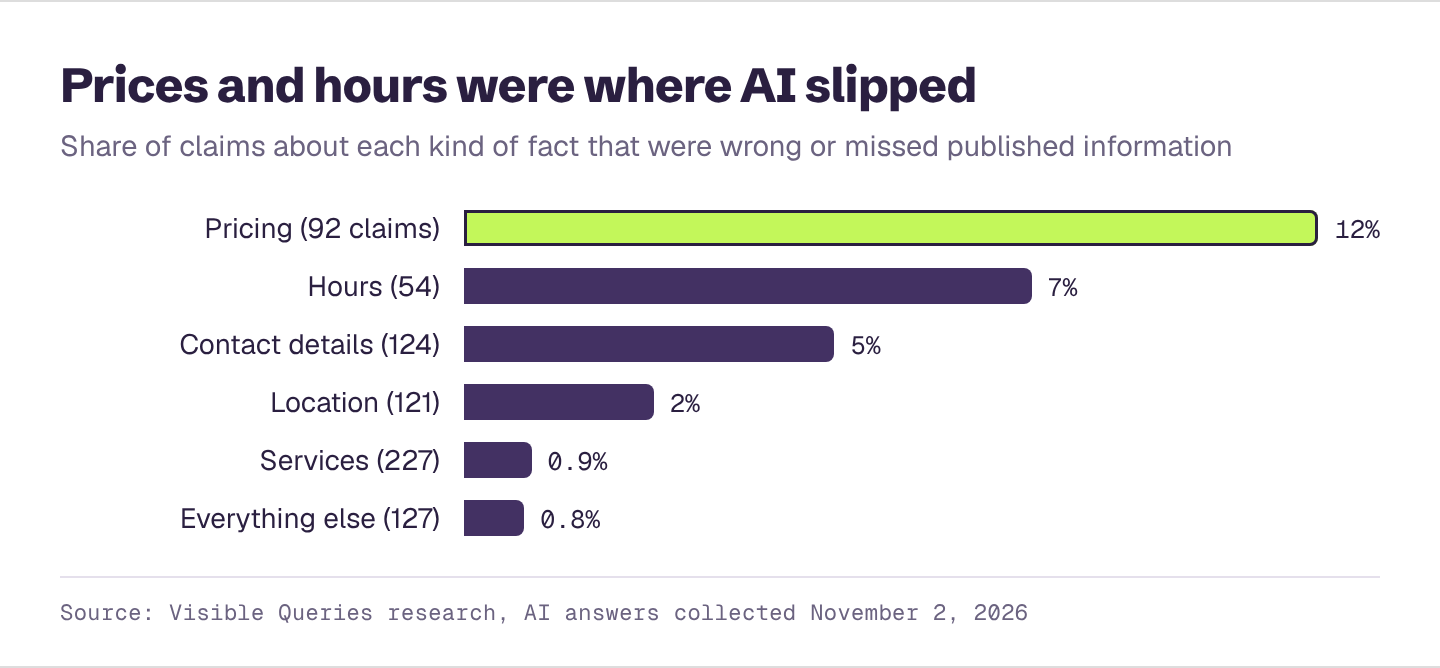
| Kind of fact | Claims checked | Wrong or missed |
|---|---|---|
| Pricing | 92 | 11 (12%) |
| Hours | 54 | 4 (7%) |
| Contact details | 124 | 6 (5%) |
| Location | 121 | 3 (2%) |
| Services | 227 | 2 (1%) |
| All other facts | 127 | 1 (1%) |
Services, the core of what a business does, were almost always right. The errors clustered in the details buyers check right before they call: price, hours and how to reach you. They're also the details that change most often, and the ones most likely to be out of date somewhere on the web.
Hours stand out for another reason. Only 11 of the 54 claims about hours could be confirmed on the business's own site. For most businesses, the assistant was getting hours from somewhere else.
What the websites didn't say
The "not addressed" group tells its own story. Here's how much of what the assistant said about each kind of fact could be confirmed on the business's own website.
| Kind of fact | Confirmed on the website | Not addressed on the website |
|---|---|---|
| Services | 70% | 30% |
| History | 61% | 36% |
| Contact details | 58% | 37% |
| Location | 52% | 45% |
| Pricing | 40% | 46% |
| Reviews and reputation | 28% | 69% |
| Hours | 20% | 72% |
Services were the one area where businesses' websites clearly did the talking. For hours, reviews and pricing, most of what buyers were told came from somewhere else. That's not always a problem: many of those claims were probably accurate. But it means that for the facts buyers check last, the version AI repeats is often one you didn't write.
Reviews are a natural case. "Customers praise their friendly staff" comes from review sites, not the business's own site, and that's how it should be. Hours and prices are different. They're facts only you can confirm, and when your site doesn't state them, the assistant has to rely on whatever listing it finds.
By industry
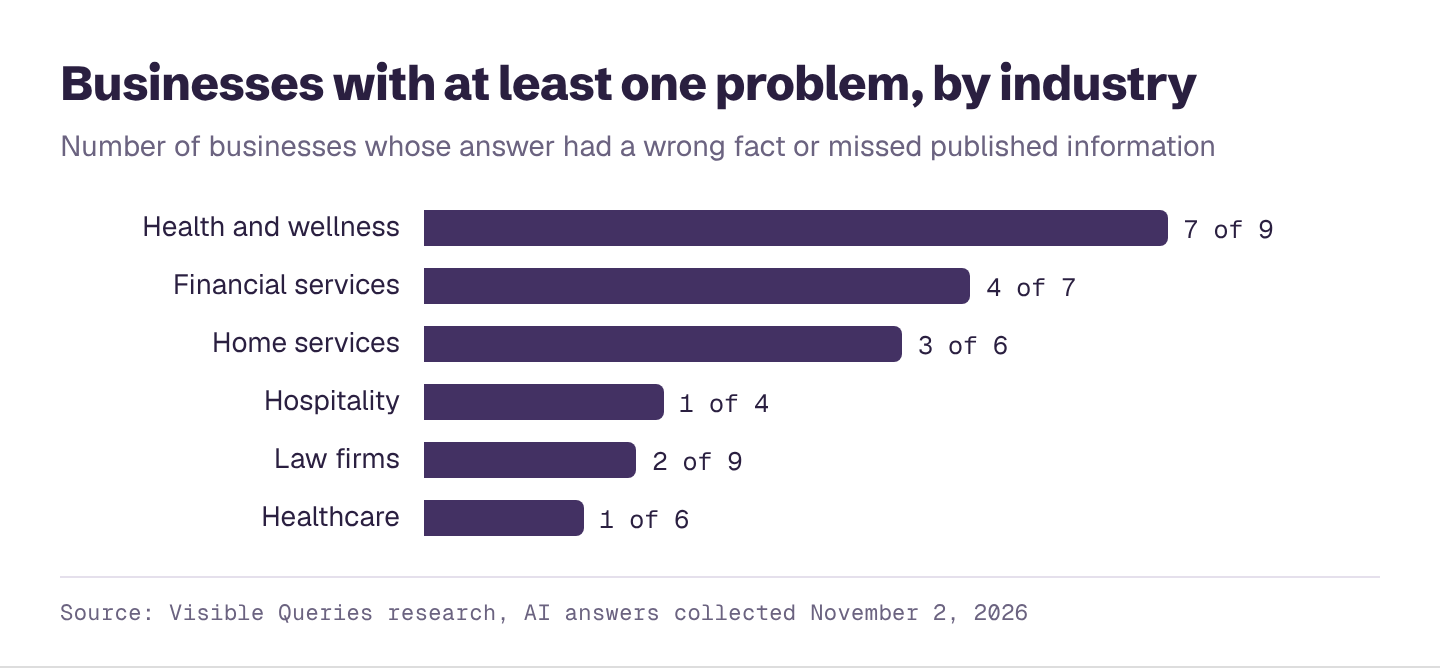
The sample in each industry is small, so treat this as a pattern to watch rather than a ranking. Still, the differences line up with the kinds of errors we found.
Health and wellness had the most problems, with 7 of 9 businesses affected. Studios, med spas and nutrition practices tend to change class schedules, intro offers and package prices often, and those were exactly the details the answers got wrong or said weren't published.
Financial services came next, with 4 of 7. The problems were rates, fees and published plan prices: details that change often for banks and that firms sometimes publish in places that are easy to miss, like a separate pricing page.
Home services had problems for 3 of 6, mostly prices that were on the website but that the answer said weren't, and contact details that didn't match.
Law firms and healthcare practices had the fewest, at 2 of 9 and 1 of 6. Their answers were mostly about services, locations and credentials, which were stated clearly on their websites and rarely change.
What this means for your business
- Ask AI about yourself. Ask the questions a buyer asks right before calling: what you offer, where you are, your hours, how to reach you and what you charge. Compare the answers to the truth.
- Publish prices and hours on your own site, in plain text. The clearest finding here is that AI either gets prices wrong or misses them, and that hours mostly come from somewhere other than the business's website. Stating them clearly on your own site gives AI an accurate source to use.
- Update the listings you've forgotten. Check Yelp, Facebook, LinkedIn, MapQuest, the Better Business Bureau and any directory in your industry. Make your hours, phone number, address and locations match your website exactly.
- Make your name and details unmistakable. If another business shares part of your name, say clearly on your site and listings who you are, what you do and where you are, so you aren't mixed up.
- Fix errors at the source. Most wrong facts come from an outdated page somewhere: an old directory listing, a stale article or a forgotten page on your own site. Here's how to fix wrong information AI says about your business.
How we did this
We started with businesses an AI assistant recommended, and whose own website it cited, when asked for recommendations in six local industries: healthcare, health and wellness, home services, financial services, law firms and hospitality. We took up to 10 per industry and dropped any whose website we couldn't read, which left 41 businesses across cities in the US and Canada.
For each business, we asked a leading AI assistant, in a fresh conversation with live web search turned on: "What can you tell me about [business] in [city]? What services do they offer, where are they located, what are their hours, how do I contact them, and roughly what do they charge?" Answers were collected on November 2, 2026.
We then read up to nine pages of each business's website, starting from the homepage and prioritizing pages about services, pricing and the business itself. An AI model listed every factual claim in each answer and compared it with the website text, marking each claim as matched, contradicted or not addressed. We then reviewed every flagged problem individually against the quoted website text and set aside any that didn't hold up, such as a price the answer stated correctly. Three of the 30 flagged claims were set aside this way, leaving the 27 problems reported here.
Two limits are worth knowing. A claim we marked "not addressed" may still be correct, since it may come from a source other than the business's website. And a website can be out of date itself, so a mismatch shows that AI and the business disagree, which is what a buyer would run into, even in the rare case that the website is the one that's wrong.
Find out what AI gets wrong about you
Enter your website and get a free AI visibility report. It takes a few minutes, and you'll see:
- What AI gets wrong about you, and what to fix first
- Who AI recommends instead of you, and how often
- Your AI visibility score, overall and for each AI platform
- A downloadable PDF you can share with your team