Ranking on Google vs being recommended by AI: what's different
Ranking well on Google doesn't guarantee AI recommends you. Here's how the two differ, what carries over, and what to do differently for AI, with data from our own studies of AI answers.
Plenty of businesses have spent years earning a good spot on Google. They rank for their main services, they show up in the map pack, and the phone rings. So it's natural to assume that if Google likes you, AI assistants will too.
Sometimes they do. Often they don't. Ranking on Google and being recommended by AI overlap, but they reward different things, and a business that's strong at one can be invisible in the other.
This guide explains the differences, what carries over from search, and what to do differently for AI. It draws on our own studies of AI answers, including where AI gets its answers across 13 industries.
The core difference: a list of pages vs an answer
A Google search returns a ranked list of pages. Your goal is to be one of the pages near the top, and the buyer does the comparing.
An AI assistant returns an answer. It reads several pages, compares the options itself, and names a short list of businesses with a reason for each. Your goal isn't to be a top page. It's to be one of the names in the answer, and ideally the first.
That changes what matters:
| Ranking on Google | Being recommended by AI | |
|---|---|---|
| What wins | Your page | Your business, as described across many pages |
| Who decides | A ranking of pages | A summary written from several sources |
| What the buyer sees | Ten or more options to compare | A few names, already compared |
| Where your reputation lives | Mostly on your site and your Google profile | On lists, review sites, directories and your site |
| How you check it | Your rank for a keyword | How often you're named, across many questions, run more than once |
What carries over from search
A lot of good search work helps with AI too.
- A clear, crawlable website. AI assistants that search the web read pages much like search engines do. If your pages are fast, readable and clearly about what you do, both benefit.
- Strong content that answers real questions. In our study of what the business websites AI cites have in common, about one in six citations to business websites went to articles and guides.
- Local pages and accurate listings. City and location pages were the second most-cited kind of business page in that study, and consistent name, address and phone details help both Google and AI identify you.
- Reviews. Reviews matter for Google's local results, and review sites are a major source for AI in local industries.
If you've done this work, you're not starting from zero.
What's different for AI
1. Other people's pages matter more than yours
In our study of where AI gets its answers, about three quarters of the sources an AI assistant cited for buyer recommendations were written by someone other than the business. "Best of" lists and blogs alone were 40%. Business websites were 22%.
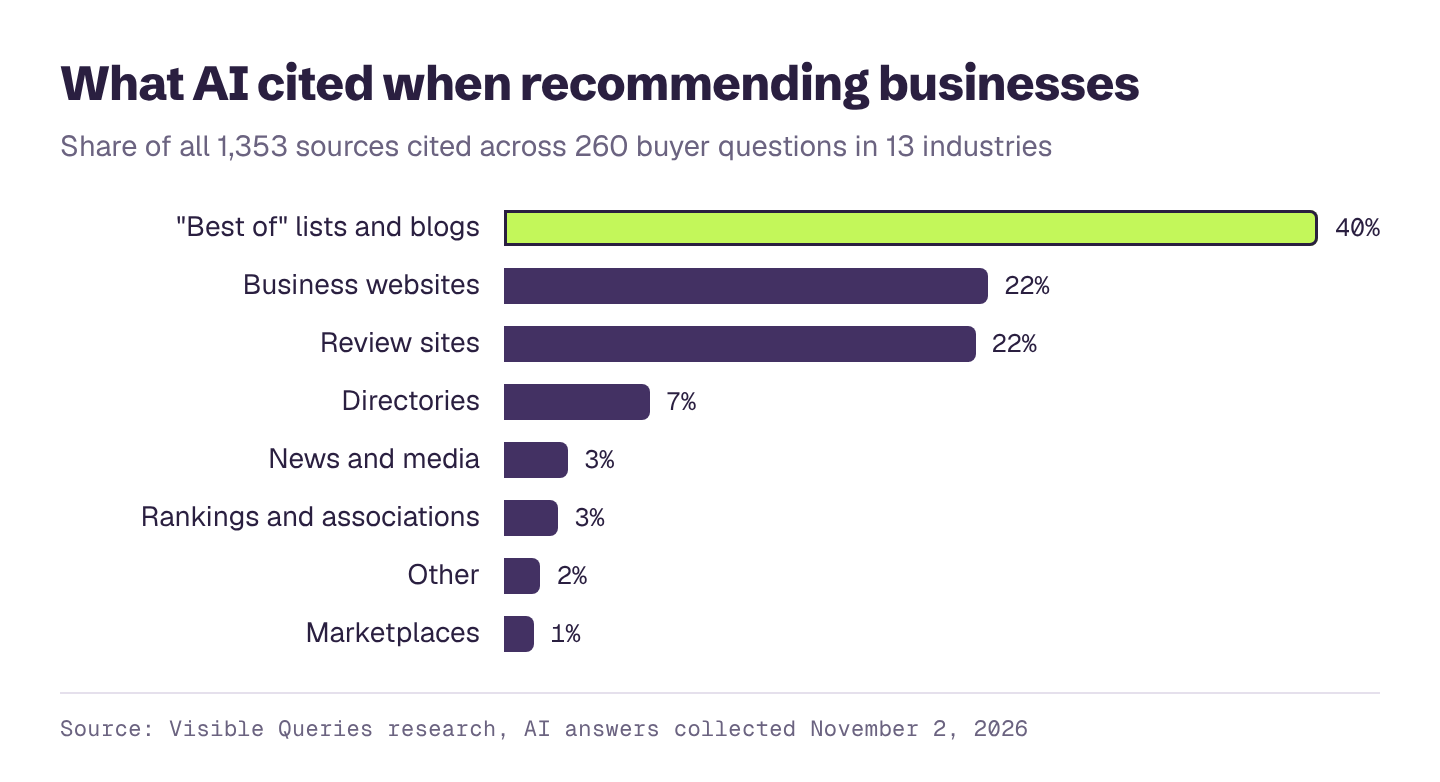
On Google, your own page is usually the thing that ranks. For AI, your own page is one input among many. What lists, review sites and directories say about you can matter as much as what you say about yourself.
2. The sources aren't the same as Google's favorites
The sites an AI assistant leans on aren't always the ones that dominate Google's results for the same question. In our answers, Yelp was cited in 62% of answers to local questions, and professional rankings like Best Lawyers and Super Lawyers were a major source for law firm questions. Small local "best of" sites, which many marketers ignore, were cited heavily across industries. Meanwhile, Google's own review pages never appeared as a cited link.
Different assistants also use different search technology. So a business can rank well on Google and still be missing from the sources a particular assistant reads.
3. AI rewards being easy to summarize
Google can rank a page for a keyword without fully understanding the business behind it. An AI assistant has to describe you in a sentence or two. If it can't work out plainly what you do, who you're best for and where you operate, it's less likely to recommend you confidently.
That's why plain statements matter so much for AI: what you do, for whom, where, and roughly what it costs. In our study of what AI tells buyers things cost, 94% of price answers drew on businesses' own websites. The businesses that publish prices are the ones shaping those answers.
4. There's no single rank to check
On Google, you can check your position for a keyword and expect it to be fairly steady from one day to the next. AI answers are written fresh each time. In our study of how stable AI recommendations are, only about 60% of the businesses in a typical answer showed up every time we asked the same question, and the first name changed in more than half the questions.
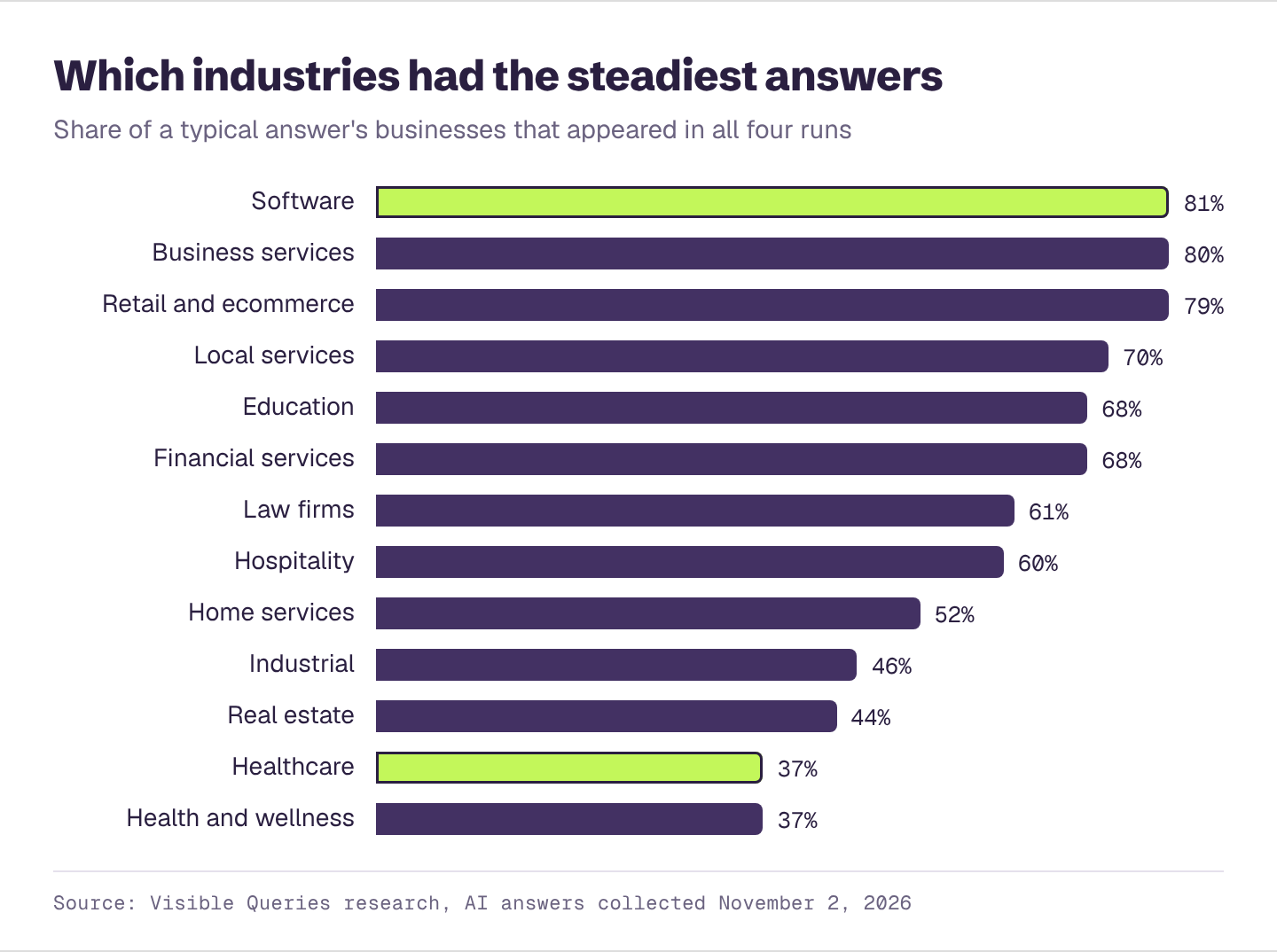
So the right measure for AI isn't a rank. It's a rate: how often you're named across many buyer questions, asked more than once.
5. Being described correctly matters as much as being found
On Google, a buyer clicks through to your site and reads your own description. In an AI answer, the assistant describes you before the buyer ever gets there. In our study of how accurate AI is about businesses, 44% of businesses had at least one fact wrong or missing in the answer, most often prices or hours. A good ranking doesn't protect you from that.
What to do differently
- Measure AI separately from search. Don't assume your Google rankings tell you where you stand in AI. Check AI directly, with the questions your buyers ask. Here's how to check your AI visibility yourself.
- Invest in the sources AI reads. Get onto the lists, review sites, directories and rankings that show up in AI answers for your industry. Our guide on how to get onto the sources AI cites walks through it.
- Make your site easy to summarize. Say plainly what you do, who you serve, where and what it costs, in text, on your homepage and service pages. The AI visibility checklist for your website covers the details.
- Fix what AI gets wrong. Search can't fix a wrong fact in an AI answer. Updating the source can. See how to fix wrong information AI says about your business.
- Keep doing good SEO. It still matters for buyers who search, and much of it helps with AI. It just isn't the whole picture anymore.
The businesses that do best over the next few years will be strong in both: easy to find when buyers search, and easy to recommend when buyers ask.
See whether AI recommends you, not just whether Google ranks you
Enter your website and get a free AI visibility report. It takes a few minutes, and you'll see:
- Your AI visibility score, overall and for each AI platform
- Who AI recommends instead of you, and how often
- Which topics you win and lose, and how often each one is searched
- What AI gets wrong about you, and what to fix first
- A downloadable PDF you can share with your team