AI referrals are becoming a real source of pipeline. Here's what the data shows
Visits from ChatGPT, Claude, Gemini and other assistants are still a small share of traffic, but they're growing fast and converting better than most channels. What the public data says, and how to track it in your own pipeline.
For most companies, AI assistants still send a small slice of website visits. If you open your analytics and look at referrals from ChatGPT, Claude, Gemini, Perplexity and Copilot, the number is probably low enough that it's easy to dismiss.
That's a mistake, for two reasons. The slice is growing quickly. And the visitors in it behave differently from almost every other kind of traffic: they arrive further along in their decision, and they convert at higher rates.
This article pulls together what the public data says about AI referrals as of late 2026, where the numbers disagree, and how to measure AI's contribution to your own pipeline instead of guessing.
How big AI referrals are now
The honest answer is that it depends on whose data you look at, because each study measures a different set of websites.
Across the broad web, AI referrals are still well under 1% of traffic. SE Ranking analyzed 101,574 websites across 250 countries and territories and found that ChatGPT's share of all referral traffic was 0.32% worldwide in May 2026, its highest point in the 17 months it tracked. In the US, ChatGPT's share rose about 24% between January and April 2026 alone (SE Ranking).
For businesses actively investing in visibility, the share is much higher. First Page Sage tracked 218 client websites across 12 industries, covering more than 3.7 billion sessions. In that panel, AI platforms grew from 0.1% of sessions in January 2023 to 6.9% in September 2026, crossing 1% in late 2024 and 5% in early 2026 (First Page Sage).
Those two numbers aren't contradictory. A broad sample of all websites includes millions of sites AI never mentions. A panel of companies working on their visibility shows what's possible when AI does mention you.
How fast it's growing
Every major dataset points the same direction, even when the totals differ.
- First Page Sage found AI referral traffic grew 98% year over year in 2026, after 286% the year before. Growth is slowing from its early pace, but it's still close to doubling every year (First Page Sage).
- Adobe, looking at more than 1 trillion visits to US retail sites, reported that AI-referral traffic in July 2026 was up 62% year over year and up 1,219% compared with October 2024 (Digital Commerce 360, reporting Adobe Analytics data).
- Similarweb reported that average monthly web visits to AI platforms grew 70% year over year to 9.5 billion between June 2025 and May 2026 (Similarweb). More people using AI assistants means more chances for those assistants to send buyers somewhere.
Why AI visitors are worth more than their numbers suggest
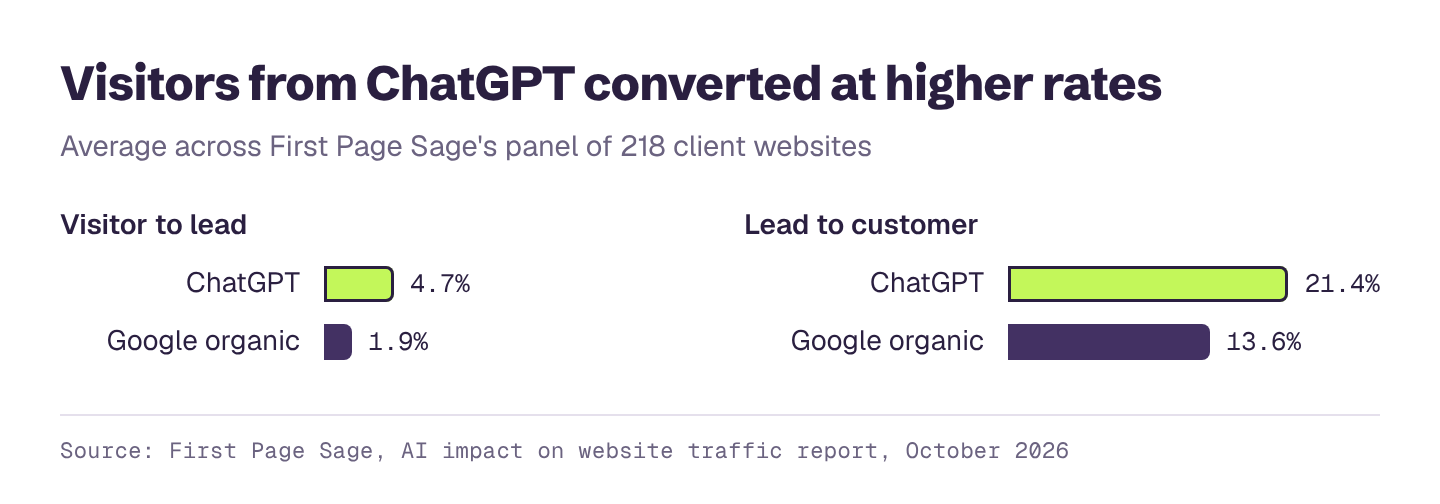
The bigger story isn't volume. It's what these visitors do once they arrive.
They convert to leads at higher rates. In First Page Sage's panel, visitors from ChatGPT converted to leads at 4.7%, compared with 1.9% for Google organic search. Those leads then became customers at 21.4%, compared with 13.6% for Google organic (First Page Sage).
They buy more in ecommerce. Adobe found that AI-referred visits to US retail sites converted at a rate 60% higher than non-AI traffic in July 2026, the eleventh month in a row that AI traffic came out ahead. Those shoppers also generated 53% more revenue per visit (Digital Commerce 360, reporting Adobe Analytics data).
They engage more. Goodie's analysis of B2B brand sites found AI-referred sessions averaged about 58.5 seconds of engagement, compared with 44.2 seconds for Google organic and 18.4 seconds for direct traffic (Goodie).
There's a simple reason for all of this. A buyer who clicks through from an AI answer has usually already done the comparing. They asked the assistant what to look for, which options fit their situation, and who's worth considering. By the time they visit your site, you're not one of ten tabs. You're one of the two or three the assistant recommended, and often the one they've already half-decided on.
It's not just ChatGPT anymore
For a long time, "AI traffic" mostly meant ChatGPT. That's changing.
Goodie found that ChatGPT's share of AI referrals to B2B sites fell from 89.1% in mid-2025 to 62.6% in March and April 2026. Over the same period, Claude's share rose from 1.4% to 18.5%, Gemini's from 2.4% to 10.6%, and Perplexity's from 3.1% to 7.3% (Goodie). First Page Sage's panel shows the same pattern: between 2025 and 2026, referrals from Gemini grew 203% and from Claude 205%, while ChatGPT grew 76% (First Page Sage).
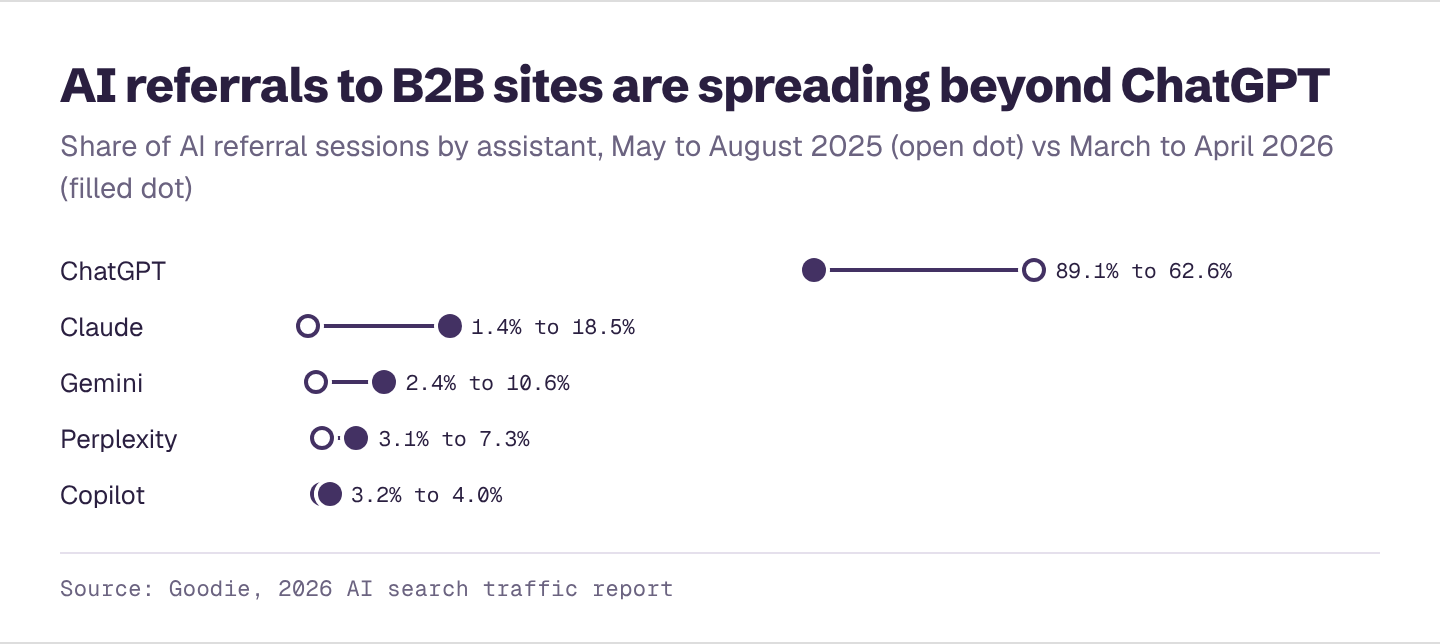
That matters because each assistant builds its answers differently and leans on different sources. Showing up well in one doesn't mean you show up in the others. A company that only checks ChatGPT is looking at a shrinking share of the picture.
What the numbers don't capture
Referral data undercounts AI's real influence on pipeline, for a few reasons.
- Many AI answers don't produce a click at all. A buyer can read a recommendation, close the chat and come back days later by typing your name into Google or your address into their browser. That visit shows up as branded search or direct traffic, not as an AI referral. We cover this in more detail in how AI visibility drives direct and branded traffic.
- Some apps don't pass referral information. Visits from inside some mobile apps can arrive without a referrer and get counted as direct.
- B2B buying happens in groups. One person may research with AI, then forward your website to a colleague who visits directly and fills out the form.
So treat the AI referral line in your analytics as a floor, not the full number.
How to track AI's contribution to your pipeline
You don't need new software to get a reasonable read on this. You need three things set up properly.
1. Separate AI referrals in your analytics
In Google Analytics 4 or whatever analytics tool you use, create a channel group or segment for AI assistants. Include at least these referral sources:
- chatgpt.com and chat.openai.com
- claude.ai
- gemini.google.com
- perplexity.ai
- copilot.microsoft.com
Then look at that segment the way you'd look at any channel: sessions, engaged sessions, conversion rate, and the pages people land on. Expect a lot of homepage landings. SE Ranking found 60% of AI-referred visits land on homepages, compared with 17% from organic search (SE Ranking).
2. Carry the source into your CRM
Make sure the first-touch and last-touch source of every lead is stored in your CRM, not just in analytics. That's what lets you follow AI-sourced leads all the way through to opportunities, closed deals and revenue, instead of stopping at form fills.
3. Ask buyers directly
Add a "How did you hear about us?" field to your forms and your sales intake, and include an option like "ChatGPT, Claude or another AI assistant." Self-reported attribution is imperfect, but it catches what analytics can't: the buyer who heard about you from an AI answer and came back later through a search or a direct visit.
Ask your sales team to listen for it on calls too, and to log it when a buyer says something like "I asked ChatGPT for options and you came up."
What this means for your business
AI referrals aren't going to replace search, referrals or outbound next quarter. But the direction is clear. More buyers use AI assistants to research, more of those assistants send traffic, and the traffic they send converts well, because the assistant has done much of the selling before the buyer arrives.
That puts the real competition upstream, inside the answer. If an assistant recommends you, you get a buyer who's already halfway to yes. If it recommends a competitor, you don't get a chance to make your case at all, and nothing in your analytics will tell you that you lost.
The companies that win this channel will be the ones that know where they stand in AI answers today, which questions they're losing, and who's winning them instead.
Sources
See whether AI is recommending you to buyers
Enter your website and get a free AI visibility report. It takes a few minutes, and you'll see:
- Your AI visibility score, overall and for each AI platform
- Who AI recommends instead of you, and how often
- Which topics you win and lose, and how often each one is searched
- What AI gets wrong about you, and what to fix first
- A downloadable PDF you can share with your team