The hidden payoff of AI visibility: direct and branded traffic
Many buyers who find you through an AI answer never click the link. They search your name or type your address later. Here's what the evidence says about that effect, where it's overstated, and how to measure it honestly.
Picture a buyer on a Tuesday night, asking an AI assistant which accounting firms in their city work with restaurants. The answer names three. The buyer reads it, makes a mental note of the second one, and closes the app.
On Thursday morning they open a browser, type that firm's name into Google, and click the first result. Or they type the firm's web address directly. They book a consultation.
In that firm's analytics, the visit shows up as branded search or direct traffic. Nothing connects it to the AI answer that started it. If the firm only looked at AI referrals, it would conclude AI did nothing.
This is the hidden payoff of AI visibility, and it's one of the most argued-about questions in marketing right now. This article looks at what the evidence actually says, where it's thin, and how to measure the effect in your own business without fooling yourself.
Why AI visibility should show up as branded and direct traffic
The reasoning is straightforward.
An AI answer works more like a recommendation from a friend than a list of search results. It names a few businesses and explains why each one fits. Many buyers don't click immediately. They're on a phone, or mid-conversation, or not ready to act. They remember the name.
When they come back, they don't return to the chat to find the link. They do what people have always done with a name they remember: search for it, or type it in. Both of those visits land in channels that marketers have traditionally credited to brand strength, word of mouth or offline advertising.
There's a second, technical reason. Some AI apps don't pass referral information when a user taps a link, so even a direct click from an answer can show up in analytics as direct traffic.
What the data shows
AI visitors go straight to the front door
Even when buyers do click through from an AI answer, they behave like people who already know who you are. SE Ranking found that 60% of AI-referred traffic lands on homepages, compared with 17% from organic search (SE Ranking). Similarweb saw the same shift after ChatGPT changed how it links to websites in May 2026: homepage visits rose from roughly 26 to 29% of ChatGPT's referrals to about 62 to 63% (Similarweb).
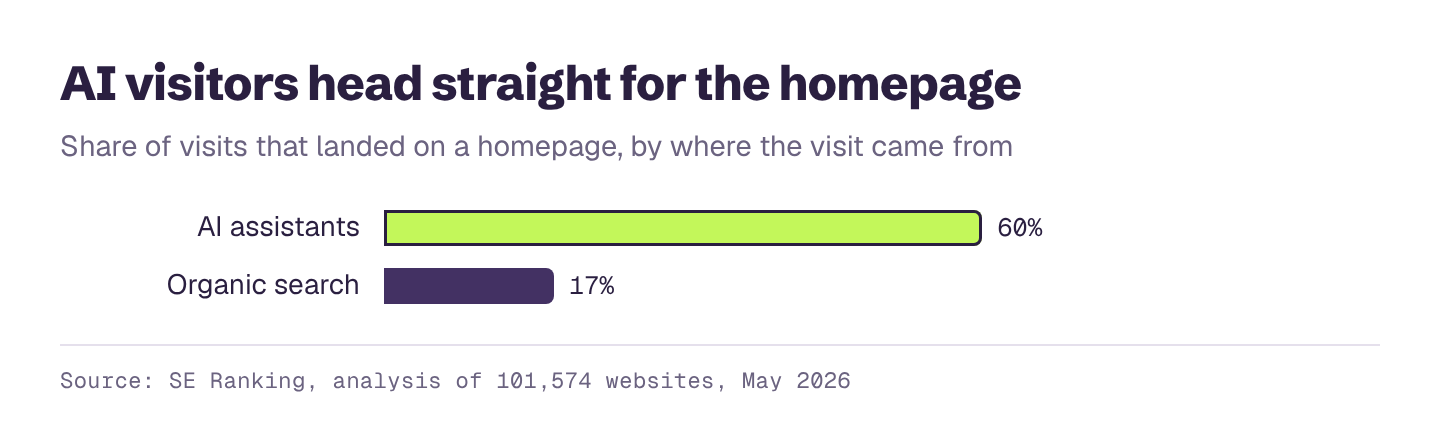
Homepage visits are what branded behavior looks like. A buyer who lands on your homepage isn't looking for an answer to a question. They're looking for you.
Some companies report large hidden effects
Ramp, the corporate card and finance software company, has reported that 30 to 40% of its direct traffic came from answer engines. That figure comes from filtering out bots and email traffic and asking visitors how they found the company (as reported by Tygart Media). It's a single company's number, measured partly through self-reported answers, but it shows how large the effect can be for a brand AI recommends often.
But the most careful test so far found no measurable link
Not everyone finds the effect. Kevin Indig, who writes the Growth Memo newsletter, tested the idea directly using analytics data from 12 websites between January and September 2026 (as reported by Tygart Media). What he found is a useful warning:
- Total direct traffic rose 140.9% across the period. But engaged direct sessions, the ones where a person actually read the page, barely moved.
- Much of the growth in direct traffic came from low-engagement visits that shared the same browser setup, which pointed to bots rather than people.
- Direct sessions with any identifiable trace of an AI referral made up about 0.003% of direct traffic on average.
- He ran 632 comparisons between weekly AI visibility and later branded search and direct traffic for four brands. Some correlations looked strong, as high as 0.72, but they fell apart when he compared them against randomly shuffled data.
His conclusion was that he could not yet detect "hidden" AI traffic in direct.
How to read the conflicting evidence
These findings don't cancel each other out. They tell you something about measurement.
Direct traffic is a noisy number. It collects bots, internal visits, bookmarks, email clicks without tracking and app visits that lose their referrer. A rise in direct traffic on its own proves very little about AI or anything else.
The effect is real for some brands and not for others. A company AI recommends constantly, for high-intent questions, will see far more downstream searches for its name than one AI mentions occasionally. Averages across many sites hide that.
Analytics alone can't see a buyer's memory. The moment that matters, a buyer reading your name in an AI answer, happens outside your website. Any method that only looks at website data will struggle to catch it. Methods that ask the buyer can.
The fair summary: there's good reason to expect AI visibility to drive branded and direct visits, and some companies measure a large effect. But it doesn't show up reliably in raw traffic numbers, and anyone claiming a precise lift from analytics alone should show their method.
How to measure it in your own business
You can get a much better answer for your own company than any industry average will give you. These methods hold up better than watching the direct traffic line.
1. Ask every new lead how they heard about you
This is the single most useful thing you can do. Add a "How did you hear about us?" question to your forms, booking flow and sales intake, with "ChatGPT, Claude or another AI assistant" as an option, and leave a free-text box. Self-reported answers aren't perfect, but they're the only way to catch the buyer who read about you in an AI answer and came back days later through a search.
2. Watch branded search in Google Search Console
Search Console shows how many people search for your brand name and click through. Track branded impressions and clicks month by month. A sustained rise that doesn't line up with a campaign, press coverage or a seasonal pattern is worth investigating, especially if it follows an improvement in how often AI recommends you.
3. Look at engaged direct sessions, not total direct sessions
Filter out the noise. In your analytics, look at direct sessions that actually engaged, and leave out pages people naturally visit directly, like your login page. If engaged direct sessions are rising, that's more meaningful than the raw total.
4. Track your AI visibility over time, alongside these numbers
None of the above tells you anything unless you also know whether AI is mentioning you more or less often. Measure how often AI names you for the questions your buyers ask, how often it names you first, and who it names instead. Then compare that trend with your self-reported AI leads and branded search.

5. Listen to sales calls
Ask your sales team to note when a buyer mentions AI. Phrases like "I asked ChatGPT who does this" or "Gemini recommended you" are direct evidence that no analytics tool will capture.
Why this matters even if you can't measure it perfectly
The point of AI visibility isn't the click. It's being the name in the answer.
A buyer who reads your name in a trusted AI recommendation has learned something about you before they ever reach your site. Whether they arrive through a referral link, a branded search or by typing your address, they arrive warmer than a stranger would. And a buyer who reads a competitor's name instead may never search for you at all.
That's why counting AI referrals alone undersells AI visibility, and why counting direct traffic alone can oversell it. The most reliable signal is the one closest to the buyer: how often AI recommends you when they ask, and what they tell you when you ask how they found you.
Sources
See how often AI puts your name in front of buyers
Enter your website and get a free AI visibility report. It takes a few minutes, and you'll see:
- Your AI visibility score, overall and for each AI platform
- How often AI names you first, and who it names instead
- Which topics you win and lose, and how often each one is searched
- What AI gets wrong about you, and what to fix first
- A downloadable PDF you can share with your team