How B2B buyers choose software now, and why AI visibility decides who makes the shortlist
Buyers now ask ChatGPT, Gemini and Claude which software to evaluate before they ever talk to sales. Here's how their journey works, what they ask at each step, and how to build a software company AI recommends.
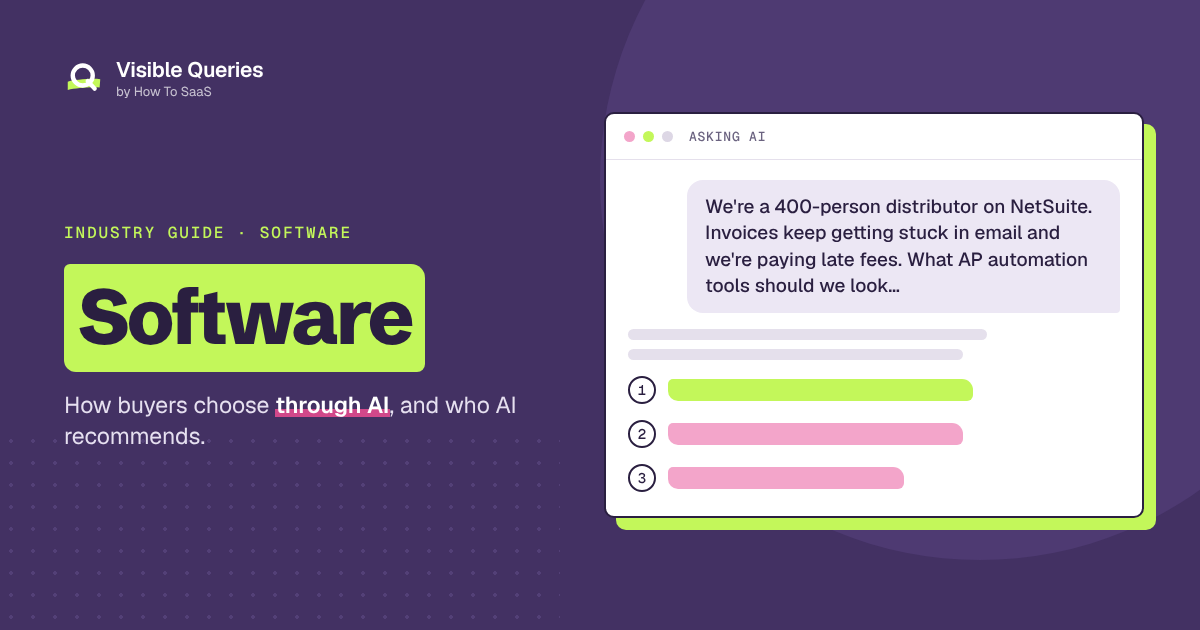
It's the second week of the month, and the controller at a 400-person distribution company is closing the books late again. Three invoices sat in someone's inbox until the vendor called. One of them carried a late fee. The CFO wants to know why this keeps happening.
Five years ago, the controller would have searched "AP automation software," opened a few vendor websites, downloaded a comparison guide, and maybe asked a peer on LinkedIn. Then a sales rep would have called.
Today there's a good chance the first thing they do is open ChatGPT and type:
"We're a 400-person distributor on NetSuite. Invoices keep getting stuck in email and we're paying late fees. What AP automation tools should we look at, and what should we watch out for?"
What comes back reads like a briefing from a well-informed colleague. It explains why invoices stall, what AP automation does, and what to look for in a tool for a company that size. Then it names four or five products, with a line on who each one is best for and a note on which ones integrate natively with NetSuite.
The controller copies that list into a Slack message to the CFO: "Here's where I'd start."
That list is the new top of the funnel. The vendors on it get demo requests. The vendors not on it often never find out they were in the running, because the buyer never visited their site, never filled out a form and never showed up in their analytics.
This article walks through how B2B software buyers move from problem to purchase now, step by step, with examples from across the industry: horizontal SaaS, vertical software, developer tools, security, fintech, HR tech, marketing tech, healthcare IT and consumer apps. It covers what buyers ask AI at each step, what makes AI recommend one product over another, and what the companies that keep getting recommended tend to do differently. Most of it isn't about gaming a new channel. It's about being the kind of software company buyers and AI can understand, trust and explain.
Along the way you'll see screenshots from a Visible Queries report for Ledgerline, a sample AP automation company. The company and its competitors are made up, but the report is real. It's what any software company sees when it runs its own.
Why the old playbook isn't enough anymore
For a decade, B2B software marketing ran on a familiar machine. You ranked for category keywords, ran paid search on competitor names, collected reviews on G2 and Capterra, chased analyst coverage, published gated ebooks, and handed the leads to SDRs.
Most of that still matters. But it was built on an assumption that's breaking down: that the buyer would do the research themselves, one website at a time, and that your job was to be one of the sites they visited.
AI changes who does the research. The buyer asks a question, and the assistant reads your website, your docs, your review profiles, Reddit threads, analyst summaries, comparison articles and your competitors' pages, then writes a synthesis. The buyer reads the synthesis, not your homepage.
Three things follow from that:
- The shortlist forms earlier and quietly. Buyers often arrive at a first sales call with a list of three vendors they got from an AI conversation you never saw. If you weren't on it, there's no lost deal in your CRM. There's just no deal.
- Your category story gets told for you. When a buyer asks "What's the difference between AP automation and a full procure-to-pay suite?", the answer shapes which products they consider. If your positioning isn't clear and published, AI will position you, often badly.
- Facts beat claims. AI is good at ignoring adjectives. "The leading AI-powered platform" means nothing to it. "Native two-way sync with NetSuite, Sage Intacct and QuickBooks Online; SOC 2 Type II; typical implementation in three weeks" is something it can repeat.
None of this means your website, reviews or content stop mattering. They matter more, because they're the raw material AI works from. What changes is that they now have to work for two readers at once: the human buyer and the assistant briefing them.
The buyer's journey, step by step
B2B software purchases range from a $20-a-month tool one person buys with a credit card to a six-figure platform that takes a buying committee nine months to approve. The steps are the same. What changes is how many people are involved and how long each step takes.
- A problem surfaces. Something breaks, a goal gets set, or a new leader arrives.
- They try to understand it. What's causing the problem, what kinds of solutions exist, and what this usually costs.
- They build a shortlist. Which products are worth a demo.
- They vet. Security, integrations, reviews, implementation risk, and whether the vendor will be around in three years.
- The committee decides. Finance, IT, legal and end users all weigh in, often asking AI their own questions.
- They adopt, renew and talk about it. Rollout, expansion, renewal and the reviews and referrals that feed the next buyer's journey.
AI now shows up at every one of these steps, and increasingly it's not just the champion asking. Here's what it looks like at each one.
Step 1: A problem surfaces
Software purchases almost never start with "we should buy software." They start with a moment of pain or ambition:
- A late fee, a failed audit, or a close that slips by a week (finance software)
- A security questionnaire from a big customer that the company can't answer (security and compliance tools)
- A new VP of Sales who wants forecasting that isn't a spreadsheet (sales tech)
- An engineering team that spent a quarter maintaining a homegrown billing system (developer tools and billing APIs)
- A clinic that's losing patients because scheduling only happens by phone (healthcare software)
- A 150-person company that just failed a payroll run in two states (HR and payroll)
What buyers ask AI at this step doesn't name a product or even a category:
- "Why does our month-end close keep slipping?"
- "A customer sent us a 200-question security questionnaire. Where do we even start?"
- "How do other 50-person engineering teams handle usage-based billing?"
- "We're expanding payroll into Canada. What changes?"
The answers to these questions frame the whole purchase. If AI says late closes are usually caused by manual AP and reconciliation, the buyer now thinks of the solution as AP automation. If it says they're caused by an outdated ERP, the buyer starts down a very different, much bigger path. The software companies whose explanations shape these early answers are effectively writing the buyer's requirements.
Step 2: They try to understand the problem and the options
This is the education step, and it's where B2B buyers spend more time with AI than anywhere else. They're learning the category, often from scratch, and they don't want to look uninformed in front of their boss or their peers.
- "What's the difference between AP automation and a full procure-to-pay suite?"
- "Do we need a CDP or is our CRM enough?"
- "SIEM vs XDR vs MDR: what does a 300-person company actually need?"
- "Build vs buy for feature flags: when does it make sense to buy?"
- "How much does an applicant tracking system cost for a company hiring 50 people a year?"
- "Are spreadsheets and email good enough for invoice approvals at a mid-size company?"
AI answers these with explanations, trade-offs, rough price ranges and, often, product examples. Those examples matter. A buyer who sees the same three products mentioned while learning the category will naturally start treating them as the category.
This is also where a lot of software companies lose quietly. Their website explains their product, not the problem. There's no plain explanation of when you need their category and when you don't, no honest pricing context, and no guidance for the "build vs buy" or "do we even need this" questions. So AI learns the category from analysts, review sites and competitors who did publish that thinking.
Here's what this looks like in a real report. Each row is a topic buyers ask about, with how often it's searched each month and the share of AI answers on that topic that name the company and each of its top competitors.
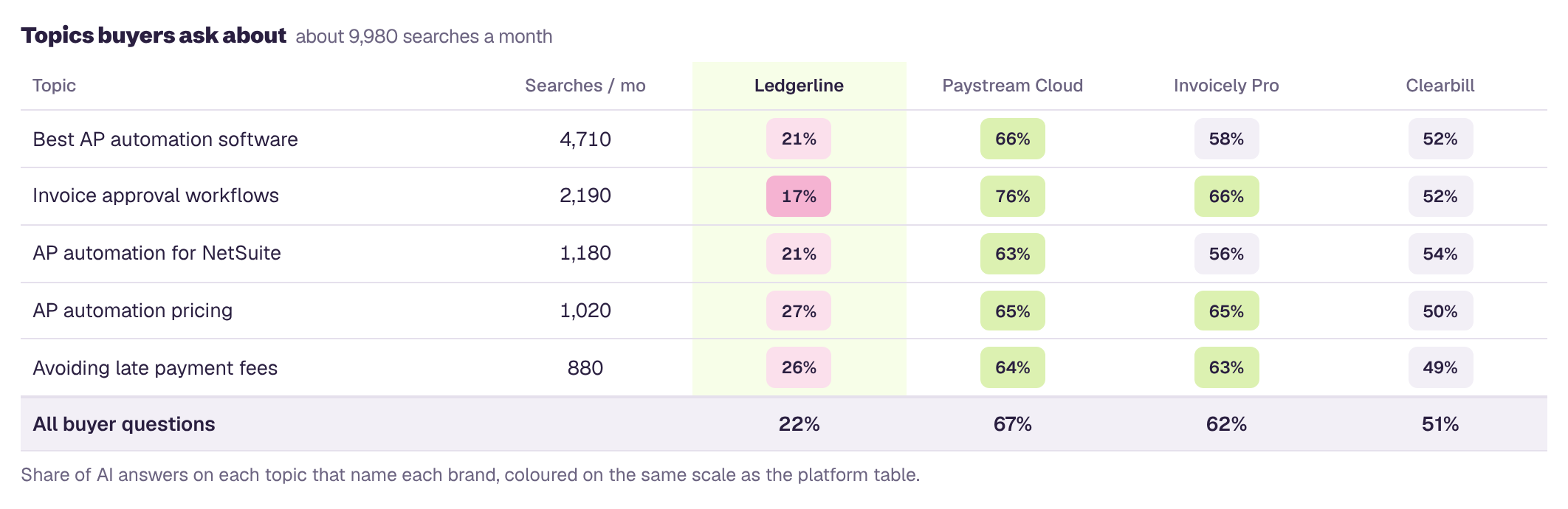
Look at "Invoice approval workflows." That's where buyers ask whether spreadsheets and email are good enough for invoice approvals, or what a better way would be. Paystream Cloud is named in 76% of those answers and Ledgerline in 17%. That's a buyer at step 2, deciding whether they even need a product like Ledgerline's, and Ledgerline is missing from most of that conversation.
What good software companies do at this step: they teach the category, not just the product. They publish clear explanations of the problem, when their category is the right answer and when it isn't, how it compares with adjacent categories, what it typically costs, and what a realistic rollout looks like. Writing "you probably don't need us yet if..." feels risky, but it's exactly the kind of honest guidance AI trusts and repeats.
Step 3: They build a shortlist
Now the buyer is shopping. They want names, usually filtered by their situation:
- "Best AP automation software for mid-size companies on NetSuite"
- "Which SOC 2 compliance platforms work for a 40-person startup?"
- "Top payroll providers for companies with employees in the US and Canada"
- "Which observability tools are affordable for a team of 15 engineers?"
- "Best practice management software for physical therapy clinics"
- "What are the best alternatives to [market leader] for a smaller team?"
These questions are where the shortlist gets made, and they are much more specific than the keywords software marketers used to target. Buyers describe their size, their stack, their industry and their constraints, because AI lets them. The answer changes with every detail.
That's both a threat and an opportunity. A market leader can dominate "best CRM" and still lose "best CRM for a 12-person property management company," where a vertical product with a clear story wins. A smaller company that's precise about who it's for can win dozens of these specific questions even if it never wins the head term.
The flip side is that vague positioning gets punished. If your site says you serve "businesses of all sizes across every industry," AI has no reason to put you on any specific shortlist.
What good software companies do at this step: they're specific about who they're for. Pages for each core segment, industry and use case, with real details: company size, typical stack, integrations that matter for that segment, and examples of similar customers. They also publish honest comparison pages that explain where they're a better fit than the market leader and where they're not.
Step 4: They vet
Once there's a shortlist, the questions get sharper. B2B buyers are trying to avoid a purchase that blows up on them: a failed implementation, a security incident, a vendor that gets acquired and sunsets the product, or a tool the team refuses to use.
- "Does Ledgerline integrate with NetSuite?"
- "Is [product] SOC 2 Type II certified? Does it support SSO and SCIM?"
- "What do customers complain about with [product]?"
- "How long does implementation usually take for [product]?"
- "Is [vendor] financially stable? Who owns them?"
- "Does [product] have a HIPAA BAA?" (healthcare)
- "What are the rate limits on [product]'s API?" (developer tools)
AI answers by pulling together your docs, trust center, review profiles, community forums, Reddit threads, news coverage and anything else it can find. Two things make or break you here.
The first is facts. If your integration list, security certifications, data residency options or pricing model aren't clearly published, AI fills the gap with guesses, old information or a competitor's comparison page. The most common and most expensive version of this is AI confidently telling a buyer you don't do something you do.
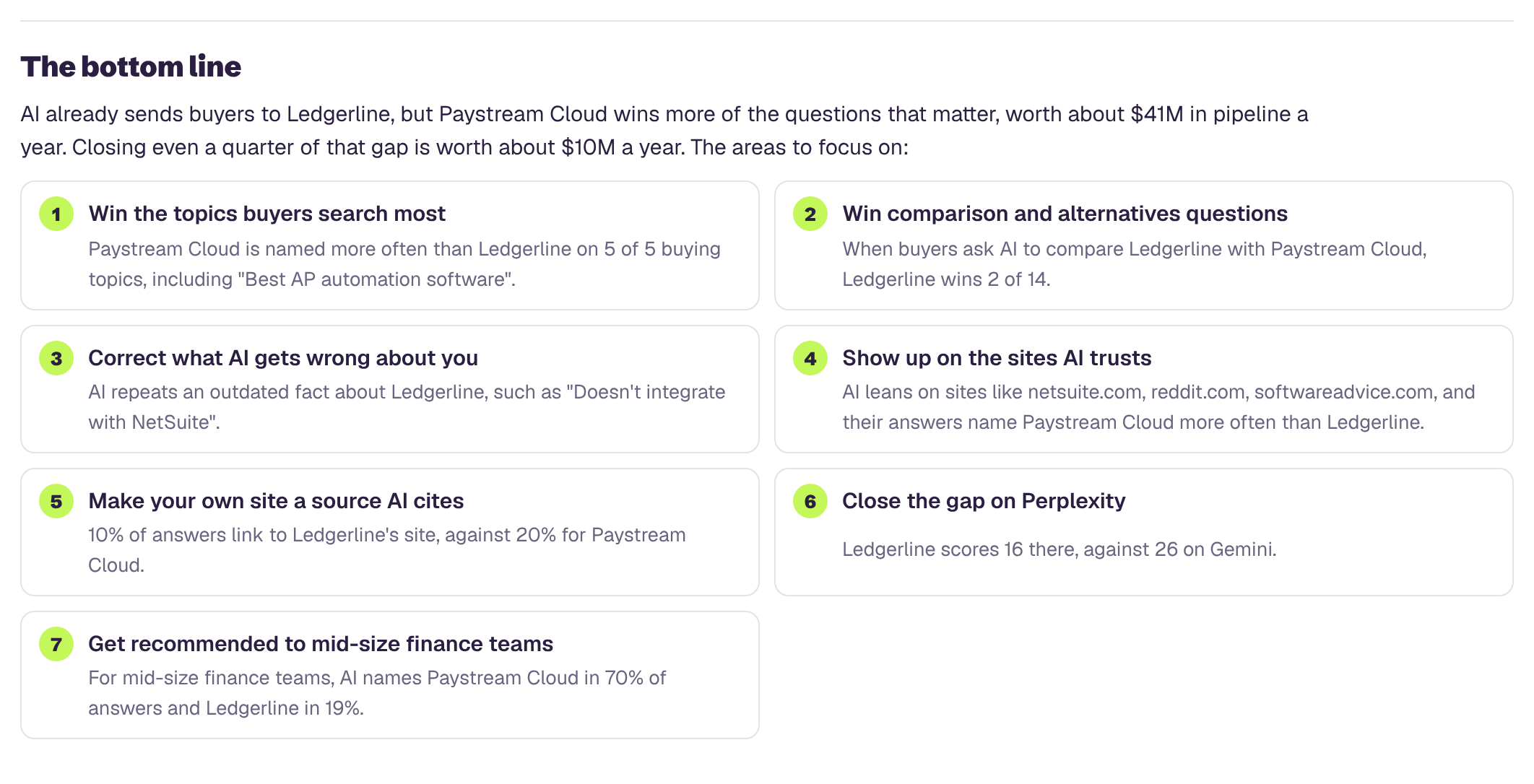
In our sample report, the top gap is exactly that. AI says Ledgerline "doesn't integrate with NetSuite." Ledgerline has a native NetSuite integration. Every NetSuite customer who asks hears that Ledgerline isn't an option, and Ledgerline never learns why those buyers never booked a demo. The report's accuracy score measures how often AI gets a company's core facts right, and in this sample it's 63%.
The second is reputation themes. AI summarizes reviews into themes, like "easy to set up but support is slow" or "powerful but expensive and complex to implement." Those summaries travel into every vetting conversation. A handful of reviews about a painful migration can become the headline.
What good software companies do at this step: they make the boring facts impossible to miss. A public integrations directory with real depth (what syncs, which direction, how often), a trust center with current certifications, clear docs, a changelog, and a plain statement of what the product doesn't do. They treat implementation and support as part of the product, because that's what reviews talk about. And they keep facts consistent across their site, docs, G2, Capterra, partner marketplaces and app stores.
Step 5: The committee decides
In B2B software, the person who found you is rarely the only one deciding. And here's the part many vendors miss: the other people on the buying committee are asking AI their own questions.
- The CFO asks: "Is AP automation worth it for a company our size? What's the typical ROI?"
- IT asks: "What are the security risks of connecting [product] to our ERP?"
- Legal asks: "What should we look for in a SaaS data processing agreement?"
- The end users ask: "Is [product] easy to use? What do AP clerks think of it?"
- Procurement asks: "Ledgerline vs Paystream Cloud: which is better value?"
Each of these is a chance to win or lose the deal without being in the room. If the CFO's question gets an answer that names three competitors and not you, your champion now has to argue against what the CFO just read.
Head-to-head and pricing questions are especially decisive. When AI compares two products, it leans on whatever concrete information it can find: pricing models, contract terms, implementation time, integrations, support options and review themes. If your competitor publishes all of that and you don't, the comparison tilts their way by default.
The competitor table shows who's winning these conversations overall: how often AI names each brand when buyers ask questions that don't name a product. In the sample report, Paystream Cloud is named in 67% of those answers and Ledgerline in 22%. Every person on a buying committee who asks AI a few questions will hear one name more than twice as often as the other.
What good software companies do at this step: they publish for the whole committee, not just the champion. That means an ROI explanation the CFO can follow, a security overview IT can verify, standard contract terms legal can read, and real examples of the day-to-day experience for end users. They're transparent about pricing models even if exact prices need a quote, and they write fair, specific comparison pages for the competitors they meet most.
Step 6: They adopt, renew and talk about it
After the contract is signed, the journey keeps going, and it feeds every earlier step for the next buyer.
- "How do we get AP clerks to actually use the new system?"
- "Best practices for rolling out [product] to 200 users"
- "Is it worth upgrading to [product]'s enterprise plan?"
- "What are the alternatives to [product] at renewal?"
That last one matters. Customers ask AI about alternatives at renewal time, and what they hear depends on the same things that won or lost the original deal.
This is also where the review and reputation loop runs. Customers who onboard smoothly, get value fast and feel supported write specific, positive reviews, post in communities, speak at events and refer peers. That material becomes what AI says about you to the next buyer at step 4. Customers who struggle write the reviews that become your AI reputation's weak spot.
What good software companies do at this step: they treat onboarding, adoption content and customer success as part of their visibility, not separate from it. Public help docs, rollout guides and community answers keep their name attached to post-purchase questions. Programs that turn happy customers into reviewers, case studies and community voices give AI specific, credible material to work from.
How the journey plays out across software categories
The six steps hold for every kind of software, but the step that decides the deal is different. Here's where the weight falls in each major category, and what the companies that win tend to do.
B2B SaaS
Horizontal SaaS, like CRM, project management, AP automation, customer support and analytics, lives in crowded categories where every vendor claims to do everything. Buyers lean on AI hardest at steps 2 and 3, trying to work out which of twenty similar-looking products fits their size and stack.
The companies that win here pick a lane and say it plainly: "for finance teams of 5 to 50 on NetSuite," "for agencies managing client projects." They publish segment pages and honest comparisons, and their reviews mention the specific use cases they want to be known for.
Full guide: AI visibility for B2B SaaS companies
Vertical SaaS
Software built for one industry, like practice management for dental offices, field service tools for HVAC companies, or property management software, has an advantage in AI answers: buyers name their industry in the question. "Best scheduling software for physical therapy clinics" is a question a horizontal tool rarely wins.
The risk is that vertical buyers are often less technical and rely even more on AI and peers. If AI doesn't know your product exists, or describes it with the wrong feature set, there's no technical evaluator to correct it. Vertical SaaS companies that publish industry-specific content, show up in trade association directories and get mentioned in industry communities tend to own their niche in AI answers.
Full guide: AI visibility for vertical SaaS companies
Developer tools and APIs
Developers increasingly ask AI coding assistants and chat tools which library, API or platform to use, often in the middle of writing code. "What's the simplest way to add usage-based billing to a Next.js app?" "Which feature flag service has a good free tier?" The answer frequently includes a code snippet using a specific product.
That makes documentation the most important marketing asset a developer tools company has. Clear, current, well-structured docs, working examples, a public changelog and active answers in community forums are what AI learns from. Products with outdated docs often get recommended with outdated code, which is its own kind of reputation problem.
Full guide: AI visibility for developer tools and API companies
Cybersecurity software
Security buyers are skeptical by profession, and the vetting step dominates. They ask AI about detection coverage, false positive rates, compliance mappings, deployment models and, very often, what went wrong at a vendor in the news. Category confusion is also high: SIEM, XDR, MDR, SOAR, CNAPP and CSPM all overlap, and buyers ask AI to untangle them.
Security companies that explain categories honestly, publish independent test results and certifications, and are clear about what they don't cover earn more trust in AI answers than those relying on fear-driven marketing.
Full guide: AI visibility for cybersecurity software companies
Consumer apps
Consumer apps, like budgeting, fitness, language learning, meditation and productivity apps, face a faster, simpler journey. People ask AI "What's the best budgeting app for couples?" or "Is [app] worth paying for?" and often download the first or second suggestion.
App store listings, review themes, pricing transparency (especially around free trials and cancellation) and press coverage all shape AI answers. Apps that are clear about who they're for and what the paid tier adds tend to do better than apps that bury the subscription.
Full guide: AI visibility for consumer apps
Fintech, HR tech, marketing tech and healthcare software
These categories share a pattern: the buyer is a business specialist, like a controller, HR leader, marketer or practice manager, not a technologist, and the purchase touches money, people or patients. That raises the stakes at the vetting step.
- Fintech and payments: buyers ask about fees, settlement times, fraud protection and which banks or ERPs a product works with. Clear, published fee structures win trust.
- HR and payroll: buyers ask about multi-state and cross-border compliance ("payroll for employees in the US and Canada"), benefits integrations and how painful switching is mid-year.
- Marketing and sales tech: buyers ask how tools fit together ("Do we need a CDP if we have HubSpot?") and AI's answers shape the whole stack.
- Healthcare software: buyers ask about HIPAA, EHR integrations and how much staff training a product needs. A visible BAA and EHR integration list are table stakes.
In each case, the companies AI recommends make compliance facts, integrations and pricing models easy to verify, and they explain the problem in the language of the business buyer rather than the language of engineering.
Building a software company AI recommends
Put the six steps and the categories together and a pattern comes out. The software companies AI recommends aren't the ones with the loudest claims. They're the ones whose product, positioning, docs and customer experience all line up, so everything AI reads about them tells a clear, consistent story.
Here's what that looks like in practice.
1. Explain the problem, not just the product. Buyers at steps 1 and 2 are learning. Publish clear explanations of what causes the problem you solve, the different ways to solve it, and when your category is or isn't the right answer.
2. Pick a lane and say it plainly. "For mid-size finance teams on NetSuite" gets you onto specific shortlists. "For businesses of all sizes" gets you onto none. Build pages for each segment, industry and use case you genuinely serve.
3. Publish the facts AI needs. Integrations (with real depth), security certifications, data residency, deployment options, implementation timelines, support hours and pricing model. If a buyer has to book a demo to learn whether you integrate with their ERP, AI will answer for you, and it may get it wrong.
4. Keep facts identical everywhere. Your website, docs, trust center, G2, Capterra, partner marketplaces and app stores should all say the same thing. Inconsistent or outdated listings are where wrong AI answers come from.
5. Write for the whole buying committee. The CFO, IT, legal and end users all ask their own questions. Give each of them a page that answers those questions in their language.
6. Be honest about competitors. Fair, specific comparison pages give AI concrete material for head-to-head questions. Overclaiming tends to backfire, because AI cross-checks.
7. Make implementation and support part of the product. Reviews talk about onboarding and support more than features. Smooth rollouts and responsive support produce the review themes AI repeats.
8. Turn customers into evidence. Case studies with specifics, active review programs, community answers, conference talks and customer quotes give AI credible, third-party material. A product nobody talks about is hard for AI to recommend.
9. Keep docs and help content public and current. For technical products, docs are your most-read marketing. For every product, help content keeps your name attached to post-purchase questions.
10. Measure it. Most software companies have never looked at what AI says about them across the questions their buyers actually ask, against the specific competitors they lose deals to.
That last point is where the report comes in. Here's the top of the sample report for Ledgerline:
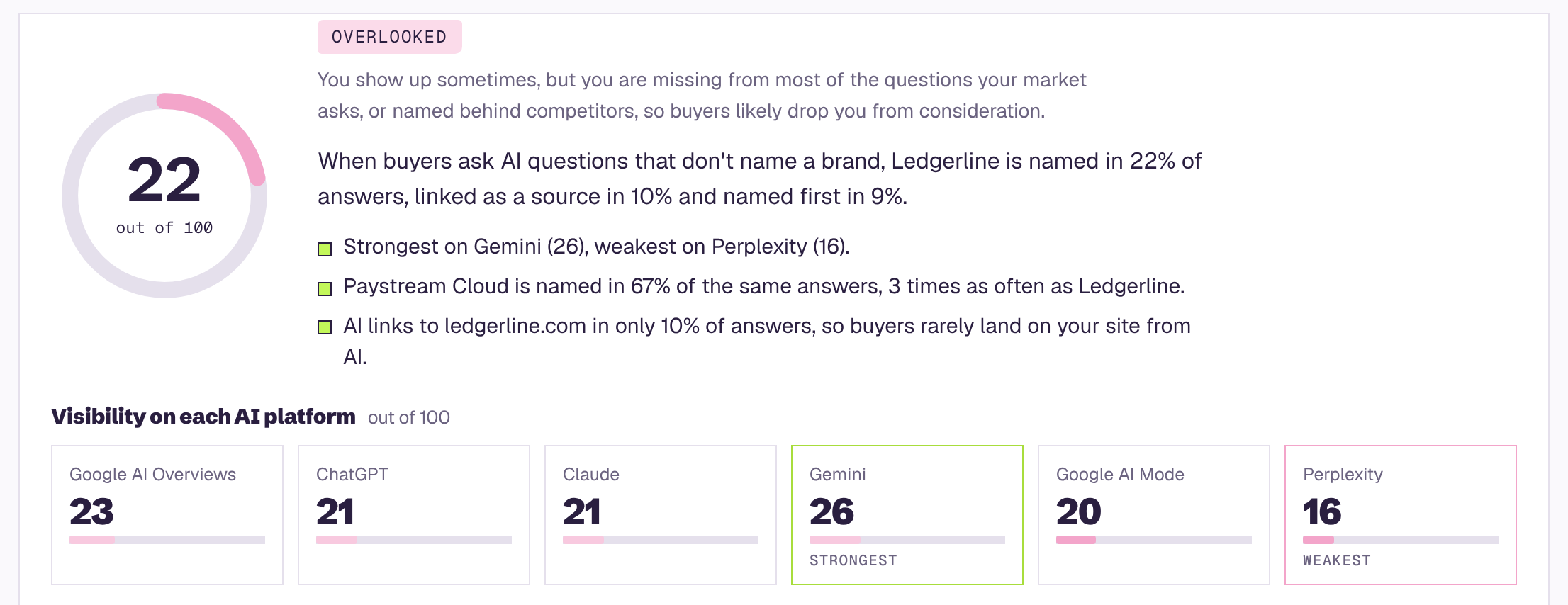
Ledgerline scores 22, in the Overlooked band. That's a very common situation for software companies: AI knows Ledgerline when it's asked by name, but rarely recommends it when buyers ask what to pick. It's named in 22% of answers to questions that don't name a brand, while Paystream Cloud is named in 67%. Just below, the report breaks this down further:

For software companies, two numbers deserve special attention. Citation rate shows whether AI sends buyers to your website or to review sites and competitors' comparison pages. Accuracy shows whether AI is telling buyers the truth about integrations, security and pricing, which are the facts that disqualify vendors at step 4.
Run the report again after making changes, and you can watch these numbers move against the competitors that matter.
Buyers haven't stopped looking for software
Buyers still need to automate their AP, secure their cloud, run payroll and ship code. What's changed is who does the first round of research. More and more, it's an AI assistant, and it hands the buyer and their whole committee a short list of products before anyone visits your website or talks to your sales team.
The good news for well-run software companies is that AI mostly rewards what good companies already care about: clear positioning, honest information, a product that does what it says, and customers who are happy to talk about it. The work is making all of that visible, specific and consistent in the places AI reads, and checking that it's working.
Keep learning
- What is AI visibility?
- How to get your business recommended by AI, with guides for ChatGPT, Google AI Overviews, Perplexity, Gemini and Claude
- AI visibility benchmark 2026
- The AI visibility glossary
See what AI tells buyers about your software
Enter your website and get a free AI visibility report. It takes a few minutes, and you'll see:
- Your AI visibility score, overall and for ChatGPT, Gemini, Claude, Perplexity and Google's AI Overviews and AI Mode
- Which competitors AI recommends instead of you, and how often
- Which topics you win and lose, and how often each one is searched
- What AI gets wrong about you, and what to fix first
- Your biggest gaps: the buyer questions where AI leaves you out, and who it recommends instead
- A downloadable PDF you can share with your team