The shortlist is written before the demo: how buyers choose B2B SaaS through AI
Software buyers now ask AI which tools to shortlist, how competitors compare and what implementation really takes. Here's what AI tells them, and how B2B SaaS companies get named.
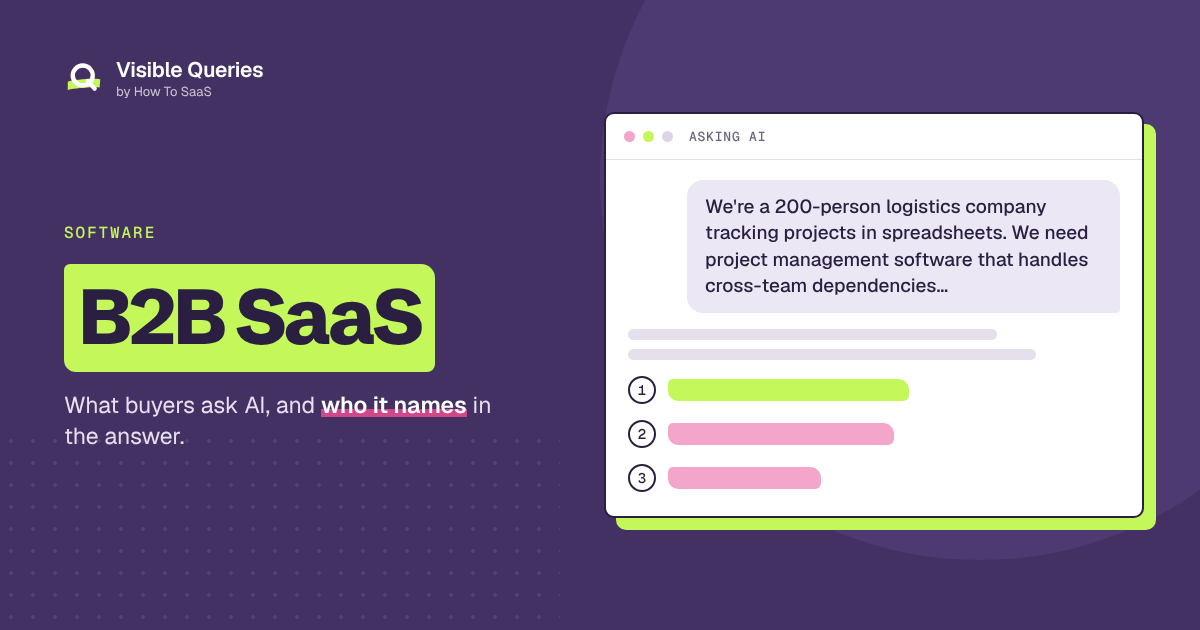
A head of operations at a 200-person logistics company has been asked to replace the team's spreadsheet-based project tracking. Their CEO wants a recommendation in two weeks. Before talking to any vendor, they open Claude:
"We're a 200-person logistics company tracking projects in spreadsheets. We need project management software that handles cross-team dependencies, integrates with Microsoft 365 and Salesforce, has good permissions and isn't a nightmare to roll out. Budget around $20 per user per month. What should we shortlist and how do the options compare?"
AI explains what to look for at this company size, the trade-offs between flexible tools and opinionated ones, integration and permission questions to ask, typical pricing tiers, rollout challenges and how to run a pilot. Then it names four products, with a line on each and a short comparison. Three of them get demo requests that week. The fourth is never contacted.
B2B software buying has moved. Buyers do more research on their own before talking to sales, and AI is now a big part of that research. By the time a prospect fills out a demo form, AI has often shaped the shortlist and the criteria.
Our software guide covers how software buyers research in general. This one goes through the questions that decide B2B SaaS shortlists, what AI usually says, and what companies can publish so AI names them.
Here are the questions at a glance:
| The question | What gets you named |
|---|---|
| "Best [category] software for [company like us]?" | Pages for each use case and company size |
| "[Product] vs [competitor]?" | Honest comparison pages |
| "Does it integrate with [tool]?" | A full integrations list |
| "How much does it cost?" | Public pricing, or a clear range |
| "How hard is it to implement?" | Your onboarding timeline |
| "Is it secure and compliant?" | A security page with certifications |
"What's the best [category] software for [company like us]?"
This is the defining question for B2B SaaS.
What AI usually says: It names a few products, often grouped by company size, industry or use case, with a line on each.
Why it matters: This is the shortlist. Products that aren't named here often never get evaluated.
What to publish: Pages for each segment you serve well, by company size, industry, team and use case, that explain why your product fits them. "Project management for logistics teams" or "for 100–500 person companies" helps AI match you to the question.
"[Your product] vs [competitor]?"
What AI usually says: It compares features, pricing, ease of use, integrations and ideal customers, often drawing from review sites, comparison articles and documentation.
What to publish: Honest comparison pages for your main competitors, including where they're a better fit. AI trusts balanced comparisons more than one-sided ones, and so do buyers.
"Does it integrate with [tool]?"
What AI usually says: It states whether integrations exist, often from outdated or incomplete information.
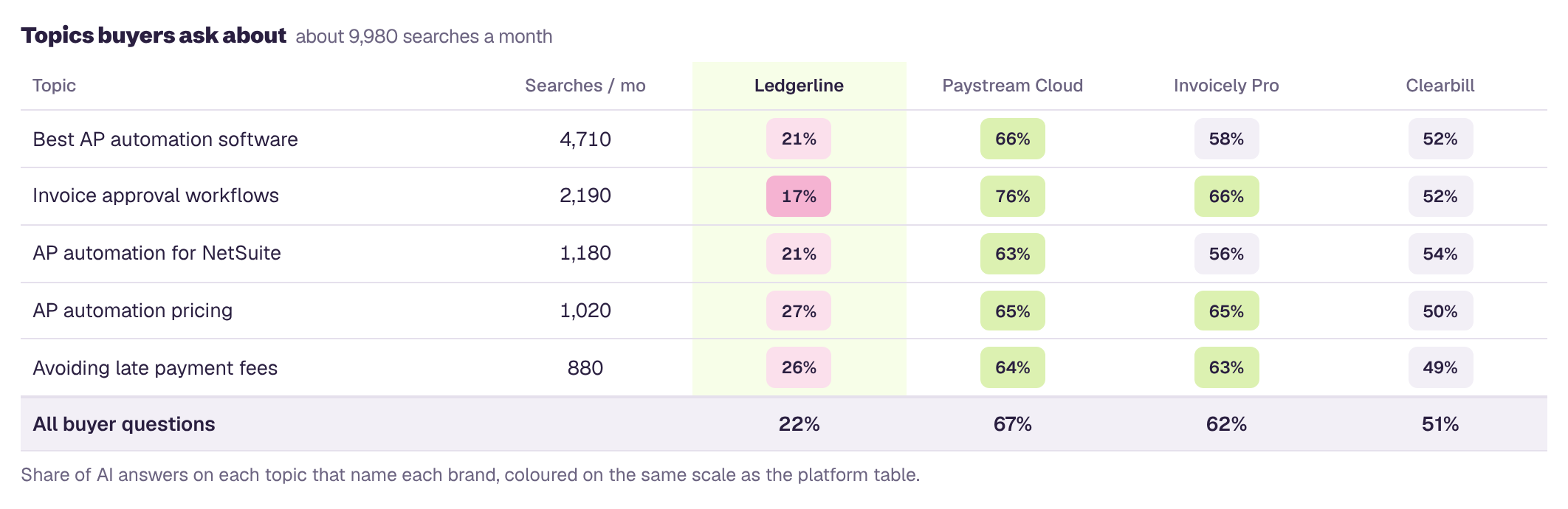
Why it matters: Integration requirements disqualify products quickly. A wrong "no" means a lost deal you never hear about. The report shows, topic by topic, where AI names you and where it names someone else:
What to publish: A page for every important integration, with what it does, how it's set up and which plans include it. Integration directories alone often aren't enough.
"How much does it cost?"
What AI usually says: It summarizes pricing tiers when it can find them, and says "contact sales" when it can't, often listing a competitor's prices instead.
What to publish: Your pricing, or at least starting prices and what drives cost. If you're enterprise-only, explain how pricing works and typical ranges.
"How hard is it to implement?"
What AI usually says: It discusses typical rollout timelines, data migration, training, admin effort and common pitfalls.
What to publish: Implementation guides, timelines by company size, migration tools, onboarding services and customer stories with real numbers.
"Is it secure? Is it compliant?"
What AI usually says: It mentions security certifications, compliance standards and data residency when it can find them.
What to publish: A security and trust page with certifications, compliance, data handling, SSO and permissions. Security reviewers increasingly ask AI too.
Every buying committee member asks differently
The economic buyer asks about cost and ROI. The end user asks about ease of use. IT asks about security and integrations. Procurement asks about contracts. Each needs content, and AI pulls from all of it when different people on the committee ask their own questions.
What the sample report shows
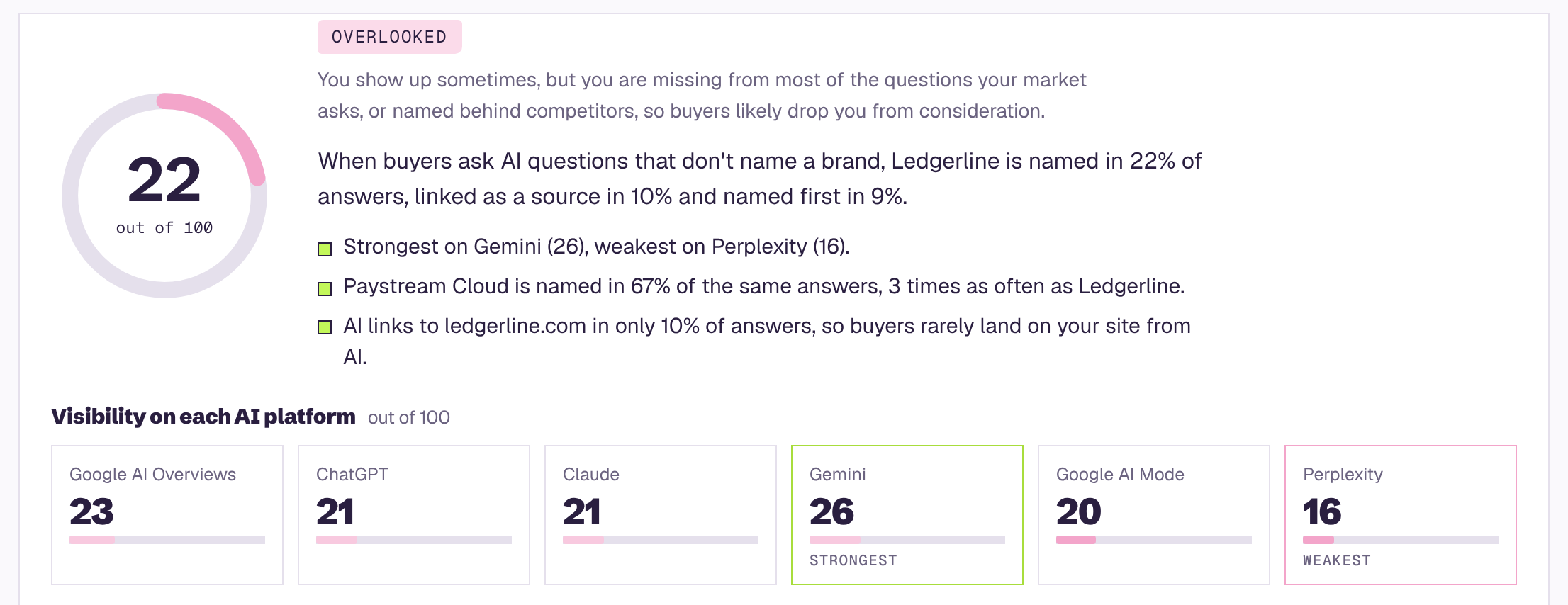
Here's what a Visible Queries report looks like for Ledgerline, the sample AP automation company from our guide. The questions are different for B2B software companies, but the patterns are the same.
The report starts with one score out of 100, a score for each AI platform, and the competitor AI names most:
The gap is clearest side by side:
If you only fix three things
- Publish pages for every segment and use case you serve well.
- Write honest comparisons and integration pages. For your main competitors and critical tools.
- Be clear about pricing, implementation and security.
Software buyers are asking AI what to shortlist. The products AI names will be the ones that explain themselves best.
Part of our guide: Why AI visibility matters for software companies
See what AI tells buyers about your product
Enter your website and get a free AI visibility report. It takes a few minutes, and you'll see:
- Your AI visibility score, overall and for ChatGPT, Gemini, Claude, Perplexity and Google's AI Overviews and AI Mode
- Which competitors AI recommends instead of you, and how often
- Which topics you win and lose, and how often each one is searched
- What AI gets wrong about you, and what to fix first
- Your biggest gaps: the buyer questions where AI leaves you out, and who it recommends instead
- A downloadable PDF you can share with your team