Docs, SDKs and the coding assistant: how developers choose tools and APIs through AI
Developers now ask AI which API or tool to use, how to integrate it and how it compares, often inside their coding assistant. Here's what AI tells them, and how developer tools and API companies get named.
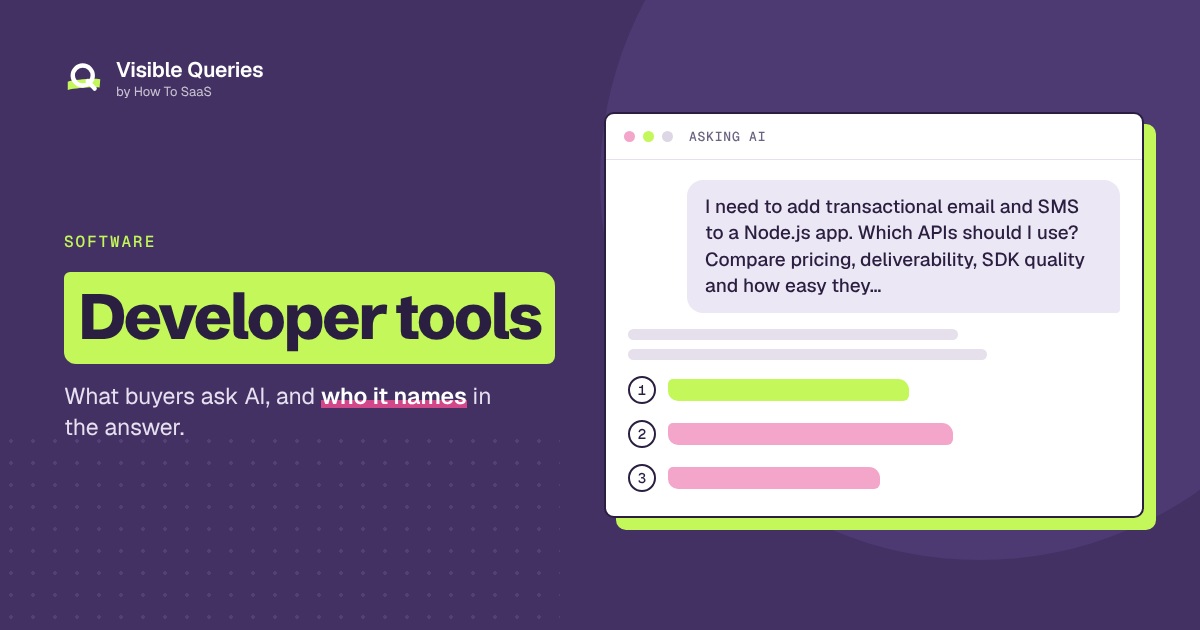
A backend developer at a 30-person startup needs to add transactional email and SMS notifications to their app this sprint. They're in their editor, so they ask their AI coding assistant:
"I need to add transactional email and SMS to a Node.js app. Which APIs should I use? Compare pricing, deliverability, SDK quality and how easy they are to set up. Show me how to send a password reset email with the one you recommend."
The assistant compares a few providers, explains trade-offs, recommends one and writes the integration code. The developer signs up for that provider, gets an API key and ships the feature that afternoon. Nobody on the team visited a pricing page, read a comparison article or talked to sales.
Developer tools have a unique relationship with AI. Developers ask chat assistants for recommendations, and they also use AI coding assistants that write the integration itself. When AI recommends a tool and writes the code for it, the decision is often made in minutes.
Our software guide covers how software buyers research in general. This one goes through the questions that decide developer tool adoption, what AI usually says, and what companies can publish so AI names them.
Here are the questions at a glance:
| The question | What gets you named |
|---|---|
| "Which tool should I use for [task]?" | Use-case pages with code |
| "How do I integrate [tool]?" | Clear, current docs and quickstarts |
| "[Tool] vs [competitor]?" | Honest comparison pages |
| "How much does it cost at scale?" | Pricing with worked examples |
| "Is it reliable?" | A public status page and uptime history |
"Which API or tool should I use for [task]?"
This is the defining question for developer tools.
What AI usually says: It names a few options, with notes on popularity, pricing, developer experience and use cases.
What to publish: Clear pages for every use case you serve, with what your product does better for each one. "Transactional email for SaaS apps" and "email for high-volume marketing" are different questions.
"How do I integrate [tool]?"
What AI usually says: It writes code, based on what it knows about the API.
Why it matters: If AI's knowledge of your API is outdated, the code it writes won't work, and developers may switch to a tool that works on the first try.
What to publish: Excellent, current, public documentation, with quickstarts in popular languages, complete examples, clear error messages and changelogs. Make your docs easy for AI to read: plain HTML or Markdown, consistent structure, and examples that run. Some companies publish machine-readable summaries of their docs for AI tools.
"[Tool] vs [competitor]?"
What AI usually says: It compares features, pricing, limits, performance, developer experience and ecosystem.
What to publish: Honest comparison pages and migration guides from competitors. Developers appreciate candor about trade-offs.
"How much does it cost at scale?"
What AI usually says: It summarizes free tiers and pricing, and often warns about costs at scale.
What to publish: Transparent pricing, free tier limits and examples of costs at different volumes.
"Is it reliable?"
What to publish: Status pages, uptime history, rate limits, SLAs, security and compliance. Developers and their managers both ask about reliability.
Being named, and cited
For developer tools, citation rate matters a lot, because AI links developers to docs:

A low citation rate usually means AI is answering from tutorials, forum posts or competitors' docs instead of yours.
Community content shapes AI's answers
AI learns from forums, open-source repositories, tutorials, conference talks and developer blogs. Tools with active communities, good examples on public code hosts and clear answers to common problems are recommended more often. Investing in developer relations and public examples is also an investment in AI visibility.
Open source and self-hosting
Developers often ask about open-source alternatives and self-hosting. If you have an open-source version, explain how it relates to your paid product, and how to self-host.
What the sample report shows
Here's what a Visible Queries report looks like for Ledgerline, the sample AP automation company from our guide. The questions are different for developer tool companies, but the patterns are the same.
And it shows the actual questions, platform by platform, with who was named:
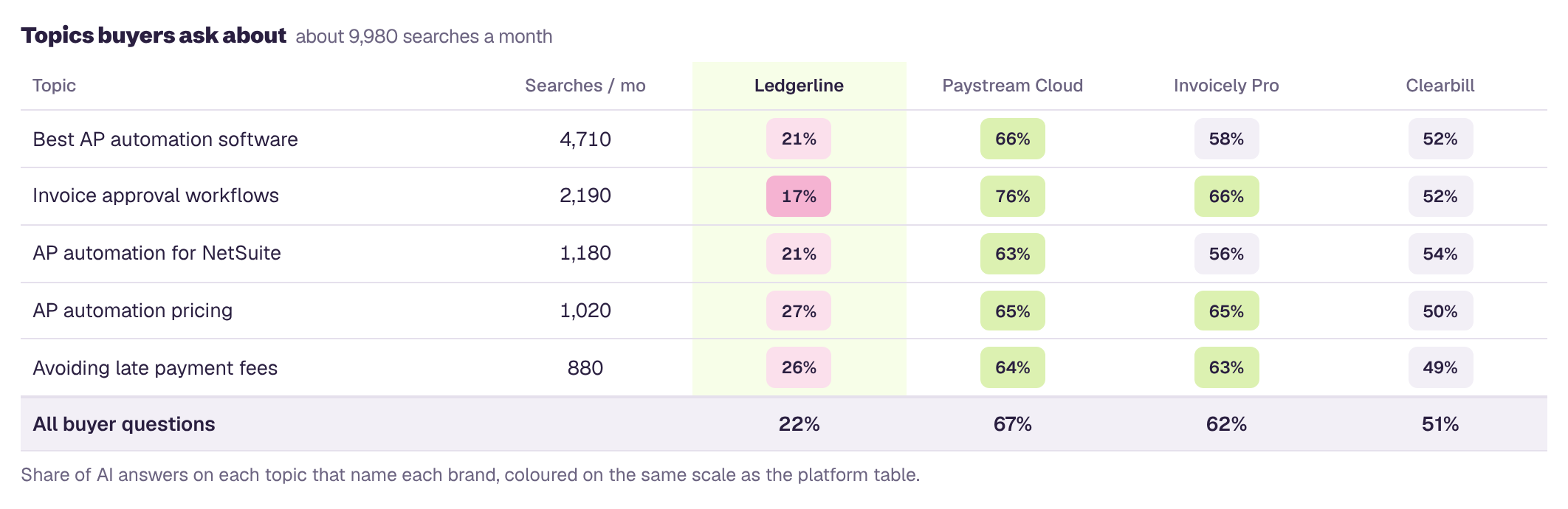
The gap is clearest side by side:
If you only fix three things
- Make your docs excellent, current and easy for AI to read.
- Publish pages for every use case, with honest comparisons.
- Be transparent about pricing at scale and reliability.
Developers are asking AI which tool to use and having it write the code. The tool AI names will be the one it understands best.
Part of our guide: Why AI visibility matters for software companies
See what AI tells developers about your product
Enter your website and get a free AI visibility report. It takes a few minutes, and you'll see:
- Your AI visibility score, overall and for ChatGPT, Gemini, Claude, Perplexity and Google's AI Overviews and AI Mode
- Which competitors AI recommends instead of you, and how often
- Which topics you win and lose, and how often each one is searched
- What AI gets wrong about you, and what to fix first
- Your biggest gaps: the buyer questions where AI leaves you out, and who it recommends instead
- A downloadable PDF you can share with your team