Proving trust in a crowded market: how buyers choose cybersecurity software through AI
Security leaders now ask AI which tools fit their environment, how vendors compare and what they need for compliance. Here's what AI tells them, and how cybersecurity software companies get named.
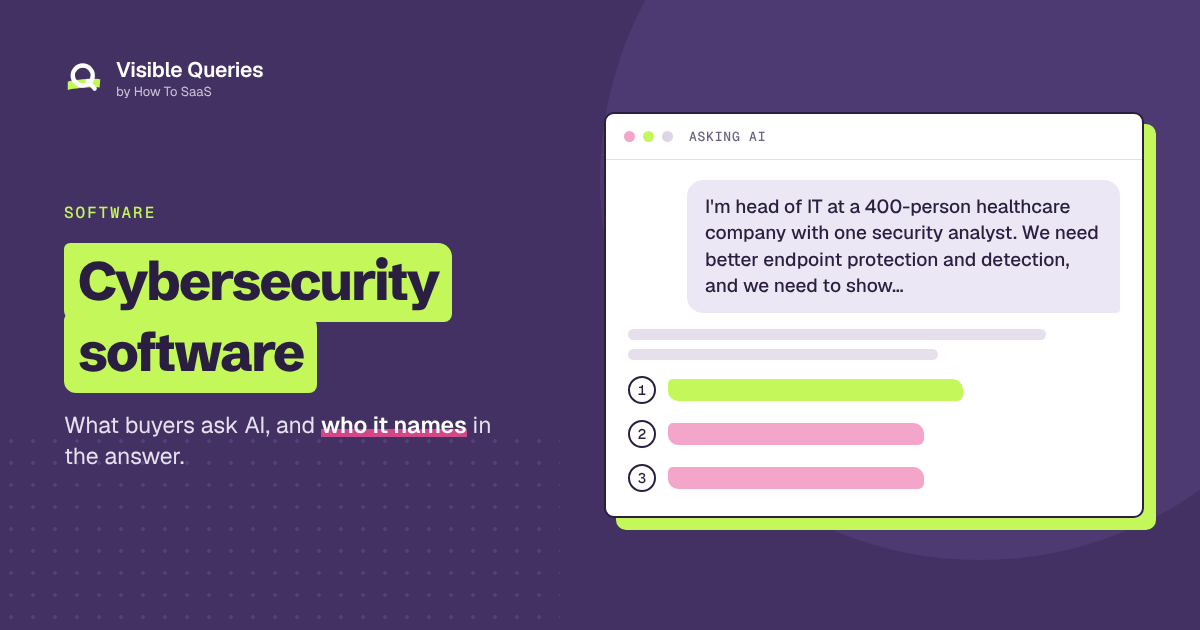
The new head of IT at a 400-person healthcare company has inherited a patchwork of security tools and a board asking about ransomware. They have one security analyst and a limited budget. They ask ChatGPT:
"I'm head of IT at a 400-person healthcare company with one security analyst. We need better endpoint protection and detection, and we need to show HIPAA compliance. Should we buy EDR, XDR or a managed detection service? Which vendors are good for lean teams, what does it cost, and how do they compare?"
AI explains the differences between EDR, XDR and managed detection and response, why lean teams often need managed services, how security tools support compliance, what to ask about deployment, false positives and integration, and typical pricing models. Then it names several vendors and a managed service option. The IT leader takes three of them to a proof of concept.
Cybersecurity is one of the most crowded software markets. Category names are confusing, every vendor claims to stop every threat, and buyers are skeptical. Security leaders use AI to cut through the noise, and AI's shortlist carries a lot of weight.
Our software guide covers how software buyers research in general. This one goes through the questions that decide cybersecurity deals, what AI usually says, and what companies can publish so AI names them.
Here are the questions at a glance:
| The question | What gets you named |
|---|---|
| "What kind of security tool do I need?" | Plain category explainers |
| "Best vendors for [environment]?" | Pages for each environment you cover |
| "[Vendor] vs [competitor]?" | Honest comparison pages |
| "Will it help with compliance?" | Mappings to the frameworks you support |
| "How hard is it to deploy?" | Deployment steps and staffing needs |
"What kind of security tool do I need?"
What AI usually says: It explains categories like EDR, XDR, SIEM, SOAR, MDR, CSPM, identity security, email security and more, and matches them to the buyer's situation.
What to publish: Plain explanations of your category, how it fits with others, and who needs it. Security buyers struggle with acronyms, and clear explanations get cited.
"Which vendors are best for [environment]?"
This is the defining question for cybersecurity.
What AI usually says: It names vendors by company size, industry, cloud or on-premise environments, team size and compliance needs.
What to publish: Pages for each environment and segment you serve: lean teams, mid-market, regulated industries like healthcare and finance, specific clouds and stacks.
"[Vendor] vs [competitor]?"
What AI usually says: It compares detection, false positives, ease of use, integrations, deployment, support and price, drawing from analyst reports, reviews and documentation.
What to publish: Honest comparisons, including where you're not the best fit. Avoid vague claims like "stops 100% of attacks." AI and security buyers are skeptical of them.
"Will it help with compliance?"
What AI usually says: It explains how tools support frameworks and regulations, and that tools alone don't make a company compliant.
What to publish: Pages for each framework you support, like SOC 2, HIPAA, PCI DSS, ISO 27001, NIST and CMMC, explaining which controls you help with and how.
"How hard is it to deploy and run?"
What to publish: Deployment guides, time to value, staffing requirements, integrations and what managed options you offer. Lean teams care most about this.
What the report's headline shows
For many security vendors, the report's headline shows a familiar pattern:
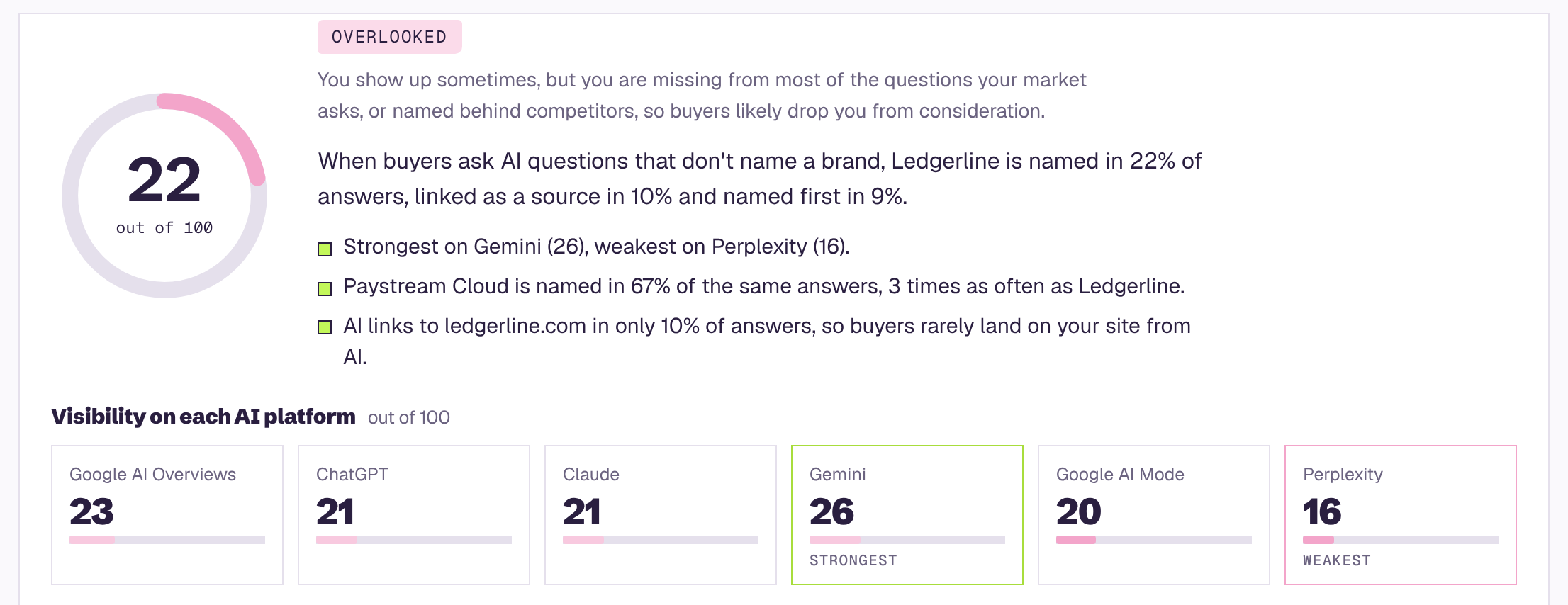
The usual pattern is that AI knows the vendor when asked by name, but rarely recommends it when buyers ask open questions like "best MDR for healthcare" or "EDR for small IT teams." Segment and use-case pages close that gap.
Here's more from the same kind of report, for Ledgerline, a fictional AP automation company.
And it shows the actual questions, platform by platform, with who was named:
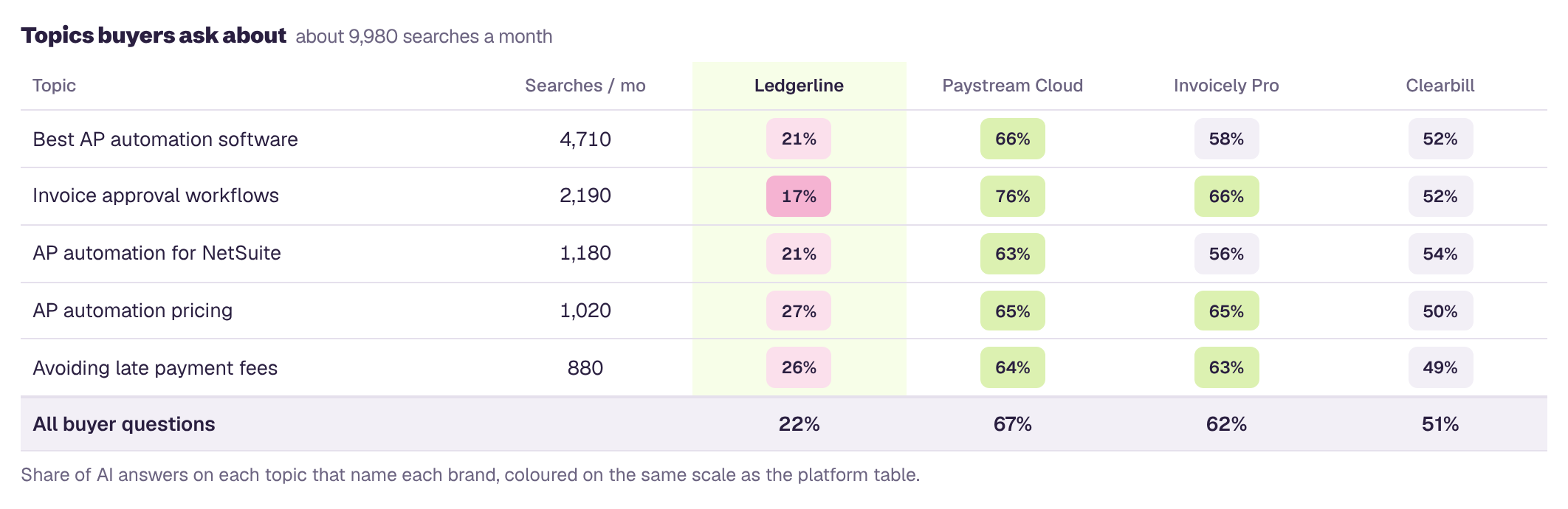
The gap is clearest side by side:
Trust is the product
Security buyers want proof: third-party testing, certifications, customer references, incident response track records, transparency about your own security, and clear vulnerability disclosure policies. Publish what you can. AI repeats credible trust signals when buyers ask whether a vendor is reliable.
Research and threat intelligence
Security companies that publish original threat research, clear incident write-ups and practical guides become sources AI cites when people ask about new threats. That visibility carries over when buyers ask which vendors to consider.
If you only fix three things
- Explain your category and fit in plain language. For each environment and segment.
- Publish honest comparisons and compliance mappings.
- Show proof. Testing, certifications, references and your own security practices.
Security leaders are asking AI which vendors they can trust. The vendor AI names will be the one that proves it most clearly.
Part of our guide: Why AI visibility matters for software companies
See what AI tells security buyers about your product
Enter your website and get a free AI visibility report. It takes a few minutes, and you'll see:
- Your AI visibility score, overall and for ChatGPT, Gemini, Claude, Perplexity and Google's AI Overviews and AI Mode
- Which competitors AI recommends instead of you, and how often
- Which topics you win and lose, and how often each one is searched
- What AI gets wrong about you, and what to fix first
- Your biggest gaps: the buyer questions where AI leaves you out, and who it recommends instead
- A downloadable PDF you can share with your team