What is AI visibility? A plain-English guide for businesses
AI visibility is how often AI assistants name your business when buyers ask questions you should be the answer to. What it is, how it's measured, why it matters, and how to improve it.
AI visibility is how often AI assistants such as ChatGPT, Claude, Gemini, Perplexity and Google's AI Overviews and AI Mode name your business when people ask questions you should be the answer to.
That's the whole definition. The rest of this guide explains what it includes, how to measure it, why it matters now, and what moves it.
The short version
- It's about being recommended, not being known. Almost every AI assistant can describe your business if asked by name. AI visibility is whether it names you when a buyer asks for options without naming anyone.
- It has five parts: being mentioned, being named first, being cited (linked to), your share of voice against competitors, and whether AI gets your facts right.
- It's usually lower than people expect. In our reports, AI named the business in 97% of answers that used its name, and in 32% of answers to unbranded buyer questions.
- It depends mostly on other websites. About three quarters of the sources AI cited in our research were written by someone other than the business.
- It varies by platform, so it needs to be measured on each one.
Want your own number? Get your free AI visibility score from just your website address.
What AI visibility includes
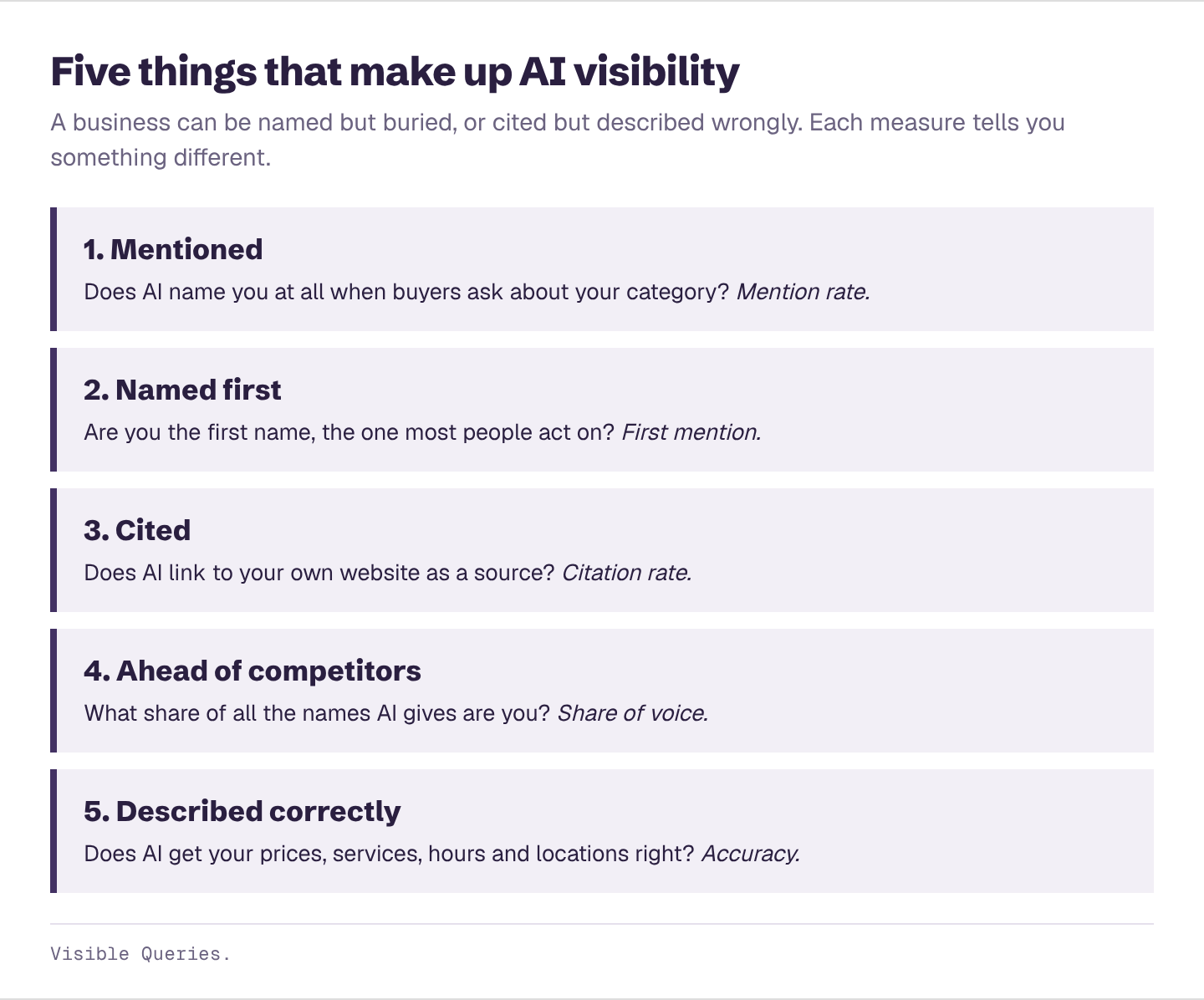
| Measure | The question it answers | How it's counted |
|---|---|---|
| Mention rate | Does AI name us at all? | Share of buyer questions where you're named |
| First mention | Are we the first name? | Share of answers where you're named first |
| Citation rate | Does AI link to our site? | Share of answers that cite your own website |
| Share of voice | How do we compare? | Your mentions as a share of all businesses named |
| Accuracy | Does AI describe us correctly? | Share of facts about you that are right |
Branded vs unbranded questions
The single most common mistake is checking AI visibility by asking about yourself.
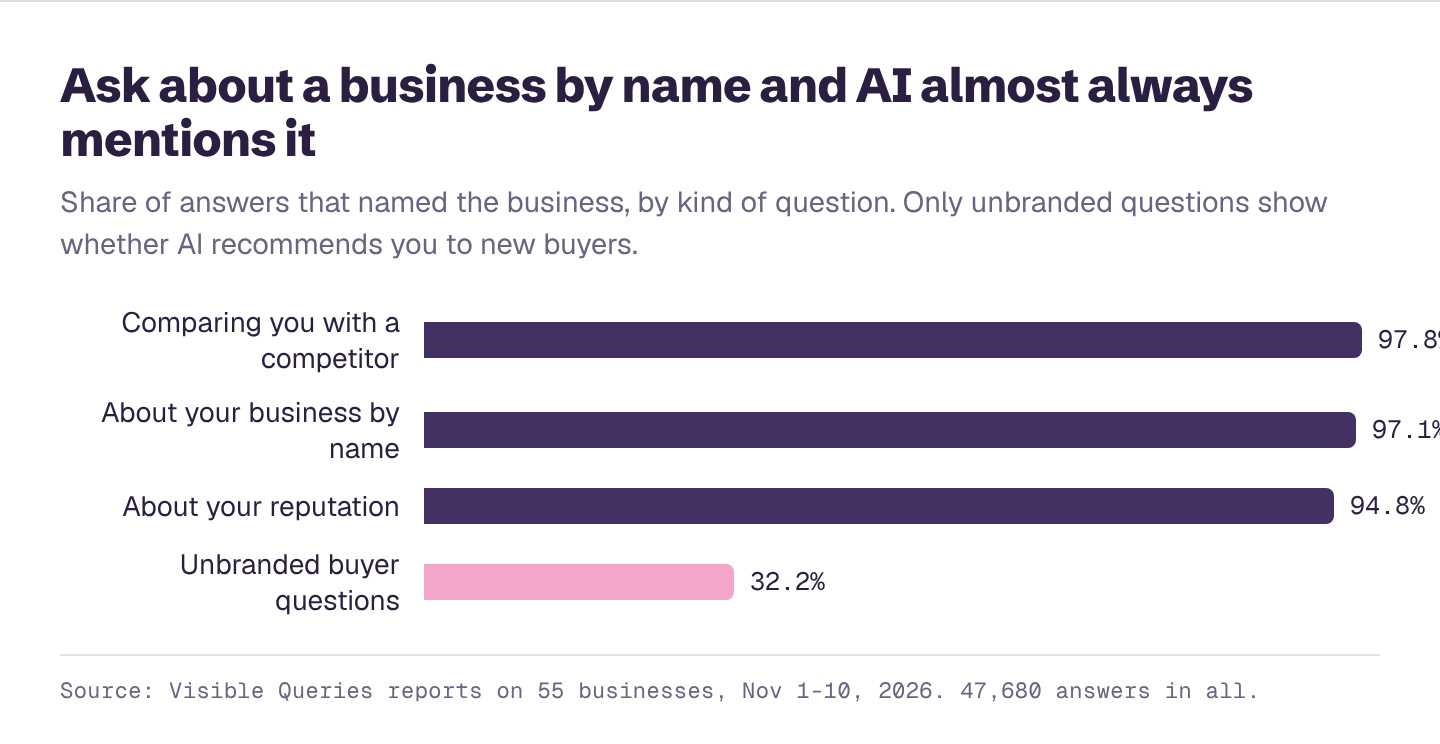
Branded questions ("What is Acme?", "Is Acme any good?") matter for reputation and accuracy. But the questions that win new buyers are unbranded: "best accounting firm for a startup in Vancouver", "what CRM should a 10-person agency use". That's where most businesses have work to do.
Why AI visibility matters now
- Buyers ask AI for shortlists. A growing share of research starts with a question to an AI assistant, and the answer is a handful of names.
- The shortlist is short. ChatGPT named 4.4 businesses per answer in our reports, and Google's AI Overviews 4.3. Missing from that list means missing from consideration.
- It doesn't show up in analytics. Most people read the AI answer without clicking. There's no ranking report for it and no referral, so you have to measure the answers themselves.
- Competitors can own it early. Being on the lists and review sites AI reads compounds over time.
How AI visibility differs from SEO
SEO is about where your pages rank in a list of links. AI visibility is about whether your business is named in a written answer. They're related: AI assistants often search Google or Bing before they answer, so strong SEO helps. But you can rank well and still not be named, because AI writes its shortlist from many pages, including lists and reviews you don't control. We explain the difference in detail in ranking on Google vs being recommended by AI, and the terms around it in GEO vs AEO vs SEO.
What moves AI visibility
In rough order of impact:
- Being on the pages AI reads. "Best of" lists and articles were 40% of the sources AI cited in our study. Review sites and business websites were 22% each.
- Reviews on the right sites, especially for local businesses. See which review sites AI trusts.
- Clear, specific pages on your own site: what you do, for whom, where, at what price.
- Letting AI search crawlers read your site.
- Consistent facts everywhere, so AI doesn't repeat outdated details.
Our guide to getting recommended by AI covers each step and the differences between platforms.
How to measure it
You can check by hand, by asking AI assistants your buyers' questions and recording the answers. Our guide on checking your AI visibility yourself shows how. Because answers change from run to run, you'll need many questions and several platforms to get a reliable picture.
Or use a tool. Our free AI visibility checker works from your website address: it writes the questions your buyers ask, asks them on every major AI platform, and gives you a score out of 100 with the competitors AI names instead. The AI visibility score explains how that number is worked out.
Common questions
Is AI visibility the same as GEO? Close. Generative engine optimization is the work of improving AI visibility. AI visibility is the thing you measure.
Does every business need to care? If your buyers research before they buy, yes. It matters most for considered purchases: software, professional services, healthcare, home services, education and anything with a shortlist.
How quickly can it change? Fixes to your own site and listings can show up within weeks. Getting onto third-party lists and building reviews takes longer, but tends to last.
Check your AI visibility for free
Enter your website and get a free AI visibility report. It takes a few minutes, and you'll see:
- Your AI visibility score, overall and for ChatGPT, Gemini, Claude, Perplexity and Google's AI Overviews and AI Mode
- Who AI recommends instead of you, and how often
- Which topics you win and lose, and how often each one is searched
- What AI gets wrong about you, and what to fix first
- A downloadable PDF you can share with your team