What is generative engine optimization (GEO)? A practical guide
Generative engine optimization (GEO) is the work of getting your business named and cited in AI-generated answers. Where the term came from, how it differs from SEO, and what to actually do.
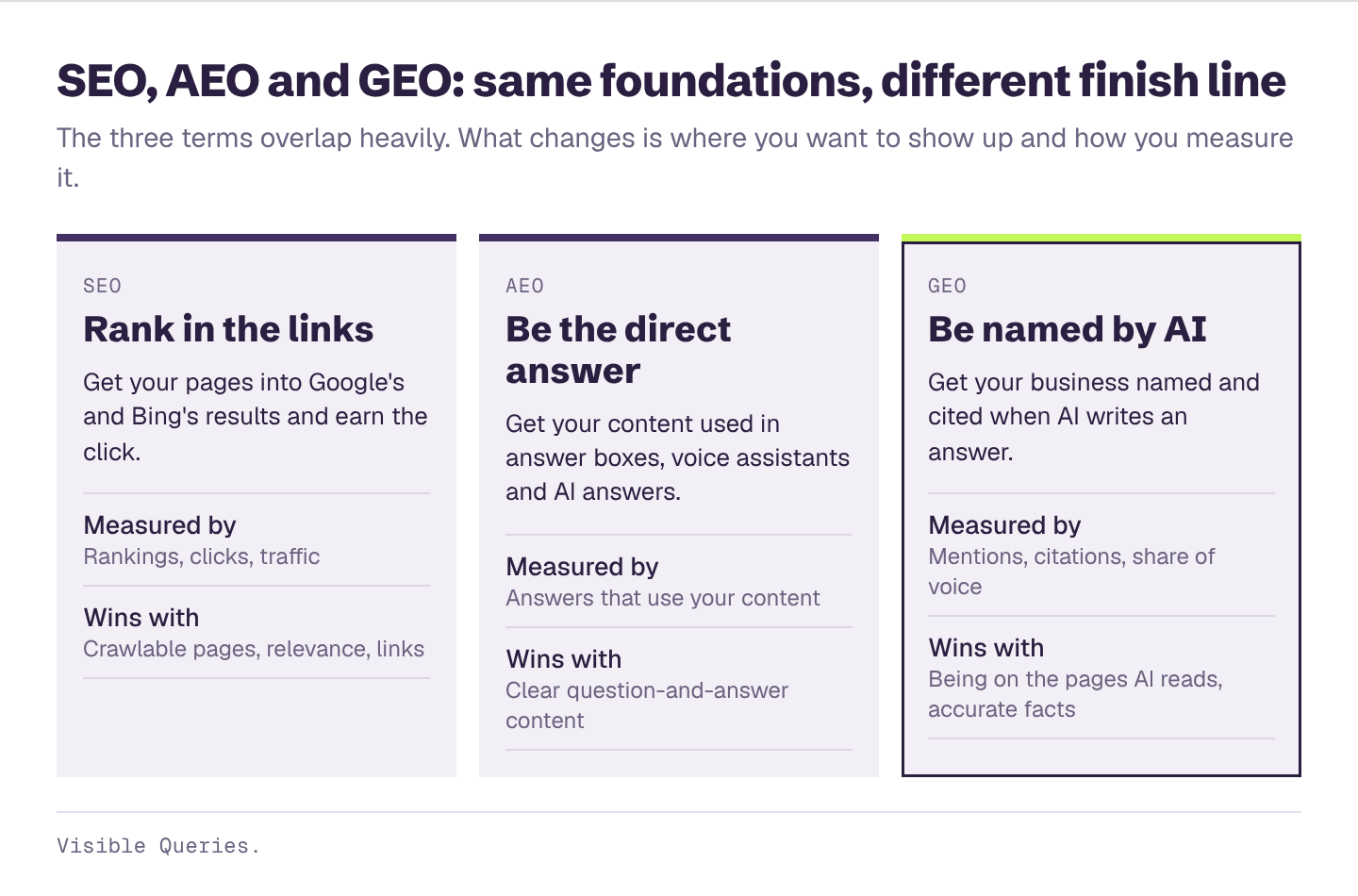
Generative engine optimization, or GEO, is the work of making your business more likely to be named and cited when AI tools like ChatGPT, Claude, Gemini, Perplexity and Google's AI Overviews write an answer.
The term was coined in a 2023 academic paper that tested which changes to a web page made it more likely to be used in AI-generated answers. It's since become the most common name for the whole field, alongside AEO and LLM SEO.
The short version
- GEO is about being in the answer, not ranking in the links. Success means AI names you, links to you and describes you correctly.
- It builds on SEO. Most AI assistants search the web before answering, so pages that can't be found in search rarely make it into AI answers.
- Most of the work happens off your site. In our research, about three quarters of the sources AI cited were written by someone other than the business.
- Clear, specific, quotable content is the on-site part. Direct answers, facts, numbers and tables.
- You measure it with mentions, citations and share of voice, not rankings and clicks.
Before you start any GEO work, check where you stand for free. It shows which questions you lose and who wins them.
How GEO works
AI assistants answer questions about businesses in three steps: they search, they read a handful of pages, and they write a shortlist from what those pages agree on. GEO targets each step:
| Step | What AI does | What GEO does |
|---|---|---|
| Search | Runs a web search (Google, Bing or its own index) | Makes sure your pages can be crawled and rank for the question |
| Read | Opens lists, reviews, directories, articles and business sites | Gets you onto the pages AI reads, and makes your own pages easy to quote |
| Write | Names the businesses the sources agree on | Makes your strengths and facts consistent everywhere, so AI repeats them |
What GEO looks like in practice
Off your site (the biggest lever)
- Get onto "best of" lists and comparison articles. They were 40% of the sources AI cited in our study.
- Build reviews on the sites AI reads for your industry. See which review sites AI trusts.
- Earn mentions in news and trade press.
- Keep directory listings complete and consistent.
On your site
- Answer buyer questions directly, in the first sentence under a clear heading.
- Be specific: prices, service areas, who you serve, how long things take.
- Use tables and lists for comparisons and steps.
- Publish original data others will cite.
- Keep pages current, with visible dates.
Technical
- Allow AI search crawlers (OAI-SearchBot, PerplexityBot, Claude-SearchBot, Googlebot, Bingbot).
- Use structured data for your business details, products and FAQs. See schema markup for AI search.
- Consider an llms.txt file, while knowing it's optional. See llms.txt: do you need one?
What GEO is not
- It's not a trick. There's no hidden tag that makes AI recommend you. Google says plainly there are "no additional requirements to appear in AI Overviews or AI Mode, nor other special optimizations necessary."
- It's not only content. Publishing more blog posts won't help much if the lists and review sites AI reads don't mention you.
- It's not a one-time fix. AI answers change from run to run and as sources change. In our stability test, about 40% of the names in a typical answer came and went between runs.
How to measure GEO
GEO needs its own measures, because the results don't show up as rankings or clicks:
- Mention rate: how often AI names you on unbranded buyer questions.
- Citation rate: how often AI links to your site.
- Share of voice: your share of all businesses AI names in your category.
- Accuracy: whether AI gets your facts right.
Measure on every platform separately. In our reports, the share of answers that named the business ranged from 27% on Google's AI Overviews to 43% on Gemini.
Where to start
- Get a baseline. Run a free AI visibility check to see your score, the competitors AI names instead, and your biggest gaps.
- Fix access. Make sure AI crawlers can read your site.
- Go after the sources. Find the lists and review sites AI cites for your top questions and get onto them.
- Improve your key pages so they answer buyer questions directly.
- Re-check monthly.
Our step-by-step guide to getting recommended by AI covers each platform in more detail. If you'd rather have it done for you, see our GEO agency page.
See where GEO would help you most
Enter your website and get a free AI visibility report. It takes a few minutes, and you'll see:
- Your AI visibility score, overall and for ChatGPT, Gemini, Claude, Perplexity and Google's AI Overviews and AI Mode
- Who AI recommends instead of you, and how often
- Which topics you win and lose, and how often each one is searched
- What AI gets wrong about you, and what to fix first
- A downloadable PDF you can share with your team