llms.txt: what it is and whether your business needs one
llms.txt is a proposed file that gives AI tools a plain summary of your website. What it is, who proposed it, what Google says about it, and whether it's worth the 20 minutes.
llms.txt is a plain text file, written in Markdown, that sits at the root of a website (yoursite.com/llms.txt) and gives AI tools a short summary of the site with links to its most important pages.
It was proposed by Jeremy Howard on September 3, 2024, as "a proposal to standardise on using an /llms.txt file to provide information to help agents use a website." The proposal lives at llmstxt.org and is still open for community input.
The short version
- It's a proposal, not a standard. No major AI company has said it relies on llms.txt to decide what to recommend.
- Google says you don't need it for AI Overviews or AI Mode: "You don't need to create new machine readable files, AI text files, or markup to appear in these features."
- It's cheap to add and does no harm. It can help AI agents and coding tools that read it.
- It won't fix AI visibility on its own. Being on the pages AI reads, and having clear pages of your own, matter far more.
If you're not sure AI can find you at all, check your AI visibility for free before you spend time on llms.txt.
What an llms.txt file looks like
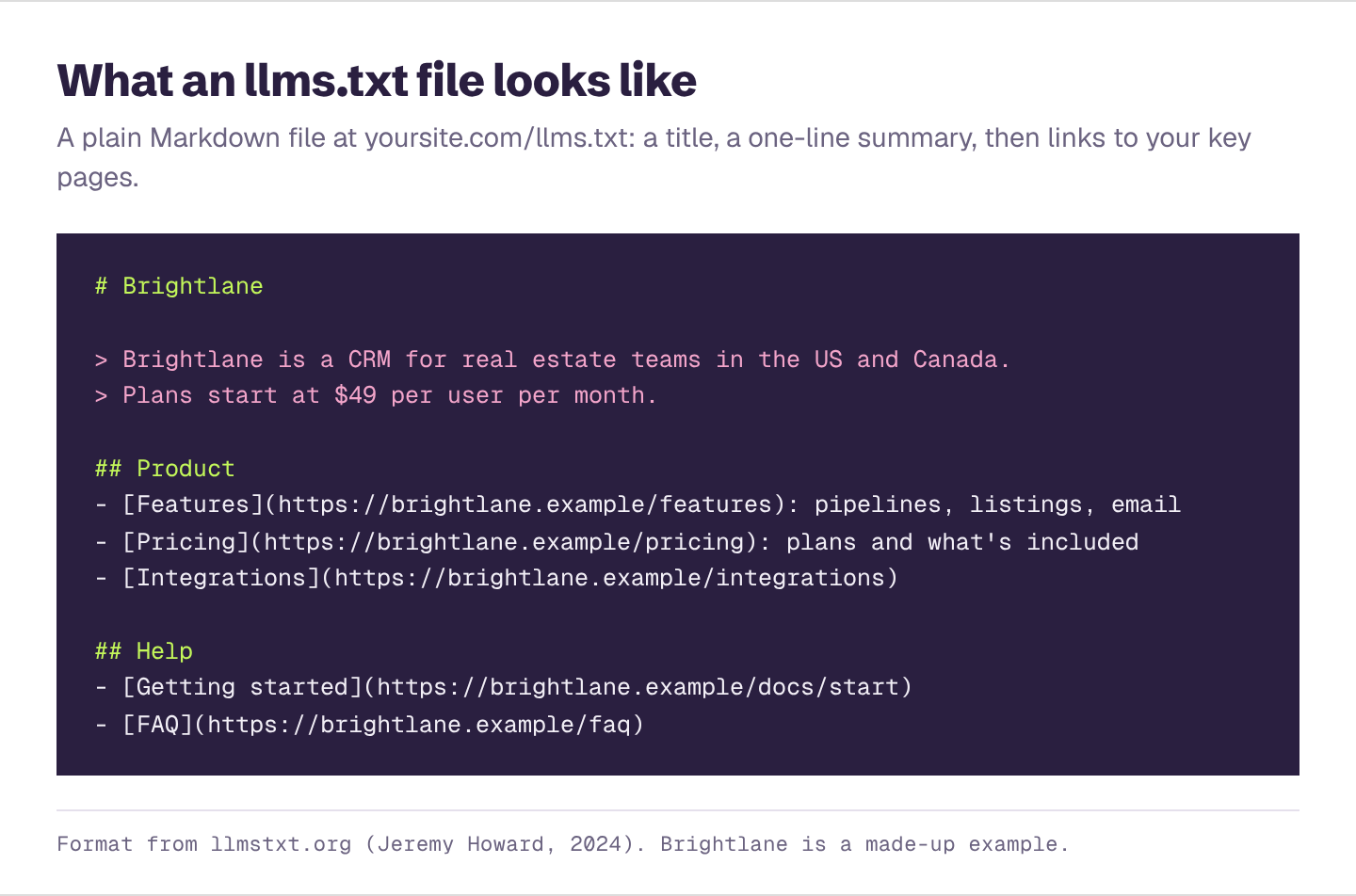
The structure is simple:
- A heading with your name
- A short summary in a quote block: what you do, for whom, and a key fact or two
- Sections of links to your most important pages, each with a few words on what's there
Some sites also publish an llms-full.txt with the full text of their key pages in one file.
llms.txt vs robots.txt
They do different jobs. As the proposal itself notes, robots.txt and llms.txt "have different purposes."
| robots.txt | llms.txt | |
|---|---|---|
| What it does | Tells crawlers what they may and may not fetch | Gives AI tools a summary and a map of key pages |
| Status | Long-established standard, honored by major AI crawlers | Proposal (2024) |
| Effect on AI search | Blocking a search crawler can remove you from answers | No confirmed effect |
| Must you have one? | Yes, check it | Optional |
robots.txt matters far more. If it blocks OAI-SearchBot, PerplexityBot or Claude-SearchBot, you can drop out of those platforms' answers.
Should your business add one?
Yes, if you have a documentation-heavy site, sell to developers, or simply want to cover the bases. It takes about 20 minutes.
Don't prioritize it if you haven't yet checked robots.txt, fixed your key pages, or worked on getting onto the lists and review sites AI reads. Those move the needle; llms.txt, as far as anyone can show today, doesn't.
How to write one in 20 minutes
- Write two sentences on what your business does, for whom and where.
- List your 5 to 15 most important pages: services, pricing, locations, about, FAQ.
- Add a few words on what each page covers.
- Save it as
llms.txtat the root of your site. - Keep it updated when you add or remove key pages.
What to do instead (or as well)
- Check robots.txt so AI search crawlers can read you.
- Add structured data to state your key facts clearly.
- Make your pages easy to cite.
- Find out where you stand before you spend time on any of it.
See what actually moves your AI visibility
Enter your website and get a free AI visibility report. It takes a few minutes, and you'll see:
- Your AI visibility score, overall and for ChatGPT, Gemini, Claude, Perplexity and Google's AI Overviews and AI Mode
- Who AI recommends instead of you, and how often
- Which topics you win and lose, and how often each one is searched
- What AI gets wrong about you, and what to fix first
- A downloadable PDF you can share with your team