Schema markup for AI search: what to add and what it does
What structured data does and doesn't do for AI visibility, the schema types worth adding for local businesses, software and services, and how to check it's working.
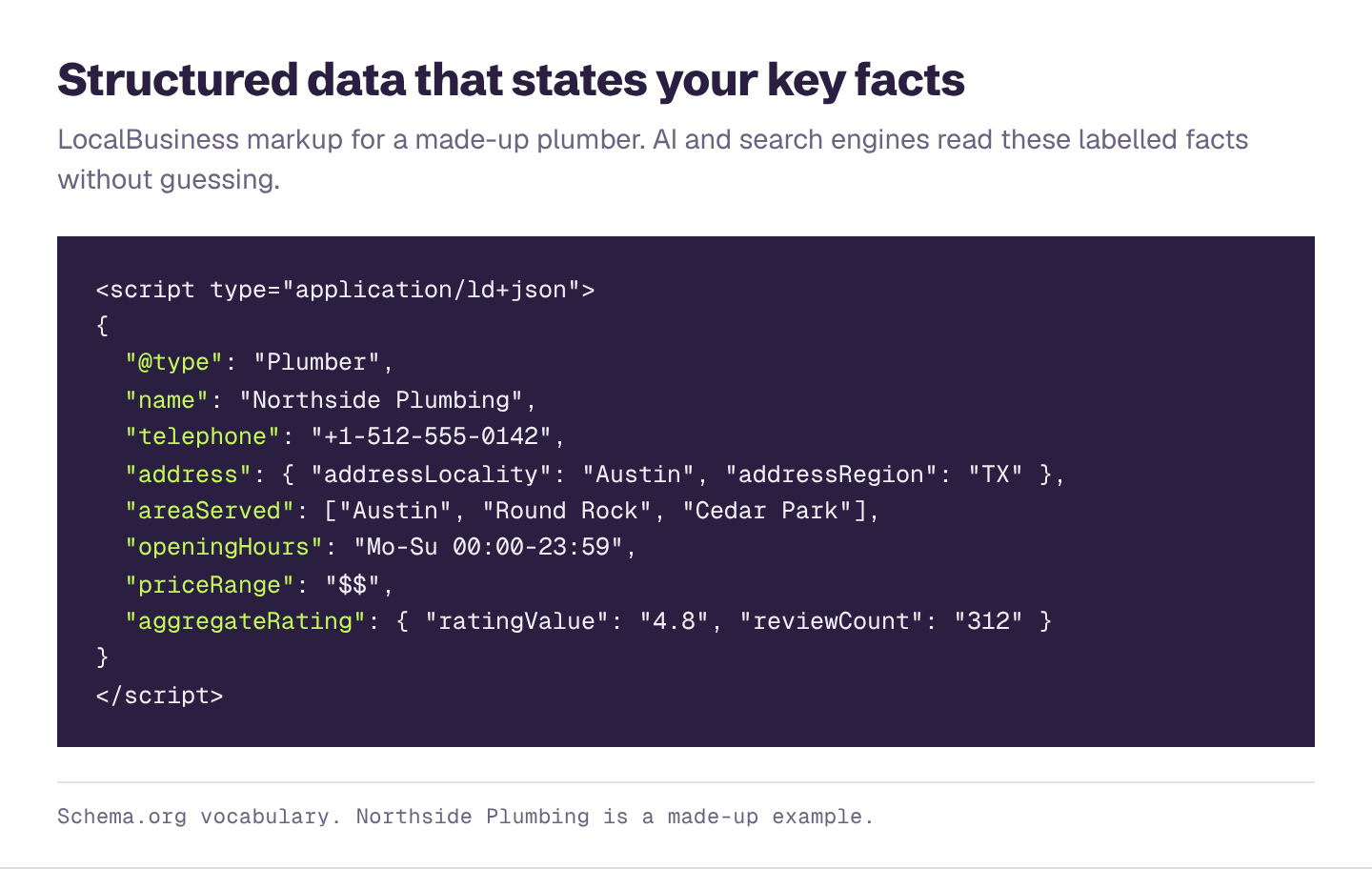
Schema markup, also called structured data, is code on a page that labels your key facts in a standard format: your business name, address, phone, hours, prices, products and reviews. Search engines and AI tools can read those labels without guessing.
It's not a shortcut into AI answers. But it's one of the basics most AI-cited websites have in place, and it helps AI get your facts right.
The short version
- Most AI-cited business sites have it. In our study of what AI-cited websites have in common, 81% of the business homepages AI cited had structured data.
- Google says it isn't required for AI Overviews or AI Mode, but it helps Google understand your pages generally.
- It helps accuracy. Clearly labelled hours, prices and locations leave less room for AI to repeat a wrong fact.
- Only mark up what's on the page. Structured data has to match what visitors can see.
Want to know if AI gets your facts right? Check what AI says about your business for free.
What schema markup does for AI visibility
It makes your facts unambiguous. A phone number in a footer could be anything; a phone number in structured data is your phone number. When AI or a search engine reads your page, labelled facts are easier to trust and repeat.
It supports accuracy. In our check of 745 AI claims about 41 businesses, 11 had at least one plainly wrong fact, most often prices and hours. Clear, consistent facts on your site, in your markup and in your listings reduce that risk.
It doesn't guarantee a mention. Google is clear that "you don't need to create new machine readable files, AI text files, or markup to appear in these features." Structured data is a foundation, not a lever.
Which types to add
| Type of business | Schema types worth adding |
|---|---|
| Local business (trades, clinics, salons, restaurants) | LocalBusiness or a specific subtype (Plumber, Dentist, Restaurant...), with address, geo, hours, areaServed, priceRange |
| Professional services (law, accounting, consulting) | ProfessionalService or LegalService, plus Person for key people |
| Software | SoftwareApplication or Product, with offers (price), operatingSystem, applicationCategory |
| E-commerce | Product with Offer, price, availability and AggregateRating |
| Every site | Organization (name, logo, sameAs links to your profiles), WebSite, BreadcrumbList |
| Pages with questions | FAQPage, where the questions and answers are visible on the page |
| Articles and guides | Article, with author and date |
How to add it
- Check what you already have. Many website builders (Shopify, Squarespace, Wix, WordPress SEO plugins) add some structured data automatically.
- Fill the gaps. Add the types above for your main pages. Most platforms have a plugin or settings panel; otherwise it's a short block of JSON-LD in the page.
- Test it. Use Google's Rich Results Test and the Schema.org validator.
- Keep it in sync. When hours, prices or locations change, update the page, the markup and your listings at the same time.
Mistakes to avoid
- Marking up things that aren't on the page, such as reviews you don't display.
- Copying another business's template and leaving their details in.
- Out-of-date prices or hours in markup after the page has changed.
- Expecting it to fix visibility alone. If the lists and review sites AI reads don't mention you, markup won't change that.
Where it fits
Structured data is one item on the AI visibility website checklist. The bigger levers are being on the pages AI reads and making your own pages easy to cite. See how to get cited by AI, or check what AI says about you to see whether accuracy is a problem.
See what AI says about your business
Enter your website and get a free AI visibility report. It takes a few minutes, and you'll see:
- Your AI visibility score, overall and for ChatGPT, Gemini, Claude, Perplexity and Google's AI Overviews and AI Mode
- Who AI recommends instead of you, and how often
- Which topics you win and lose, and how often each one is searched
- What AI gets wrong about you, and what to fix first
- A downloadable PDF you can share with your team