How people choose an auto shop, car wash or pet groomer now, and why AI visibility decides who gets their business
People now ask AI which auto shop, car wash, pet groomer or dog daycare to trust. Here's how their journey works, what they ask at each step, and how to build a local service business AI recommends.
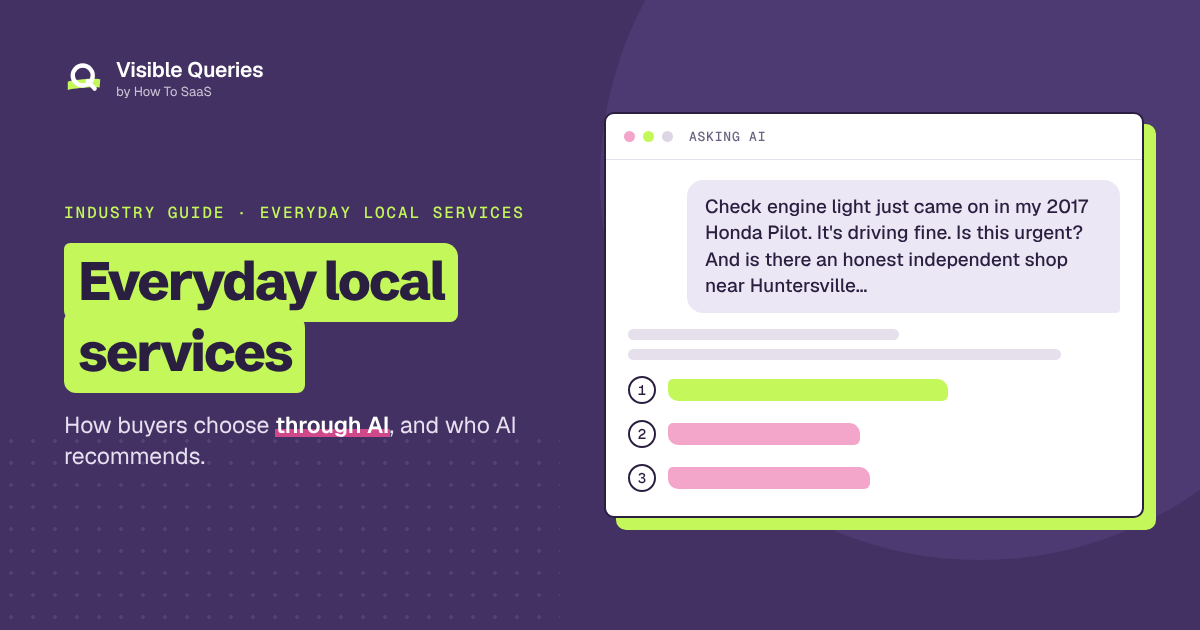
It's 7:15 on a Monday morning in Huntersville, North Carolina. The check engine light just came on in a 2017 Honda Pilot, halfway through the school drop-off. The owner remembers the last time this happened: they went to the dealership, waited four hours and paid $1,100 for something a friend later said should have cost $400.
A few years ago, they would have searched "auto repair near me," scrolled the map, picked something with four-plus stars that was open, and hoped for the best.
This morning, still in the school parking lot, they ask Gemini instead:
"Check engine light just came on in my 2017 Honda Pilot. It's driving fine. Is this urgent? And is there an honest independent shop near Huntersville that's cheaper than the dealer?"
The answer explains the most common causes of a check engine light on that model, which ones are urgent, and how to tell if the light is flashing or steady. It suggests getting the code read, explains that many shops will do that for little or nothing, and gives a rough idea of what common repairs cost. Then it names three independent shops nearby, with a line on what reviewers say about each one.
They drive to the first one after drop-off.
That's how a growing share of people now choose the everyday local businesses they rely on: auto repair shops, body shops, car washes, pet groomers, dog daycares and boarding kennels, dry cleaners, self storage and more. They ask a question in their own words, and AI hands them a short list. The businesses on that list get the visit. The others don't get the chance to earn a loyal customer.
This article walks through how people choose everyday local service businesses today, step by step, with examples from auto repair and collision, car washes, pet grooming, boarding and daycare, plus self storage and dry cleaning. It covers what people ask AI at each step, what makes AI recommend one business over another, and what the businesses that keep getting recommended tend to do differently. Most of it comes down to being honest, reliable and easy to understand from the outside.
Along the way you'll see screenshots from a Visible Queries report for Precision Auto Care, a sample independent repair shop in the Charlotte area. The shop and its competitors are made up, but the report is real. It's exactly what any local business sees when it runs its own.
Why the old playbook isn't enough anymore
For local service businesses, the playbook has been simple for years: a Google Business Profile, as many good reviews as you can get, a basic website, maybe some local ads, and a sign people can see from the road. If you showed up in the map pack, the phone rang.
All of that still matters. But the map pack let people compare. They looked at stars, distance and photos and made their own call. AI does that comparing for them. It reads your reviews, your website, local forums and neighborhood groups, then tells people which businesses to trust and why.
Three things follow from that:
- The shortlist got shorter. A map shows a dozen shops. An AI answer names three. Being fourth is the same as not being there.
- Trust is summarized for you. People ask "Is [shop] honest?" or "Does [groomer] treat anxious dogs well?" AI answers in a sentence or two, based on patterns in your reviews and what people say online.
- Specifics win. "Independent Honda specialist," "touchless car wash with unlimited plans" or "dog daycare with webcams and small-dog play groups" match specific questions. "Quality service at great prices" matches nothing.
None of this makes reviews, your Google profile or word of mouth less important. They're the raw material AI reads. What changes is that they now have to tell a clear, specific story to an assistant, not just look good on a map.
The customer's journey, step by step
Whether it's a $15 car wash, a $90 groom or a $2,500 transmission repair, the path looks similar. What changes is how urgent it is and how much trust is needed.
- Something comes up. A warning light, a fender bender, a filthy car, an overgrown dog, a vacation that needs boarding, or a move that needs storage.
- They try to understand it. What's wrong, how urgent it is and what it should cost.
- They build a shortlist. Who's nearby, open and good at this specific thing.
- They check who to trust. Honesty, reviews, credentials, safety and policies.
- They choose. Price, availability, convenience and comparisons.
- They come back, or they don't. Repeat visits, memberships, referrals and reviews.
AI now shows up at every one of these steps. Here's what it looks like at each one.
Step 1: Something comes up
Everyday services start with everyday moments, some urgent and some routine:
- A check engine light, a grinding noise when braking, or a car that won't start on a cold morning (auto repair)
- A fender bender in a parking lot and an insurance claim to sort out (collision repair)
- Road salt caked on the car after a Toronto winter, or pollen season in Atlanta (car washes)
- A doodle that's starting to mat, or a new puppy that needs its first groom (pet grooming)
- A week-long trip and nobody to watch the dog (boarding)
- A new job with long hours and a dog who hates being alone (dog daycare)
- A move between apartments with a two-month gap (self storage)
- A wedding suit that needs pressing by Friday (dry cleaning)
The first questions people ask AI are about the situation:
- "My brakes are squeaking. Is it safe to drive?"
- "Is the dealership the best place to fix a check engine light?"
- "How often should a goldendoodle be groomed?"
- "Is dog daycare good for a dog with separation anxiety?"
- "Do touchless car washes actually get cars clean?"
The answers shape what people look for next. If AI explains that independent shops can handle most warranty-safe maintenance for less than a dealership, the person is now looking for an independent shop. The businesses whose content helped shape that answer have a head start.
Step 2: They try to understand it
People want to know what's going on, how urgent it is and what a fair price looks like, mostly so they don't get taken advantage of.
- "What does it cost to replace front brake pads and rotors on a Honda Pilot?"
- "Why are dealership repair prices so high?"
- "Is a car wash membership worth it if I wash my car twice a month?"
- "How much does a full groom cost for a large dog?"
- "What vaccines does a dog need for boarding?"
- "Climate-controlled storage vs regular: do I need it for furniture?"
AI answers with explanations, typical prices and, often, local examples. The businesses that publish honest answers to these questions, like fair price ranges, what affects the cost and what's actually urgent, become the ones people trust before they've walked in.
This is where many local businesses lose quietly. Their websites list services and a phone number and stop there. No prices, no explanations, nothing that helps someone understand their situation. So AI builds its answers from national chains, cost guides and competitors who did publish that information.
Here's what this looks like in a real report. Each row is a topic customers ask about, with how often it's searched each month and the share of AI answers on that topic that name the shop and each of its top competitors.
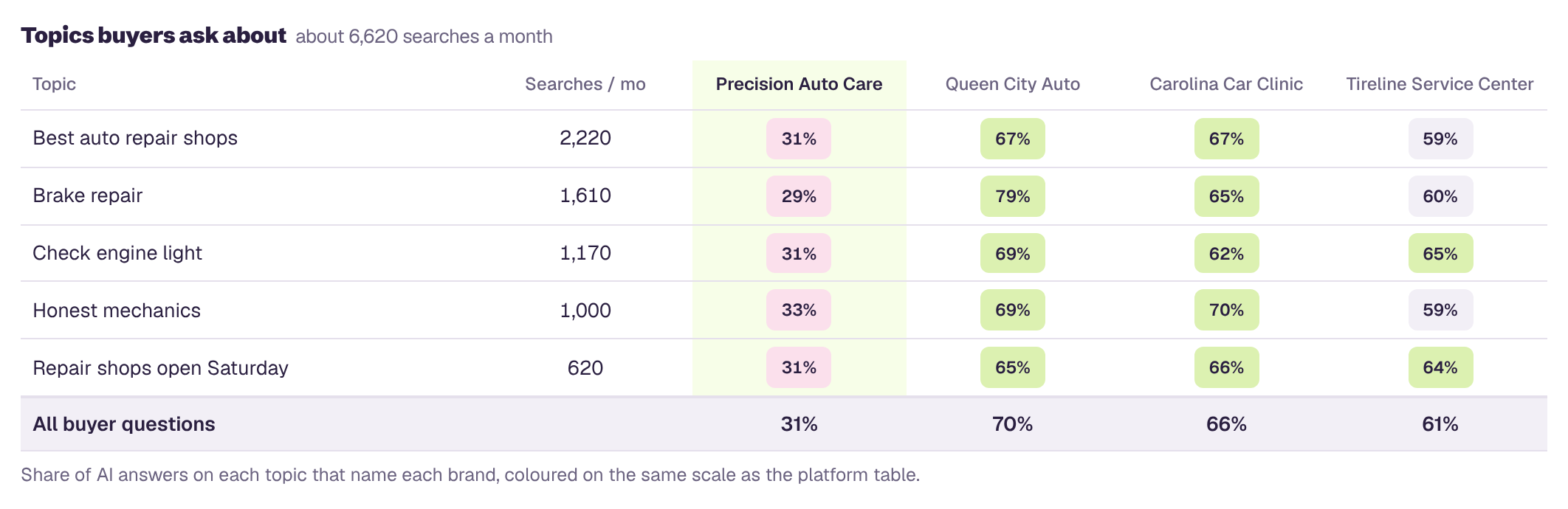
Look at "Honest mechanics." That's where people ask whether there's something better than the dealership for car repairs. Carolina Car Clinic is named in 70% of those answers and Precision Auto Care in 33%. That's someone actively looking to leave the dealership for an independent shop, which is exactly Precision's customer, and in two answers out of three, Precision isn't there.
What good local businesses do at this step: they explain things honestly. Price ranges for common jobs, what drives the cost, what's urgent and what can wait, and what a customer can check themselves. A shop that says "here's what brake jobs usually cost and why" earns trust that a shop saying "call for a quote" never gets.
Step 3: They build a shortlist
Now people want names, and they're specific about what they need:
- "Honest independent auto repair near Huntersville that works on Hondas"
- "Collision repair shops in Charlotte that work with State Farm"
- "Best unlimited car wash membership in Matthews"
- "Dog groomers near Concord that are good with anxious dogs"
- "Dog daycare in Charlotte with webcams and separate small-dog groups"
- "Cheap self storage near UNC Charlotte for the summer"
These answers are local, and they change from town to town. A shop can be well known in one part of a metro area and invisible a few exits away, even though people there would happily drive over.
Here's what that looks like for our sample shop:
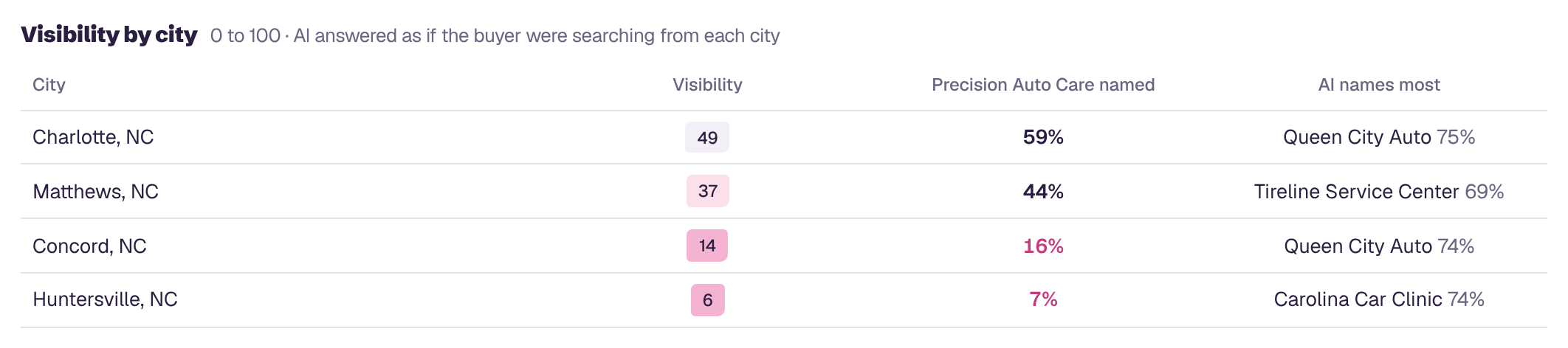
Precision Auto Care scores 49 in Charlotte, where it's named in 59% of local answers, and does reasonably well in Matthews. But in Concord it's named in 16% of answers, and in Huntersville, just 7%. That's the Huntersville driver from the beginning of this article, and in most of the answers they'd get, Precision isn't on the list.
The same pattern shows up across everyday services. A car wash might own its own intersection and be invisible across town. A groomer might come up for small dogs but not for large breeds. A dog daycare might show up for daycare but not for boarding, which is where the holiday revenue is.
What good local businesses do at this step: they're specific about what they do and where. Pages for each core service (brakes, diagnostics, collision, unlimited wash plans, large-breed grooming, boarding), the makes, breeds or needs they specialize in, and the neighborhoods and nearby towns they serve. They also keep their Google Business Profile categories, services and hours accurate and detailed.
Step 4: They check who to trust
Trust is the whole game for everyday services. People are handing over their car, their pet or their belongings, and almost everyone has a story about getting overcharged or a pet coming home stressed. So they vet:
- "Is Precision Auto Care honest? Do they upsell?"
- "Are the mechanics at [shop] ASE certified?"
- "Does [collision shop] offer a lifetime warranty on repairs?"
- "Does [car wash] damage paint or wheels?"
- "How do groomers at [salon] handle anxious dogs? Do they use sedation?"
- "How many dogs per staff member at [daycare]? Are there cameras?"
- "Is [storage facility] secure? Any break-ins?"
AI answers by summarizing reviews from Google, Yelp, Nextdoor, Facebook groups and Reddit, plus your own website. It's especially good at finding patterns in what people complain about. "Fair prices and explains everything" is the kind of summary that wins customers. "Some customers report being pressured into extra repairs" is the kind that loses them.
This step also exposes a quieter problem: AI getting basic facts wrong.
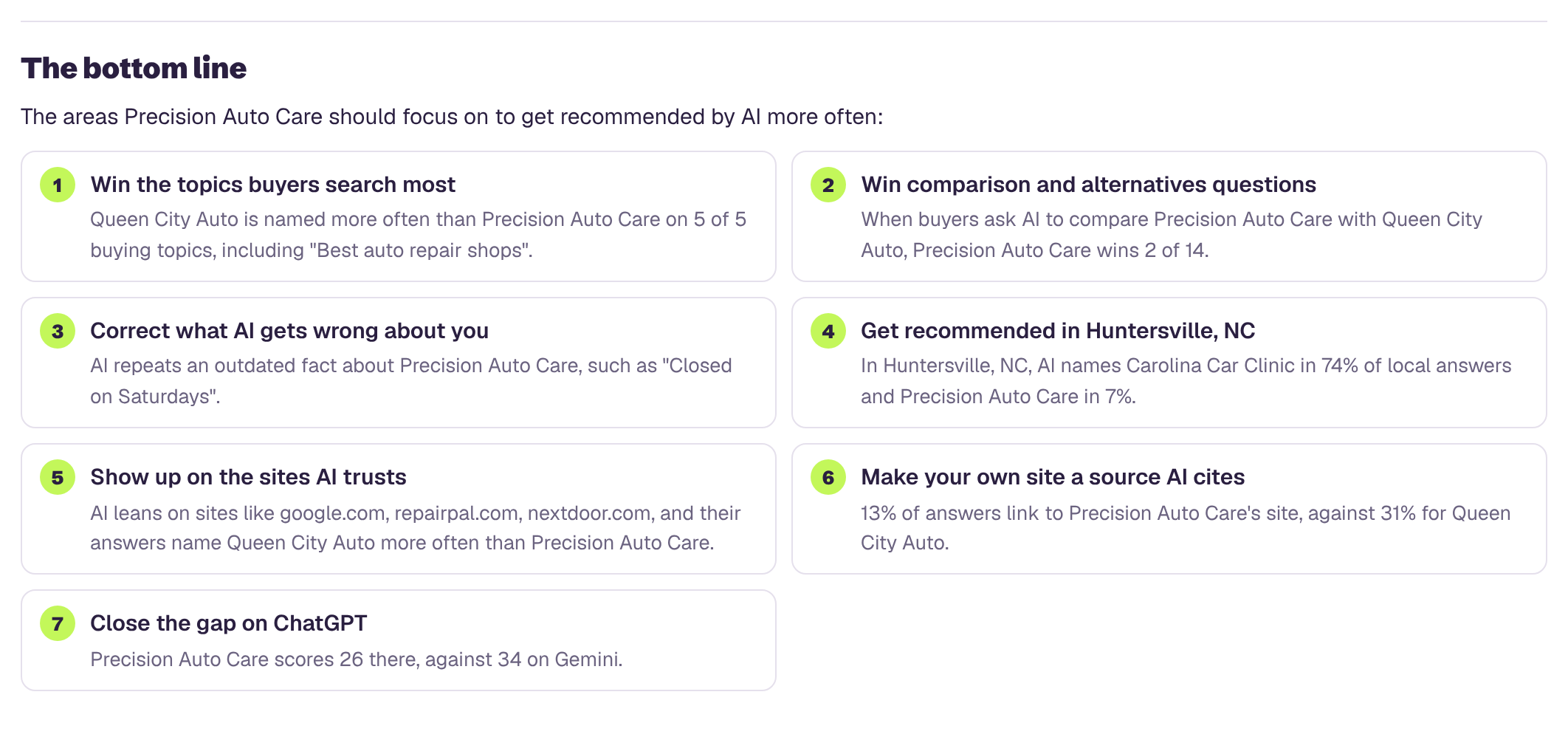
In our sample report, the top gap is a simple wrong fact. AI says Precision Auto Care is "closed on Saturdays." It's open Saturdays from 8 to 2, which is exactly when a lot of working people need a mechanic. Anyone who asks AI whether they can bring their car in this weekend hears no. The report's accuracy score, 67% in this sample, measures how often AI gets core facts right.
Wrong facts are common for local businesses: old hours, holiday hours that never got updated, services you've added or dropped, a previous owner's name, an old phone number, or confusion with a similarly named business nearby.
What good local businesses do at this step: they make trust easy to see. Certifications, warranties, guarantees and safety practices stated plainly. Honest policies on estimates and approvals ("we never do work without your OK"). Cameras, staff ratios and vaccine policies for pet businesses. Security features for storage. And the same accurate hours, services and contact details on their website, Google Business Profile, Yelp, Facebook and Apple Maps. They also reply to reviews, good and bad, because AI reads the replies.
Step 5: They choose
The final decision comes down to price, convenience and confidence:
- "Can I get my car in today at a shop near Huntersville?"
- "Precision Auto Care vs Queen City Auto: which is better?"
- "Which car washes in Charlotte have the cheapest unlimited plan?"
- "Does [groomer] take online bookings?"
- "Does [daycare] require a temperament test first?"
- "Does [storage facility] have a first-month-free deal?"
Comparisons hinge on concrete details: availability, prices, shuttle or loaner cars, warranties, membership terms, booking options and intro offers. If a competitor publishes "free shuttle within 5 miles, 3-year/36,000-mile warranty, online booking" and your site says "call us," AI's comparison tilts their way.
The competitor table shows who's winning these moments overall: how often AI names each business when people ask questions that don't name one. In the sample report, Queen City Auto is named in 70% of those answers and Precision Auto Care in 31%. Someone who asks AI a few questions will hear one shop more than twice as often as the other.
What good local businesses do at this step: they make choosing them easy. Pricing for common jobs, membership terms, warranties, booking options, hours, wait times and extras like loaner cars or shuttles are all published clearly. They also make it simple to book or request an appointment online.
Step 6: They come back, or they don't
Everyday services are repeat businesses. A good mechanic gets years of oil changes and repairs. A car wash wants members. A groomer wants a standing appointment every six weeks. A daycare wants a dog three days a week for years.
- "How often should I change the oil in a 2017 Pilot?"
- "How do I keep my car clean between washes in winter?"
- "How do I brush out mats between grooms?"
- "Is it normal for my dog to be tired after daycare?"
- "When should I switch mechanics?"
That last question is the switcher question, and it's where shops win and lose customers.
This is also where the reputation loop runs. Customers who feel treated honestly and see good results come back, tell friends and neighbors, and leave specific reviews: "They told me I didn't need the repair the dealer quoted." That's exactly the material AI uses to recommend the business to the next person. Customers who feel taken advantage of leave the reviews AI warns people about.
What good local businesses do at this step: they build the relationship. Maintenance reminders, membership perks, rebooking reminders, report cards for pets, and follow-ups after big repairs keep customers coming back. They ask happy customers for reviews that describe what happened, which is the most useful thing AI can read about them.
How the journey plays out across local services
The six steps hold for every everyday service, but the step that decides the visit is different. Here's where the weight falls, and what the businesses that win tend to do.
Auto repair and collision shops
Auto repair is a trust business with a reputation problem. Steps 2 and 4 decide most visits: people want to know what a repair should cost and whether a shop will be honest. They ask "Is it worth fixing a 12-year-old car?", "Independent shop vs dealer for warranty maintenance" and "Which shops near me are known for not upselling?" Collision customers add insurance questions: "Do I have to use the shop my insurance recommends?"
Shops that publish price ranges for common jobs, explain their approval process, list certifications and makes they specialize in, offer clear warranties and earn reviews that mention honesty tend to dominate AI answers. Collision shops that explain the insurance process and list the insurers they work with win the claim questions.
Full guide: AI visibility for auto repair and collision shops
Car washes
Car wash customers ask about memberships, wash types and paint safety: "Is an unlimited wash plan worth it?", "Touchless vs soft-touch: which is safer for paint?", "Which car washes near me have free vacuums?" The decision is fast and local, and membership economics make each new member valuable.
Car washes that publish plan prices and what's included, explain their wash technology and paint-safety approach, list all locations clearly and make cancellation terms easy to find tend to win both the first wash and the membership.
Full guide: AI visibility for car washes
Pet grooming, boarding and daycare
Pet owners are anxious and protective. They ask about safety, staff, handling of nervous animals, vaccination requirements, play groups and cameras: "Dog daycare near me with webcams," "Cat-only boarding in Charlotte," "Groomers who are good with senior dogs." Step 4 decides almost everything.
Pet businesses that publish their safety practices, staff training, staff-to-dog ratios, vaccine requirements, temperament testing, handling approach and prices, and earn reviews that mention how their pets felt, tend to be the ones AI recommends.
Full guide: AI visibility for pet grooming, boarding and daycare
Self storage, dry cleaners and other everyday services
These businesses don't have their own spoke article, but the same journey applies.
- Self storage: people ask about unit sizes, climate control, security, access hours and move-in deals. Size guides and transparent pricing win.
- Dry cleaners and laundry: people ask about turnaround, delivery, eco-friendly cleaning and specialty items like wedding dresses or leather. Clear service lists and turnaround times win.
- Other everyday services, like key cutting, shoe repair, tailoring and phone repair, follow the same pattern: a specific service, a fair price and an honest reputation, clearly stated.
Building a local business AI recommends
Put the six steps and the business types together and a pattern comes out. The local businesses AI recommends aren't always the biggest or the closest. They're the ones whose services, prices and reputation are clearly described and consistent everywhere AI looks.
1. Explain things honestly. Price ranges, what's urgent and what can wait, what affects the cost. Customers trust whoever helped them understand.
2. Be specific about what you do best. Makes and models, breeds and temperaments, wash types, unit sizes. Specific fit wins specific questions.
3. Publish prices and policies. Common job prices, memberships, warranties, estimate approvals, cancellation terms and vaccine requirements.
4. Cover every area you serve. Make it clear which neighborhoods and nearby towns you serve, so AI recommends you beyond the few blocks around your door.
5. Keep facts identical everywhere. Hours, holiday hours, services, phone numbers and addresses on your website, Google Business Profile, Yelp, Apple Maps, Facebook and booking apps.
6. Earn reviews that describe the experience. Ask customers to mention what you did and how it went. "They told me I didn't need the $800 repair" is worth more than fifty "great service" reviews.
7. Show your credentials. Certifications, insurance, warranties, training and safety practices, stated plainly.
8. Be part of the community. Local sponsorships, neighborhood groups, school fundraisers and local press give AI independent signals that you're a trusted local business.
9. Be the honest option. No content fixes a pattern of upselling, missed promises or stressed pets. AI will find it. The most reliable way to be recommended is to be a business people recommend.
10. Measure it. Most local businesses have never seen what AI tells people about them, town by town, compared with the shops nearby.
That last point is where the report comes in. Here's the top of the sample report for Precision Auto Care:
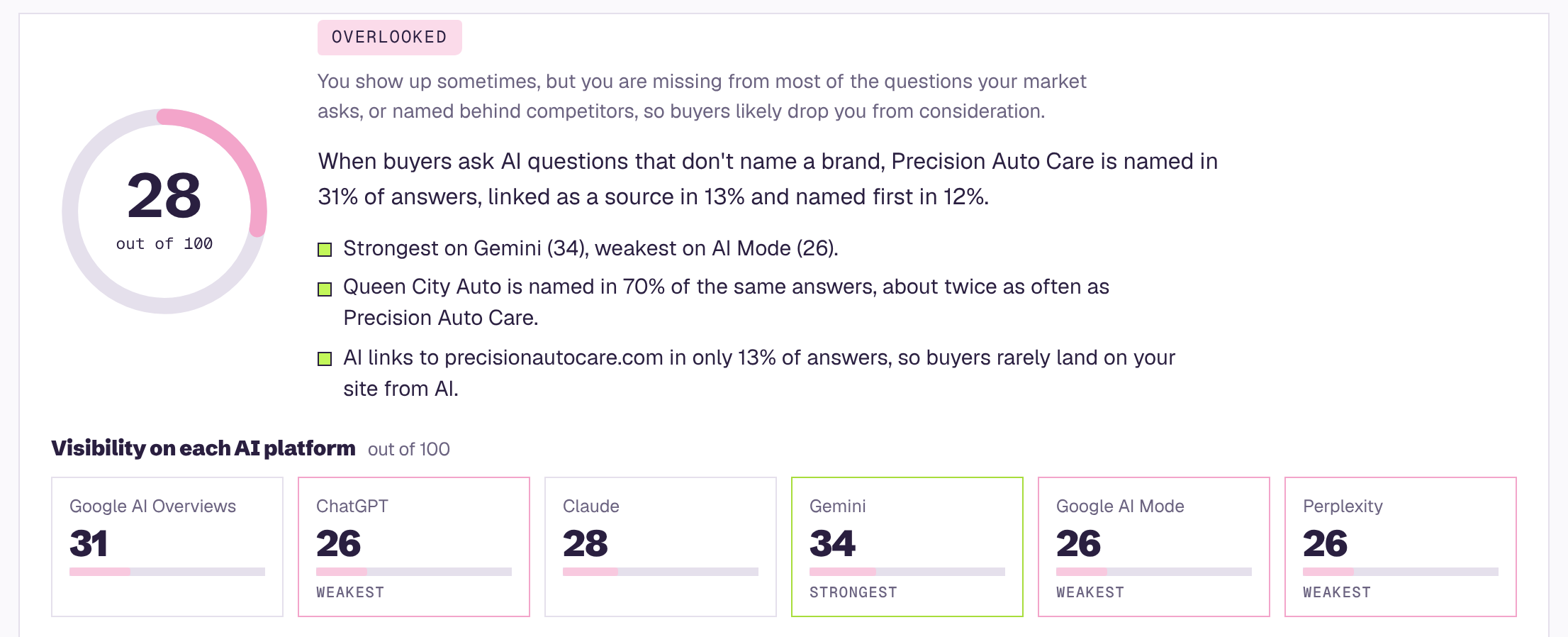
Precision Auto Care scores 28, in the Overlooked band. That's a pattern many local businesses will recognize: AI knows Precision Auto Care when it's asked by name, but rarely recommends it when people ask where to go. It's named in 31% of answers to questions that don't name a shop, while Queen City Auto is named in 70%. Just below, the report breaks it down further:

For everyday local services, first mention and accuracy deserve special attention. People with a warning light or a matted dog often go with the first business named, and a single wrong fact about hours or services sends them somewhere else.
Run the report again after making changes, and you can watch these numbers move in each town, against the businesses nearby.
People still need someone they can trust
People still need their cars fixed, their dogs groomed and their stuff stored. What's changed is who helps them pick. More and more, it's an AI assistant, and it hands them a short list before they've seen your sign or your stars.
The good news for honest, well-run local businesses is that AI mostly rewards what customers already value: fair prices, clear communication, real expertise and a reputation for doing right by people. The work is making all of that visible, specific and consistent in the places AI reads, and checking that it's working.
Keep learning
- What is AI visibility?
- How to get your business recommended by AI, with guides for ChatGPT, Google AI Overviews, Perplexity, Gemini and Claude
- AI visibility benchmark 2026
- The AI visibility glossary
See what AI tells customers about your business
Enter your website and get a free AI visibility report. It takes a few minutes, and you'll see:
- Your AI visibility score, overall and for ChatGPT, Gemini, Claude, Perplexity and Google's AI Overviews and AI Mode
- Which local competitors AI recommends instead of you, and how often
- Your visibility in every town you serve, and the competitor AI names most in each one
- What AI gets wrong about you, and what to fix first
- Your biggest gaps: the buyer questions where AI leaves you out, and who it recommends instead
- A downloadable PDF you can share with your team