Fees, tenants and the 2 a.m. leak: how owners choose a property management company through AI
Rental owners now ask AI what property managers charge, what they do and how to avoid a bad one. Here's what AI tells them, and how property management companies get named.
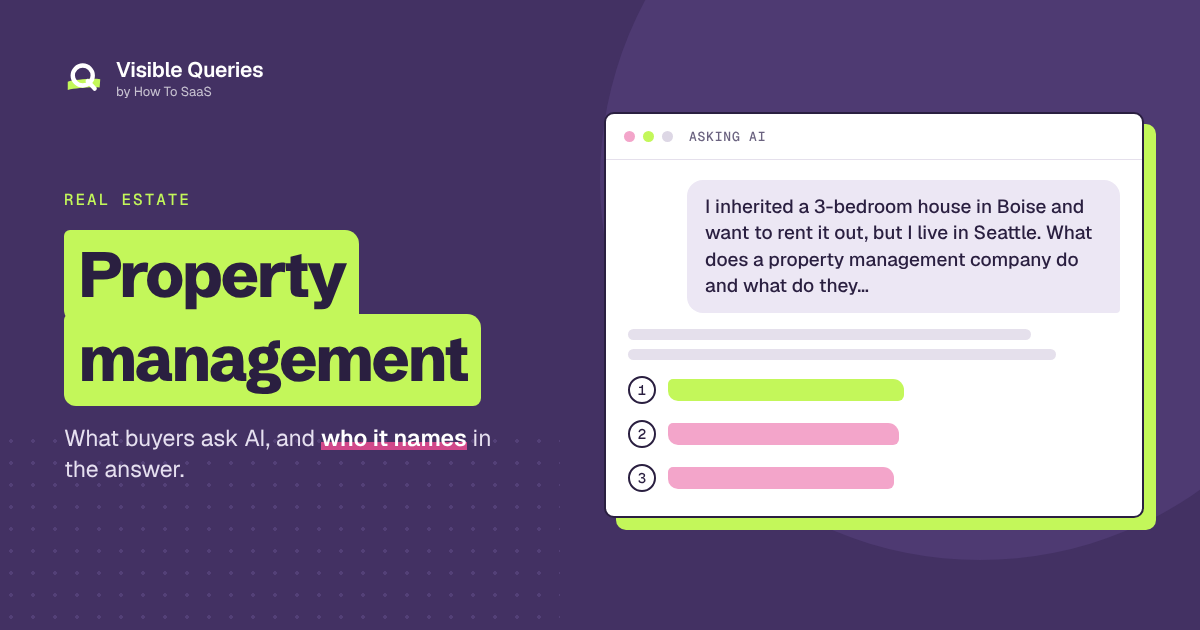
An engineer who lives in Seattle inherited their parents' three-bedroom house in Boise. They want to keep it as a rental, but they live 500 miles away and have never been a landlord. They ask ChatGPT:
"I inherited a 3-bedroom house in Boise and want to rent it out, but I live in Seattle. What does a property management company do and what do they charge? What fees should I watch for? How do I choose a good one in Boise?"
AI explains what property managers typically handle (marketing, screening, leases, rent collection, maintenance, inspections, evictions and accounting), common fee structures (a monthly percentage, leasing fees, renewal fees and maintenance markups), what to ask about screening, maintenance and communication, and red flags. Then it names three Boise companies. The owner schedules calls with two of them.
Property management is a trust business with two customers: owners and tenants. Owners worry about vacancies, bad tenants, maintenance costs and hidden fees. Tenants talk about responsiveness and fairness in reviews. AI reads both.
Our real estate guide covers how people choose real estate businesses in general. This one goes through the questions that decide property management clients, what AI usually says, and what companies can publish so AI names them.
Here are the questions at a glance:
| The question | What gets you named |
|---|---|
| "Do I need a property manager?" | What you do and who it suits |
| "How much do they charge?" | Your fees, all of them |
| "How do they screen tenants?" | Your screening process |
| "How do they handle maintenance?" | Response times and how repairs are approved |
| "What do tenants say?" | Reviews from owners and tenants, with replies |
"What does a property manager do? Do I need one?"
What AI usually says: It explains the typical services and when self-managing might work: owners who live nearby, have time and have one or two properties.
What to publish: A clear list of what you handle and what you don't, plus honest guidance on when owners might not need you.
"How much do property managers charge?"
This is the defining question for the category.
What AI usually says: It explains common fee structures, typical ranges and fees to watch for, like leasing, renewal, vacancy, maintenance markups and early termination.
What to publish: Every fee, in plain words, with examples. "On a $2,000-a-month rental, here's what an owner typically pays in a year." Property managers that are transparent about fees stand out to owners and to AI.
"How do they screen tenants?"
What AI usually says: It suggests asking about credit, income, rental history and background checks, and about compliance with fair housing laws.
What to publish: Your screening criteria and process, how quickly you typically fill vacancies, and any guarantees you offer.
"How do they handle maintenance?"
What AI usually says: It suggests asking about 24/7 emergency response, approval limits, vendor markups and how owners are informed.
What to publish: How maintenance works: emergency response, approval thresholds, in-house or vendor teams, markups and how owners see invoices and photos.
"Is [company] good? What do tenants say?"
What AI usually says: A summary of reviews from owners and tenants. Tenant reviews often focus on responsiveness, repairs and deposits.
What to publish: Respond to tenant reviews professionally and explain how you handle repairs and deposits. AI reads tenant reviews when owners ask about you, so they matter for winning owners too.
Where you're named, city by city
Property managers usually serve a metro area or region, and AI's answers change by city:
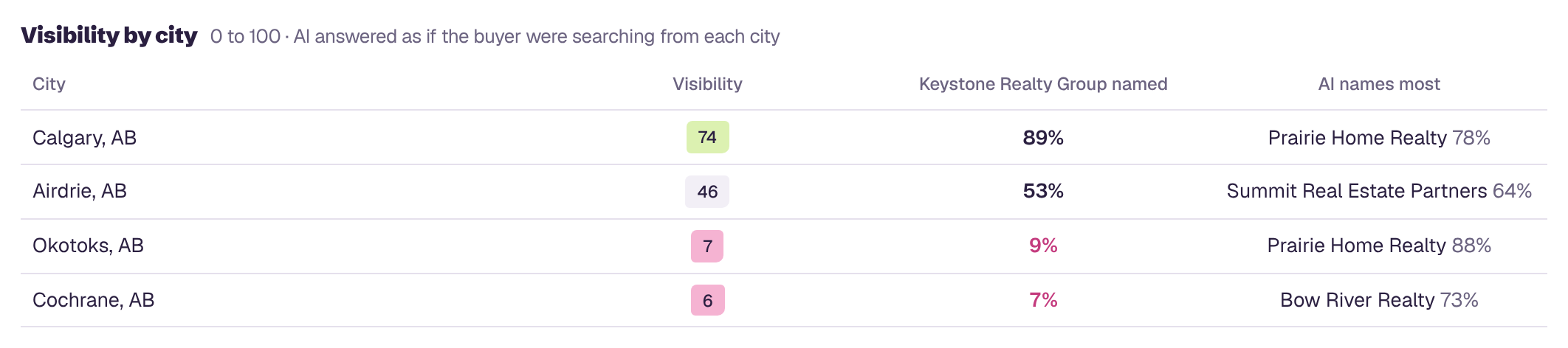
If you serve several cities or suburbs, give each one its own page with local rental market information.
Every property type is its own search
Single-family homes, condos, small multifamily, apartment buildings, HOAs, short-term rentals and commercial properties are each different searches with different owners. Give each property type you manage its own page, with services and fees.
Out-of-town and first-time landlords
Owners who live far away, inherited a property or became accidental landlords after moving are a big part of the market. They ask very basic questions. Content written for them, like "how to rent out a house you inherited" or "managing a rental from another state," brings them to you.
What the sample report shows
Here's what a Visible Queries report looks like for Keystone Realty Group, the sample brokerage in the Calgary area from our guide. The questions are different for property managers, but the patterns are the same.
The report then picks out your biggest gaps: the buyer questions where AI leaves you out, and who it recommends instead:
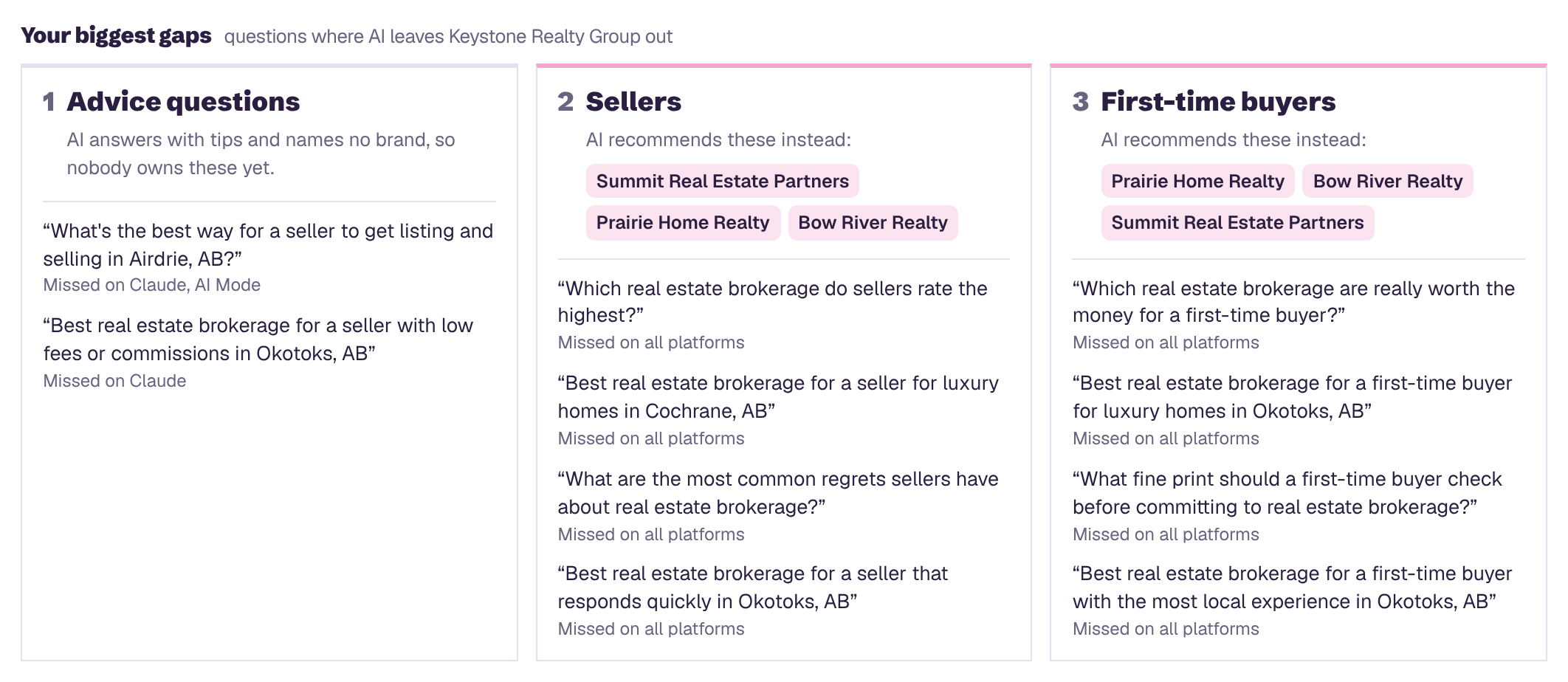
The gap is clearest side by side:
If you only fix three things
- Publish every fee in plain words, with examples.
- Explain screening, maintenance and communication.
- Give each city and property type its own page.
Owners are asking AI who they can trust with their property. The company AI names will be the one that's most transparent about how it works.
Part of our guide: Why AI visibility matters for real estate businesses
See what AI tells owners about your property management company
Enter your website and get a free AI visibility report. It takes a few minutes, and you'll see:
- Your AI visibility score, overall and for ChatGPT, Gemini, Claude, Perplexity and Google's AI Overviews and AI Mode
- Which property managers AI recommends instead of you, and how often
- Your visibility in every city you serve, and the competitor AI names most in each one
- What AI gets wrong about you, and what to fix first
- Your biggest gaps: the buyer questions where AI leaves you out, and who it recommends instead
- A downloadable PDF you can share with your team