How buyers, sellers and owners choose an agent, manager or builder now, and why AI visibility decides who gets the listing
Buyers, sellers, landlords and future homeowners now ask AI which agent, property manager or builder to trust. Here's how their journey works, what they ask at each step, and how to build a real estate business AI recommends.
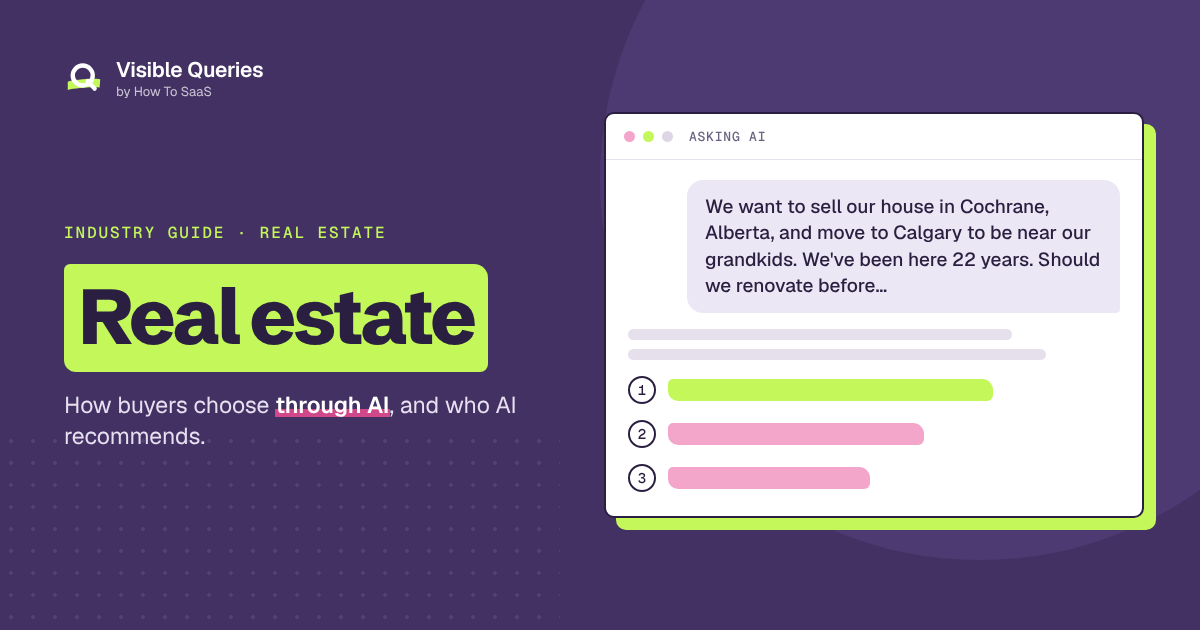
It's a Sunday night in Cochrane. A couple in their sixties has finally decided: the kids and grandkids are in Calgary, the house has too many stairs, and it's time to sell. They've lived there for 22 years. They have no idea what it's worth now, whether to fix the kitchen first, or how to choose an agent. A neighbor used a discount brokerage last spring and the house sat for months. Another neighbor's house sold in a weekend.
A few years ago, they would have called the agent whose face is on the grocery cart, or the one who sends the fridge magnets, or asked around at church.
Tonight, one of them opens ChatGPT and types:
"We want to sell our house in Cochrane, Alberta, and move to Calgary to be near our grandkids. We've been here 22 years. Should we renovate before selling? Is a discount brokerage good enough, or do we need a full-service agent? Who are the best agents for sellers around Cochrane?"
The answer explains that small, inexpensive updates usually beat big renovations before a sale, that pricing right in the first two weeks matters more than almost anything else, and how full-service agents differ from discount brokerages. It suggests interviewing two or three agents and asking for recent local sales. Then it names three brokerages, with a line on each.
They call the first two on Monday.
That's how a growing share of people now choose real estate agents, property managers and home builders. They describe their situation, their timeline, their worries and their budget, and AI gives them a short list. The businesses on that list get the listing appointment, the management contract or the model home visit. The rest don't hear about it.
This article walks through how buyers, sellers, landlords and future homeowners choose a real estate business today, step by step, with examples from real estate agents and brokerages, property management companies and home builders. It covers what people ask AI at each step, what makes AI recommend one business over another, and what the businesses that keep getting recommended tend to do differently. Most of it comes down to being clear about who you serve, where you work and what results you get.
Along the way you'll see screenshots from a Visible Queries report for Keystone Realty Group, a sample brokerage in the Calgary area. The brokerage and its competitors are made up, but the report is real. It's exactly what any real estate business sees when it runs its own.
Why the old playbook isn't enough anymore
Real estate has always been a referral and relationship business. Past clients, sphere of influence, open houses, signs on lawns, community sponsorships and the agent everyone at the school knows. Marketing filled in with listing portals, social media, mailers and paid leads.
All of that still matters. But more and more, the first conversation someone has about buying, selling or building isn't with an agent at an open house. It's with an AI assistant at 10 p.m., where they can ask every "dumb" question without anyone trying to sign them.
Three things follow from that:
- People describe their situation, not a service. "Downsizing after 22 years and moving closer to family" or "first-time buyer who's self-employed" gets agents who clearly specialize. "Your trusted real estate professional" matches nothing in particular.
- The shortlist is tiny. A portal shows hundreds of agents. An AI answer names three. Those three get the listing appointments.
- Your reputation is summarized. People ask "Is [agent] good for sellers? How fast do their listings sell?" and get a short answer drawn from reviews, your website and whatever else AI can find.
None of this replaces relationships or referrals. They're the raw material AI reads. What's changed is that your track record now has to be written down, specific and findable, not just known around town.
The client's journey, step by step
Whether it's a rental condo, a first home, a downsizing sale, a portfolio of rentals that needs a manager or a new build, the path looks similar. What changes is how long it takes and how much is at stake.
- Something prompts the search. A move, a life change, a market shift, a frustrating landlord experience or a dream of building.
- They try to understand the process. How it works, what it costs and what to watch out for.
- They build a shortlist. Which agents, managers or builders know their area and situation.
- They check who to trust. Track record, reviews, fees and how they communicate.
- They choose. Interviews, listing presentations, contracts, model homes and fit.
- They stay, refer, or come back. The experience, the result, reviews and the next transaction.
AI now shows up at every one of these steps. Here's what that looks like.
Step 1: Something prompts the search
Real estate searches almost always start with a life event.
- A new job, a transfer or a move to be closer to family.
- A new baby, kids leaving home, a divorce or a death in the family.
- Rising rent and the question "should we finally buy?"
- A rental property that's become too much work to manage.
- Rates changing, prices changing, or a neighbor's house selling for a surprising number.
- The dream of building a home exactly the way you want it.
The first questions people ask AI are about the situation, not about you. "Should we sell before or after buying?" "Is it a good time to buy in Calgary?" "How much is my house worth?" "Should I hire a property manager for one rental?" "How long does it take to build a house in Alberta?"
This is where AI shapes what people think they need, and that decides who gets called. If AI tells the Cochrane couple that a full-service agent with strong local data usually nets sellers more, they look for a full-service agent with strong local data. If it suggests a discount brokerage is enough, the full-service agent never gets the call.
The businesses that do well at this step publish honest, useful answers to the questions people ask before they're ready to hire anyone. An agent with a clear, regularly updated guide to the local market. A brokerage with an honest page on what to fix before selling and what to leave. A property manager with a plain-language guide to what self-managing really involves. A builder with a realistic build timeline and the steps from lot to keys.
AI relies on that kind of content because it's specific, local and current. Once your explanation shapes the answer, your name tends to follow.
What good businesses do at this step:
- Write about the life events that start the search, in plain language.
- Publish local market updates regularly. "What's happening in Airdrie this month" is the kind of content AI loves to cite.
- Be honest. "You probably don't need to renovate the kitchen" builds more trust than any slogan.
Step 2: They try to understand the process
Next, people learn how it all works. This is where they're most open, and where AI does most of the teaching.
- "Is a discount brokerage good enough to sell my home?"
- "Full-service agent vs discount brokerage: which nets more?"
- "How do buyers end up overpaying for a home?"
- "What does a property manager charge, and is it worth it?"
- "Production builder vs custom builder: what's the difference?"
- "What are closing costs for a buyer in Alberta?"
This is where people decide what kind of help they want, and that decides who's even in the running.
Here's what this step looks like in a real report. These are questions AI was asked about real estate agents in the Calgary area, and who each platform named in its answer:
Look at the pattern. "Is a discount brokerage good enough to sell my home?" Bow River Realty on two platforms and Prairie Home Realty on another. "Is a full-service agent better than a discount brokerage for selling a home?" Bow River Realty on two platforms, with Keystone mentioned on the other two. "What does a home sitting on the market really cost a seller?" Competitors on every platform. "How do buyers end up overpaying for a home?" Competitors on three of four.
These are exactly the questions the Cochrane couple is asking. They're sellers deciding what kind of agent to hire, and they haven't chosen one yet. The brokerage that appears in those answers is very often the one they call for a listing appointment.
What moves a business into these answers is the same thing that helps people understand the process:
- Clear explanations of how you work compared with the alternatives: discount brokerages, flat-fee models, selling privately, self-managing a rental or buying a resale instead of building.
- Plain information about cost: commission structure, what's included, management fees, builder pricing and what upgrades typically cost.
- Who you serve best: sellers, first-time buyers, downsizers, investors, relocations, acreages, luxury homes, specific communities.
What good businesses do at this step:
- Explain your approach and compare it fairly with the alternatives people are weighing.
- Be clear about cost and what's included.
- Say exactly who you're best for, and in which communities.
Step 3: They build a shortlist
Real estate is intensely local. People want an agent who knows the specific community, the schools, the streets that flood, the builders' reputations and what homes actually sold for last month.
The questions get specific:
- "Best listing agent in Cochrane for an older home."
- "Real estate agent in Airdrie for first-time buyers."
- "Property management company in Calgary for a single condo."
- "Home builders in Okotoks with lots available this year."
- "Agent who specializes in acreages near Calgary."
For brokerages and builders working across several communities, this is where gaps show. AI can recommend you every time in one city and almost never in the next. Here's the sample brokerage across the four communities it serves:
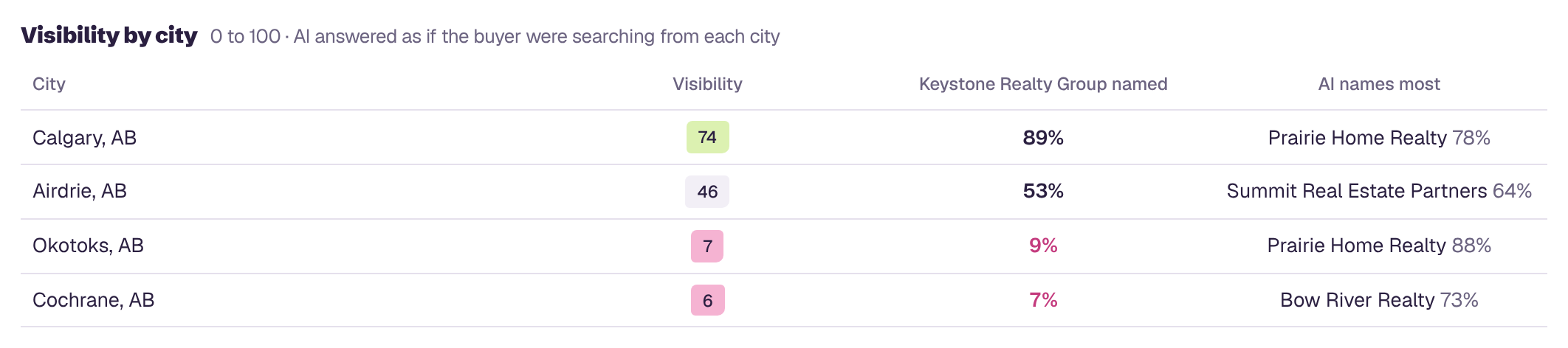
In Calgary, Keystone scores 74 and is named in 89% of answers. In Airdrie it scores 46 and is named in about half of them. But in Cochrane, where the couple in the opening example lives, it scores 6 and is named in just 7% of answers, while Bow River Realty is named in 73%. In Okotoks it scores 7, named in 9%, while Prairie Home Realty is named in 88%.
That's typical. A brokerage's home market has years of sales, reviews, signs and community presence. The surrounding communities might have plenty of actual sales, but no community pages, no local market updates and few reviews that mention the town by name. AI can't recommend you somewhere it doesn't know you work.
What good businesses do at this step:
- Build a real page for every community you serve: recent sales, market trends, neighborhoods, schools and reviews from clients there.
- Mention communities by name in your market updates, listings, sold stories and reviews.
- Be specific about specialties: acreages, condos, new builds, relocations, investors, first-time buyers or downsizers.
Step 4: They check who to trust
A home is usually the biggest purchase or sale of someone's life. People are trusting you with their savings, their timeline and often their emotions. So they check.
- "Is [agent] good for sellers? How fast do their listings sell?"
- "What do clients say about [brokerage]?"
- "Does [property manager] actually respond to tenants?"
- "Any complaints about [builder]'s quality or warranty?"
- "Does [agent] work with buyers and sellers, or just one?"
AI answers these in a couple of sentences. When it's accurate, that's a strong endorsement. When it's wrong, the person moves on quietly.
Here's what that looks like in the sample report:
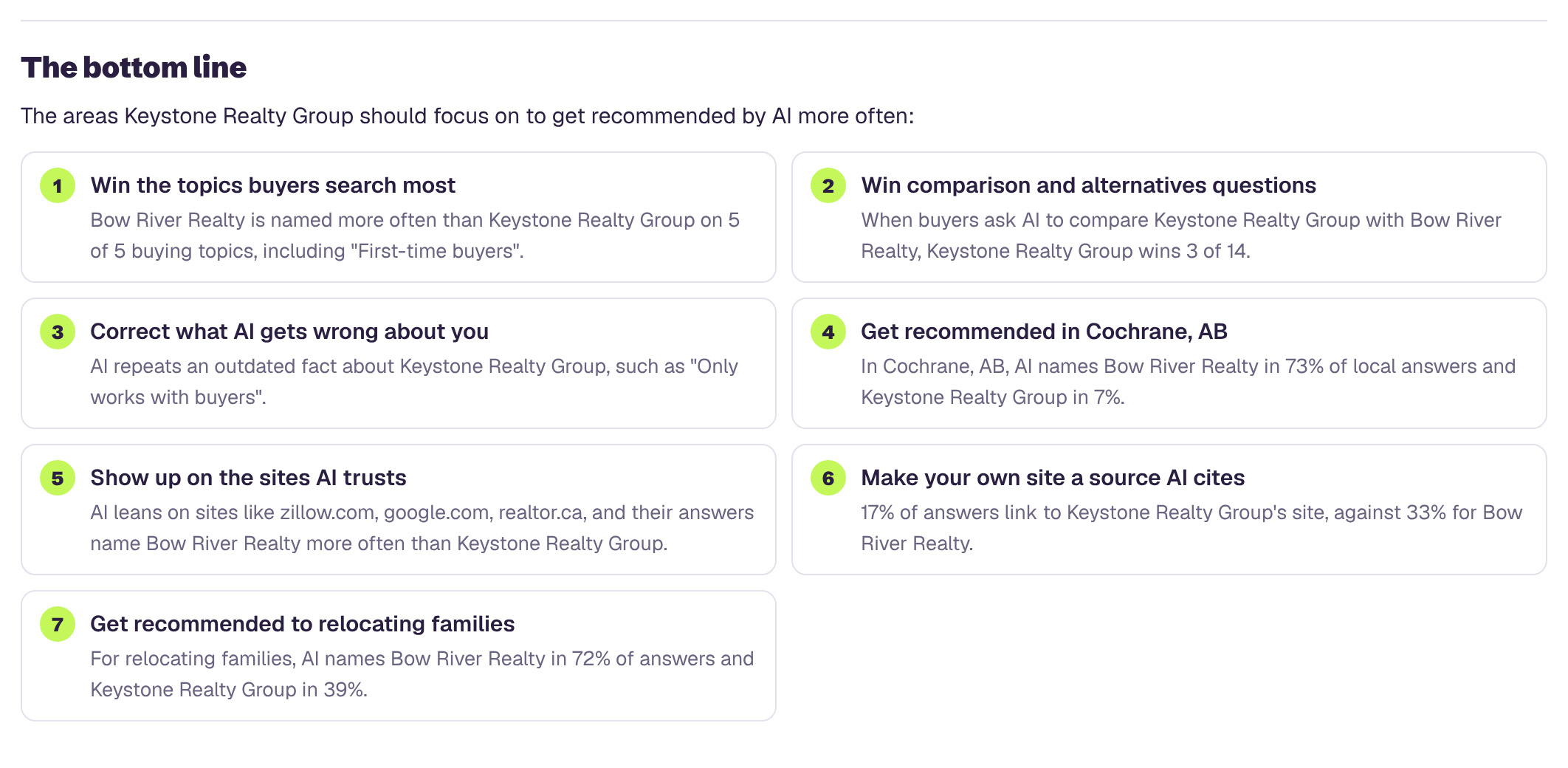
The first gap is the kind that costs listings. AI tells people Keystone "only works with buyers." In reality, it represents buyers and sellers. Every seller who hears that answer, including the Cochrane couple, crosses Keystone off the list before calling.
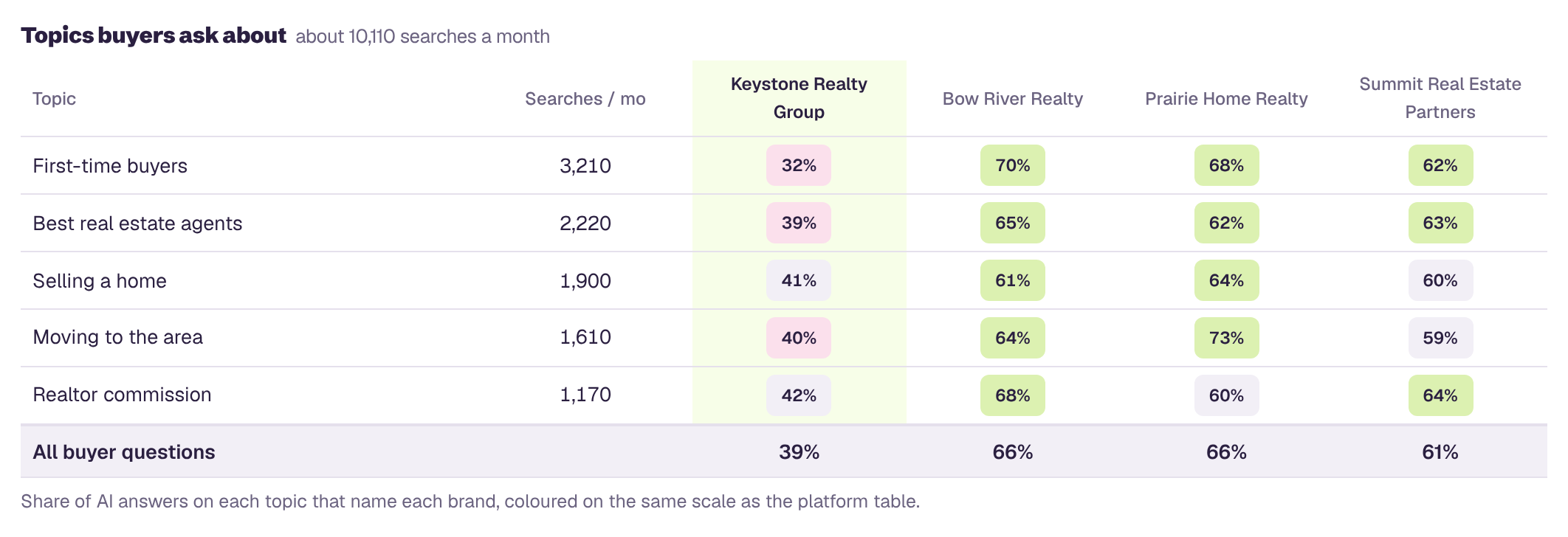
The report also shows Keystone named in only 44% of "best real estate agents" answers, and Bow River Realty named instead in 43% of buyer questions, including "Why do some homes sit on the market for months?", which is a question every listing agent should want to answer. Overall accuracy is 58%. Nearly half of what AI says about the brokerage's core facts is wrong.
Wrong facts in real estate usually come from a few places:
- History. A brokerage that started as a buyers' team, an agent who changed brokerages, a builder that used to build in different communities.
- Portal and directory profiles that are out of date or generic.
- Agent vs brokerage confusion. Reviews for individual agents scattered across platforms, under slightly different names.
- Silence. If you never state who you represent, where you work, your fees and your results, AI fills the gap with whatever it can find.
What good businesses do at this step:
- State the core facts plainly: who you represent, which communities you serve, how you charge and what's included.
- Share results honestly and clearly: recent sales, days on market and sale-to-list ratios where your rules allow, management results like occupancy and tenant retention, or build timelines and warranty details.
- Keep every profile consistent: website, portals, Google Business Profile, social media and brokerage pages.
- Ask happy clients for reviews that mention the community, the situation and the result.
Step 5: They choose
By now, people usually have two or three names in mind. They're comparing the details that decide it:
- "Keystone vs Bow River Realty for selling a house in Cochrane?"
- "What commission do agents charge in Calgary?"
- "Which property managers in Calgary charge under 10%?"
- "Which Okotoks builders have quick possession homes?"
- "Will [agent] help us buy and sell at the same time?"
Head-to-head questions are where share of voice matters most. If someone asks AI to compare you with a competitor and AI has much more to say about the competitor, the competitor tends to win.
In the sample report, Bow River Realty is named in 66% of answers, Prairie Home Realty in 66% and Summit Real Estate Partners in 61%. Keystone is named in 39%. Despite a commanding position in Calgary, Keystone scores 35 overall, in the Overlooked band, and is the fourth name in most conversations across the region.
The businesses that win at this step make the decision easy:
- A clear first step. A free home valuation, a buyer consultation, a rental analysis or a model home tour, easy to book online.
- A clear process. What happens from listing to sold, from offer to keys, from signing a management agreement to the first tenant, or from contract to possession.
- Transparent costs. Commission and what it covers, management fees and leasing fees, builder base prices and typical upgrades.
- Named differences. Professional photography and staging, a pricing strategy, local data, a dedicated property manager, a construction warranty. Say so plainly.
What good businesses do at this step:
- Publish a fair comparison of your approach against the alternatives. People are already asking AI to make that comparison.
- Make the first step free, easy and quick.
- Keep fees, availability and inventory current everywhere.
Step 6: They stay, refer, or come back
Real estate relationships pay off over decades. A happy buyer becomes a seller in seven years. A downsizer refers their kids. A landlord with one condo adds three more. A homeowner who loved their builder tells everyone at the barbecue. Most of the business comes from people you've already served and people they send you.
Clients ask AI questions after the deal too:
- "Should we refinance or sell?"
- "Is it time to switch property managers?"
- "What should we do about a warranty issue with our builder?"
- "How much is our house worth now?"
The businesses that stay top of mind publish for past clients too: market updates, home value check-ins, maintenance guides and investment advice. And when clients feel well looked after, they write reviews, refer friends and come back. That's exactly what AI reads when it decides who to recommend next.
What good businesses do at this step:
- Stay in touch with useful content, not just "just listed" announcements.
- Make it easy for past clients to check their home's value or ask a question.
- Ask for reviews at natural moments, like closing day, possession day, a successful lease-up or the first anniversary in a home.
How the journey plays out across real estate
The six steps are the same everywhere, but what people ask, and what decides the choice, varies a lot by type of business.
Real estate agents and brokerages
This is the journey in the example above. Sellers ask about pricing, preparation, timing and agent choice. Buyers ask about affordability, neighborhoods, offers and closing costs. Both ask: "How do I choose a real estate agent?" "What commission is normal?" "Best agent in [community] for [situation]?"
AI recommends agents and brokerages that are specific about who they represent, where they work and what results they get, and that publish regular, genuinely useful local market content. Community pages, sold stories with real details and reviews that mention the neighborhood make a big difference. Agents with a clear niche, like downsizers, first-time buyers, acreages, condos or relocations, get recommended far more often for those questions.
Full guide: AI visibility for real estate agents and brokerages
Property management companies
Property management searches are usually triggered by frustration: a bad tenant, a late-night repair call, a landlord who's moving away or simply too busy. Owners ask: "Is a property manager worth it for one rental?" "What do property managers charge in Calgary?" "Best property management for condos." Tenants ask about the managers, too.
AI recommends managers that are clear about fees (management, leasing, renewals and maintenance markups), the property types they handle, how they screen tenants, how they handle maintenance, and how they report to owners. Reviews from both owners and tenants matter, because AI reads both.
Full guide: AI visibility for property management companies
Home builders
Building is the longest journey in real estate, often a year or more from first search to possession. People ask: "Production vs custom builder," "how long does it take to build a house in Alberta," "best builders in Okotoks," "what's included in a builder's base price?" "Any complaints about [builder]?"
AI recommends builders that publish their communities, floor plans, starting prices, what's included as standard, build timelines, warranty details and quick-possession inventory. Honest content about the building process, including delays and how they're handled, builds the kind of trust that turns into referrals.
Full guide: AI visibility for home builders
Building a real estate business AI recommends
Across agents, property managers and builders, the businesses AI keeps recommending share the same habits. None of them are tricks. They're what great real estate businesses already do, written down clearly enough for a client, or an AI, to understand.
- Say exactly who you serve. Buyers, sellers, investors, downsizers, landlords, first-time buyers, custom builds. Be specific.
- Name every community you work in. Give each one a real page with local data, sales and reviews.
- Publish local market updates regularly. Current, specific, honest and easy to cite.
- Explain the process in plain language. From first call to keys, step by step.
- Be clear about cost. Commissions, management fees, builder pricing and what's included.
- Share results. Sales, days on market, occupancy, build timelines and warranties, presented honestly.
- Fix wrong facts fast. One wrong line about who you represent can cost you every seller who hears it.
- Keep every profile consistent. Website, portals, directories, brokerage pages and social profiles.
- Make the first step easy. Valuations, consultations, rental analyses and tours, bookable online.
- Build reviews that mention specifics. The community, the situation and the result.
You can see how much these habits matter in the full report. Here's the sample brokerage's overall score and the metrics behind it:
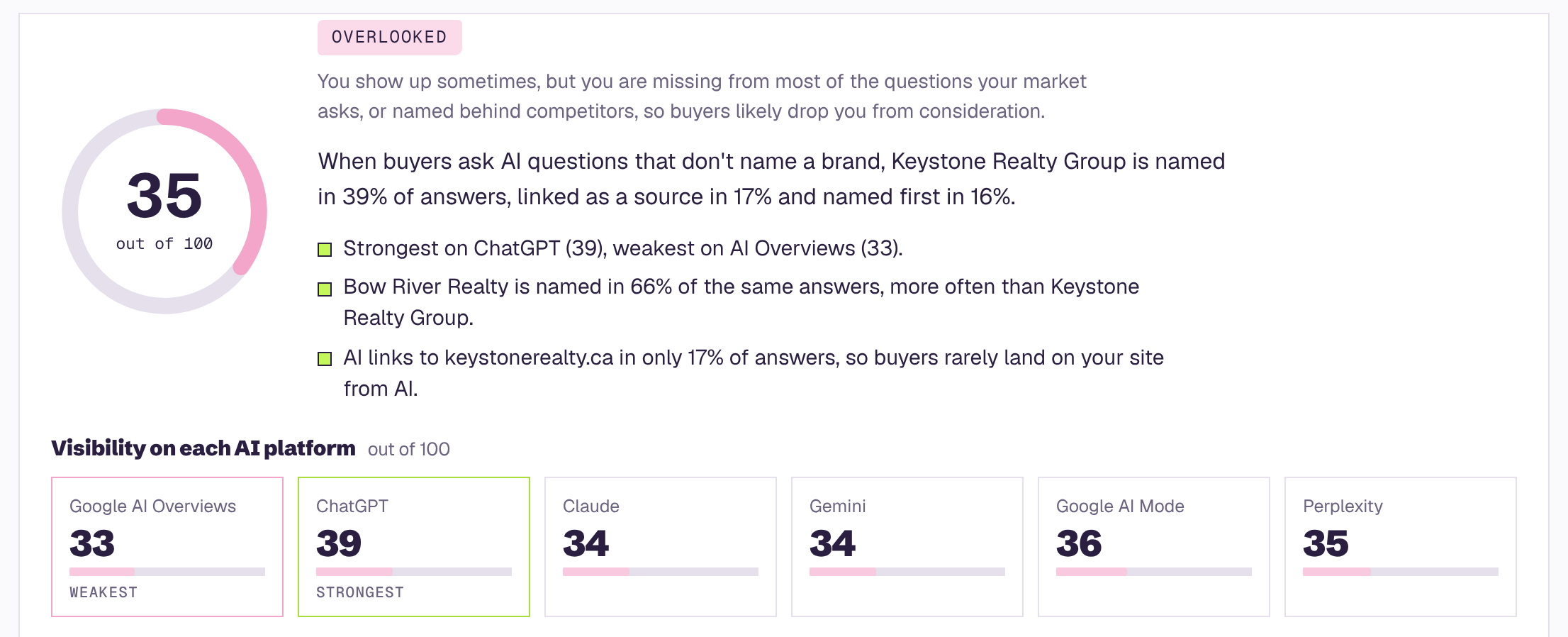

An Overlooked score with 72% accuracy tells a clear story. AI recommends Keystone in its home market, but it gets more than a quarter of the core facts wrong, rarely cites the brokerage's website, and barely knows it works in the surrounding communities. The fixes are concrete: correct the "buyers only" error everywhere it appears, build real community pages and reviews for Cochrane and Okotoks, and own the seller questions about pricing, preparation and days on market.
People still want someone who knows the market
People have always chosen agents, managers and builders based on trust, local knowledge and referrals. That hasn't changed. What's changed is who they ask first. More and more, it's an AI assistant, and it recommends the businesses it understands best.
The real estate businesses that win this shift aren't doing anything exotic. They're clear about who they serve and where. They publish real local knowledge. They keep their facts consistent everywhere. And they make sure what AI says about them is true.
The first step is knowing where you stand today.
Keep learning
- What is AI visibility?
- How to get your business recommended by AI, with guides for ChatGPT, Google AI Overviews, Perplexity, Gemini and Claude
- AI visibility benchmark 2026
- The AI visibility glossary
See what AI tells clients about your business
Enter your website and get a free AI visibility report. It takes a few minutes, and you'll see:
- Your AI visibility score, overall and for ChatGPT, Gemini, Claude, Perplexity and Google's AI Overviews and AI Mode
- Which agents, brokerages or builders AI recommends instead of you, and how often
- Your visibility in every city and community you serve, with the questions you win and lose in each one
- What AI gets wrong about you, and what to fix first
- Your biggest gaps: the buyer questions where AI leaves you out, and who it recommends instead
- A downloadable PDF you can share with your team