Free AI visibility check vs paid tracking: which do you need?
Free AI visibility checks show where you stand today. Paid trackers watch the same prompts every day. What each tells you, what tracking really costs, and how to know when you're ready to pay for it.
The owner of a three-location physical therapy practice asks Gemini:
"Who's the best physical therapist in Austin for a running injury? I'd like somewhere that can see me this week."
Two clinics come back, and neither is theirs. They find a list of AI visibility tools. Some are free. Some cost $50, $95 or $99 a month. A few say "contact sales."
Which do they need? Probably not the expensive one, at least not yet. This article explains the difference between a free check and paid tracking, and how to tell when tracking is worth paying for.
What a free check tells you
A free AI visibility check is a snapshot. It asks AI platforms a set of questions about your market today, and reports what came back.
A good one answers four questions:
- Does AI recommend you when buyers ask about what you sell, where you sell it?
- Who does it recommend instead, and how often?
- Which questions do you lose, and what did AI say in its answer?
- What does AI get wrong about you, such as services, prices, hours or locations?
That's the information you need to decide what to work on. Free checks include Visible Queries, which works from your website address and reports across ChatGPT, Gemini, Claude, Perplexity, Google's AI Overviews and Google AI Mode, and HubSpot's AI Search Grader, which works from a short description of your business and focuses on how AI describes your brand. The full tools guide compares them.

What paid tracking adds
A tracker asks the same set of prompts every day or week and charts the results. What you get for the money:
- Trends. Whether your visibility is rising or falling, and when it changed.
- Stability. AI answers vary from one day to the next. Asking repeatedly shows whether a result is a pattern or a one-off.
- Alerts and history. When a competitor overtakes you, or a new source starts getting cited.
- Scale. More prompts, more platforms, more regions and languages, more brands.
- Extra data on the bigger platforms, such as prompt volume estimates, AI crawler activity or shopping visibility.
What tracking actually costs
Published starting prices, as listed on each vendor's site on November 2, 2026:
| Tracker | Starting price | Prompts included |
|---|---|---|
| HubSpot AEO | $50 a month, or included in Marketing Hub Pro and Enterprise | 25 |
| Peec AI | $95 a month | 50 |
| Semrush AI Visibility Toolkit | $99 a month | 25 |
| Profound | Free 7-day trial; paid plans custom-priced | 50 on the trial |
| Ahrefs Brand Radar | From $199 a month (AI Visibility Index); custom prompts from $50 a month | Large built-in prompt database; custom prompts vary by tier |
Sources: HubSpot AEO, Peec AI, Semrush, Profound, Ahrefs.
The subscription is the smaller cost. The bigger one is the time to choose good prompts, read the dashboard, and turn changes into work. A tracker nobody reads costs the same as one that changes your business.
The prompt problem
Every tracker asks you to choose what to track, and this is where most teams go wrong.
Left to themselves, teams write prompts in their own language about their own product: "best [our category] software," "is [our brand] good." Those are the questions they're most likely to win already. Real buyers ask about their problem first ("my knee hurts after running, should I see a physio or a doctor?"), then about a shortlist in their city, then about price and trust.
Tracking the wrong prompts every day gives you a precise, steady measurement of the wrong thing. That's the strongest reason to run a check first: it shows you which buyer questions you lose, and those become your tracking prompts.
When to move from a check to a tracker
Four questions, in order:
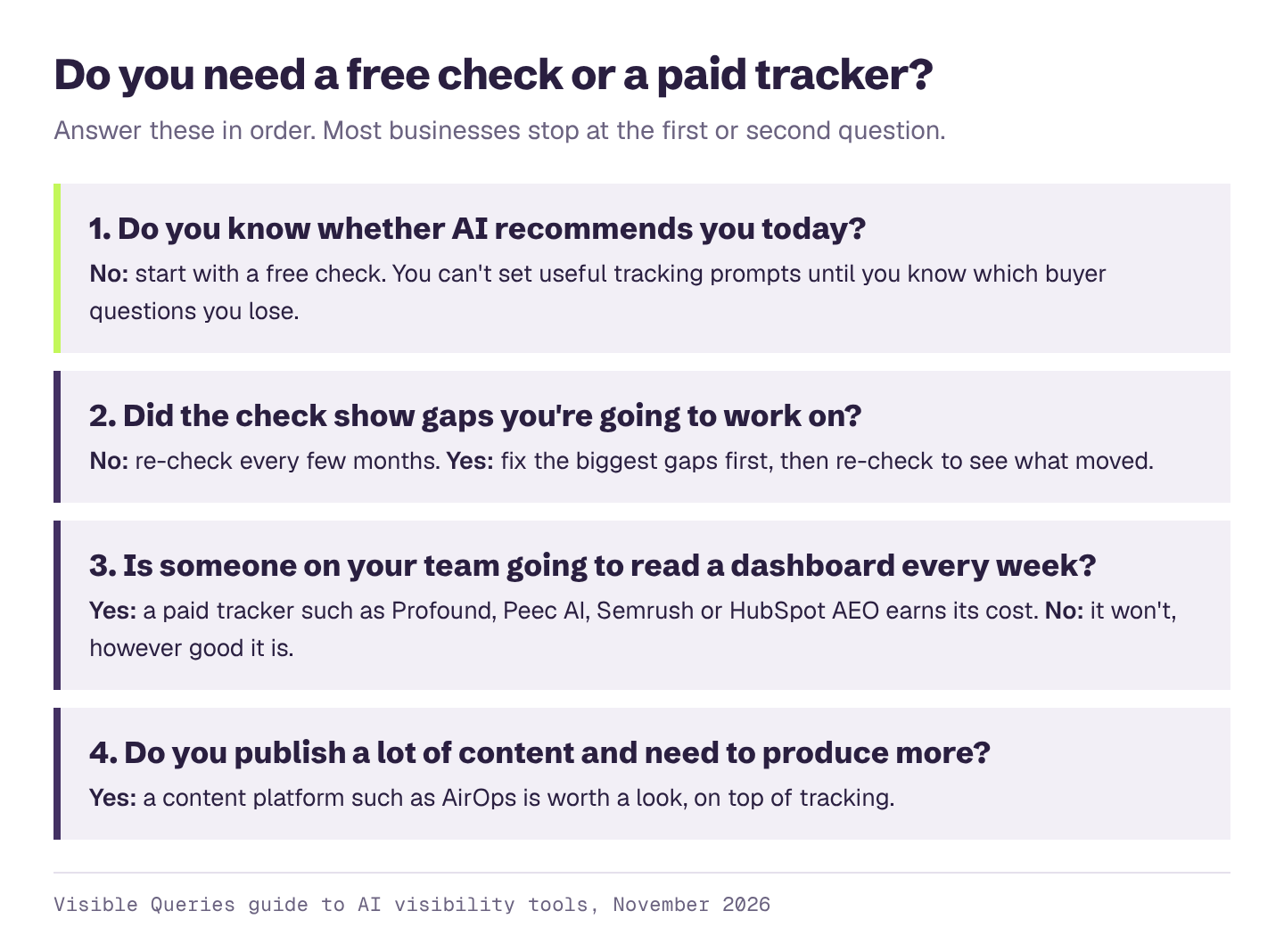
Some rules of thumb:
- If you haven't checked yet, check first. There's nothing to track until you know where you stand.
- If you're not actively working on AI visibility, a re-check every few months is enough. Nothing will change fast enough to need daily data.
- If you're publishing and fixing things every month, and someone owns the result, tracking becomes worth it. You'll want to see which changes moved the numbers.
- If you're a large brand with many products, markets and competitors, tracking is part of the job, and the enterprise platforms earn their price.
The bottom line
A free check and a tracker aren't competitors. They're steps.
The check tells you where you stand and what to fix. The fixing is the work: correcting wrong facts, getting onto the lists and review sites AI reads, and publishing pages that answer the questions buyers ask. Tracking tells you whether that work is paying off, and it's worth paying for once there's work to measure.
Part of our guide: AI visibility tools compared. See also: the best AI visibility tools in 2026, Profound alternatives and free AI visibility tools.
Start with a free check
Enter your website and get a free AI visibility report. It takes a few minutes, and you'll see:
- Your AI visibility score, overall and for ChatGPT, Gemini, Claude, Perplexity and Google's AI Overviews and AI Mode
- Who AI recommends instead of you, and how often
- Which topics you win and lose, and how often each one is searched
- What AI gets wrong about you, and what to fix first
- A downloadable PDF you can share with your team