AI visibility tools compared: how to pick the right one for your business
An honest guide to the tools that show how your business appears in ChatGPT, Gemini, Claude, Perplexity and Google's AI answers: what each kind of tool does, what it costs, what it asks of you, and which one fits where you are.
A marketing lead at a 60-person software company opens ChatGPT and types the question their buyers ask:
"What's the best accounts payable automation software for a mid-sized company that uses NetSuite?"
Three competitors come back. Their company isn't one of them. The next morning they search for "AI visibility tool" and find a dozen products, each promising to fix this, with prices that run from free to "talk to sales."
This guide is for that moment. It explains what AI visibility tools actually do, sorts them by the job they're built for, and compares the main options on what matters to a business deciding what to buy: what you get, what you have to set up, which AI platforms are covered, and what it costs.
We make one of these tools, Visible Queries, so read our view of it with that in mind. We've tried to describe every product, ours included, by what it does and doesn't do, and every price and feature below comes from the vendor's own website, checked on November 2, 2026. Plans change often in this market, so check the vendor's page before you buy.
What an AI visibility tool actually measures
Every tool in this category works the same basic way. It sends questions to AI assistants such as ChatGPT, Gemini, Claude and Perplexity, or to Google's AI Overviews, collects the answers, and looks for your brand in them.
From those answers they report some mix of:
- Mentions: how often your brand is named in the answer.
- Citations: how often the answer links to your website as a source.
- Share of voice: how often you're named compared with competitors.
- Position: whether you're the first name in the answer or the fifth.
- Sentiment or accuracy: how AI describes you, and whether what it says is true.
The differences between tools come from four choices, and they matter more than any feature list:
- Who writes the questions. Some tools ask you to write the prompts to track. Others work out the questions from your website or from large databases of real searches. If you write the questions yourself, you'll tend to test the questions you already expect to win.
- How often they ask. A one-time check gives you a snapshot. A tracking tool asks the same questions every day or week and shows trends.
- Which AI platforms they cover. Buyers don't all use ChatGPT. Coverage of Google's AI Overviews, Gemini, Claude, Perplexity and Copilot varies a lot, and often depends on the plan.
- What happens after the report. Some tools stop at the diagnosis. Others add recommendations, content writing, or a full content production system.
Three jobs, three kinds of tool
The easiest way to make sense of the market is to ask which job you're hiring a tool for. Almost every product is built mainly for one of three.
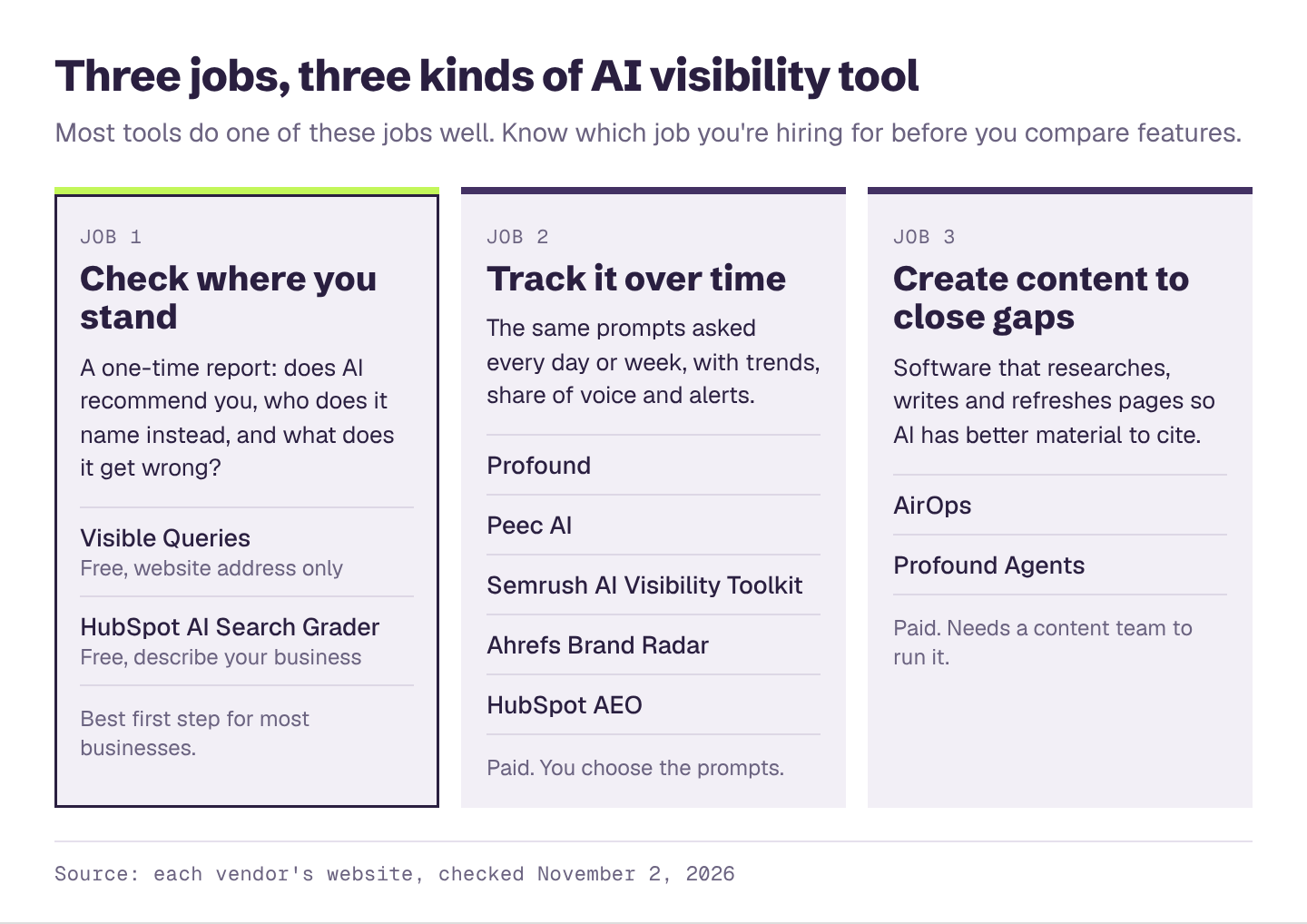
Job 1: Check where you stand. You want to know, today, whether AI recommends you when buyers ask about what you sell, who it recommends instead, and what it says about you. This is a one-time report. Visible Queries and HubSpot's AI Search Grader are both free tools built for this job.
Job 2: Track it over time. You already know where you stand, you're working on it, and you want to see whether the numbers move. These tools ask a fixed set of prompts every day or week and chart the results. Profound, Peec AI, Semrush's AI Visibility Toolkit, Ahrefs Brand Radar and HubSpot AEO all live here. They're paid, and most ask you to choose the prompts.
Job 3: Create content to close the gaps. You know which questions you're losing and you need to produce the pages, comparisons and answers that would change that. AirOps is built mainly for this, and Profound has added AI agents that do some of it.
Most businesses need Job 1 first. You can't write useful tracking prompts, or brief a content team, until you know which buyer questions you lose and why. Our article on free checks versus paid tracking goes deeper on when to move from one to the next.
The tools at a glance
| Tool | Main job | What you give it | Starting price |
|---|---|---|---|
| Visible Queries | Check where you stand | Your website address | Free |
| HubSpot AI Search Grader | Check where you stand | Company name, location, products, industry | Free |
| HubSpot AEO | Track over time | Prompts you write (25 included) | $50 a month, or included in Marketing Hub Pro and Enterprise |
| Profound | Track over time, plus content agents | Prompts you choose | Free 7-day trial; paid plans are custom-priced |
| Peec AI | Track over time | Prompts you choose | $95 a month (Starter, 50 prompts) |
| Semrush AI Visibility Toolkit | Track over time | Prompts you choose (25 included) | $99 a month |
| Ahrefs Brand Radar | Track over time, against a large prompt database | A brand or category to look up; custom prompts optional | From $199 a month (AI Visibility Index), or $50 a month for custom prompts |
| AirOps | Create content | Brand kit, knowledge bases, workflows | Free to start; Enterprise is custom-priced |
| Otterly.AI | Track over time | Prompts you choose | €29 a month (Lite, 16 prompts) |
| Scrunch | Track over time, plus an AI-friendly site | Prompts and personas | $250 a month billed yearly |
| AthenaHQ | Track over time | Topics and prompts, paid in credits | Free tier; $295 a month |
Prices and plans as listed on each vendor's website on November 2, 2026.
Which AI platforms each tool covers
Coverage is where tools differ most, and where the plan you pick matters. A tool that only checks ChatGPT will miss buyers who meet Google's AI Overviews on a normal search, and a tool that skips Claude will miss the buyers who do their research there.
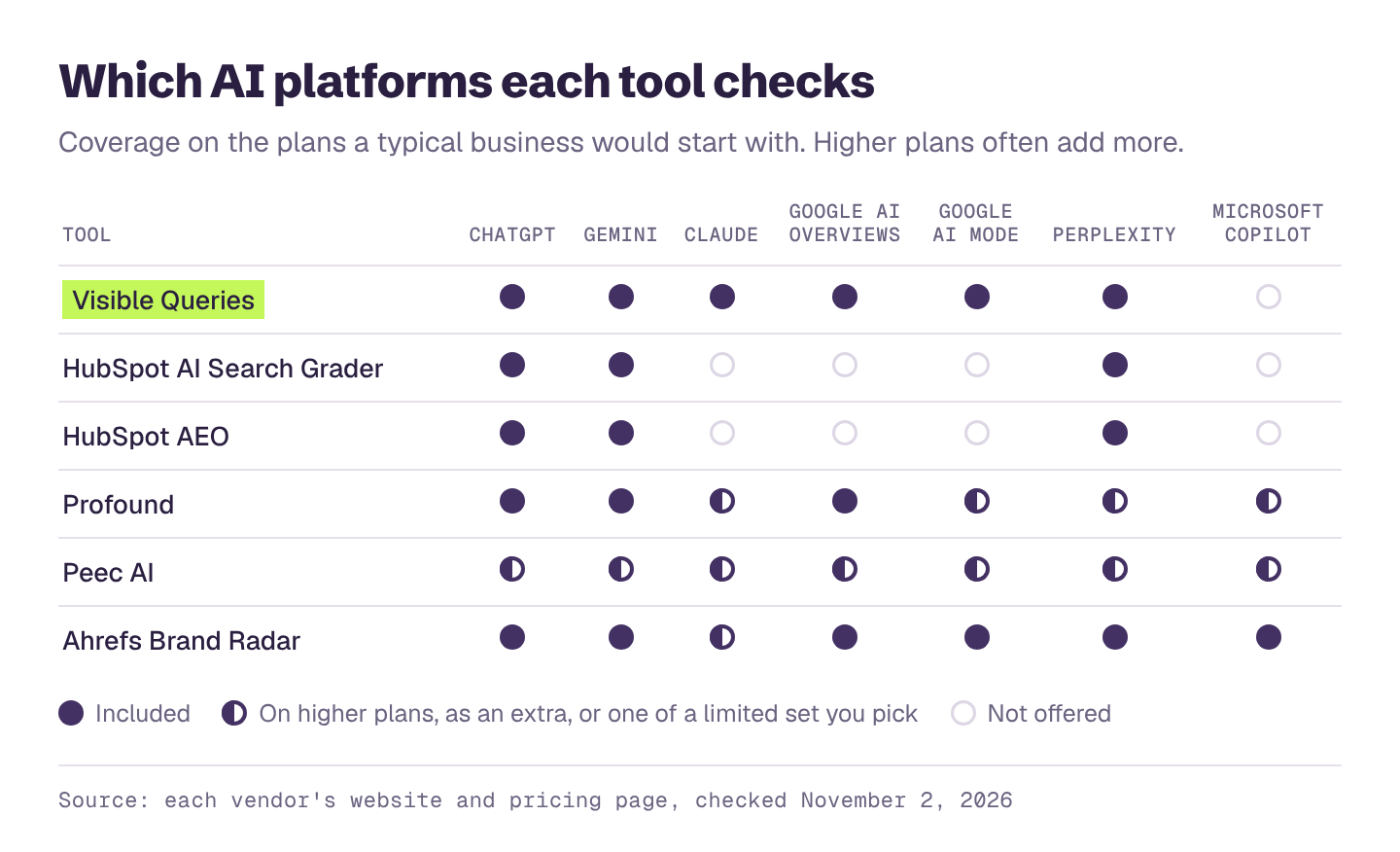
A few things stand out:
- Google's AI Overviews appear on ordinary Google searches, so they reach buyers who never open an AI assistant. HubSpot's tools don't check them. Visible Queries, Profound, Ahrefs and Peec AI do.
- Google AI Mode is Google's full AI search experience. Visible Queries and Ahrefs include it; Profound and Peec AI offer it on higher plans or as one of the models you pick.
- Claude is covered by Visible Queries as standard. Profound, Peec AI and Ahrefs offer it on higher plans or as an extra, and HubSpot doesn't cover it.
- Perplexity is covered by Visible Queries and both HubSpot tools as standard, and by the tracking platforms, often on higher tiers.
- Copilot is covered by the tracking platforms, often on higher tiers. Visible Queries doesn't check it today, and if your buyers lean on Copilot, that's a gap to weigh.
What you hand over before you see a result
Tools also differ in how much work they ask of you up front. That matters for two reasons: setup takes time, and whatever you type in shapes the result.
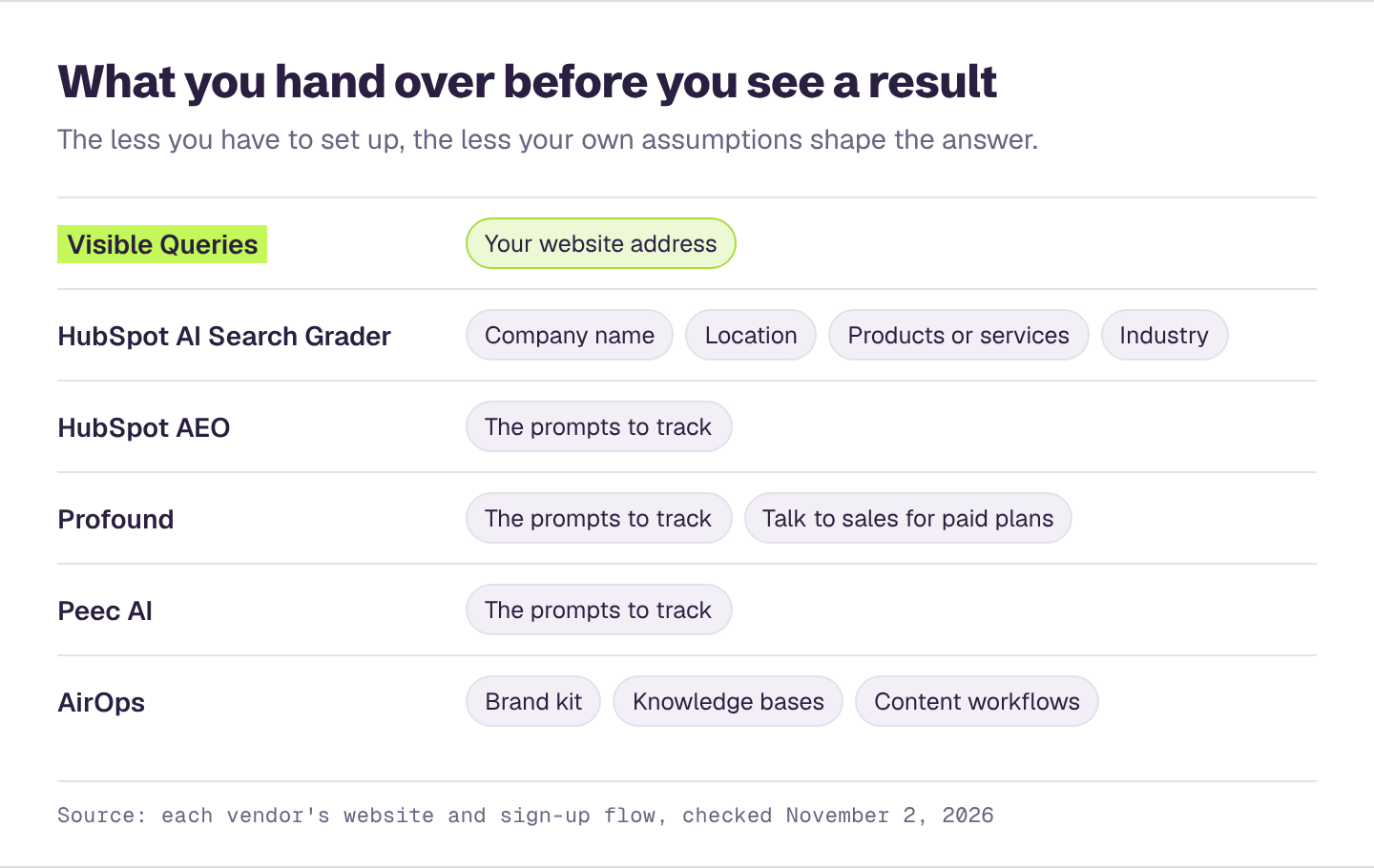
If you write the prompts yourself, you're likely to test your own brand's language and the questions you already expect to rank for. Real buyers ask messier questions, and they ask about their problem before they ask about any product. Tools that work out the questions from your website, or from databases of real searches, are less likely to flatter you.
The free tools: Visible Queries and HubSpot's AI Search Grader
Both are free, and both give you a picture of where you stand today. They're built quite differently.
HubSpot's AI Search Grader asks for your company name, location, products or services, and industry, then checks ChatGPT, Gemini and Perplexity. It returns a score out of 100. The largest part of that score, up to 40 points, is sentiment: how positively AI describes your brand. The rest covers presence quality, brand recognition, share of voice and market competition (HubSpot). It's a quick read on how AI sees your brand when asked about it.
Visible Queries asks only for your website address. It reads your site, works out what you sell, who buys it and where, then asks the questions those buyers ask across ChatGPT, Gemini, Claude, Perplexity, Google's AI Overviews and Google AI Mode. The report shows how often you're named and cited, which competitors AI recommends instead, which buyer questions you win and lose with what AI actually said, which facts AI gets wrong compared with your own website, and, for local businesses, how visible you are city by city.
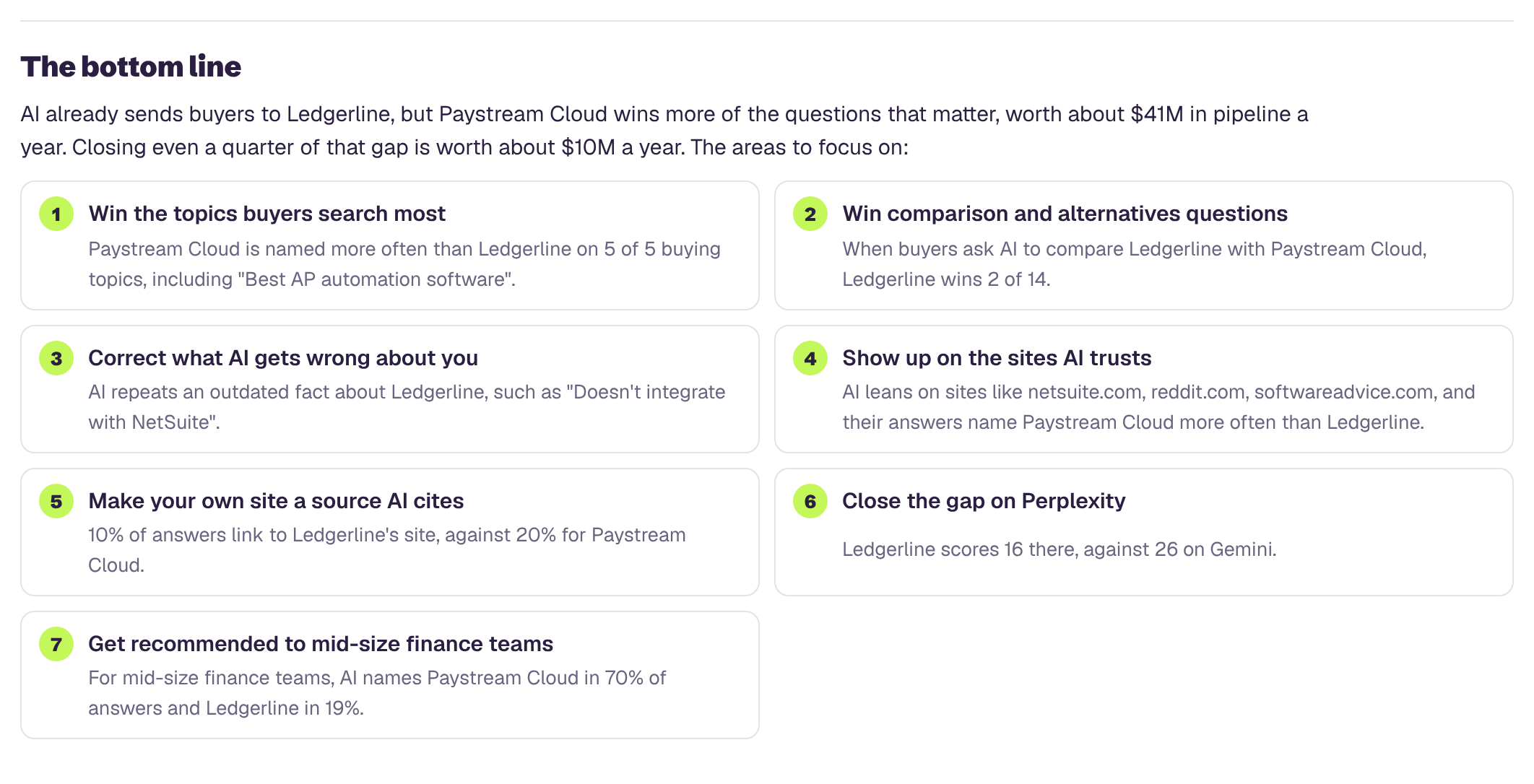
The main difference is the kind of question. The Grader mostly measures how AI talks about your brand. Visible Queries mostly measures whether AI brings you up when a buyer asks about their problem and hasn't heard of you yet. Both are useful, and since both are free, there's no reason not to run both. Our full comparison with HubSpot covers the Grader and HubSpot's paid AEO tool in detail.
What neither free tool does: track your numbers over time, or create content for you.
The tracking platforms
If you've done a check, you're working on the gaps, and you want to see progress week by week, a tracking platform is the next step. They're priced by the number of prompts you track and how many AI platforms you include.
Profound is the best-known enterprise platform. It tracks prompts daily across up to nine answer engines on its Enterprise plan, including ChatGPT, Perplexity, Google AI Mode, Gemini, Copilot, Claude and Google's AI Overviews. It adds Prompt Volumes, which estimates what people actually ask AI from a large set of real conversations, Agent Analytics, which shows how AI crawlers visit your site, ChatGPT Shopping data for retailers, and AI agents that help produce content. A free trial tracks 50 prompts daily for 7 days on ChatGPT, Gemini and Google's AI Overviews. Paid plans are custom-priced (Profound pricing). Visible Queries vs Profound goes into when each makes sense.
Peec AI is a self-serve tracker with published prices: $95 a month for 50 prompts, $245 for 150 and $495 for 350, each run daily on a set of AI models you pick, with more models on Enterprise (Peec AI pricing). It's a good fit for a marketing team that wants tracking without an enterprise sales process. Visible Queries vs Peec AI compares the two.
Semrush's AI Visibility Toolkit costs $99 a month and includes 25 tracked prompts, competitor research, prompt research with volume estimates, brand sentiment analysis, and a site audit that flags issues blocking AI crawlers (Semrush). It fits teams that already run their SEO in Semrush. See Visible Queries vs Semrush.
Ahrefs Brand Radar takes a different approach. Instead of only tracking prompts you write, it runs a very large database of search-based prompts through each AI platform and reports mentions, citations, share of voice and estimated impressions, with custom prompt tracking available too (Ahrefs). The index starts at $199 a month, and it's strongest for brands with a lot of search demand. See Visible Queries vs Ahrefs Brand Radar.
HubSpot AEO tracks 25 prompts you write across ChatGPT, Gemini and Perplexity, with daily updates and recommendations, for $50 a month. It's included in Marketing Hub Pro and Enterprise (HubSpot AEO). If you already live in HubSpot, it's the easiest tracker to add.
All of these are good at what they're built for. The honest catch is that a tracker is only as useful as the prompts you give it and the person who reads it. If nobody on your team will look at the dashboard each week and act on it, a monthly bill buys very little.
The content platforms
AirOps describes itself as the partner behind a brand's AI search strategy. Its core is a content system that researches, writes, publishes and refreshes pages, governed by your brand kit and knowledge bases, plus a view of your AI market share and an expert strategy team for larger customers. Plans start free, with usage billed by task, and Enterprise is custom-priced (AirOps pricing).
A content platform is the right buy when you already know which questions you're losing, you have a team that publishes regularly, and the bottleneck is output. It's the wrong first buy if you don't yet know what to write. Visible Queries vs AirOps covers how the two fit together.
How to choose
Most businesses can make this decision in four questions.
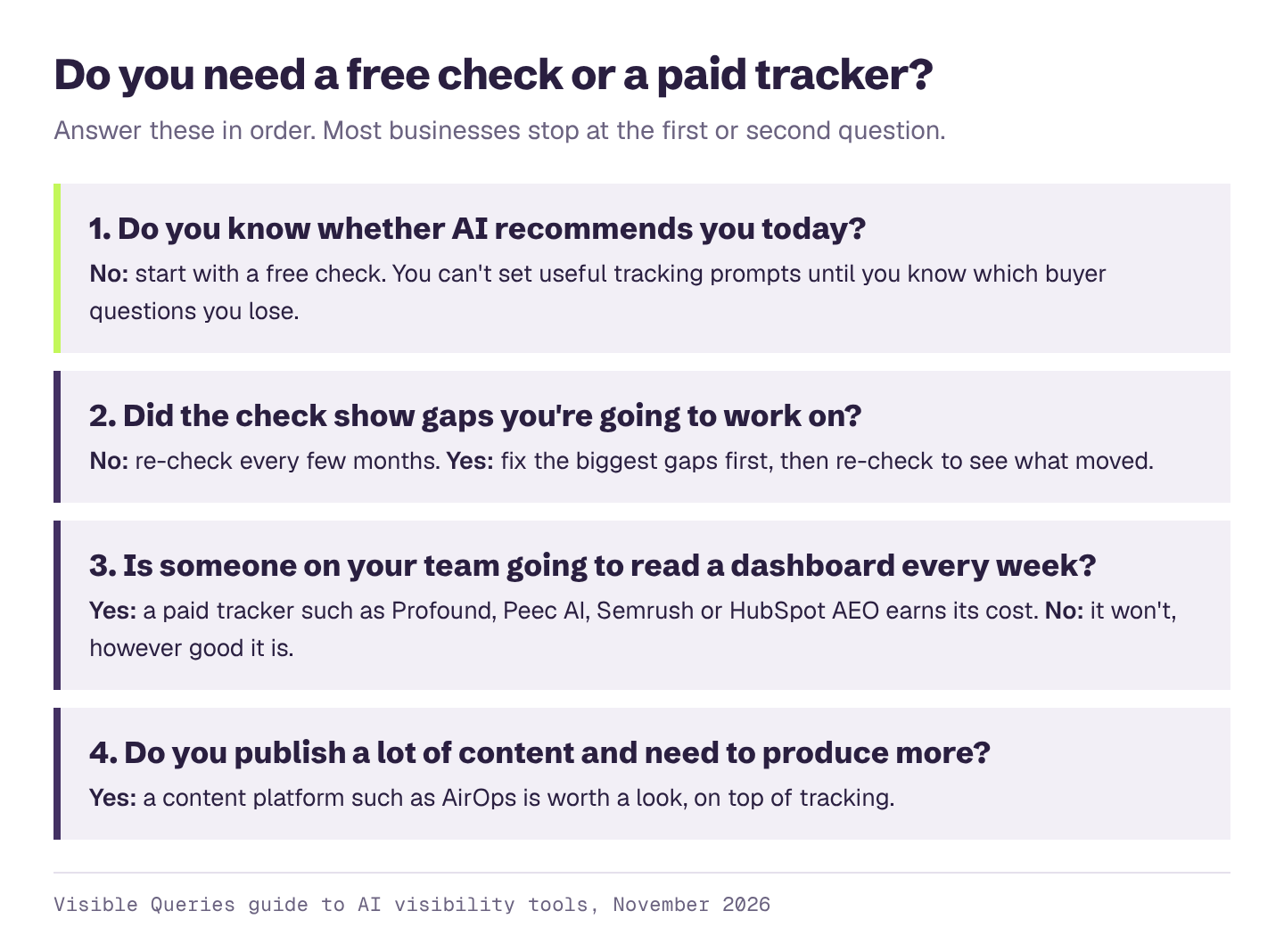
A few patterns we see often:
- Local businesses (clinics, law firms, home services, restaurants) usually need a check and then a re-check every few months, not a daily tracker. What matters most is whether AI names you in each city you serve, and whether it gets your services, hours and prices right. A tool that reports by city is worth more here than one that tracks 300 prompts.
- B2B software and services companies with an active marketing team often benefit from a check first, then a tracker once they're publishing comparison pages and category content regularly.
- Large brands and retailers with many products, markets and competitors are where enterprise platforms like Profound and Ahrefs Brand Radar earn their price.
- Content-heavy teams that already know their gaps should look at a content platform such as AirOps, usually alongside a tracker.
What no tool can do for you
Every tool in this guide measures. None of them, on its own, makes AI recommend you.
AI recommends businesses that are described clearly and consistently on their own websites, that show up on the "best of" lists, review sites and directories AI reads, and that have real evidence behind their claims. Our research on where AI gets its answers found that "best of" lists and blogs, business websites and review sites make up most of what AI cites when it recommends a business. Fixing that is work on your website and your reputation, and a tool can only show you where to start.
So pick the tool that matches the job in front of you. If you don't yet know where you stand, start with a free check, read it closely, and fix the biggest gap before you pay for anything that tracks it.
In this guide
- Visible Queries vs HubSpot's AI Search Grader and AEO
- Visible Queries vs Profound
- Visible Queries vs AirOps
- Visible Queries vs Semrush's AI Visibility Toolkit
- Visible Queries vs Peec AI
- Visible Queries vs Ahrefs Brand Radar
- Free AI visibility check vs paid tracking: which do you need?
- Visible Queries vs Otterly.AI
- Visible Queries vs Scrunch
- Visible Queries vs AthenaHQ
- The best AI visibility tools in 2026
- Profound alternatives
- Peec AI alternatives
- Free AI visibility tools
Start with a free check of where you stand
Enter your website and get a free AI visibility report. It takes a few minutes, and you'll see:
- Your AI visibility score, overall and for ChatGPT, Gemini, Claude, Perplexity and Google's AI Overviews and AI Mode
- Who AI recommends instead of you, and how often
- Which topics you win and lose, and how often each one is searched
- What AI gets wrong about you, and what to fix first
- A downloadable PDF you can share with your team