Visible Queries vs Otterly.AI: a free check or a low-cost tracker?
Otterly.AI is a self-serve AI search monitoring tool from €29 a month. Visible Queries is a free report on where you stand today. What each does, what each costs, and when to use which.
Otterly.AI is one of the lowest-cost ways to start tracking your brand in AI search. It has published prices from €29 a month, a free trial, and covers a long list of AI platforms.
Visible Queries is a free, one-time report on whether AI recommends your business, who it names instead, and why.
They do different jobs. Every Otterly.AI detail here comes from its own website and pricing page, checked on November 10, 2026.
The short version
| Visible Queries | Otterly.AI | |
|---|---|---|
| What it is | Free AI visibility report | Self-serve AI search monitoring and optimization platform |
| Main job | Show where you stand today | Track prompts daily and report on them |
| What you give it | Your website address | The prompts to track |
| Who picks the questions | Worked out from your website and your buyers | You |
| AI platforms | ChatGPT, Gemini, Claude, Perplexity, Google AI Overviews, Google AI Mode | ChatGPT, Google AI Overviews, Google AI Mode, Gemini, Microsoft Copilot, Claude and Perplexity; the entry plan covers "4 of 7 AI engines" |
| How often | Once, re-run any time | Daily (Premium: daily or weekly) |
| Price | Free | €29 a month (16 prompts), €189 (120), €489 (403); Enterprise custom from 1,000 prompts |
| Trial | Not needed | 7 days, no credit card |
Prices are listed in euros on Otterly.AI's pricing page; its homepage says pricing "starts at $29/month". Check before you buy.
Want to see the free report first? Check your AI visibility score in a few minutes.
What Otterly.AI does well
- A low entry price. The Lite plan at €29 a month is one of the cheapest ways to start tracking.
- Broad platform coverage. It lists ChatGPT, Google AI Overviews, Google AI Mode, Gemini, Copilot, Claude and Perplexity, with more engines marked as coming soon.
- Self-serve. Published prices and a 7-day trial with no credit card.
- Credits for scale. Plans include monthly credits; Otterly.AI notes Claude answers cost more credits than others.
Where it asks more of you
- You write the prompts. Tracking is only as good as the questions you choose, and it's easy to pick ones you already win.
- Small prompt counts on lower plans. 16 prompts on Lite is enough for a few key questions, not a full picture of your category.
- Someone has to use it. Daily tracking pays off when a person reviews it and acts on it.
What Visible Queries does differently
Visible Queries needs only your website address. It works out what you sell, where and to whom, writes the buyer questions for you, including the early ones where a buyer describes a problem without naming a product, and asks them on ChatGPT, Gemini, Claude, Perplexity and Google's AI Overviews and AI Mode. You get a score on each platform, who AI recommends instead, the questions you lose, and what it gets wrong about you.
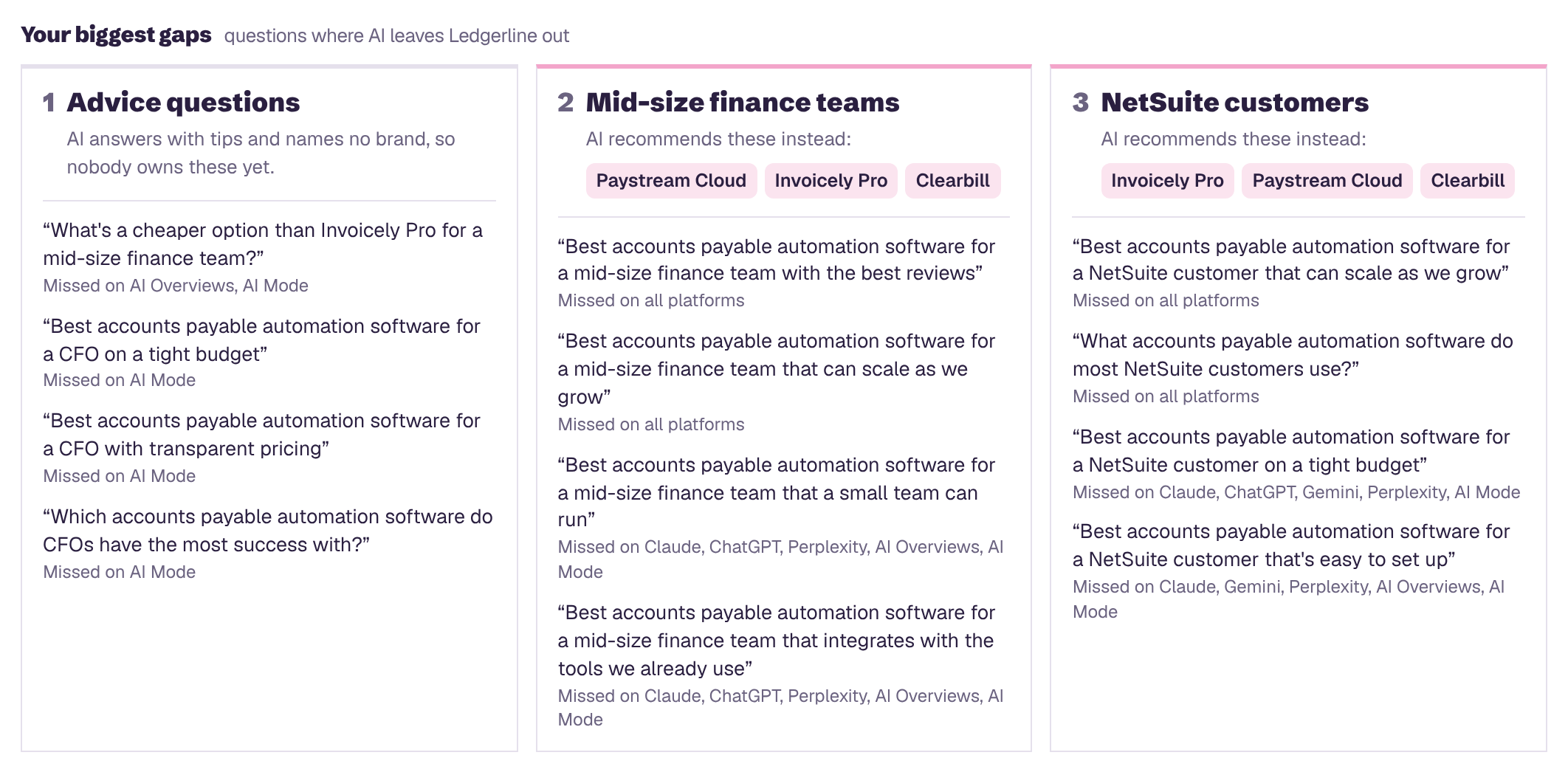
It doesn't track daily or chart trends, and it doesn't cover Copilot today.
Which one do you need?
Start with Visible Queries if you don't yet know where you stand or which prompts matter.
Choose Otterly.AI if you want low-cost daily tracking of a short list of prompts you already know matter.
Use both if you're about to start tracking. The free report shows the buyer questions you lose, which makes a much better first prompt list than a guess.
Part of our guide: AI visibility tools compared. See also: the best AI visibility tools in 2026.
Find the prompts worth tracking
Enter your website and get a free AI visibility report. It takes a few minutes, and you'll see:
- Your AI visibility score, overall and for ChatGPT, Gemini, Claude, Perplexity and Google's AI Overviews and AI Mode
- Who AI recommends instead of you, and how often
- Which topics you win and lose, and how often each one is searched
- What AI gets wrong about you, and what to fix first
- A downloadable PDF you can share with your team