Visible Queries vs AirOps: finding your AI visibility gaps vs filling them
AirOps is a content platform for winning AI search. Visible Queries is a free report that shows where AI leaves you out. How they differ, where each fits, and why the order you use them in matters.
AirOps and Visible Queries both come up when people search for ways to improve their visibility in AI answers, but they do almost opposite jobs.
- Visible Queries finds the gaps. It's a free report on whether AI recommends you, who it names instead, which buyer questions you lose, and what it gets wrong about you.
- AirOps fills them. It's a platform for researching, writing, publishing and refreshing content so AI has better material to cite.
This article explains what each does, where they overlap, and how to use them in the right order. Every AirOps detail comes from AirOps' own website and pricing page, checked on November 2, 2026.
The short version
| Visible Queries | AirOps | |
|---|---|---|
| What it is | Free AI visibility report | AI search content platform, with strategy services |
| Main job | Show where you stand and what to fix | Produce and refresh content that wins AI citations |
| What you give it | Your website address | Brand kit, knowledge bases, content workflows |
| Visibility data | Score per AI platform, mention and citation rates, share of voice, questions won and lost, wrong facts, visibility by city | AI market share and insights; ChatGPT only on Solo, more answer engines on Pro |
| Content creation | No | Yes, the core of the product |
| Who it's for | Any business that wants to know where it stands | Teams that publish content regularly and need more output |
| Price | Free | Free to start, billed by task; Enterprise custom-priced |
Source: AirOps and AirOps pricing.
What AirOps does
AirOps describes itself as "the partner behind your brand's AI search strategy." In practice that's three things:
- A content system. Workflows and AI agents that research, write, publish and refresh pages, governed by your brand kit and knowledge bases so the output sounds like you. It connects to your CMS and SEO tools.
- AI search insights. A view of your brand's market share in AI answers, showing where competitors lead. The Solo plan covers ChatGPT; the Pro plan covers more answer engines.
- Strategy and expert help. For larger customers, a team that helps set strategy and stays involved through execution.
Plans start free. The Solo plan is for one person and one brand, Pro is for small teams, and Enterprise is custom-priced with custom limits, agent builds and onboarding. Usage is billed by task, and each workspace gets free credits to test workflows.
AirOps is strongest for content and SEO teams that already publish a lot, know which topics they need to own, and want to produce and update far more pages than they could by hand.
What Visible Queries does
Visible Queries starts with a simpler question: when your buyers ask AI for help, does it recommend you?
You enter your website address. It reads the site, works out what you sell, who buys it and where, then asks the questions those buyers ask across ChatGPT, Gemini, Claude, Perplexity, Google's AI Overviews and Google AI Mode. The report shows where you're named, where a competitor is named instead, what AI said, and which facts it got wrong.
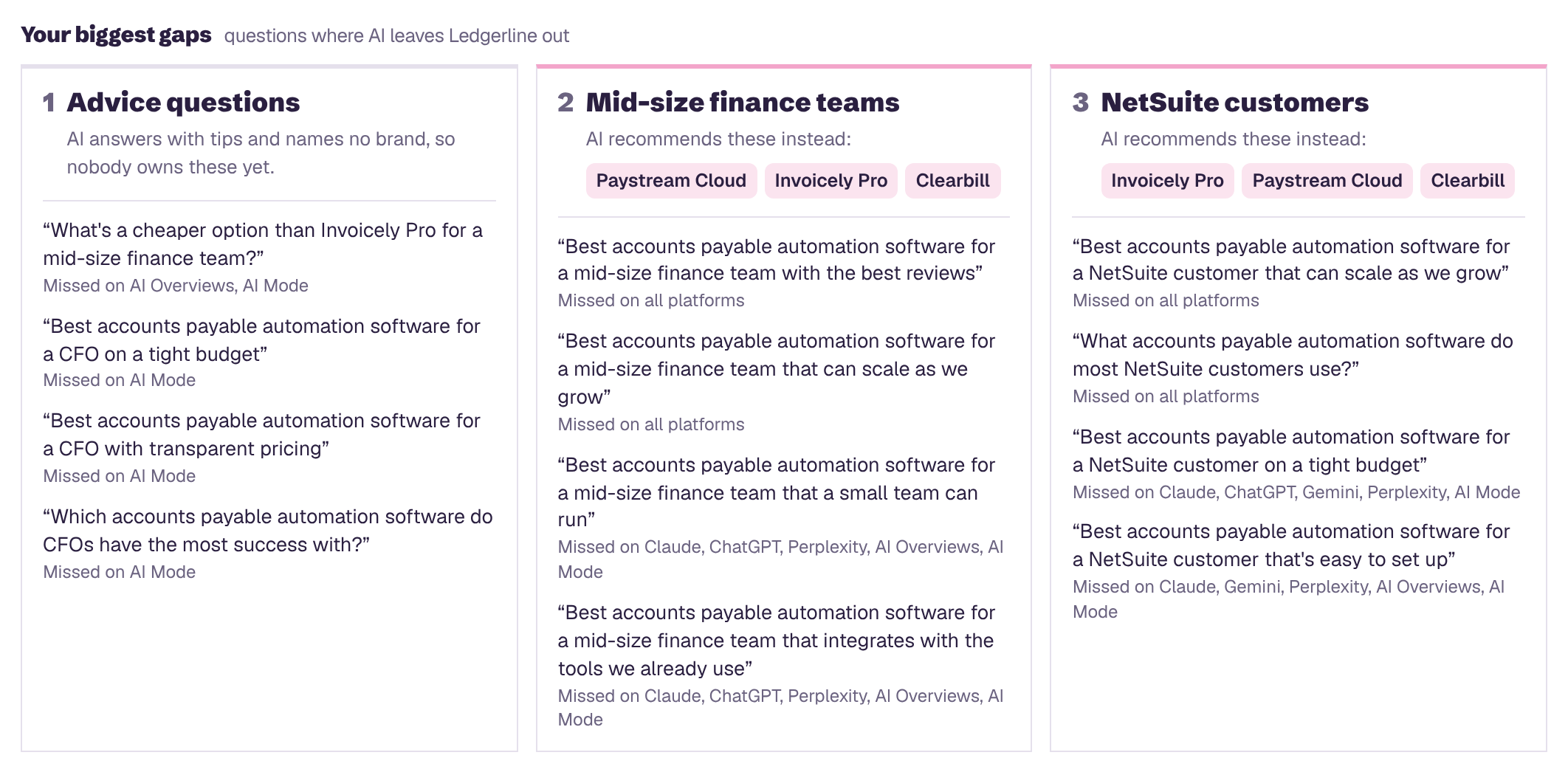
The gaps in that sample are typical, and they show why content alone isn't always the fix:
- A wrong fact. AI says the product doesn't integrate with NetSuite. The company's own site says it does. More blog posts won't fix that; a clear, findable integration page and corrected listings will.
- Missing from "best of" lists. AI names the company in only 31% of answers about the category leaders. That's about being on the third-party lists AI reads, not only about your own pages.
- A competitor winning problem-stage questions. That one is a content gap, and a content platform can help close it.
Why the order matters
The most common mistake we see is buying content production before knowing what to produce.
Content platforms are very good at output. But output aimed at the wrong questions doesn't move AI answers, and some of the biggest gaps aren't content problems at all: a wrong fact repeated from an old directory listing, a missing comparison on a review site, a city page that doesn't exist.
So the order that works is:
- Diagnose. Run a free check. Find the buyer questions you lose, the competitors AI names instead, the facts it gets wrong, and the cities where you're invisible.
- Sort the gaps. Some need fixes to your website. Some need work on listings, reviews and "best of" lists. Some need new content.
- Produce. If the content gap is big and you have a team to run it, a platform like AirOps can produce it faster.
- Re-check. Run the report again to see which answers changed.
Which one do you need?
Start with Visible Queries if you haven't measured your AI visibility yet, you're not sure whether your problem is content, reputation or wrong facts, or you're a local or service business that doesn't publish much content.
Choose AirOps if you already know which questions and topics you need to win, you have a content team, and your bottleneck is producing and refreshing pages at scale.
Use both if you're a content-led company starting on AI visibility. Use the free report to build the brief, and the content platform to execute it.
Part of our guide: AI visibility tools compared. See also: the best AI visibility tools in 2026, Profound alternatives and free AI visibility tools.
Find out what to fix before you write anything
Enter your website and get a free AI visibility report. It takes a few minutes, and you'll see:
- Your AI visibility score, overall and for ChatGPT, Gemini, Claude, Perplexity and Google's AI Overviews and AI Mode
- Who AI recommends instead of you, and how often
- Which topics you win and lose, and how often each one is searched
- What AI gets wrong about you, and what to fix first
- A downloadable PDF you can share with your team