In stock, near me and the right spec: how buyers choose an industrial distributor or supplier through AI
Maintenance teams and buyers now ask AI who stocks a part, which suppliers deliver fast and who offers technical support. Here's what AI tells them, and how industrial distributors and suppliers get named.
A maintenance manager at a packaging plant outside Charlotte has a conveyor gearbox failing and a line down. The OEM's lead time is three weeks. They need a compatible gearbox, or a rebuild, this week. They ask ChatGPT:
"Our conveyor gearbox failed and the line is down near Charlotte. OEM lead time is 3 weeks. Who stocks compatible gearboxes or offers emergency rebuilds near Charlotte? What info should I have ready, and what are my options to get running this week?"
AI explains the options, including stocked equivalents, emergency repair and rebuild shops, and temporary solutions, what information to have ready (nameplate data, ratio, mounting, shaft sizes), and names several distributors and repair shops in the region. The manager calls the first one and has a replacement the next morning.
Industrial distribution runs on availability, speed, technical knowledge and relationships. Buyers range from maintenance teams with urgent problems to procurement teams setting up supply agreements. AI is now one of the first places many of them look.
Our industrial guide covers how industrial buyers research suppliers in general. This one goes through the questions that decide distributor business, what AI usually says, and what distributors and suppliers can publish so AI names them.
Here are the questions at a glance:
| The question | What gets you named |
|---|---|
| "Who stocks [product] near me?" | Product lines and branches in text |
| "Who can help me choose?" | Selection guides and technical support |
| "Emergency service or same-day delivery?" | Your service and delivery policies |
| "Suppliers for [industry]?" | Pages for the industries you serve |
"Who stocks [product] near me?"
This is the defining question for distributors.
What AI usually says: It names distributors it understands carry the product line and serve the area.
What to publish: Pages for every product category and brand you carry, with the locations that stock them. Line cards help, but pages that describe categories and applications help AI more.
"Who can help me choose the right [product]?"
What AI usually says: It suggests distributors with application engineers or technical specialists.
What to publish: Your technical services: application support, sizing, selection, training and custom assemblies. Explain which specialists you have and what problems they solve.
"Who offers emergency service, repair or same-day delivery?"
What to publish: Emergency services, after-hours support, delivery options, repair and rebuild services, and response times. Urgent buyers choose fast.
"Which suppliers serve [industry]?"
What to publish: Pages for the industries you serve, like food and beverage, packaging, water treatment, mining, oil and gas, and pharmaceuticals, with relevant products, compliance and services.
Which topics AI gives to competitors
Here's how the report shows which topics a supplier wins and loses:
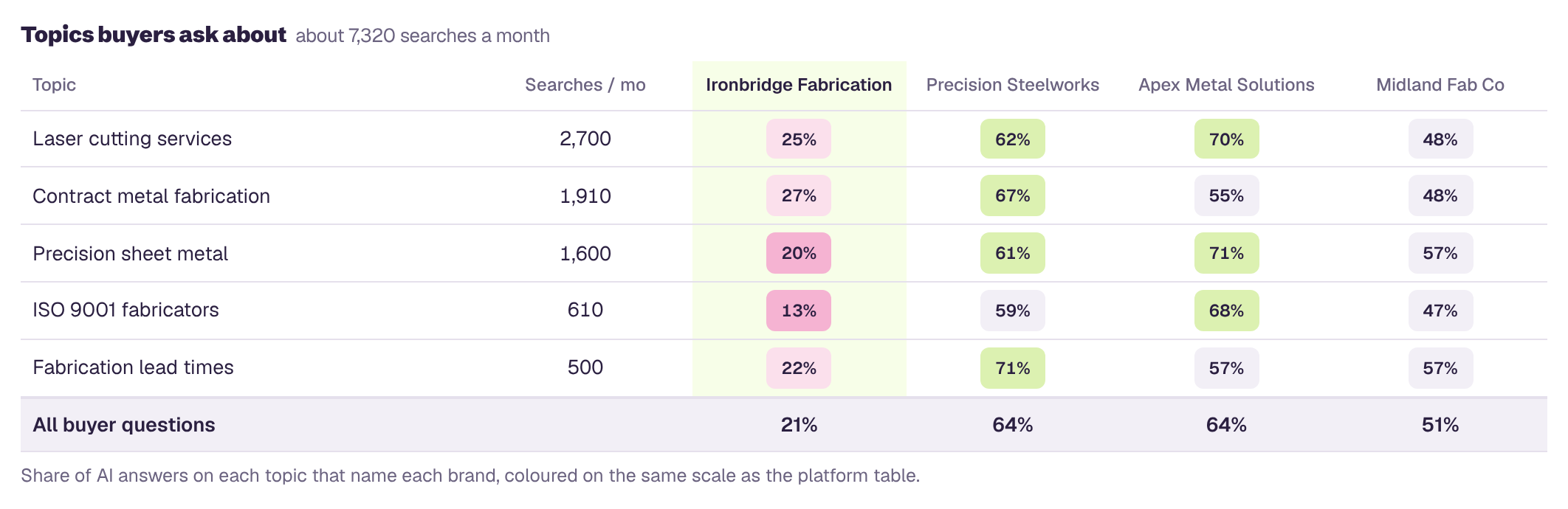
Distributors often find they're named for the brands they carry but not for the problems they solve, like "emergency gearbox replacement" or "pneumatic system design help." Problem and service pages close that gap.
Here's more from the same kind of report, for Ironbridge Fabrication, a fictional contract metal fabricator.
The report starts with one score out of 100, a score for each AI platform, and the competitor AI names most:
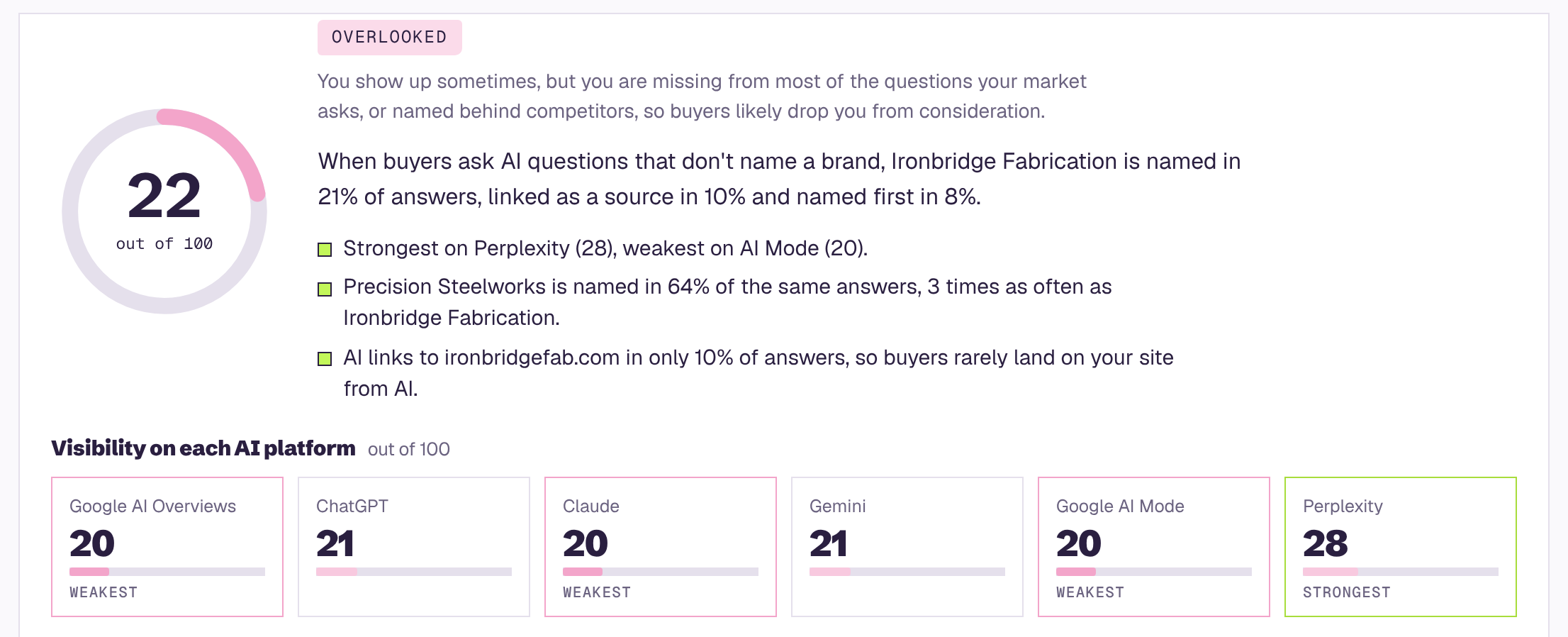
The gap is clearest side by side:
Supply programs and procurement
Procurement teams ask AI about vendor-managed inventory, vending, e-procurement integrations, consolidated billing and supply agreements. If you offer them, give each one a page.
Local branches matter
Every branch should have its own page, with its address, hours, inventory focus, services and contacts.
If you only fix three things
- Give every product category, brand and branch its own page.
- Describe technical and emergency services clearly.
- Publish pages for the industries and problems you solve.
Maintenance teams and buyers are asking AI who can help right now. The distributor AI names will be the one that explains what it stocks and solves most clearly.
Part of our guide: Why AI visibility matters for industrial companies
See what AI tells buyers about your company
Enter your website and get a free AI visibility report. It takes a few minutes, and you'll see:
- Your AI visibility score, overall and for ChatGPT, Gemini, Claude, Perplexity and Google's AI Overviews and AI Mode
- Which competitors AI recommends instead of you, and how often
- Which topics you win and lose, and how often each one is searched
- What AI gets wrong about you, and what to fix first
- Your biggest gaps: the buyer questions where AI leaves you out, and who it recommends instead
- A downloadable PDF you can share with your team