Who can make this part? How engineers and buyers choose a manufacturer or machine shop through AI
Engineers and procurement teams now ask AI which shops can make their part, which certifications they hold and who handles their volume. Here's what AI tells them, and how manufacturers and machine shops get named.
A mechanical engineer at a medical device startup in Minneapolis needs a prototype run of 50 titanium parts with tight tolerances, then a few thousand a year if the device is approved. Their usual supplier doesn't machine titanium. They ask ChatGPT:
"I need 50 prototype titanium parts with ±0.0005 in tolerances for a medical device, then maybe 3,000 a year in production. Which CNC machine shops in the Midwest handle titanium, are ISO 13485 certified and can do both prototypes and production? What lead times and quality documentation should I expect?"
AI explains what to look for in a shop for medical parts (ISO 13485, material traceability, inspection equipment, first article inspection, cleanroom or passivation capabilities), typical prototype and production lead times, questions to ask about capacity and pricing, and the value of a shop that can scale from prototype to production. Then it names several shops. The engineer sends drawings to three of them.
Industrial buyers are engineers, buyers and operations leaders. They need specific capabilities, certifications, materials and capacity. They used to search directories, ask colleagues and go to trade shows. Now they also ask AI, and they describe their requirements in detail.
Our industrial guide covers how industrial buyers research suppliers in general. This one goes through the questions that decide manufacturing work, what AI usually says, and what manufacturers and machine shops can publish so AI names them.
Here are the questions at a glance:
| The question | What gets you named |
|---|---|
| "Who can make [part] to [tolerance]?" | Capabilities, materials and tolerances in text |
| "Which shops are [certification] certified?" | Certifications, listed plainly |
| "Who serves [industry]?" | Pages for the industries you serve |
| "Typical lead times? Prototypes?" | Lead times and volumes you handle |
| "Is this shop reliable?" | Quality metrics and customer stories |
"Who can make [part] in [material] to [tolerance]?"
This is the defining question for the category.
What AI usually says: It names shops whose capabilities clearly match: processes, materials, tolerances, part sizes and volumes.
What to publish: Detailed capability pages: every process (CNC milling, turning, Swiss machining, EDM, sheet metal, welding, casting, molding), materials you work with, tolerances you hold, part sizes, volumes and secondary operations. Equipment lists help too. Vague "precision manufacturing" pages tell AI almost nothing.
"Which shops are [certification] certified?"
What AI usually says: It names shops it knows hold specific certifications: ISO 9001, AS9100, ISO 13485, ITAR registration, IATF 16949, NADCAP.
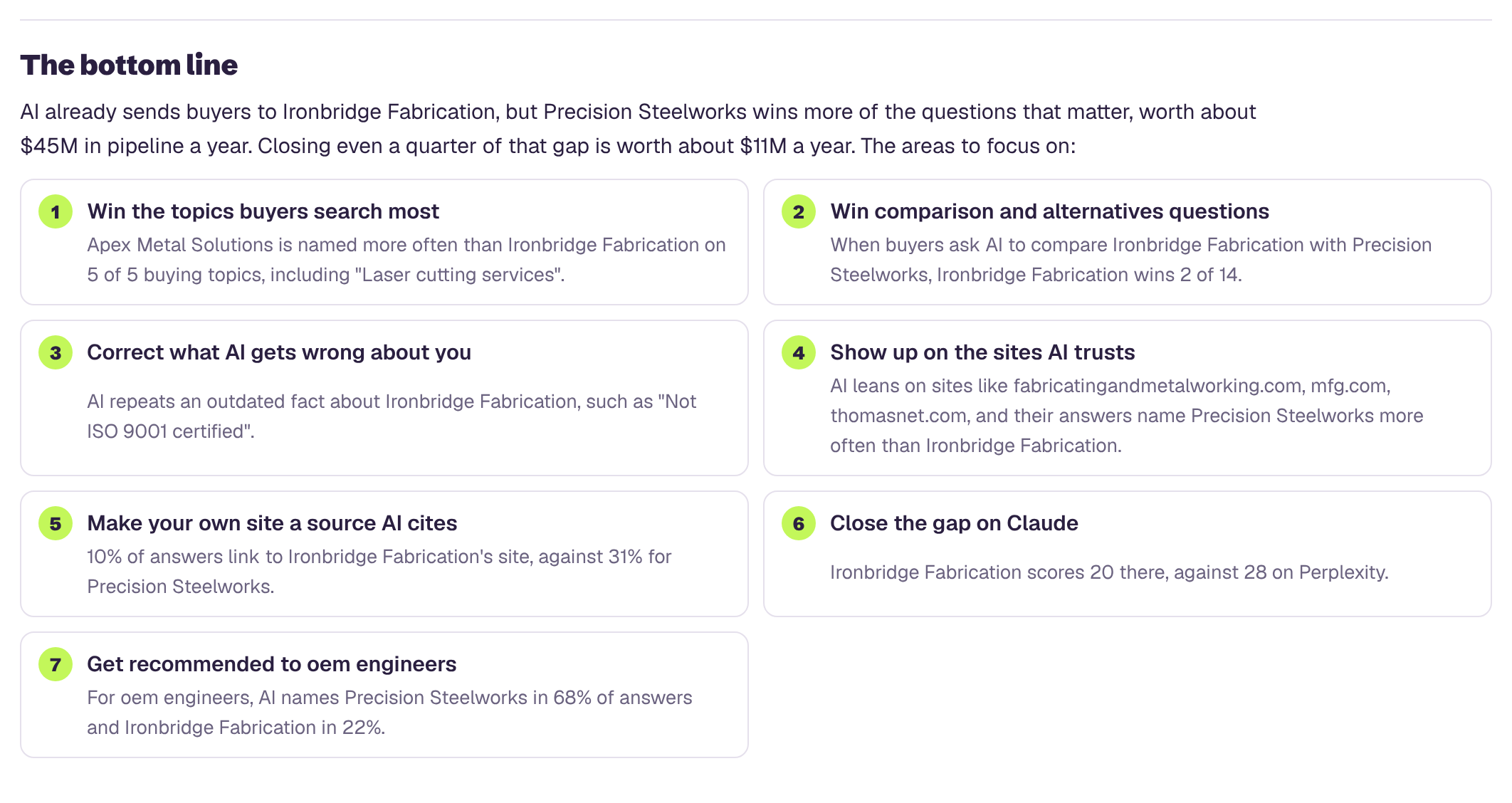
Why it matters: Certifications are pass-or-fail. When AI gets them wrong, you're disqualified before an RFQ. Here's how that looks in a report:
What to publish: A certifications page with every certification, scope, registrar and date, plus quality documentation you provide, like first article inspection, PPAP and material certs.
"Who serves [industry]?"
What AI usually says: It names shops with experience in the buyer's industry.
What to publish: A page for every industry you serve, like medical, aerospace, defense, automotive, energy, food equipment, semiconductor and agriculture, with the kinds of parts you make for each.
"What are typical lead times? Can they handle prototypes and production?"
What to publish: Typical lead times for prototypes and production, capacity, whether you offer quick-turn services, and how you scale.
"Is this shop reliable?"
What to publish: Years in business, quality metrics you're comfortable sharing, on-time delivery, facilities and case studies described within confidentiality.
Reshoring and supply chain changes
Many buyers are looking to move work closer to home. They ask AI about domestic suppliers, nearshoring and dual sourcing. If you're winning reshored work, explain your capabilities and why buyers move work to you.
What the sample report shows
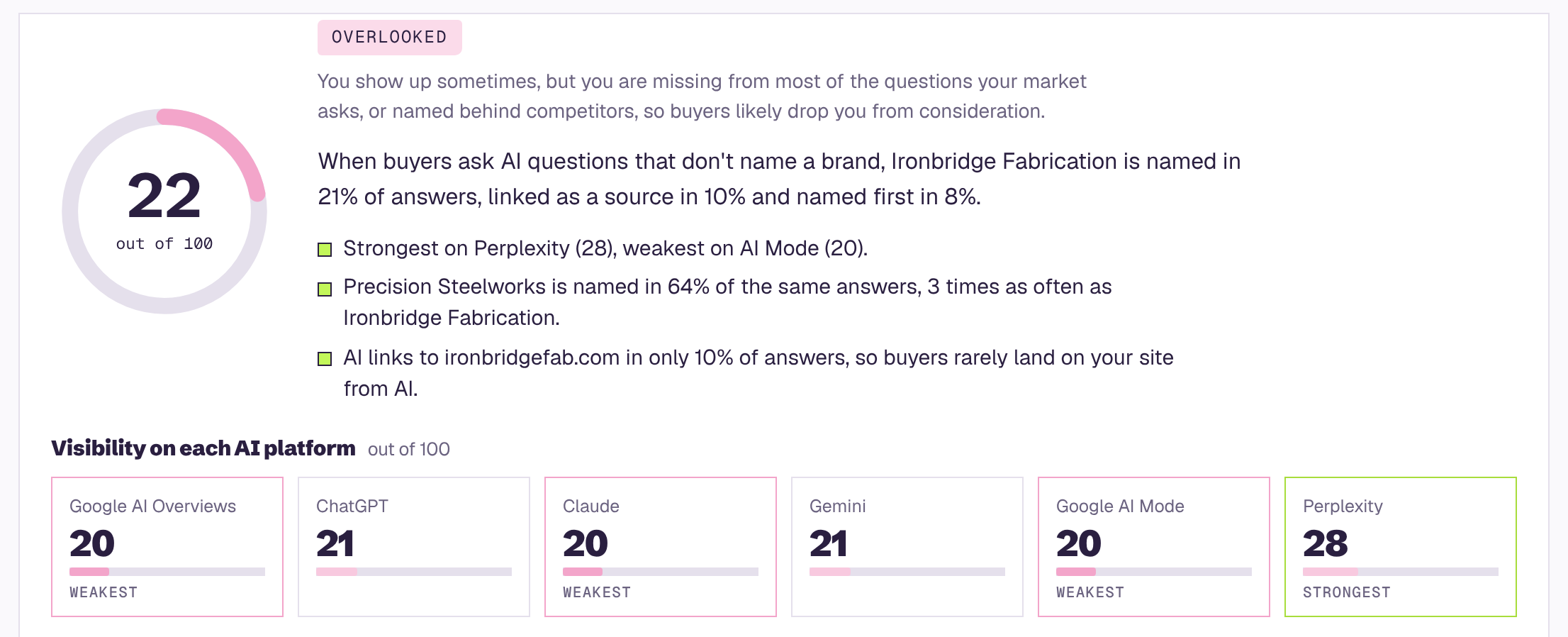
Here's what a Visible Queries report looks like for Ironbridge Fabrication, the sample contract metal fabricator from our guide. The questions are different for manufacturers, but the patterns are the same.
The report starts with one score out of 100, a score for each AI platform, and the competitor AI names most:
The gap is clearest side by side:
If you only fix three things
- Publish detailed capability pages. Processes, materials, tolerances, sizes and volumes.
- Make certifications impossible to get wrong.
- Give every industry you serve its own page.
Engineers are asking AI who can make their part. The shop AI names will be the one that describes its capabilities most precisely.
Part of our guide: Why AI visibility matters for industrial companies
See what AI tells buyers about your shop
Enter your website and get a free AI visibility report. It takes a few minutes, and you'll see:
- Your AI visibility score, overall and for ChatGPT, Gemini, Claude, Perplexity and Google's AI Overviews and AI Mode
- Which competitors AI recommends instead of you, and how often
- Which topics you win and lose, and how often each one is searched
- What AI gets wrong about you, and what to fix first
- Your biggest gaps: the buyer questions where AI leaves you out, and who it recommends instead
- A downloadable PDF you can share with your team