How industrial buyers find suppliers now, and why AI visibility decides who gets the RFQ
Engineers and buyers now ask AI which manufacturers, distributors and equipment dealers can meet their specs. Here's how their journey works, what they ask at each step, and how to build an industrial company AI recommends.
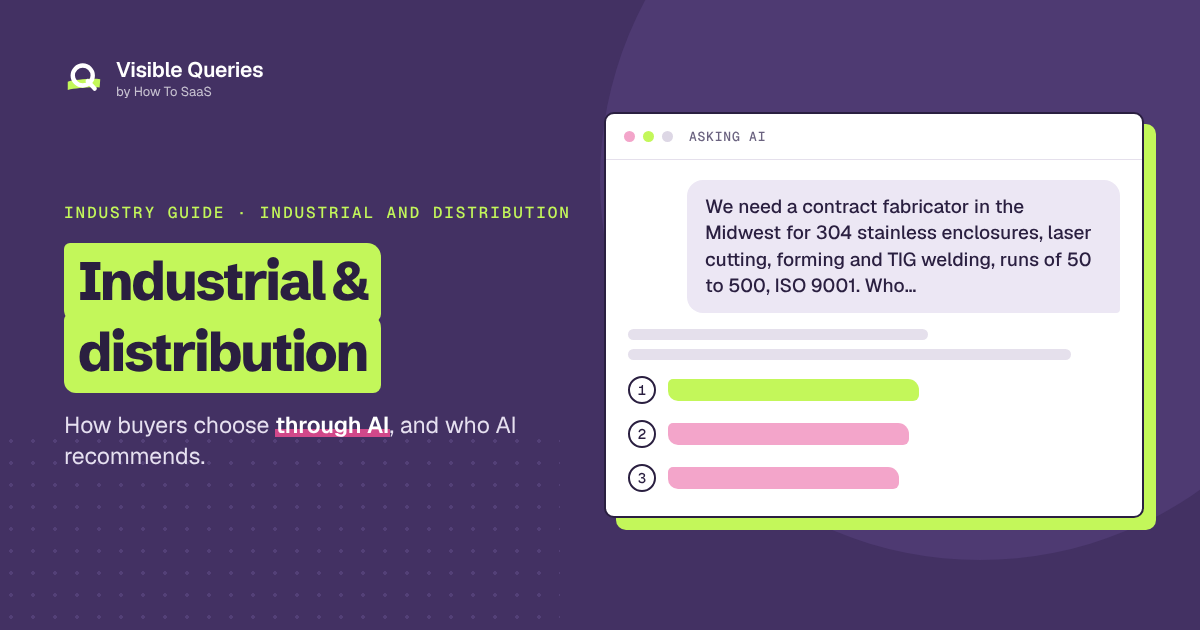
It's Thursday afternoon at a company in Michigan that builds commercial food-processing equipment. Their main sheet-metal supplier just pushed a critical order out by three weeks, for the second time this quarter. The production schedule is slipping, a customer is calling daily, and the VP of Operations has told the purchasing manager to "get a second source qualified, fast."
Ten years ago, that purchasing manager would have opened Thomasnet, searched Google for "stainless steel fabrication Michigan," called a couple of shops a colleague recommended, and sent out RFQs.
Today there's a good chance they start somewhere else. Maybe it's ChatGPT, maybe it's the AI Overview at the top of a Google search, maybe it's the AI assistant built into their company's software:
"We need a contract fabricator in the Midwest for 304 stainless enclosures, laser cutting, forming and TIG welding, runs of 50 to 500, ISO 9001. Who should we look at and what should we ask?"
The answer lays out what to look for in a fabrication partner for food equipment: sanitary welding experience, certifications, capacity, quoting turnaround and how to run a first-article inspection. Then it names four or five shops, with a line on what each one is known for.
The purchasing manager adds those names to a spreadsheet. Three of them get RFQs on Monday.
Industrial buying is changing more quietly than consumer buying, but it is changing. Engineers, buyers and plant managers are busy and often understaffed, and an assistant that can summarize capabilities, certifications and reputations in one answer saves them hours. The suppliers that show up in those answers get the RFQs. The ones that don't rarely know they were in the running.
This article walks through how industrial buyers find and qualify suppliers today, step by step, with examples from across manufacturing and distribution: contract manufacturers, machine shops, metal fabricators, plastics and molding, MRO and industrial distributors, fastener and component suppliers, electrical and electronic components, packaging, chemicals, building materials, and equipment dealers and rental. It covers what buyers ask AI at each step, what makes AI recommend one supplier over another, and what the suppliers that keep getting recommended tend to do differently. Most of it comes down to being a supplier whose capabilities are easy to understand and easy to verify.
Along the way you'll see screenshots from a Visible Queries report for Ironbridge Fabrication, a sample contract metal fabricator. The company and its competitors are made up, but the report is real. It's exactly what any industrial company sees when it runs its own.
Why the old playbook isn't enough anymore
Industrial sales have always run on relationships, trade shows, distributor networks, sales reps and directories like Thomasnet. A good reputation spread through engineers and buyers who moved from company to company. Many excellent manufacturers still have websites that haven't been meaningfully updated in a decade, because the website was never where business came from.
That's becoming a risk. When a buyer asks AI to find a supplier, the assistant can only work with what it can read: your website, directory listings, certifications databases, trade association member lists, distributor line cards, press releases and any articles that mention you. If your capabilities live in a sales rep's head and a PDF line card from 2016, AI doesn't know them.
Three things follow from that:
- Capability matching moves to AI. Buyers describe their part, material, process, volume, tolerance and certifications in plain language, and AI matches them to suppliers who have described the same things. Vague "full-service manufacturing solutions" copy matches nothing.
- Certifications become filters. If AI can't confirm you're ISO 9001, AS9100, ITAR registered or UL listed, it may leave you off any list where that matters, or worse, tell buyers you're not.
- The newest buyers start here. Younger engineers and buyers who never built a Rolodex of suppliers are the most likely to ask AI first. They're also the ones replacing retiring buyers who knew you personally.
None of this replaces relationships, trade shows or great reps. It changes how a new buyer finds you in the first place, and what they believe about you before your rep ever calls.
The buyer's journey, step by step
Whether it's a one-time order of 10,000 fasteners or a multi-year contract manufacturing program, industrial buying follows a similar path. What changes is how many people are involved and how much qualification is needed.
- Something forces a sourcing decision. A supplier fails, a new product launches, demand jumps, or a cost-down mandate arrives.
- They work out the requirements and options. Processes, materials, make versus buy, and what this should cost.
- They build a shortlist. Who has the capability, capacity, certifications and location.
- They qualify. Quality systems, track record, financial stability and references.
- They decide. RFQs, quotes, lead times, first articles and, often, an engineering and quality sign-off.
- They manage the relationship. Scorecards, reorders, expansions and, eventually, the decision to stay or switch.
AI now shows up at every one of these steps. Here's what it looks like at each one.
Step 1: Something forces a sourcing decision
Industrial buyers rarely go looking for a new supplier for fun. Something forces it:
- A current supplier misses deliveries, has a quality escape or raises prices again (contract manufacturing, fabrication, machining)
- A new product needs a process the company doesn't have in-house, like precision machining, injection molding or a cleanroom assembly
- Reshoring or tariff changes push a part back to North America
- A plant expansion needs equipment, MRO supply programs or a new packaging line
- A distributor drops a product line, or a key component goes on allocation (electrical and electronic components)
- A cost-down target from leadership means re-quoting everything
The first questions buyers ask AI are about the problem:
- "Why do we keep getting late deliveries from our fabricator?"
- "What's the risk of single-sourcing a critical machined part?"
- "Should we bring sheet metal fabrication in-house or keep outsourcing it?"
- "How do other manufacturers handle component shortages?"
The answers frame the sourcing decision. If AI explains that late deliveries are often a capacity problem at small job shops and recommends dual-sourcing with a larger contract manufacturer, the buyer is now looking for a different kind of supplier than they were an hour ago.
Step 2: They work out the requirements and options
Industrial buyers, and especially the engineers who write the specs, use AI heavily at this step. They're comparing processes, materials and sourcing strategies, often outside their own specialty.
- "Laser cutting vs waterjet vs plasma for 1/4-inch stainless: what's the difference in cost and edge quality?"
- "When does injection molding make more sense than 3D printing or urethane casting?"
- "What does ISO 9001 actually require from a supplier?"
- "Is our current fabricator good enough, or should we find a second source?"
- "What should a cost-per-part look like for a 6061 aluminum bracket at 1,000 units?"
- "Do we need a VMI program from our MRO distributor?"
AI answers with explanations, trade-offs and, often, examples of suppliers. The suppliers whose technical content shapes these answers, like process guides, design-for-manufacturing tips and material comparisons, become familiar names before the buyer ever asks for a list.
This is also where many industrial companies lose quietly. Their websites list equipment and capabilities but explain nothing. There's no guidance on which process fits which part, no design tips and no context on cost drivers. So AI learns from the few suppliers and marketplaces that did publish it.
Here's what this looks like in a real report. Each row is a topic buyers ask about, with how often it's searched each month and the share of AI answers on that topic that name the company and each of its top competitors.
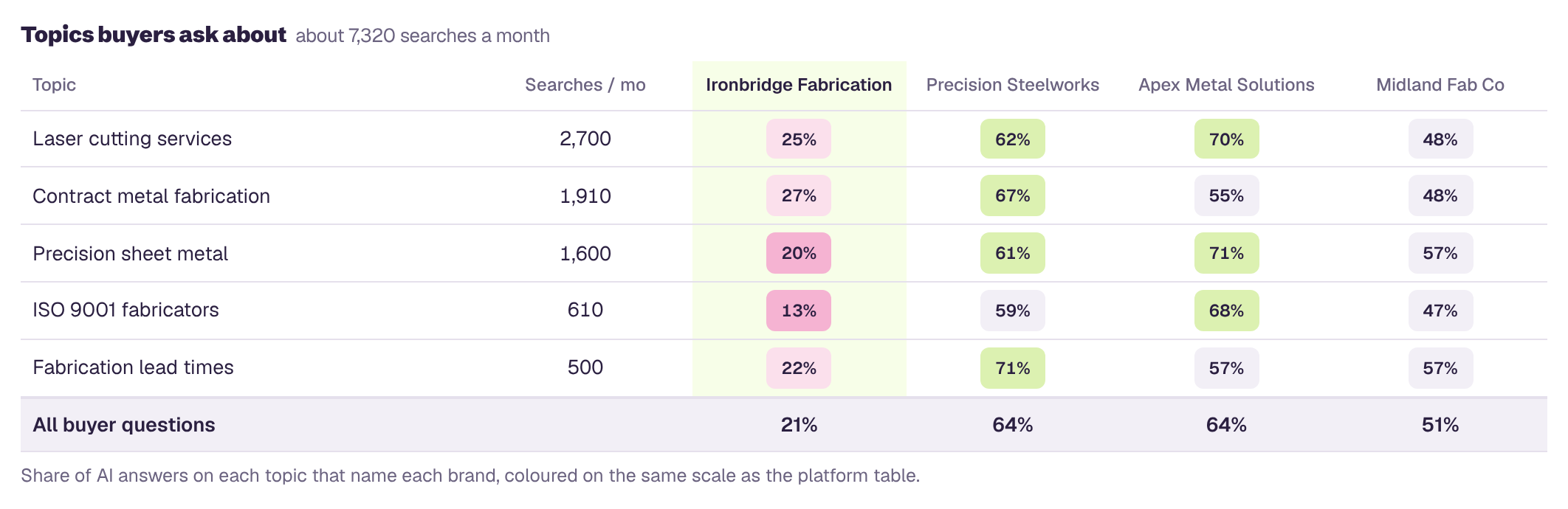
Look at "ISO 9001 fabricators" and "Fabrication lead times." Ironbridge Fabrication is named in 12% and 22% of those answers, while Apex Metal Solutions and Precision Steelworks are named in 68% and 71%. A purchasing manager asking about certified shops or late deliveries is actively looking for a new fabricator, and Ironbridge is missing from most of those conversations.
What good industrial companies do at this step: they teach the engineering. Process comparison guides, design-for-manufacturing tips, tolerance and material guides, explanations of what drives part cost, and honest advice about when their process isn't the right fit. Engineers trust suppliers who help them design better parts, and AI treats that content as a source worth citing.
Step 3: They build a shortlist
Now the buyer wants names. Industrial shortlist questions are unusually specific, because the buyer is matching a real part or need to real capabilities:
- "Contract metal fabricators in the Midwest with ISO 9001, robotic welding and powder coating"
- "CNC machine shops in Ontario that do 5-axis aerospace work and are AS9100 certified"
- "Injection molders for medical devices with cleanroom molding in the Southeast"
- "Industrial distributors that offer vending and VMI for a 3-plant manufacturer in Texas"
- "Who supplies custom corrugated packaging in short runs near Atlanta?"
- "Forklift dealers in Alberta that offer rental and service contracts"
AI matches these questions to suppliers who have described the same things: processes, materials, part sizes, volumes, certifications, industries served and locations. A shop that lists "fabrication, welding, finishing" won't match a buyer asking for "robotic MIG welding of carbon steel weldments up to 2,000 pounds." A shop that publishes those details will.
Region matters too. Buyers often want suppliers within a few hours' drive for site visits and freight costs. Industrial companies that are clear about where they're located and where they ship tend to be matched to regional questions more often.
What good industrial companies do at this step: they publish capabilities like a spec sheet. Processes, equipment, materials, size limits, tolerances, volumes, lead times, finishing options, certifications and industries served, all on clear, crawlable pages rather than locked inside PDFs. They keep the same details current on Thomasnet, trade association directories and their distributors' line cards.
Step 4: They qualify
In industrial buying, a bad supplier doesn't just cost money. It stops a production line, ships bad parts to a customer or triggers a recall. So qualification is serious, and buyers increasingly use AI to do the first pass:
- "Is Ironbridge Fabrication ISO 9001 certified?"
- "Does [machine shop] have AS9100 and ITAR registration?"
- "What do customers say about [supplier]'s on-time delivery?"
- "Is [distributor] an authorized distributor for [brand]?"
- "How big is [manufacturer], and are they financially stable?"
- "Has [company] had any recalls, OSHA violations or quality issues in the news?"
AI answers by pulling together your website, certification registries, directory listings, press, LinkedIn, trade association pages and any reviews or forum mentions it can find. Certifications are the biggest single factor at this step, and also where AI most often gets things wrong.
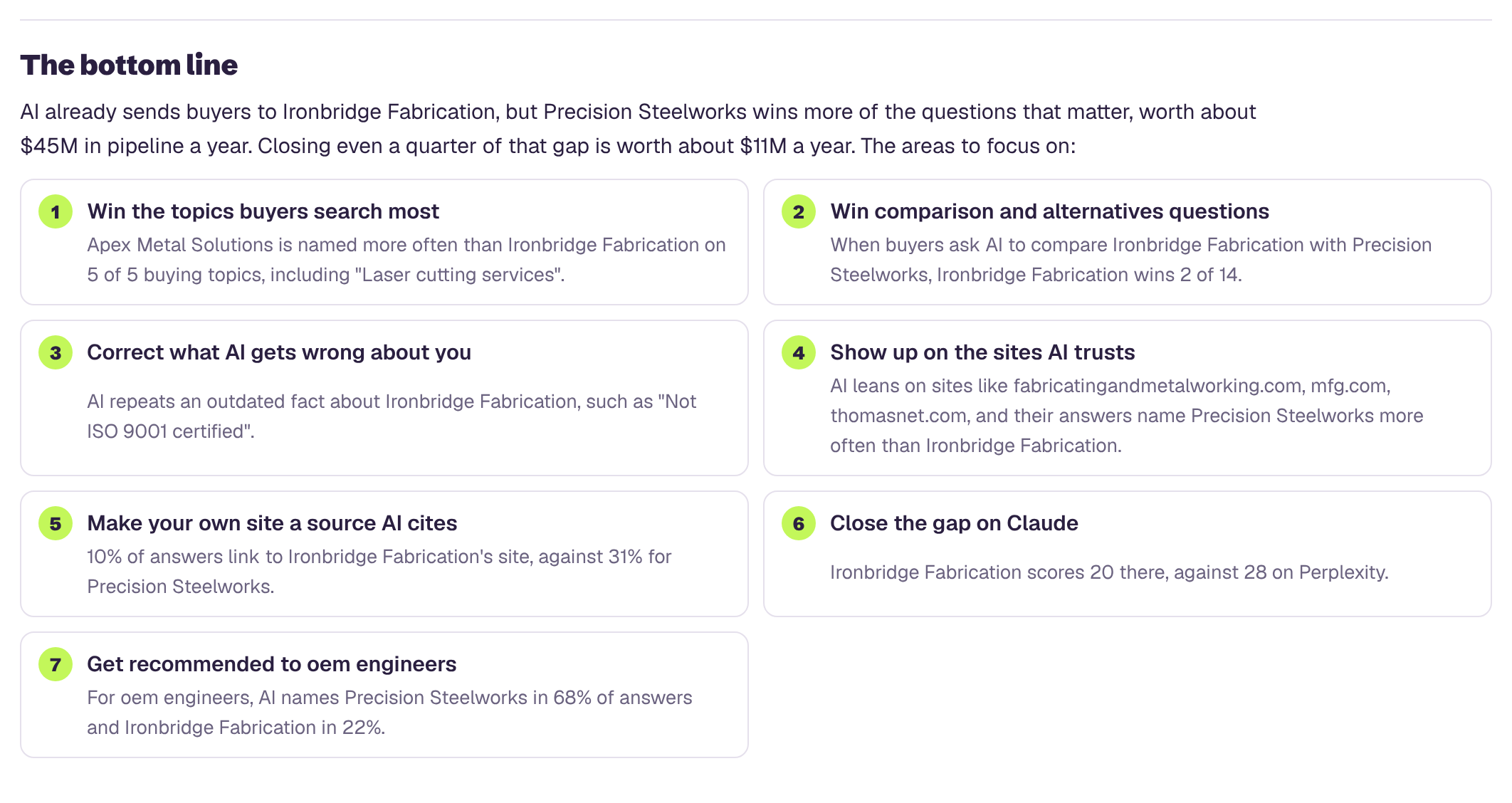
In our sample report, the top gap is exactly that. AI says Ironbridge Fabrication is "not ISO 9001 certified." Ironbridge is ISO 9001:2015 certified. For a buyer who requires ISO 9001, that one wrong sentence disqualifies Ironbridge before an RFQ is ever sent, and Ironbridge never finds out. The report's accuracy score measures how often AI gets core facts right. Here it's 79%, which sounds good until you remember the 21% includes a disqualifying error.
Wrong facts are common for industrial companies, because so much of their information is out of date or locked in PDFs: old certifications, discontinued processes, an acquired company's former name, a closed plant, or a size limit from before a new machine was installed.
What good industrial companies do at this step: they make qualification easy. Current certificates posted as clear text on the site, not just badge images, with scope and expiration dates. A quality page that explains their inspection equipment, PPAP or first-article process and quality metrics. Plant locations, square footage, headcount and years in business stated plainly. Authorized distributor and OEM relationships listed explicitly. And every directory and registry they appear in shows the same, current facts.
Step 5: They decide
Industrial decisions usually involve purchasing, engineering and quality, and sometimes operations and finance. Each of them may ask AI their own questions:
- Purchasing: "Ironbridge Fabrication vs Precision Steelworks: which is better for mid-volume stainless work?"
- Engineering: "Which fabricators offer DFM feedback before quoting?"
- Quality: "What should a supplier quality agreement include?"
- Operations: "How do we transition a part to a new supplier without disrupting production?"
- Finance: "What's the total cost of switching suppliers, beyond piece price?"
Comparisons hinge on concrete details like quote turnaround, lead times, minimum order quantities, engineering support, inventory programs and freight. If a competitor publishes "quotes in 48 hours, standard lead time of 3 weeks, kanban and consignment programs available" and your site doesn't mention any of that, AI's comparison tilts their way.
The competitor table shows who's winning these conversations overall: how often AI names each supplier when buyers ask questions that don't name a company. In the sample report, Precision Steelworks is named in 64% of those answers and Ironbridge Fabrication in 21%. An engineer or buyer who asks AI a handful of questions will keep hearing the same competitor, and that familiarity carries into the RFQ list.
What good industrial companies do at this step: they publish the details that decide RFQs. Quote turnaround, typical lead times, MOQs, inventory and kanban programs, engineering support, shipping regions and how they onboard a new part. They also make it easy to send an RFQ, with clear instructions on what files and information they need.
Step 6: They manage the relationship
Industrial supplier relationships can run for decades, and they're measured constantly through scorecards, on-time delivery, PPM defect rates and cost reviews.
- "How do we build a supplier scorecard?"
- "What's a reasonable annual price increase from a contract manufacturer?"
- "When should we consider a second source for a critical part?"
- "How do we get our distributor to manage inventory for us?"
These questions matter for two reasons. Satisfied customers become references, case studies and word-of-mouth, which is the raw material AI uses at step 4. And the "should we find a second source?" question is where competitors win business away from you, and where you win it from them.
What good industrial companies do at this step: they make performance visible. They share delivery and quality metrics, support customers with engineering changes, and turn long-term relationships into case studies (with permission) that show real results, like reduced lead times, cost-downs or quality improvements. They publish the kind of supplier-management guidance their customers' buyers look for, which keeps their name attached to those conversations.
How the journey plays out across industrial businesses
The six steps hold across manufacturing and distribution, but the step that decides the business is different. Here's where the weight falls, and what the companies that win tend to do.
Manufacturers and machine shops
This covers contract manufacturers, CNC machine shops, metal fabricators, plastics and injection molders, and packaging manufacturers. Their buyers are matching parts to capabilities, so steps 3 and 4 decide almost everything: process, material, size, tolerance, volume and certifications.
The winners publish capabilities with engineering-level detail, show real parts they've made (with permission) organized by industry and process, and keep certifications current and verifiable. Shops that serve regulated industries, like aerospace, medical, defense and food, gain the most from making their compliance visible, because buyers in those industries filter hardest.
Full guide: AI visibility for manufacturers and machine shops
Distributors and suppliers
This covers MRO and industrial distributors, fastener and component suppliers, electrical and electronic component distributors, chemical suppliers and building materials suppliers. Buyers ask about availability, lines carried, authorized status, inventory programs and delivery: "Who stocks [brand] bearings near Houston with same-day delivery?" "Authorized distributors for [connector brand] in Canada."
Distributors that publish their line cards, branch locations, inventory and service programs (vending, VMI, kitting) and technical support as clear, crawlable content tend to win these questions. Authorized-distributor status matters especially in electronics, where counterfeit parts are a real concern and AI often tells buyers to check it.
Full guide: AI visibility for industrial distributors and suppliers
Equipment dealers and rental
This covers forklift and material handling dealers, construction and heavy equipment dealers, and industrial equipment rental. Buyers ask buy-versus-rent questions, compare brands, and care a lot about service: "Which forklift dealers in Dallas have the fastest service response?" "Is it cheaper to rent or buy a scissor lift for a 6-month project?"
Dealers that publish clear guidance on buying versus renting, their service territory and response times, available brands and inventory, and financing options give AI the concrete material it needs to recommend them.
Full guide: AI visibility for equipment dealers and rental companies
Packaging and chemical suppliers
These suppliers sit between manufacturing and distribution, and their buyers ask very technical questions about materials, regulatory compliance (food contact, hazardous materials, sustainability claims), minimums and custom work. Detailed technical content and clear compliance information carry these businesses in AI answers, the same way capabilities do for manufacturers.
Building an industrial company AI recommends
Put the six steps and the business types together and a pattern comes out. The industrial companies AI recommends aren't the ones with the biggest trade show booths. They're the ones whose capabilities, certifications and track record are clearly written down and consistent everywhere AI looks.
1. Publish capabilities like a spec sheet. Processes, equipment, materials, size limits, tolerances, volumes, lead times and finishing. Put them on real web pages, not just PDFs.
2. Make certifications verifiable. Certificate scope and dates in plain text, registry numbers where they exist, and the same information on every directory.
3. Say which industries you serve, with proof. Pages for each industry you serve, like aerospace, medical, food equipment, energy or agriculture, showing the kinds of parts or programs you handle.
4. Teach the engineering. Design-for-manufacturing guides, process comparisons, material selection tips and cost-driver explanations. Engineers and AI both trust suppliers who help them make better decisions.
5. Be clear about where you are and where you ship. Plant and branch locations, service territories and freight options, so AI can match you to regional questions.
6. Publish the details that decide RFQs. Quote turnaround, lead times, MOQs, inventory programs and how to send a request.
7. Keep every listing current. Thomasnet, trade associations, distributor line cards, OEM partner pages, LinkedIn and Google Business Profile should all match your website. Out-of-date listings are where wrong AI answers come from.
8. Turn customer relationships into evidence. Case studies with measurable results, testimonials from engineers and buyers, and long-standing customer relationships stated plainly (with permission).
9. Run a supplier people stay with. On-time delivery, quality and responsiveness are what customers talk about, and what AI eventually hears.
10. Measure it. Most industrial companies have never seen what AI says about them when an engineer or buyer goes looking for a supplier like them.
That last point is where the report comes in. Here's the top of the sample report for Ironbridge Fabrication:
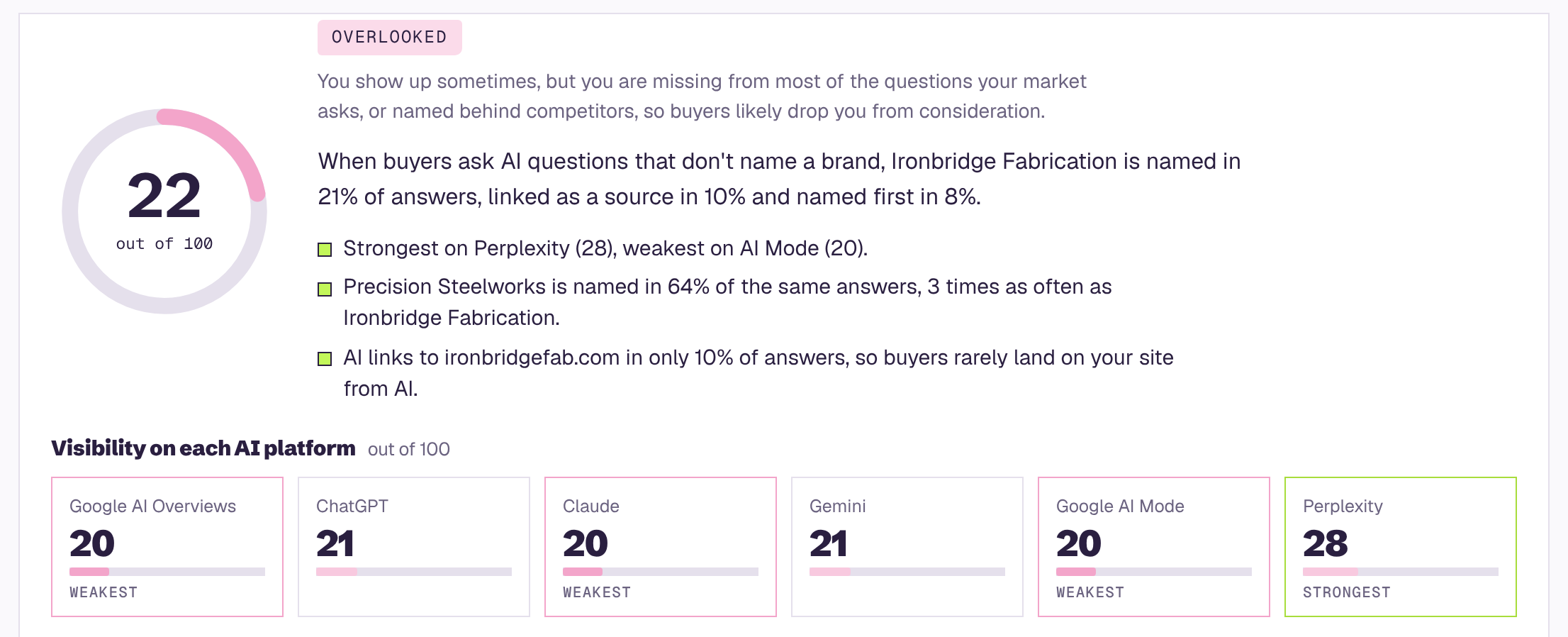
Ironbridge Fabrication scores 22, in the Overlooked band. It's named in 21% of answers to questions that don't name a supplier, while Precision Steelworks and Apex Metal Solutions are each named in 64%. Just below, the report breaks it down further:

The number that stands out here is citation rate: AI links to Ironbridge's own website in just 10% of answers. That usually means the website doesn't say enough for AI to cite it, so AI relies on directories and competitors' pages instead. For industrial companies, that's often the single biggest, most fixable gap.
Run the report again after making changes, and you can watch these numbers move against the suppliers you compete with.
Buyers still need great suppliers
Manufacturers still need parts made, lines supplied and equipment serviced. What's changed is how a new buyer or engineer finds a supplier they haven't worked with before. More and more, an AI assistant hands them a short list before your rep ever gets a meeting.
The good news for well-run industrial companies is that AI mostly rewards what buyers already value: real capabilities, verified quality, reliable delivery and helpful engineering support. The work is making all of that visible, specific and consistent in the places AI reads, and checking that it's working.
Keep learning
- What is AI visibility?
- How to get your business recommended by AI, with guides for ChatGPT, Google AI Overviews, Perplexity, Gemini and Claude
- AI visibility benchmark 2026
- The AI visibility glossary
See what AI tells buyers about your company
Enter your website and get a free AI visibility report. It takes a few minutes, and you'll see:
- Your AI visibility score, overall and for ChatGPT, Gemini, Claude, Perplexity and Google's AI Overviews and AI Mode
- Which competitors AI recommends instead of you, and how often
- Which topics you win and lose, and how often each one is searched
- What AI gets wrong about you, and what to fix first
- Your biggest gaps: the buyer questions where AI leaves you out, and who it recommends instead
- A downloadable PDF you can share with your team