Brokers ask AI too: how employers choose claims and benefits administrators
HR leaders, CFOs and benefits brokers now ask AI which third-party administrators and benefits administration firms to consider. Here's what AI tells them, and how TPAs and claims administrators get named.
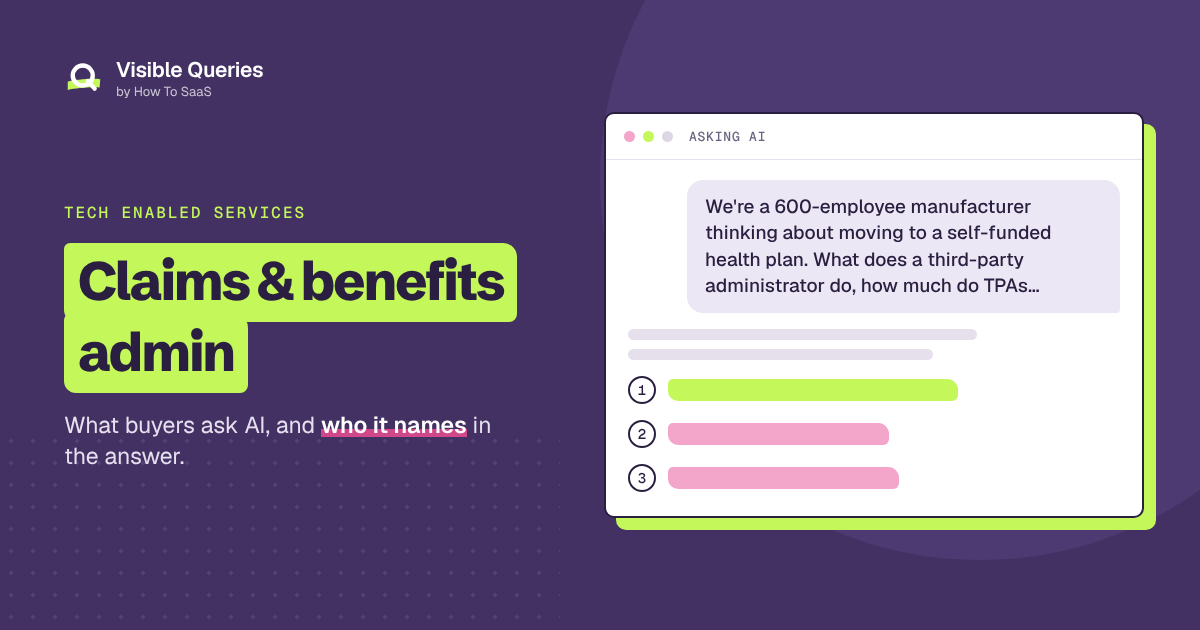
The CFO of a 600-employee manufacturer in Ohio has been told by the broker that moving to a self-funded health plan could save 8 to 12% next year. The broker has a TPA in mind. The CFO wants a second opinion before the leadership meeting, so they ask Gemini:
"We're a 600-employee manufacturer thinking about moving to a self-funded health plan. What does a third-party administrator do, how much do TPAs charge, and which ones are good for mid-size employers?"
AI explains self-funding, stop-loss coverage, what a TPA handles (claims, eligibility, member service, reporting), how fees usually work per employee per month, and what to ask about claims accuracy and turnaround. Then it names several administrators, with a line on what each is known for. The CFO forwards the list to the broker with a note: "Can we get quotes from these too?"
Claims and benefits administrators have always been sold through brokers and consultants. Those brokers, and the employers they serve, now ask AI. Our tech enabled services guide covers how companies choose outsourcing partners in general. This one goes through the questions that decide TPA and benefits administration shortlists, what AI usually says, and what administrators can publish to get named.
Here are the questions at a glance:
| The question | What gets you named |
|---|---|
| "What does a TPA do, and do we need one?" | A plain explainer on your role |
| "Best TPAs for [plan type, group size]?" | Pages by plan type, group size and industry |
| "How much do TPAs charge?" | Your fee model and what's included |
| "How accurate and fast are their claims?" | Published service levels and accuracy |
| "What's the member experience like?" | Real views of your member and employer tools |
| "Which TPAs work with [broker, carrier, stop-loss]?" | Accurate partner and network listings |
"What does a TPA do, and do we need one?"
What AI usually says: It explains self-funded plans, what administrators handle, and when a fully insured plan is simpler.
What to publish: A plain explainer on what you do and don't do, written for a CFO or HR leader who's new to self-funding. The administrators that help employers understand the decision get named as examples.
"Best TPAs for [plan type, group size]?"
What AI usually says: It names several administrators, often grouped by group size and plan type (medical, dental, level-funded, reference-based pricing).
What to publish: Pages for each plan type, group size and industry you serve well, with typical clients, networks and stop-loss relationships. "Self-funded plans for 200 to 2,000 employee manufacturers" is the kind of match AI looks for.
"How much do TPAs charge?"
What AI usually says: It explains per-employee-per-month fees and what can be added on.
What to publish: Your fee model, what's included and what costs extra. Typical ranges by group size help AI describe you rather than a competitor.
"How accurate and fast are their claims?"
What AI usually says: It looks for service levels: claims accuracy, turnaround times, call answer times. If it finds none, it says buyers should ask, which is a missed chance.
What to publish: Your service levels, how you measure them, and results over time. Specific numbers are what AI repeats.
"What's the member and employer experience like?"
What AI usually says: It summarizes reviews and descriptions of apps, portals and member service.
What to publish: Screenshots and plain descriptions of your member app, employer reporting and broker tools. This is where the "tech" in tech enabled services matters, and it's where AI often describes an administrator as an old-school paper processor because nothing on the website shows the technology.
Brokers and consultants are a second audience
In this category, the buyer often isn't the first to ask. Brokers and consultants research administrators for their clients, and many of them use AI to build the list. That means AI answers are shaped by broker-facing content as well as employer-facing content. Keep your listings on association sites, carrier and stop-loss partner pages, and broker directories accurate and consistent with your own site.
What the sample report shows
Here's what a Visible Queries report looks like for Clearpath Revenue, the sample revenue cycle management company from our tech enabled services guide. It's a different service line, but the metrics that matter for administrators are the same.

Citation rate is the one to watch: whether AI sends buyers to your site or to someone else's.
Want to see which administrators AI recommends to employers and brokers? Get your free AI visibility score from just your website address.
If you only fix three things
- Build pages by plan type, group size and industry.
- Publish service levels and claims accuracy.
- Show your technology. Member app, employer reporting and broker tools.
Employers and brokers are asking AI who should run their plan. The administrators that win will be the ones AI can describe with specifics.
See what your report covers on our tech enabled services page.
Part of our guide: How companies choose who to outsource to now
See which administrators AI recommends
Enter your website and get a free AI visibility report. It takes a few minutes, and you'll see:
- Your AI visibility score, overall and for ChatGPT, Gemini, Claude, Perplexity and Google's AI Overviews and AI Mode
- Which competitors AI recommends instead of you, and how often
- Which topics you win and lose, and how often each one is searched
- What AI gets wrong about your services and platform
- A downloadable PDF you can share with your team