Outsource or automate? How companies choose tech-enabled BPO firms through AI
Companies now ask AI whether to outsource support and back-office work or automate it, and which BPO firms to consider. Here's what AI tells them, and how tech-enabled BPO firms get named.
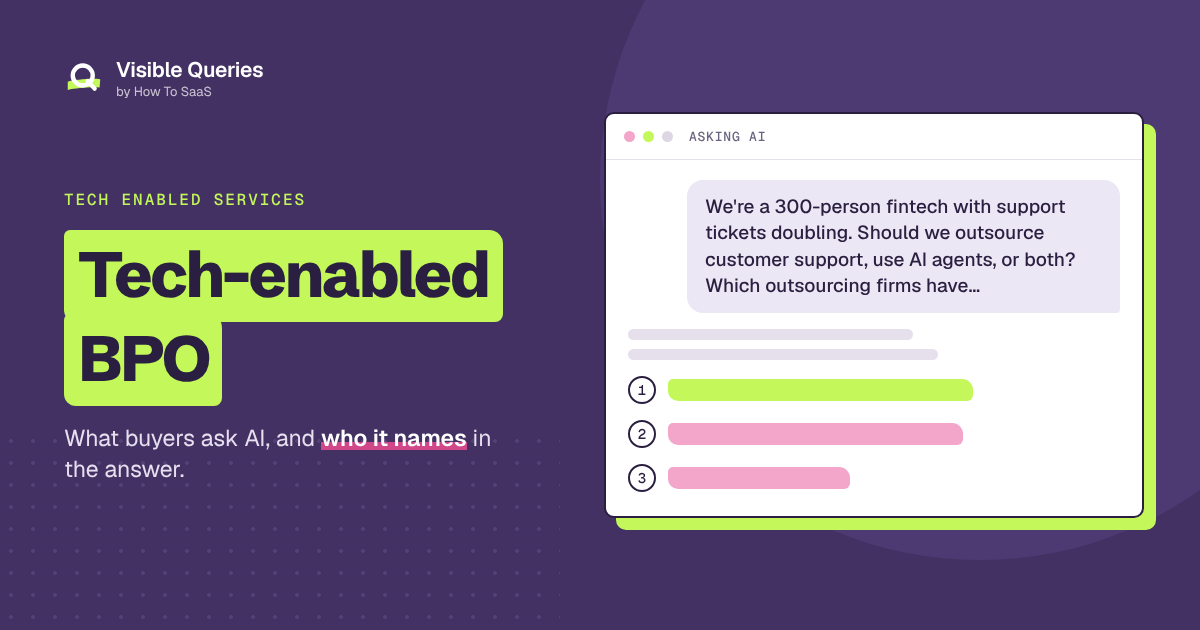
The VP of Customer Experience at a fast-growing fintech has a problem. Ticket volume doubled after the last product launch, response times are slipping, and hiring in-house takes three months per agent. The CEO asked whether AI agents could handle it instead. The VP asks Claude:
"We're a 300-person fintech with support tickets doubling. Should we outsource customer support, use AI agents, or both? Which outsourcing firms have US-based agents, fintech experience and their own automation?"
AI explains what AI agents handle well today and what still needs people (disputes, fraud, sensitive account issues), how blended models work, what compliance matters in fintech support, and how BPO pricing usually works. Then it names several firms, noting which have fintech experience, where their agents are and what technology they bring. The VP sets up three calls.
Tech-enabled business process outsourcing covers customer support, back-office processing, finance and accounting operations, data work, trust and safety, and more. Buyers increasingly ask AI whether to outsource or automate, which makes how you describe your technology more important every year. Our tech enabled services guide covers how companies choose outsourcing partners in general. This one goes through the questions that decide BPO shortlists, what AI usually says, and what BPO firms can publish to get named.
Here are the questions at a glance:
| The question | What gets you named |
|---|---|
| "Outsource, automate or both?" | An honest explainer on blended models |
| "Best outsourcing firms for [function, industry]?" | Pages by function and industry |
| "Where are their teams, and what languages?" | Locations, languages and hours in plain text |
| "How much does outsourced support cost?" | Your pricing models and typical ranges |
| "What results do they get?" | Published quality and efficiency metrics |
| "Is it secure and compliant?" | Certifications and compliance by industry |
"Should we outsource, automate, or both?"
This question now comes before almost every BPO purchase.
What AI usually says: It explains what automation handles well, where people are still needed, and how blended models work.
Why it matters: If AI tells the buyer to automate, a firm described as "people only" is out. If it recommends a blend, the firms whose technology is clearly described get named.
What to publish: An honest explainer on what you automate, what your people handle, and how they work together, with examples. Say plainly what kinds of work you'd tell a client to automate instead of outsourcing to you.
"Best outsourcing firms for [function, industry]?"
What AI usually says: It names several firms, often matching function (support, back office, finance operations, content moderation) and industry (fintech, healthcare, retail, travel).
What to publish: Pages for each function and industry you serve well, with the regulations, systems and volumes you handle and client examples.
"Where are their teams, and what languages?"
What AI usually says: Whatever it can find about locations and coverage, often out of date.
What to publish: Your delivery locations, languages, hours, and what each location is best for. Buyers ask about onshore, nearshore and offshore options directly.
"How much does outsourced support cost?"
What AI usually says: It explains per-hour, per-agent, per-transaction and outcome-based pricing, with typical ranges.
What to publish: Your pricing models and what drives cost. Typical ranges by location and function help AI describe you accurately.
"What results do they get? Is it secure?"
What AI usually says: It looks for quality scores, customer satisfaction, response times, cost savings, certifications and any security incidents.
What to publish: Your metrics with how they're measured. Case studies with before-and-after numbers. Security and compliance certifications, by industry where it matters (PCI for payments, HIPAA for healthcare).
AI often files BPO firms as "people only"
This is the BPO version of the problem our sample company has. AI tends to describe outsourcing firms as headcount providers, even when they bring their own platforms, automation and analytics. In the sample report, AI describes the sample revenue cycle company as "billing software only, no billing team," the reverse mistake.
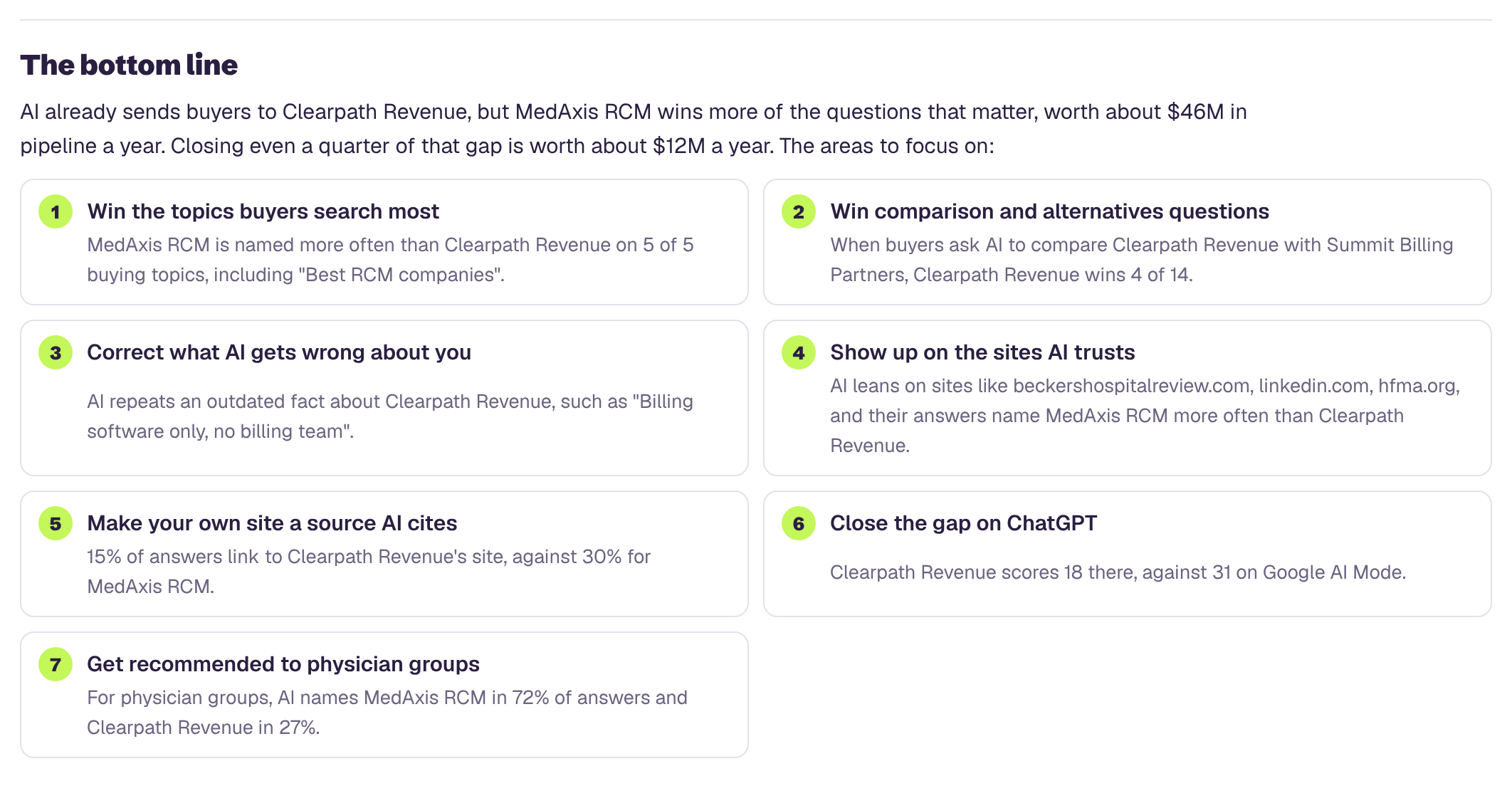
Either way, the fix is the same: say plainly what your technology does and what your people do, and say it everywhere.
What the sample report shows
In the sample Clearpath Revenue report, the pipeline going to competitors in AI answers is worth about $46M a year, and closing a quarter of that gap is worth about $12M. Most of it sits with one buyer group:
Want to see which BPO firms AI recommends to your buyers? Get your free AI visibility score from just your website address.
If you only fix three things
- Explain plainly how your technology and people work together.
- Build pages by function and industry, with locations and languages.
- Publish your metrics and certifications.
Companies are asking AI whether to outsource or automate. The BPO firms that win will be the ones AI can describe as doing both well.
See what your report covers on our tech enabled services page.
Part of our guide: How companies choose who to outsource to now
See which BPO firms AI recommends
Enter your website and get a free AI visibility report. It takes a few minutes, and you'll see:
- Your AI visibility score, overall and for ChatGPT, Gemini, Claude, Perplexity and Google's AI Overviews and AI Mode
- Which competitors AI recommends instead of you, and how often
- Which topics you win and lose, and how often each one is searched
- What AI gets wrong about your services and technology
- What the gap is worth: the pipeline going to competitors in AI answers each year
- A downloadable PDF you can share with your team