Software or billing team? How practices choose revenue cycle management companies through AI
Practice leaders now ask AI whether to outsource billing, which RCM companies to shortlist and what it should cost. Here's what AI tells them, and how revenue cycle management and medical billing companies get named.
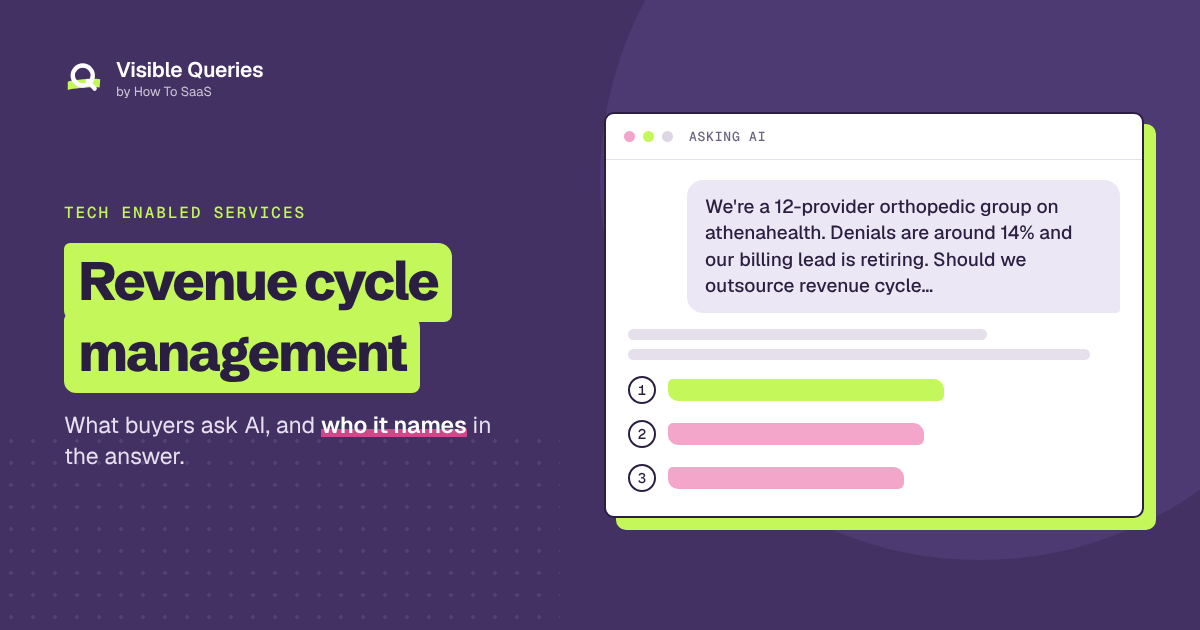
The practice administrator at a 12-provider orthopedic group has watched denials climb for three quarters. Their in-house billing lead is retiring in the spring, and nobody else knows the payer rules the way she does. The physician owners want options at the next partners' meeting. The administrator opens Claude:
"We're a 12-provider orthopedic group on athenahealth. Denials are around 14% and our billing lead is retiring. Should we outsource revenue cycle management? Which RCM companies specialize in orthopedics, and what do they usually charge?"
AI explains what drives orthopedic denials (prior authorizations, modifier errors, documentation for imaging and surgery), what outsourced RCM covers, how pricing as a percentage of collections usually works and what range is typical, and what to ask about athenahealth experience. Then it names four companies, with a line on each. Two are described as having orthopedic specialists. Those two get a call.
Revenue cycle management is one of the clearest examples of a tech enabled service: a platform and a team that do the work together. It's also one of the categories where AI most often gets that wrong. Our tech enabled services guide covers how companies choose outsourcing partners in general. This one goes through the questions that decide RCM shortlists, what AI usually says, and what RCM and medical billing companies can publish to get named.
Here are the questions at a glance:
| The question | What gets you named |
|---|---|
| "Should we outsource billing or keep it in-house?" | An honest outsourcing guide with real numbers |
| "Best RCM companies for [specialty, size]?" | Pages for each specialty and practice type |
| "What does outsourced RCM cost?" | Your pricing model and typical ranges |
| "Does [company] work with [EHR]?" | A list of EHR and PM systems you work in |
| "Is [company] software or a billing team?" | One plain sentence on what you are |
| "What results does [company] get?" | Published KPIs by specialty |
"Should we outsource billing or keep it in-house?"
What AI usually says: It weighs staffing costs, turnover, expertise and control against outsourcing fees and transition risk, and suggests outsourcing makes sense when denials are high, staff are hard to keep, or the practice is growing fast.
Why it matters: This is the decision that creates the deal. The companies whose guidance shapes this answer get named as examples.
What to publish: An honest guide to in-house versus outsourced RCM: what an in-house billing team really costs, what the practice keeps doing after outsourcing, and when a practice is too small or too simple to need you.
"Who are the best RCM companies for [specialty, size]?"
What AI usually says: It names four to six companies, often with a note on specialty, size and EHR fit.
Why it matters: RCM is highly specialty-specific. "Best RCM for behavioral health" and "best RCM for orthopedics" get very different answers, and a focused company can win its specialty without winning the head term.
What to publish: A page for each specialty you serve well, with the codes, payers and denial patterns you handle, the EHRs you work in, and results for clients in that specialty. Pages for practice types too: single-specialty groups, multi-specialty groups, ASCs, hospitals.
"What does outsourced RCM cost?"
What AI usually says: It explains percentage-of-collections pricing and typical ranges, and notes what might cost extra (credentialing, coding, old AR cleanup).
What to publish: Your pricing model, what's included, what isn't, and typical ranges by practice size. You don't need a price list. You need enough that AI can describe how you charge.
"Is [company] software or a billing team?"
This is the question that quietly decides whether an RCM company is even considered.
What AI usually says: It sorts companies into "RCM software" and "outsourced billing services." Companies with their own platform and their own billing team often get put in the wrong bucket.
Why it matters: A buyer escaping staffing problems doesn't want software that needs a team to run it. A buyer who wants technology doesn't want a firm with no platform. Get filed in the wrong bucket and you lose both.
What to publish: One plain sentence, repeated everywhere: "We run your billing for you, on our own platform, with a dedicated billing team." Then explain what the team does, what the platform does, and who the client talks to.
"What results does [company] get?"
What AI usually says: It looks for numbers: clean claim rates, denial rates, days in AR, collection rates. If it can't find yours, it uses a competitor's.
What to publish: Your KPIs, by specialty and practice size, with how they're measured and over what time. Case studies with before-and-after numbers. Specific, checkable results are what AI repeats.
Where RCM buyers' AI answers come from
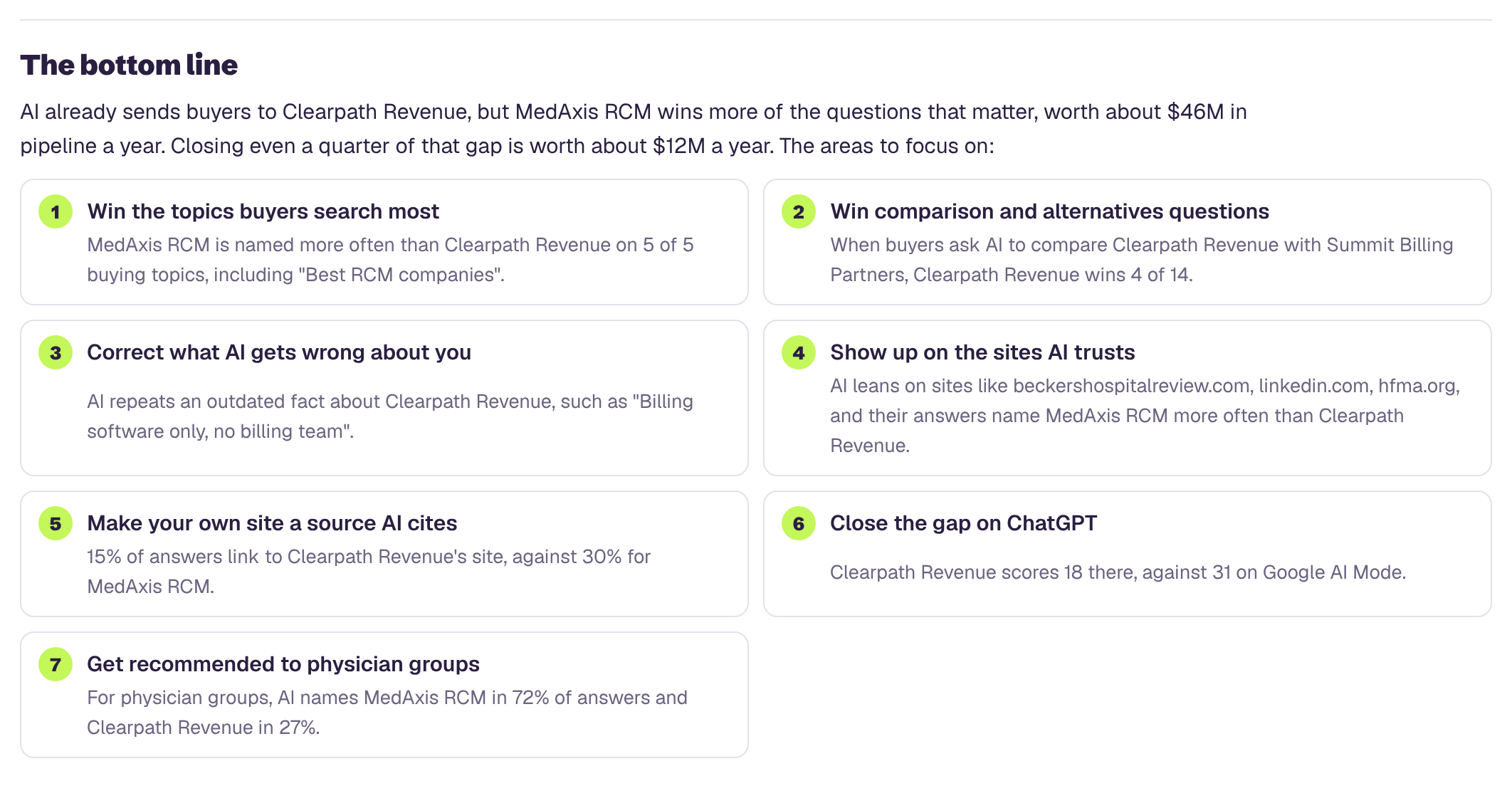
RCM is a field where trade press and associations carry a lot of weight. In the sample report, AI leans on beckershospitalreview.com, linkedin.com and hfma.org, and those answers name MedAxis RCM more often than Clearpath Revenue. Bylined articles, conference talks, association listings and LinkedIn posts from your leaders all feed what AI says about you.
What the sample report shows
Here's what a Visible Queries report looks like for Clearpath Revenue, the sample RCM company from our tech enabled services guide.
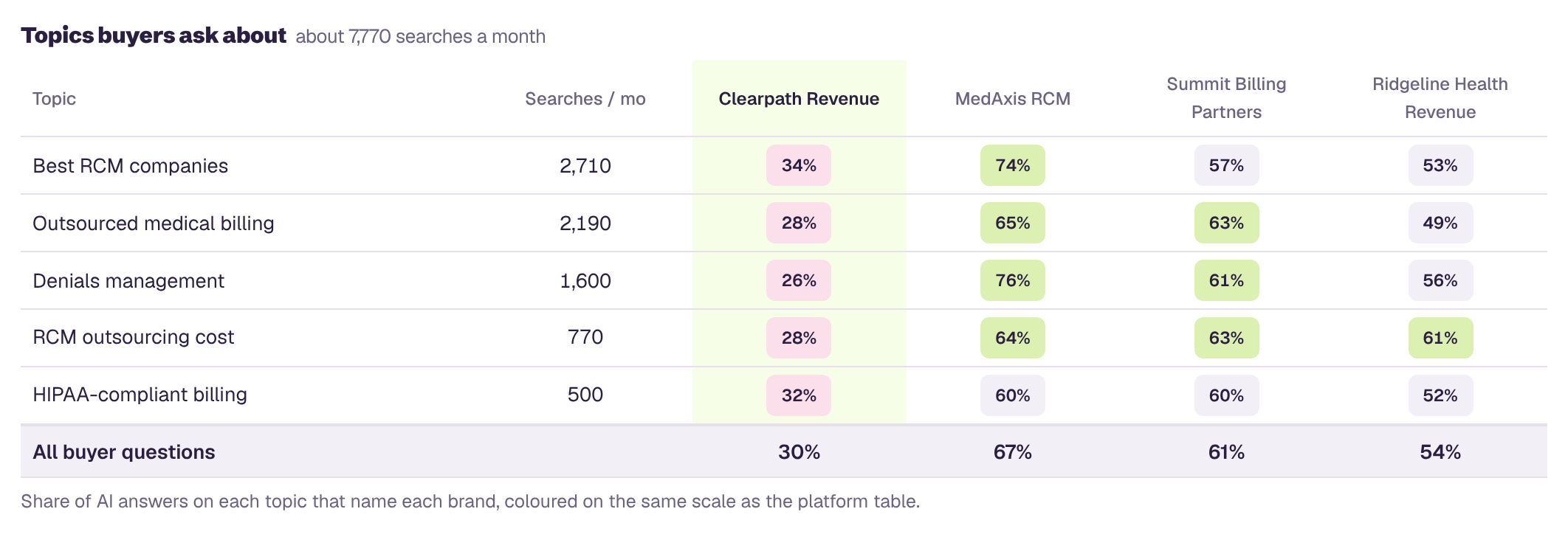
The widest gap is on "Denials management," the exact problem behind most RCM searches:
Want to see which RCM companies AI recommends to your buyers? Get your free AI visibility score from just your website address.
If you only fix three things
- Say plainly that you're a platform and a team. Everywhere.
- Build specialty pages with results. And list every EHR you work in.
- Publish your pricing model and KPIs.
Practices are asking AI who to trust with their revenue. The RCM companies that win will be the ones AI can describe accurately.
See what your report covers on our tech enabled services page.
Part of our guide: How companies choose who to outsource to now
See which RCM companies AI recommends
Enter your website and get a free AI visibility report. It takes a few minutes, and you'll see:
- Your AI visibility score, overall and for ChatGPT, Gemini, Claude, Perplexity and Google's AI Overviews and AI Mode
- Which competitors AI recommends instead of you, and how often
- Which topics you win and lose, and how often each one is searched
- What AI gets wrong about your services and platform
- What the gap is worth: the pipeline going to competitors in AI answers each year
- A downloadable PDF you can share with your team