How companies choose who to outsource to now, and why AI visibility decides which tech enabled services firms get the RFP
Companies now ask ChatGPT, Gemini and Claude who to hand their payroll, billing, claims or compliance work to. Here's how their journey works, what they ask at each step, and how to build a tech enabled services firm AI recommends.
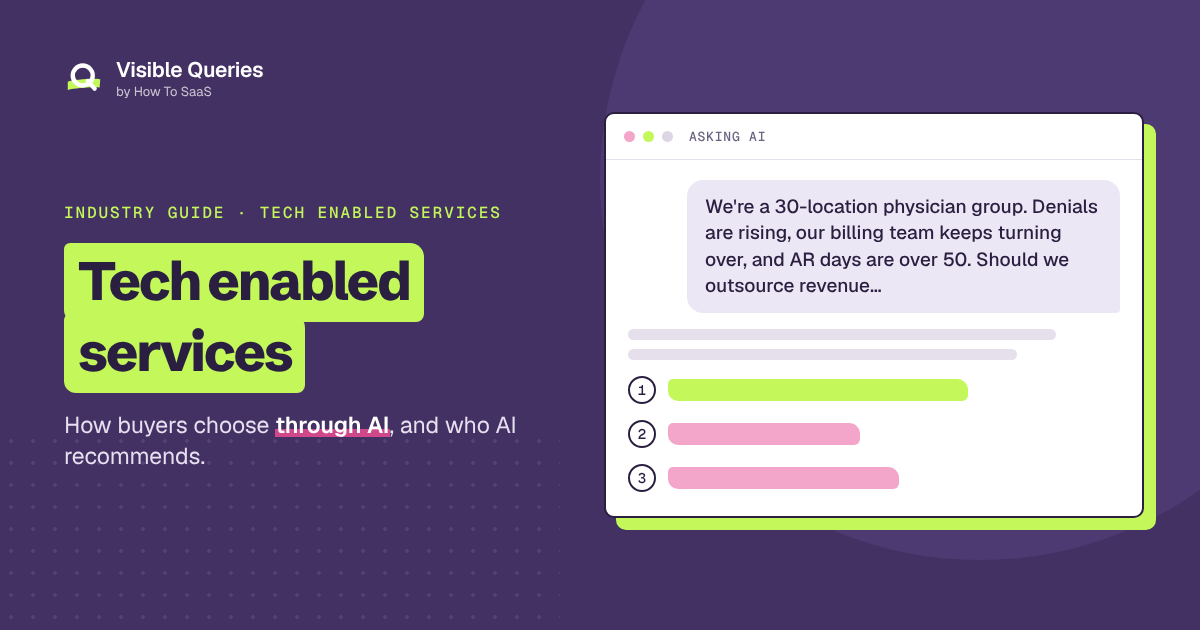
The VP of Finance at a 30-location physician group has just come out of another bad month-end review. Denials are up again. Two billers quit in the spring, and the replacements are still learning the payer rules. Days in accounts receivable have crept past 50, and the CFO wants a plan by the next board meeting.
Five years ago, the plan would have started with phone calls: a peer at another group, the account rep from the last HFMA conference, maybe a consultant. Then three vendor webinars and a long spreadsheet.
Today there's a good chance the first thing she does is open ChatGPT and type:
"We're a 30-location physician group. Denials are rising, our billing team keeps turning over, and AR days are over 50. Should we outsource revenue cycle management, and which RCM companies should we talk to?"
What comes back reads like a briefing from a well-informed colleague. It explains the common causes of rising denials, what outsourced revenue cycle management covers, how pricing usually works (a percentage of collections, typically), what to ask about technology, reporting and staff, and the risks of switching. Then it names four or five providers, with a line on what each is known for and who it suits.
She pastes that list into an email to the CFO: "Here's where I'd start."
That list is the new top of the funnel for tech enabled services. The firms on it get the discovery calls and the RFPs. The firms not on it often never learn they were in the running, because the buyer never visited their site, never downloaded the whitepaper and never showed up in their CRM.
This guide walks through how companies choose an outsourcing partner now, step by step, with examples from across the industry: payroll, HR and PEO providers, revenue cycle management and medical billing, claims and benefits administration, background screening and compliance, and tech-enabled BPO. It covers what buyers ask AI at each step, what makes AI recommend one provider over another, and what the firms that keep getting recommended tend to do differently.
Tech enabled services firms have a particular problem with AI, and it runs through every step: AI tends to file you as either a software company or a plain outsourcer. Your value is the platform and the people together, and AI often only sees half of it.
Along the way you'll see screenshots from a Visible Queries report for Clearpath Revenue, a sample revenue cycle management company. The company and its competitors are made up, but the report is real. It's what any tech enabled services firm sees when it runs its own. You can see the same report for your firm on our tech enabled services page.
Why the old playbook isn't enough anymore
For years, tech enabled services firms grew on a familiar mix. Conference booths and sponsorships. Analyst and trade press coverage. Referral partners like brokers, consultants and software vendors. Gated whitepapers and webinars that fed an outbound sales team. RFP responses, and a lot of relationship selling.
Most of that still matters. But it was built on an assumption that's breaking down: that the buyer would build their shortlist from the people and publications they already knew, and that your job was to be known by them.
AI changes who builds the shortlist. The buyer asks a question, and the assistant reads your website, your case studies, trade press, LinkedIn posts, review sites, association pages, analyst summaries and your competitors' pages, then writes a synthesis. The buyer reads the synthesis, not your capabilities deck.
Three things follow from that:
- The shortlist forms before the RFP. Buyers often arrive at a first call, or send an RFP, to three or four firms they got from an AI conversation you never saw. If you weren't on the list, there's no lost deal in your CRM. There's just no deal.
- AI decides what kind of company you are. When a buyer asks "Should we buy RCM software or outsource billing?", the answer sorts every provider into a bucket. If AI thinks you're software only, it tells the buyer they'll need their own billing team to run you. If it thinks you're a traditional outsourcer, it doesn't mention your platform at all. Either way, it's describing a company that isn't quite yours.
- Proof beats claims. AI is good at ignoring "best-in-class" and "end-to-end." It picks up "clean claim rate of 97%, average 22 days in AR across 140 clients, SOC 2 Type II, HITRUST certified, US-based billing team with a named account manager." Specific, checkable facts get repeated. Adjectives don't.
None of this means your website, case studies or conference presence stop mattering. They matter more, because they're the raw material AI works from. What changes is that they now have to work for two readers at once: the buyer and the assistant briefing them.
The buyer's journey, step by step
Outsourcing decisions range from a 20-person company switching payroll providers in a week to a health system moving its whole revenue cycle over a year. The steps are the same. What changes is how many people are involved and how much is at risk if it goes wrong.
- A problem surfaces. Something breaks, a key person leaves, costs climb, or a compliance deadline arrives.
- They work out whether to outsource. Build in-house, buy software, or hand the work to a provider with its own platform.
- They build a shortlist. Which providers are worth a call or an RFP.
- They vet. Results, security, compliance, references, contract terms and transition risk.
- The committee decides. Finance, operations, IT, legal and the people whose jobs change, each asking AI their own questions.
- They transition, renew and talk about it. Onboarding, the first year of results, renewal, and the reviews and referrals that feed the next buyer's journey.
AI now shows up at every one of these steps. Here's what it looks like at each one.
Step 1: A problem surfaces
Outsourcing decisions almost never start with "we should outsource." They start with a moment of pain:
- A month where denials jump and cash flow tightens (revenue cycle)
- A payroll error in a new state that triggers a tax notice (payroll and PEO)
- An open enrollment that swamps a two-person HR team (benefits administration)
- A bad hire who slipped through a weak background check (screening)
- A claims backlog that's making members angry and regulators curious (claims administration)
- A customer support queue that doubles after a product launch (BPO)
What buyers ask AI at this step doesn't name a provider or even a category:
- "Why are our claim denials going up?"
- "We just hired our first employees in Ontario. What changes for payroll?"
- "How do other 200-person companies handle open enrollment without a big HR team?"
- "What should a background check for a healthcare worker include?"
The answers frame the whole purchase. If AI says rising denials usually come from front-end eligibility and coding problems, the buyer thinks of the fix as a process and technology problem. If it says they come from understaffing, the buyer starts looking at staffing agencies. The firms whose explanations shape these early answers are effectively writing the buyer's requirements.
Step 2: They work out whether to outsource
This is the education step, and for tech enabled services it's the most important one. The buyer isn't just choosing a provider. They're choosing between three different ways of solving the problem, and AI is helping them decide.
- "Should we outsource medical billing or keep it in-house?"
- "PEO vs payroll software vs HR outsourcing: what's right for a 150-person company?"
- "How much does outsourced revenue cycle management cost?"
- "Is it cheaper to run benefits administration ourselves with software?"
- "What are the risks of outsourcing claims processing?"
- "Do we need a TPA or can our carrier handle it?"
AI answers with trade-offs, rough pricing models and, often, a few example providers. Those examples matter. A buyer who sees the same three names while deciding whether to outsource at all will treat those three as the category.
This is where tech enabled services firms lose quietly. Their website explains their services, but not the decision. There's no plain explanation of when outsourcing makes sense and when it doesn't, how their pricing model compares with hiring, or what the buyer keeps doing in-house. So AI learns the decision from trade associations, consultants and competitors who did publish that thinking.
Here's what this looks like in a real report. Each row is a topic buyers ask about, with how often it's searched each month and the share of AI answers on that topic that name the sample company and each of its top competitors.
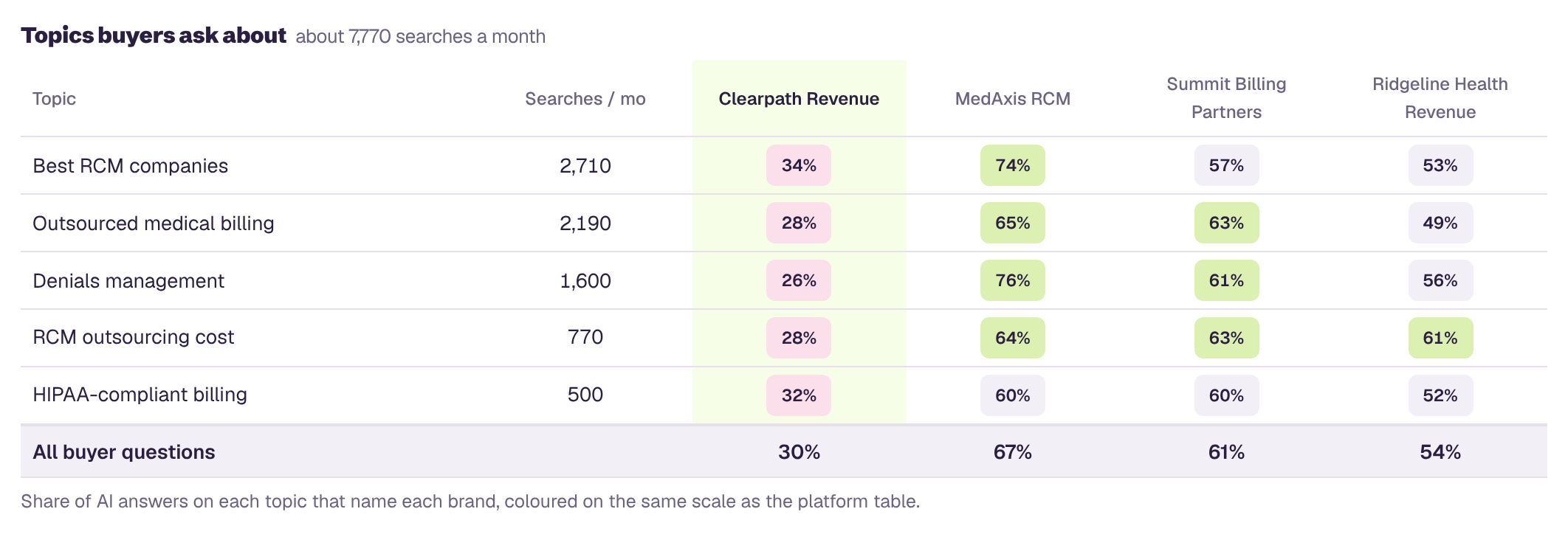
Look at "RCM outsourcing cost" and "Outsourced medical billing." Those are buyers at step 2, deciding whether to hand the work over and what it should cost. Clearpath Revenue is named in 28% of answers on both. MedAxis RCM is named in 64% and 65%. And on "Denials management," the exact problem in our opening scene, MedAxis is named in 76% of answers and Clearpath in 26%.
What good tech enabled services firms do at this step: they help buyers make the decision, not just pick a vendor. They publish honest guides to outsourcing versus software versus hiring, explain their pricing model with real ranges, show what the client keeps doing and what the provider takes on, and say plainly when a company is too small or too simple to need them. That kind of guidance is exactly what AI trusts and repeats.
Step 3: They build a shortlist
Now the buyer wants names, usually filtered by their situation:
- "Best revenue cycle management companies for a 20-location physician group"
- "Which PEOs are best for a 150-person company with employees in Texas and Ontario?"
- "Top third-party administrators for self-funded health plans under 1,000 lives"
- "Which background screening providers are best for healthcare staffing?"
- "Outsourced customer support companies with US-based agents for fintech"
- "What are good alternatives to [market leader] for a mid-size group?"
These questions are where the shortlist gets made, and they're far more specific than the keywords tech enabled services firms used to target. Buyers describe their size, their specialty, their states and countries, their systems and their constraints. The answer changes with every detail.
That's both a threat and an opportunity. A big provider can dominate "best RCM companies" and still lose "best RCM company for orthopedic groups on athenahealth," where a firm that's clear about its specialty and its integrations wins. A focused firm can win dozens of these specific questions even if it never wins the head term.
The flip side is that vague positioning gets punished. If your site says you serve "healthcare organizations of all sizes," AI has no reason to put you on any specific shortlist. The report shows this as gaps: groups of buyers whose questions leave you out, and the competitors AI names instead.
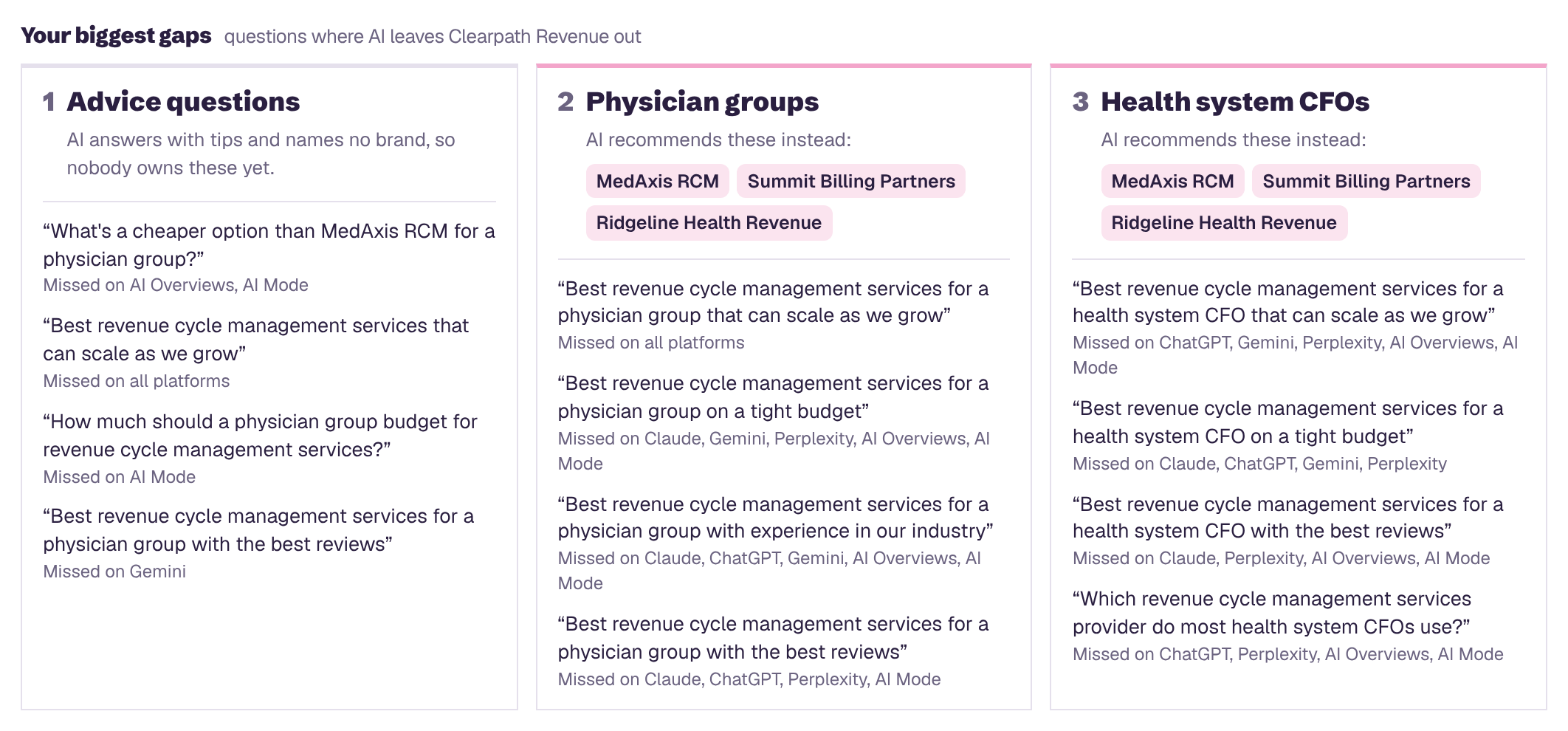
In the sample, physician groups and health system CFOs are the two biggest gaps, and the same three competitors fill both. For physician groups, AI names MedAxis RCM in 72% of answers and Clearpath Revenue in 27%. That's the buyer from our opening scene, and Clearpath is missing from most of their shortlists.
What good tech enabled services firms do at this step: they're specific about who they serve. Pages for each client type, specialty, size and region, with real details: the systems they work with, the states or provinces they cover, the typical client, and results for clients like that. They also publish honest comparison pages for the competitors they meet in most deals.
Step 4: They vet
Once there's a shortlist, the questions get sharper. Outsourcing buyers are handing over money, employee data, patient data or regulatory risk. They're trying to avoid a transition that blows up, a security incident, a provider that loses their best account manager, or results that never match the pitch.
- "Does [provider] have its own billing team, or is it just software?"
- "Is [provider] SOC 2 Type II certified? HITRUST?"
- "What do clients complain about with [provider]?"
- "How long does it take to switch to [provider]?"
- "What results does [provider] get on denials and AR days?"
- "Is [provider] PE-owned? Did they just get acquired?"
- "Who will actually work on our account?"
AI answers by pulling together your website, case studies, trust or security page, review sites, LinkedIn, trade press, association listings and anything else it can find. Two things make or break you here.
The first is facts about what you are and what you do. For tech enabled services, the most dangerous wrong fact is often the most basic one: what kind of company you are.
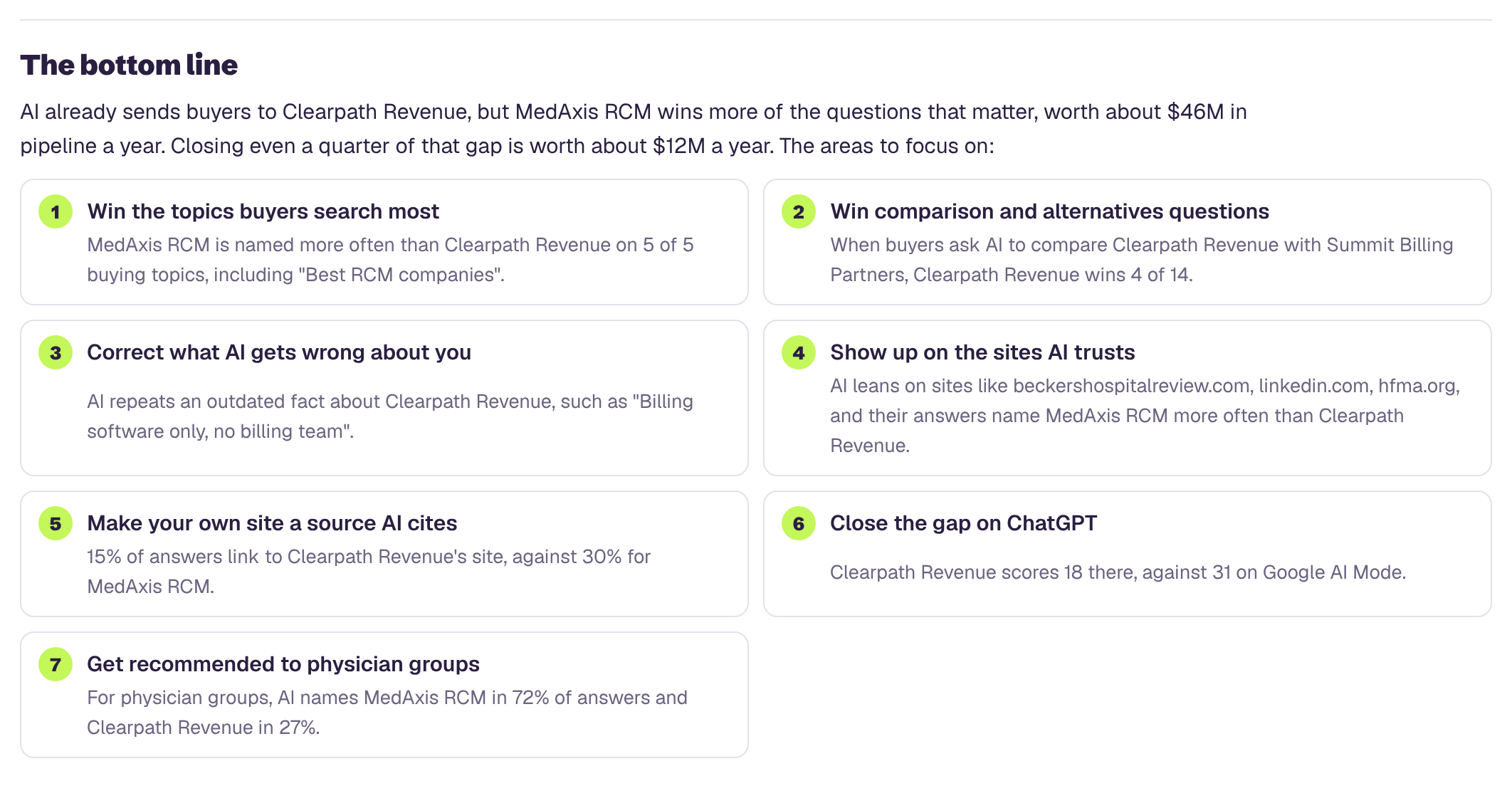
In the sample, AI tells buyers Clearpath Revenue is "billing software only, no billing team." Clearpath runs a full billing team on its own platform. Every physician group that asks hears that Clearpath would leave them to staff the work themselves, which is exactly the problem they're trying to escape. The report's accuracy score measures how often AI gets a firm's core facts right. In this sample it's 80%, and the 20% it gets wrong includes the one fact that decides whether Clearpath is even in the right category.
The second is proof and reputation. AI summarizes what clients say into themes, like "great technology but account managers turn over" or "responsive team, clunky portal." Those summaries travel into every vetting conversation. A few public complaints about a rough transition can become the headline.
What good tech enabled services firms do at this step: they make the boring facts impossible to miss. A plain statement of what the platform does and what the team does. A security and compliance page with current certifications. Published results with real numbers and the client types they came from. A transition plan with a realistic timeline. Named leadership and a description of who works on a client's account. And they keep those facts consistent across their site, LinkedIn, association directories and partner pages.
Step 5: The committee decides
Outsourcing decisions are rarely made by one person, and the other people on the committee are asking AI their own questions.
- The CFO asks: "What's the ROI of outsourcing revenue cycle management for a group our size?"
- Operations asks: "How disruptive is switching RCM providers mid-year?"
- IT and security ask: "What should we require from a vendor that handles PHI?"
- Legal asks: "What should be in an RCM outsourcing contract? What about termination and data return?"
- The billing manager asks: "What happens to our billing staff if we outsource?"
- Procurement asks: "Clearpath Revenue vs Summit Billing Partners: which is better value?"
Each of these is a chance to win or lose the deal without being in the room. If the CFO's question gets an answer that names three competitors and not you, your champion now has to argue against what the CFO just read.
Head-to-head questions are especially decisive. In the sample, when buyers ask AI to compare Clearpath Revenue with a competitor by name, AI recommends Clearpath in 45% of answers. Against Summit Billing Partners specifically, Clearpath wins 4 of 14 comparisons. When AI compares two providers, it leans on whatever concrete information it can find: pricing models, results, certifications, client types, contract terms and review themes. If a competitor publishes all of that and you don't, the comparison tilts their way by default.
Want to see who AI recommends when your buyers compare you by name? Get your free AI visibility score from just your website address.
What good tech enabled services firms do at this step: they publish for the whole committee. An ROI explanation the CFO can follow, a security overview IT can verify, standard contract terms legal can read, a transition plan operations can trust, and an honest answer about what happens to the in-house team. They're transparent about pricing models even if exact prices need a proposal, and they write fair comparison pages for the competitors they meet most.
Step 6: They transition, renew and talk about it
After the contract is signed, the journey keeps going, and it feeds every earlier step for the next buyer.
- "How long should an RCM transition take before collections recover?"
- "What KPIs should we track with our payroll provider?"
- "Is our PEO still the right fit now that we're 300 people?"
- "What are the alternatives to [provider] at renewal?"
That last one matters. Clients ask AI about alternatives at renewal, and what they hear depends on the same things that won or lost the original deal.
This is also where the reputation loop runs. Clients who get a smooth transition, see results fast and trust their account team write specific, positive reviews, speak at conferences, take reference calls and refer peers. That material becomes what AI says about you to the next buyer at step 4. Clients who struggle become the reviews and forum posts that weigh you down.
What good tech enabled services firms do at this step: they treat transition and account management as part of their visibility. Public KPI benchmarks and transition guides keep their name attached to post-purchase questions. Programs that turn happy clients into case studies, reviews, conference talks and LinkedIn posts give AI credible, specific material to work from.
How the journey plays out across tech enabled services
The six steps hold across every kind of tech enabled service, but the step that decides the deal is different. Here's where the weight falls in each, and what the firms that win tend to do.
Payroll, HR and PEO providers
Payroll and HR buyers are often growing companies hitting a new kind of complexity: a first employee in a new state or country, a jump past 50 employees, or benefits that no longer compete. They lean on AI heavily at step 2, trying to work out the difference between payroll software, a PEO, an employer of record and HR outsourcing.
The providers that win explain those differences honestly, publish clear pricing models (per employee per month, or a percentage of payroll), list the states, provinces and countries they cover, and are specific about the company sizes and industries they fit. Compliance facts carry a lot of weight, because a payroll mistake is the buyer's nightmare.
Full guide: AI visibility for payroll, HR and PEO providers
Revenue cycle management and medical billing
RCM buyers are practice administrators, CFOs and physician owners under pressure on cash flow. They ask AI about denials, AR days, coding, pricing as a percentage of collections, EHR integrations and whether a provider has a real billing team. Specialty matters enormously: "best RCM for behavioral health" is a different question from "best RCM for orthopedics."
The firms that win publish results by specialty, list the EHRs and practice management systems they work in, explain their pricing model and what's included, and are clear that their platform and their team work together. That last point is exactly where our sample company loses.
Full guide: AI visibility for revenue cycle management companies
Claims and benefits administration
Third-party administrators, benefits administration firms and claims processors sell to HR leaders, CFOs, brokers and insurers. Many buyers find them through brokers and consultants, who now ask AI too. Questions are about plan types, member experience, claims accuracy, turnaround times, stop-loss relationships and technology.
The firms that win are clear about which plan types and group sizes they handle, publish service levels and turnaround times, show their member and employer technology, and keep their broker and partner listings accurate. AI often answers these questions from association and broker content, so being present there matters.
Full guide: AI visibility for claims and benefits administrators
Background screening and compliance
Screening buyers are HR, talent acquisition and compliance leaders, and the vetting step dominates. They ask AI about turnaround times, accuracy, FCRA compliance, industry-specific checks (healthcare, transportation, financial services), integrations with their applicant tracking system, and candidate experience.
The providers that win publish turnaround times by check type, list their compliance credentials and accreditations, explain their integrations with ATS and HR systems, and are specific about the industries they serve. Accuracy and fairness questions come up often, so a clear explanation of dispute handling helps.
Full guide: AI visibility for background screening companies
Tech-enabled BPO and outsourced operations
Customer support, back-office processing, finance and accounting operations and other outsourced functions are often sold on a mix of people, process and technology. Buyers ask AI about locations, languages, quality scores, security, pricing models and how AI and automation fit with human agents.
The firms that win are specific about the functions and industries they handle, publish where their teams are and what that means for cost and coverage, show real quality and efficiency results, and explain plainly how their technology and people work together. That last point matters more every year, as buyers ask AI whether they should automate instead of outsource.
Full guide: AI visibility for tech-enabled BPO firms
Freight, logistics and other platform-plus-service firms
Digital freight brokers, tech-enabled insurance agencies, outsourced IT with proprietary platforms and similar firms don't have their own spoke article, but the same journey applies, with the same central risk: AI filing you as pure software or pure service. The fix is the same too. Say plainly what the platform does, what the people do, who you serve and what results you get, and say it consistently everywhere AI reads.
Building a tech enabled services firm AI recommends
Put the six steps and the service lines together and a pattern comes out. The firms AI recommends aren't the ones with the loudest claims or the biggest conference booths. They're the ones whose services, platform, proof and client experience all line up, so everything AI reads about them tells a clear, consistent story.
Here's what that looks like in practice.
1. Say what you are in one plain sentence. "We run your billing for you, on our own platform, with a dedicated team" leaves AI no room to file you as software only or as an old-school outsourcer. Put that sentence on your homepage, your About page, your LinkedIn and your directory listings.
2. Help buyers make the outsourcing decision. Publish honest guides to outsourcing versus software versus hiring, with pricing models and the situations where you're not the right answer.
3. Pick a lane and say it plainly. "For multi-site physician groups in orthopedics and pain management" gets you onto specific shortlists. "For healthcare organizations of all sizes" gets you onto none. Build pages for each client type, specialty, size and region you genuinely serve.
4. Publish your results with real numbers. Clean claim rates, AR days, error rates, turnaround times, retention, cost savings, with the client types they came from. Case studies with specifics give AI facts to repeat.
5. Make security and compliance easy to verify. A current trust page with certifications, audits, data handling and where data lives. Buyers' IT and legal teams ask AI about this, and a missing answer reads as a risk.
6. Keep facts identical everywhere. Your website, LinkedIn, association directories, partner and broker listings, review sites and press releases should all describe the same services, systems, regions and results. Inconsistent and outdated listings are where wrong AI answers come from.
7. Write for the whole committee. The CFO, operations, IT, legal and the in-house team all ask their own questions. Give each of them a page that answers those questions in their language.
8. Be honest about competitors. Fair, specific comparison pages give AI concrete material for head-to-head questions. Overclaiming tends to backfire, because AI cross-checks.
9. Show up where AI looks in your industry. Trade press, association sites, industry LinkedIn conversations, conference agendas and analyst summaries are among the sources AI leans on. In the sample, AI leans on beckershospitalreview.com, linkedin.com and hfma.org, and those answers name MedAxis RCM more often than Clearpath Revenue.
10. Measure it. Most tech enabled services firms have never looked at what AI says about them across the questions their buyers ask, against the competitors they lose deals to.
That last point is where the report comes in. Here's the top of the sample report for Clearpath Revenue:
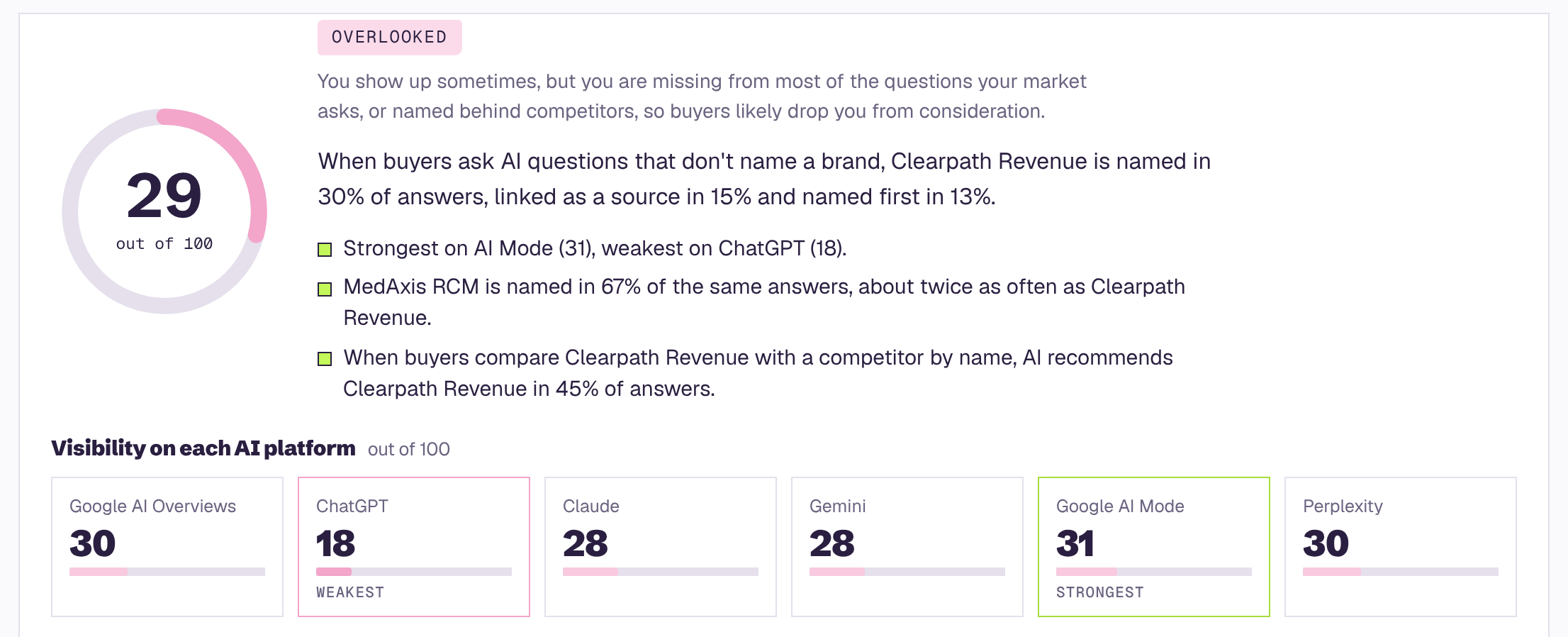
Clearpath Revenue scores 29, in the Overlooked band. That's a common place for good tech enabled services firms: AI knows them when asked by name, but rarely recommends them when buyers ask who to hire. Clearpath is named in 30% of answers to questions that don't name a provider, while MedAxis RCM is named in 67%, about twice as often. Clearpath is strongest on Google's AI Mode at 31 and weakest on ChatGPT at 18, the assistant many finance leaders open first.

The report also puts a number on the gap. In the sample, MedAxis RCM wins more of the questions that matter, worth about $46M in pipeline a year. Closing even a quarter of that gap is worth about $12M a year. For a firm that sells multi-year contracts, a single deal won or lost at the shortlist stage is worth more than most marketing budgets.
Run the report again after making changes, and you can watch these numbers move against the competitors that matter.
Companies haven't stopped outsourcing
Companies still need their claims paid, their payroll right, their candidates screened and their customers answered. What's changed is who does the first round of research. More and more, it's an AI assistant, and it hands the buyer and their whole committee a short list of providers before anyone visits your website or calls your sales team.
The good news for well-run tech enabled services firms is that AI mostly rewards what good firms already care about: a clear model, real results, strong security, a team clients trust, and clients who are happy to talk about it. The work is making all of that visible, specific and consistent in the places AI reads, and checking that it's working.
Keep learning
- AI visibility for tech enabled services: what your report shows and the questions buyers ask at each stage
- How companies choose a service provider now, our guide for agencies, IT, accounting and staffing firms
- What is AI visibility?
- How to get your business recommended by AI, with guides for ChatGPT, Google AI Overviews, Perplexity, Gemini and Claude
- The AI visibility glossary
See which providers AI recommends instead of you
Enter your website and get a free AI visibility report. It takes a few minutes, and you'll see:
- Your AI visibility score, overall and for ChatGPT, Gemini, Claude, Perplexity and Google's AI Overviews and AI Mode
- Which competitors AI recommends instead of you, and how often
- Which topics you win and lose, and how often each one is searched
- What AI gets wrong about your services and platform, and what to fix first
- What the gap is worth: the pipeline going to competitors in AI answers each year
- A downloadable PDF you can share with your team