How companies choose a service provider now, and why AI visibility decides which firms get the call
Business owners now ask AI which IT provider, accounting firm, agency or recruiter to hire. Here's how their journey works, what they ask at each step, and how to build a services firm AI recommends.
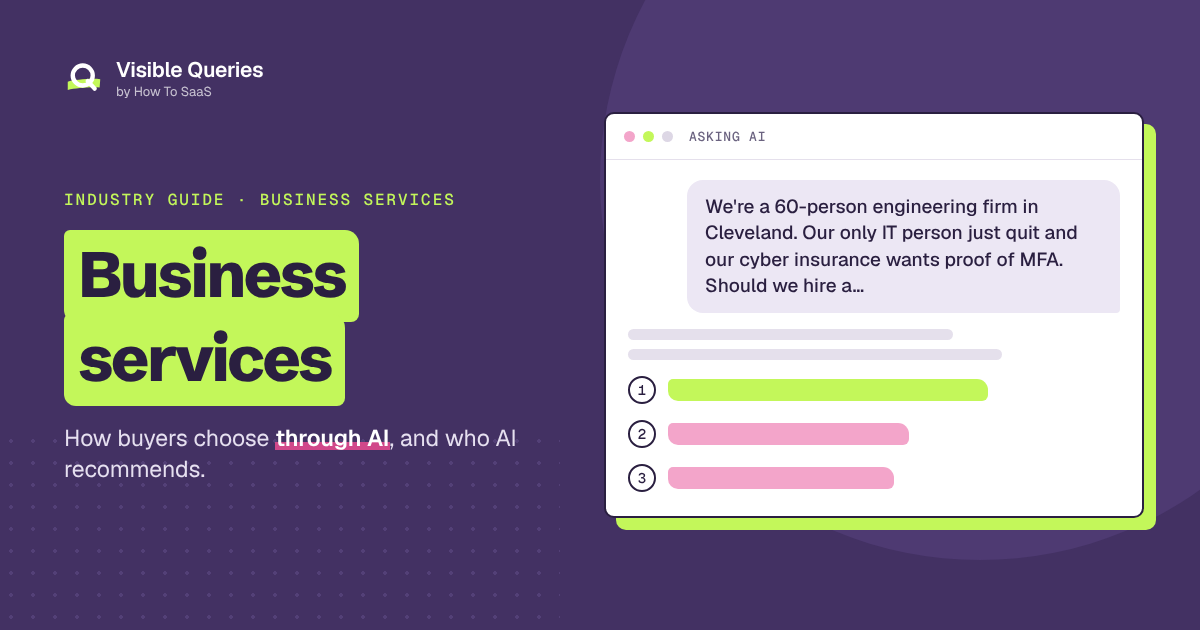
It's a Tuesday morning at a 60-person engineering firm in Cleveland. The one person who handled IT gave notice on Friday. Since then, two laptops have stopped syncing, the printer is offline, and a partner just forwarded an email from the firm's cyber insurance carrier asking whether they have multi-factor authentication on every account. Nobody knows.
The operations manager has been told to "find us an IT company."
A few years ago, they would have searched "managed IT services Cleveland," clicked through a handful of nearly identical websites that all promised "proactive, end-to-end solutions," and asked a friend at another firm who they used.
Today there's a good chance they start somewhere else. They open ChatGPT and write:
"We're a 60-person engineering firm in Cleveland. Our only IT person just quit and our cyber insurance wants proof of MFA. Should we hire a replacement or use a managed IT provider? Who are good options locally?"
The answer walks them through the trade-offs of hiring versus outsourcing, explains what a managed services provider typically includes, gives a rough monthly cost per user, and lists what to ask about security and response times. Then it names three or four local providers, with a line on what each is known for.
The operations manager forwards that list to the managing partner. Two of those firms get calls that afternoon.
That's how a growing share of service-provider searches start now, whether the company is looking for an IT provider, an accounting firm, a recruiter, a marketing agency, a consultant, a logistics partner or a commercial cleaning company. And unlike a search results page, the answer doesn't have room for twenty firms. It has room for three or four.
This article walks through how businesses find and choose service providers today, step by step, with examples from across professional services: managed IT, accounting and bookkeeping, staffing and executive search, marketing and web agencies, management consulting, logistics, commercial cleaning, and architecture and engineering. It covers what buyers ask AI at each step, what makes AI recommend one firm over another, and what the firms that keep getting recommended tend to do differently. Most of it comes down to being a firm that's easy to understand, easy to trust and genuinely good at what it does.
Along the way you'll see screenshots from a Visible Queries report for Northgate IT, a sample managed IT provider in Ohio. The firm and its competitors are made up, but the report is real. It's exactly what any services firm sees when it runs its own.
Why the old playbook isn't enough anymore
Services firms have always grown mostly on referrals. Someone asks a peer, "Who does your books?" or "Who handles your IT?", and the answer becomes the shortlist. Marketing filled in around the edges with a website, a few directory listings, some LinkedIn posts, maybe a sponsorship at the local chamber.
That referral instinct hasn't gone away. What's changed is who's being asked. More and more, the "peer" a business owner turns to first is an AI assistant. It answers the way a well-connected friend would, except it's drawing on every website, review, directory, article and forum thread it can find.
Three things follow from that:
- Everyone gets the same shortlist. A business owner in Cincinnati and their competitor across town can ask the same question and hear the same three names. If you're not one of them, you're not just missing one referral. You're missing the default referral for your whole market.
- Generic positioning disappears. Services firms are notorious for interchangeable websites: "trusted partner," "tailored solutions," "client-focused." AI can't recommend a firm for a specific need if the firm never says what it's specifically good at.
- Your reputation is summarized for you. When a buyer asks "Is [firm] any good?", AI condenses your reviews, case studies, client mentions and any complaints into a couple of sentences. That summary arrives before your proposal does.
None of this makes referrals, relationships or reputation less important. It makes them more important, because they're the raw material AI draws from. What changes is that a firm's reputation now has to be visible and written down, not just passed by word of mouth.
The buyer's journey, step by step
Hiring a services firm, whether it's a $1,500-a-month bookkeeper or a $500,000 consulting engagement, follows a similar path. What changes is how many people are involved and how much is at stake.
- Something forces the decision. A person leaves, a deadline hits, growth outpaces the team, or something goes wrong.
- They try to understand their options. Hire or outsource? What kind of firm? What does it cost?
- They build a shortlist. Who's good, nearby or specialized in their industry.
- They check who to trust. Credentials, client results, reviews, and red flags.
- They choose. Proposals, pricing models, fit and chemistry, often with partners or a board weighing in.
- They live with the relationship. Onboarding, results, renewal, and referrals.
AI now shows up at every one of these steps. Here's what it looks like at each one.
Step 1: Something forces the decision
Companies rarely hire a services firm on a calm afternoon. Something forces it:
- The in-house IT person, bookkeeper or recruiter leaves (managed IT, accounting, staffing)
- A cyber insurance renewal, audit or client security review exposes a gap (IT and cybersecurity)
- Tax season arrives and the books are a mess, or the company crosses a size where it needs a real controller (accounting and bookkeeping)
- The company needs to hire 30 people in a quarter, or replace a key executive (staffing and executive search)
- Growth stalls and the CEO wants a new marketing approach (agencies)
- A merger, a pricing problem or a board mandate demands outside expertise (consulting)
- A new contract doubles shipping volume overnight (logistics and 3PL)
- The office lease renews and the cleaning crew is unreliable (commercial cleaning)
The first questions buyers ask AI are about the situation, not the vendor:
- "Our IT person just quit. What should a 60-person company do?"
- "How do I know if we've outgrown our bookkeeper?"
- "Should we use a recruiting agency or hire an in-house recruiter?"
- "Is it worth hiring a marketing agency for a $10M company?"
The answers frame everything that follows. If AI explains that a growing company usually needs a fractional CFO rather than another bookkeeper, the buyer is now shopping for a different kind of firm. The firms whose thinking shapes those early answers are effectively writing the job description.
Step 2: They try to understand their options
This is where buyers educate themselves, and services buyers have a lot to learn. Most people hire an IT provider, an accounting firm or a recruiter only a few times in their career. They don't know what's normal.
- "What does a managed IT provider typically include, and what does it cost per user?"
- "What's the difference between a bookkeeper, an accountant and a fractional CFO?"
- "Contingency vs retained search: which makes sense for a VP of Sales hire?"
- "How much does a marketing agency cost per month for a B2B company?"
- "Is one in-house IT person enough for a 50-person company?"
- "What does a 3PL charge for pick and pack?"
AI answers with explanations, typical pricing models, rough ranges and, often, examples of firms. The firms that show up in these educational answers start to feel like the obvious choices, long before the buyer asks for recommendations.
This is also where most services firms lose without knowing it. Their websites describe their services in vague, interchangeable terms, and almost none publish pricing models, typical engagement sizes or plain explanations of when a client doesn't need them. So AI learns how the category works from directories, national firms and competitors who did explain it.
Here's what this looks like in a real report. Each row is a topic buyers ask about, with how often it's searched each month and the share of AI answers on that topic that name the firm and each of its top competitors.
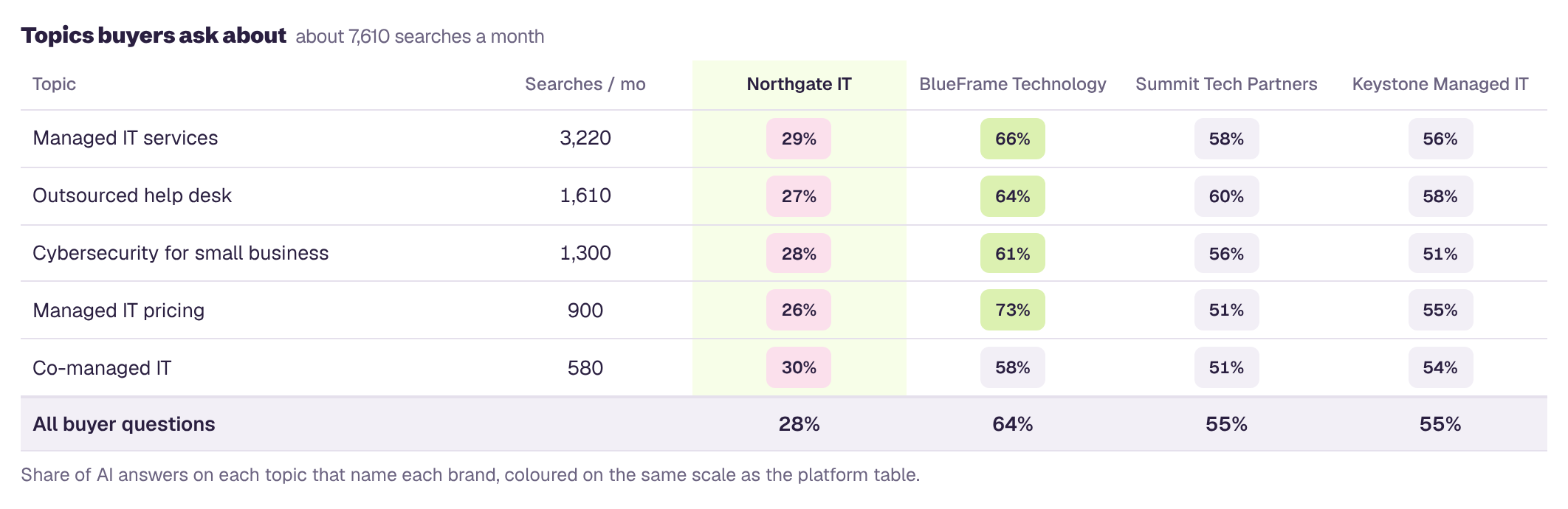
Look at "Outsourced help desk." That's where operations managers ask whether one in-house IT person is enough for a 50-person company, or what a better option would be. BlueFrame Technology is named in 64% of those answers and Northgate IT in 27%. Those are exactly the questions the operations manager in Cleveland is asking, and Northgate IT is missing from most of them.
What good firms do at this step: they teach. They explain the options honestly, including in-house versus outsourced, the different service models and what drives cost, and they publish pricing models or typical ranges even when every engagement is quoted. They write the "do you even need us?" guide. It feels counterintuitive, but it's exactly the kind of content AI trusts and repeats, and the buyer who learned from you is already halfway to hiring you.
Step 3: They build a shortlist
Now the buyer wants names. Services buyers almost always filter by location, industry or size:
- "Best managed IT providers in Cleveland for engineering firms"
- "Which accounting firms in Toronto specialize in construction companies?"
- "Top recruiting firms for hiring software engineers in Austin"
- "B2B marketing agencies that work with manufacturers"
- "Which 3PLs in New Jersey handle Shopify brands under 5,000 orders a month?"
- "Commercial cleaning companies in Calgary that do medical offices"
Two things make these answers different from a search results page. First, they're local. Many services firms serve several cities, and AI's answer changes from city to city. Second, they're specific. A buyer who names their industry gets firms that have clearly said they serve that industry.
Here's what the local side looks like for our sample firm:
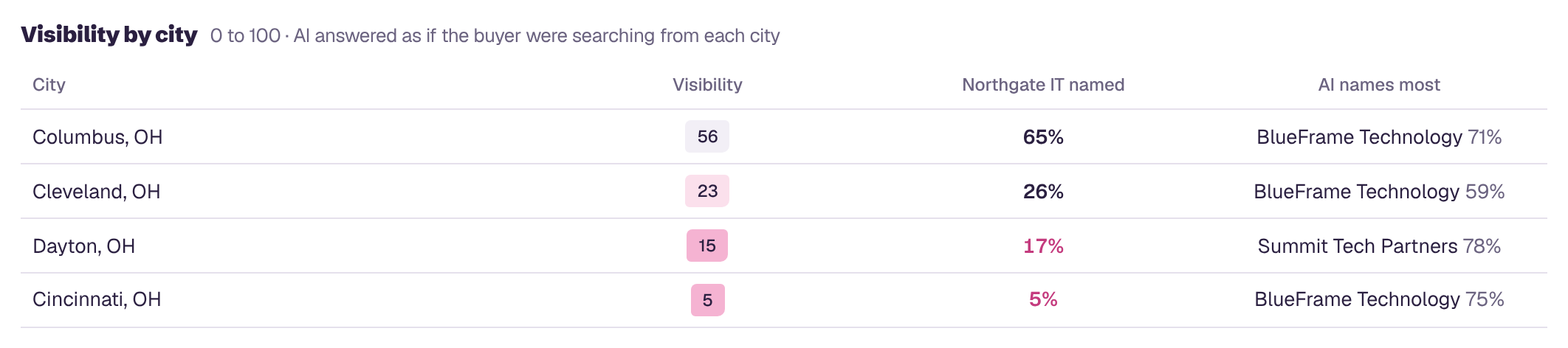
Northgate IT is strongest in Columbus, where it scores 56 and is named in 65% of local answers. In Cleveland it scores 23. In Dayton it scores 15, and in Cincinnati, a market it actively serves, it scores 5 and is named in just 5% of answers. Everywhere except Dayton, AI names the same competitor most often.
This pattern is common across business services. An accounting firm with offices in three cities might be known in only one. A staffing agency might be visible for warehouse roles and invisible for office roles, even though office placements carry better margins. A marketing agency might win "best agencies in Denver" and lose "best agencies for SaaS companies," which is the business it actually wants.
What good firms do at this step: they make it obvious where they work, who they work with and what they're best at. That means a real page for each office or market, with local clients, team members and context; pages for each industry they serve, with examples; and service pages specific enough to match how buyers ask. They also invest in local and industry presence: chambers, associations, events, local business press and industry publications.
Step 4: They check who to trust
Hiring a services firm means handing over something important: your network, your books, your hiring, your brand or your supply chain. Buyers know a bad choice is expensive and slow to undo. So they vet:
- "Is Northgate IT any good? What do clients say?"
- "What are the most common complaints about [firm]?"
- "Is [accounting firm] a licensed CPA firm? Do they do audits or just tax?"
- "Does [IT provider] have SOC 2 or other security certifications?"
- "How long do clients usually stay with [agency]?"
- "Has [staffing firm] had any lawsuits or worker complaints?"
- "Is [3PL] good at peak season, or do orders get delayed?"
AI answers by pulling together your website, Google reviews, Clutch and industry directory profiles, LinkedIn, case studies, news coverage and any forum discussion it can find. It looks for patterns. "Responsive and knowledgeable, but some clients mention turnover in their account team" is the kind of summary that can quietly cost a firm a deal.
Trust questions also expose a quieter problem: AI getting basic facts wrong.
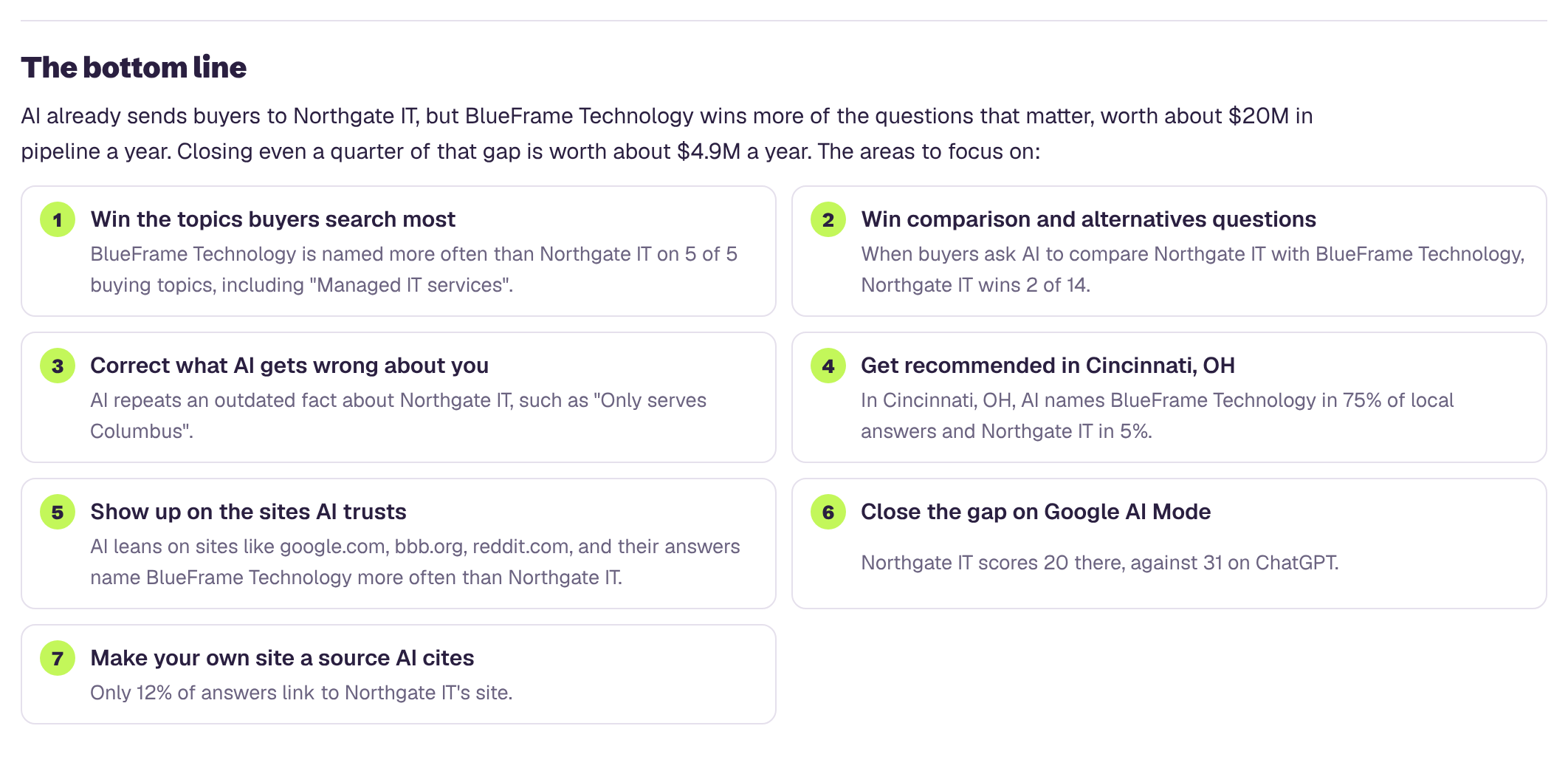
In our sample report, the top gap is factual. AI tells buyers that Northgate IT only serves Columbus. The firm actually serves Columbus, Cleveland, Cincinnati and Dayton. Every buyer in those other three cities who asks about Northgate IT hears that it's not an option, which goes a long way toward explaining the weak city scores above. The report's accuracy score, 75% in this sample, measures how often AI gets a firm's core facts right.
Wrong facts are common in professional services: an old office address, services the firm stopped offering, a partner who left years ago, a pre-merger firm name, or a claim that the firm doesn't serve a certain industry or company size. They usually happen because the right information isn't stated clearly and consistently in the places AI reads.
What good firms do at this step: they make trust easy to verify. Credentials, certifications, licenses, insurance, team bios and how they handle problems are stated plainly. Case studies include real specifics, like the client's industry and size, the problem, what was done and the measurable result, even when the client has to stay anonymous. They ask happy clients for reviews that describe the work, and they keep their facts identical across their website, Google Business Profile, LinkedIn, Clutch and industry directories.
Step 5: They choose
By now the buyer has two or three firms in mind. The decision usually involves more than one person, like a managing partner, a CFO or a board, and they ask AI their own questions.
- "Northgate IT vs BlueFrame Technology: which is better for a 60-person firm?"
- "Is a flat monthly fee or hourly billing better for managed IT?"
- "What should be in a managed services agreement?"
- "What's a fair retainer for a B2B marketing agency?"
- "What should a recruiting fee be for a $150K role?"
- "What questions should we ask a 3PL before signing?"
Comparisons and pricing questions are where firms win or lose deals they almost had. If AI says a competitor offers a flat per-user price, a guaranteed 15-minute response time and no long-term contract, and says nothing about you on those points because your site doesn't mention them, the buyer reasonably assumes you don't offer them.
The competitor table shows who's winning these conversations overall: how often AI names each firm when buyers ask questions that don't name a firm. In the sample report, BlueFrame Technology is named in 64% of those answers and Northgate IT in 28%. A managing partner who asks AI a few questions will hear one name more than twice as often as the other, and that familiarity carries into the decision.
What good firms do at this step: they make the decision easy. They publish their engagement model, how pricing works, what's included, response or turnaround commitments, contract terms and what happens if things go wrong. They explain honestly how they differ from the larger or cheaper alternatives. Firms that are transparent about how they work give AI concrete things to say.
Step 6: They live with the relationship
Services relationships run for years, and what happens after the contract shapes every earlier step for the next buyer.
- "How do we get the most out of our managed IT provider?"
- "What should a monthly report from our marketing agency include?"
- "How do we know if our accounting firm is doing a good job?"
- "When is it time to switch IT providers?"
That last question matters. Clients ask AI whether it's time to switch, and what they hear depends on the same reputation signals that won or lost the original deal.
This is where the reputation loop runs. Firms that onboard smoothly, communicate proactively and deliver measurable results earn specific, positive reviews, case studies and referrals. That material becomes what AI says about them to the next buyer at step 4. Firms that let service slip produce the patterns AI picks up and repeats.
What good firms do at this step: they treat client experience as part of their visibility. Regular reporting, quarterly business reviews and proactive communication keep clients happy. They also systematically turn happy clients into evidence through reviews, case studies, testimonials and referrals, and they publish the guides clients need after they hire, which keeps the firm's name attached to post-purchase questions.
How the journey plays out by type of firm
The six steps hold across business services, but the step that decides the engagement is different for each type of firm. Here's where the weight falls, and what the firms that win tend to do.
Managed IT and cybersecurity services
IT buyers often arrive in a crisis, like a departed IT person, a breach scare or an insurance questionnaire, so steps 1 and 3 move fast. But the vetting step is intense, because the buyer is handing over the keys to the whole company. Buyers ask about response times, security certifications, what's included in the monthly fee, and whether the provider understands their industry's compliance needs (HIPAA for clinics, CMMC for defense suppliers, PCI for retailers).
Providers that publish clear service tiers, per-user pricing models, response-time commitments and industry-specific security guidance give AI exactly what it needs to recommend them.
Full guide: AI visibility for managed IT and cybersecurity providers
Accounting, bookkeeping and payroll firms
Accounting buyers spend a long time at step 2. They're trying to work out what kind of help they need: a bookkeeper, a CPA, a tax specialist or a fractional CFO. Industry specialization matters a lot ("accountants for dental practices," "CPA for real estate investors in Ontario"), and so does the software the firm works in.
Firms that explain the differences between service levels, state their industry focus and publish typical fee structures, whether that's monthly packages, fixed-fee tax returns or hourly advisory, tend to show up in both the educational and the shortlist answers.
Full guide: AI visibility for accounting and bookkeeping firms
Staffing, recruiting and executive search
Staffing has two buyers: the companies hiring and the candidates looking for work. Both ask AI. Hiring managers ask "best staffing agencies for warehouse workers in Dallas" or "retained search firms for CFOs in healthcare." Candidates ask "which recruiting agencies are legit for software jobs in Toronto?"
Firms with clear specializations by role, industry and region, published fee models (contingency, retained, temp markup), and visible placement track records tend to win both sides. Complaints from candidates can shape AI's view of a firm as much as client reviews do.
Full guide: AI visibility for staffing and recruiting firms
Marketing, advertising and web agencies
There are thousands of agencies, and most of their websites say the same thing. That makes step 3 brutal: buyers ask for agencies by industry, channel and budget ("paid social agency for DTC brands under $5M"), and AI can only recommend agencies that have said clearly what they specialize in.
Agencies with a sharp niche, published case studies with real numbers, transparent retainer ranges and visible thought leadership in their niche tend to dominate those specific questions, even against much bigger shops.
Full guide: AI visibility for marketing agencies
Management consulting firms
Consulting buyers are senior and skeptical, and the engagements are large. They ask AI about approaches ("how do mid-market companies run a pricing project?"), firms ("boutique consulting firms for private equity value creation") and proof ("what results has [firm] delivered?").
For consultants, published expertise is everything: frameworks, research, articles, talks and case studies that show how the firm thinks. AI recommends the firms whose thinking it has read.
Full guide: AI visibility for management consulting firms
Logistics, 3PL and freight brokers
Logistics buyers ask very practical, very specific questions: order volumes, SKU counts, sales channels, warehouse locations, carriers, integrations and peak-season performance. "Which 3PLs in the Midwest integrate with Shopify and handle oversized items?"
Providers that publish their capabilities in that level of detail, including warehouse locations, integrations, minimums, pricing structure and service levels, are the ones AI can match to a buyer's situation. Vague "end-to-end logistics solutions" copy rarely makes a shortlist.
Full guide: AI visibility for logistics and 3PL companies
Commercial cleaning, and architecture and engineering
These firms don't have their own spoke article, but the same journey applies.
- Commercial cleaning buyers, like office managers and facility managers, ask about reliability, background checks, insurance, green products and specialized cleaning (medical offices, gyms, post-construction). Local presence and specific service pages win.
- Architecture and engineering buyers ask about project types, licensing in their state or province, past projects like theirs and how fees are structured. Detailed project portfolios with building types, sizes and locations give AI concrete evidence to work with.
Building a services firm AI recommends
Put the six steps and the firm types together and a clear pattern comes out. The firms AI recommends aren't the ones with the slickest websites. They're the ones whose expertise, reputation and information all line up, so everything AI reads about them tells the same clear story.
1. Say exactly what you're best at. Industries, company sizes, services and situations. "IT for engineering and architecture firms with 20 to 200 people" beats "tailored IT solutions for businesses."
2. Teach before you sell. Explain the options, including in-house versus outsourced, the different service models and what drives cost. Buyers at step 2 trust whoever helped them understand.
3. Be transparent about how you work and what it costs. Pricing models, typical ranges, what's included, response times and contract terms. If you have to quote every engagement, explain what the quote depends on.
4. Make every market you serve visible. A real page for each city or office, with local clients and team members, so AI knows you serve more than your headquarters city.
5. Show your work with specifics. Case studies with the client's industry, size, problem and measurable result. Specific evidence is what AI repeats.
6. Earn reviews that describe the work. Ask clients to mention what you did and what changed. Respond to every review, because AI reads the replies too.
7. Keep your facts identical everywhere. Website, Google Business Profile, LinkedIn, Clutch, industry directories and association listings. Inconsistent facts are where wrong AI answers come from.
8. Build reputation beyond your own website. Industry associations, chambers, speaking, local business press, podcasts and partner directories, like a software vendor's partner list or a carrier's preferred provider list, are sources AI trusts.
9. Deliver a client experience worth talking about. No content fixes slow responses or high turnover on account teams. AI will find the pattern. The most reliable way to be recommended is to be a firm clients recommend.
10. Measure it. Most services firms have never seen what AI says about them in each market they serve, against the specific firms they compete with.
That last point is where the report comes in. Here's the top of the sample report for Northgate IT:
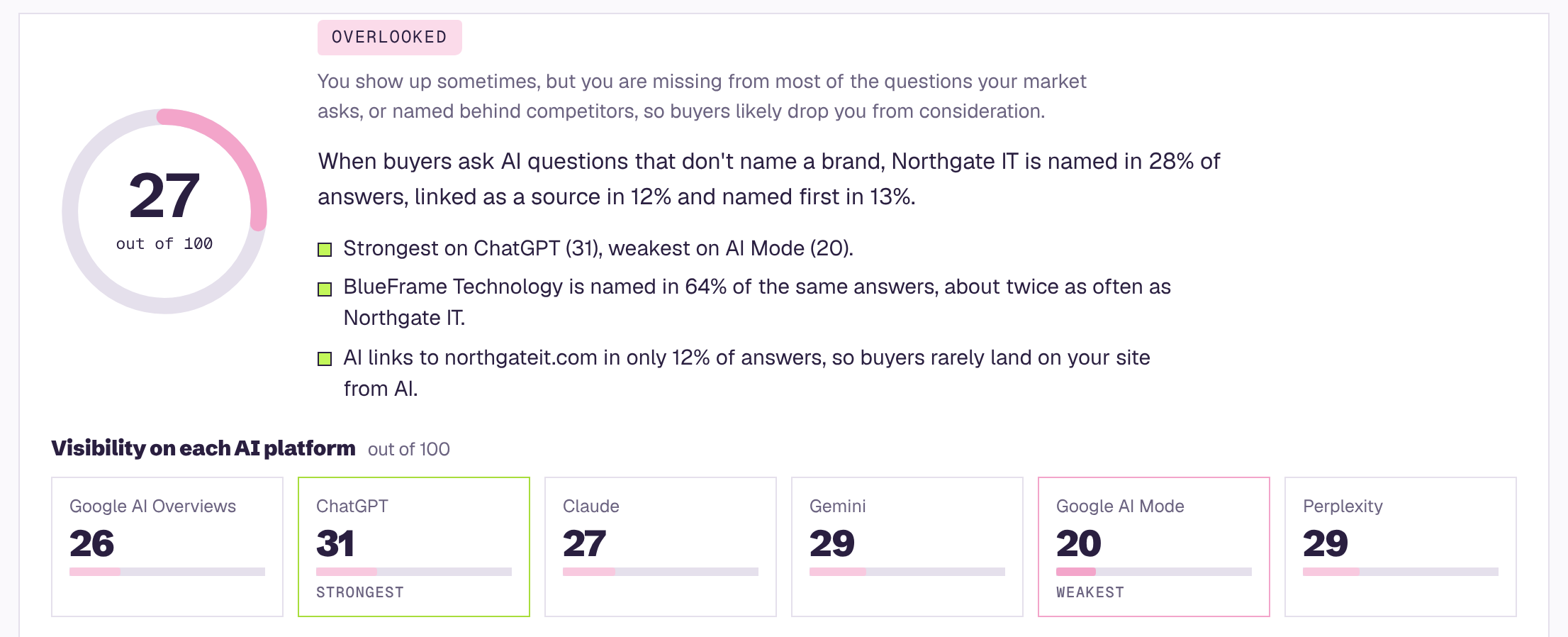
Northgate IT scores 27, in the Overlooked band. That's a pattern many services firms will recognize: AI knows Northgate IT when it's asked by name, but rarely recommends it when buyers ask who to hire. It's named in 28% of answers to questions that don't name a firm, while BlueFrame Technology is named in 64%. Just below, the report breaks it down further:

For services firms, first mention and accuracy deserve special attention. Buyers often call the first firm named, and wrong facts like a missing city, a service you do offer or an outdated specialty quietly disqualify you before anyone calls.
Run the report again after making changes, and you can watch these numbers move in each market, against the firms that matter.
Buyers still need great firms
Companies still need someone to run their IT, close their books, fill their roles and grow their pipeline. What's changed is who they ask first. More and more, it's an AI assistant, and it hands them a short list of firms before they ever visit your website or call a peer.
The good news for well-run firms is that AI mostly rewards what clients already value: real expertise, clear communication, honest pricing and results worth talking about. The work is making all of that visible, specific and consistent in the places AI reads, and checking that it's working.
Keep learning
- What is AI visibility?
- How to get your business recommended by AI, with guides for ChatGPT, Google AI Overviews, Perplexity, Gemini and Claude
- AI visibility benchmark 2026
- The AI visibility glossary
See what AI tells buyers about your firm
Enter your website and get a free AI visibility report. It takes a few minutes, and you'll see:
- Your AI visibility score, overall and for ChatGPT, Gemini, Claude, Perplexity and Google's AI Overviews and AI Mode
- Which competitors AI recommends instead of you, and how often
- Your visibility in every city you serve, and the competitor AI names most in each one
- What AI gets wrong about you, and what to fix first
- Your biggest gaps: the buyer questions where AI leaves you out, and who it recommends instead
- A downloadable PDF you can share with your partners