Our IT guy retired: how businesses choose a managed IT or cybersecurity provider through AI
Business owners now ask AI whether to outsource IT, what managed services should cost and how to judge a provider's security. Here's what AI tells them, and how MSPs and MSSPs get named.
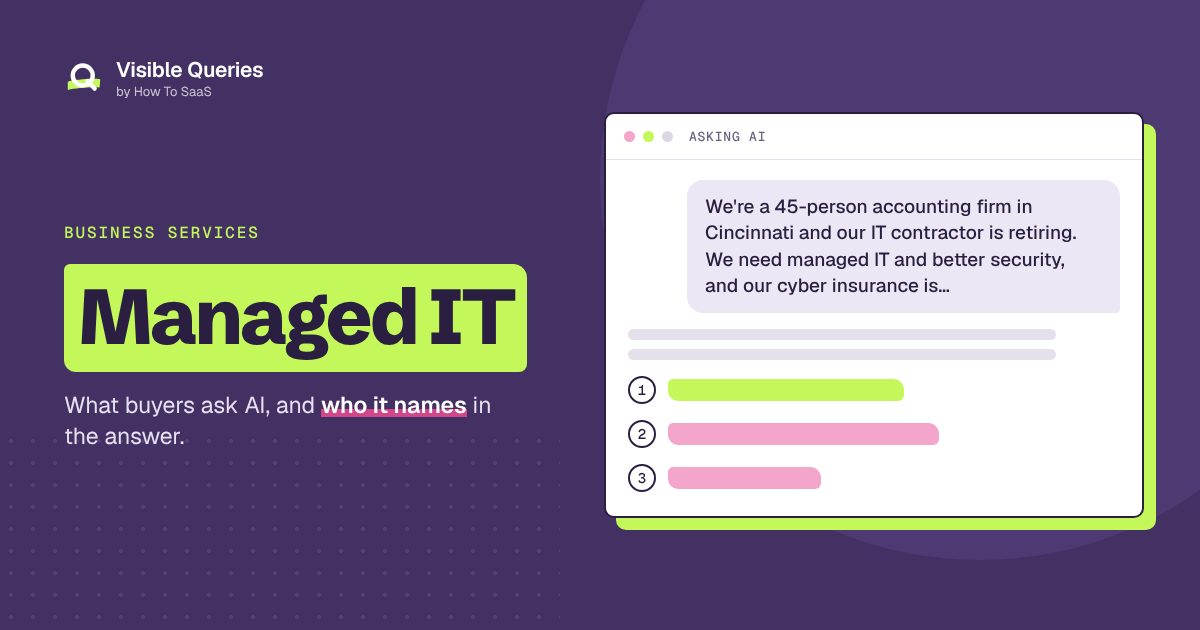
The managing partner of a 45-person accounting firm in Cincinnati just learned that their part-time IT contractor is retiring. Last month a staff member clicked a phishing link and the firm spent two days recovering. Their cyber insurance renewal asks about multi-factor authentication, backups and endpoint protection, and they're not sure how to answer. They ask ChatGPT:
"We're a 45-person accounting firm in Cincinnati and our IT contractor is retiring. We need managed IT and better security, and our cyber insurance is asking about MFA, backups and EDR. What does a managed service provider cost per user? What should be included? How do we choose a good MSP in Cincinnati that understands accounting firms?"
AI explains what managed IT services usually include, common pricing models (per user, per device, tiered), what security services are often bundled or separate, what cyber insurers commonly require, questions to ask about response times, onboarding and contracts, and why industry experience matters. Then it names three local providers. The managing partner schedules calls with two.
Managed IT and cybersecurity providers sell trust and peace of mind to businesses that don't have their own IT departments. The buyers are often owners, office managers or finance leaders, not technical experts. They ask AI in plain language, and AI's shortlist matters.
Our business services guide covers how businesses choose service firms in general. This one goes through the questions that decide managed IT clients, what AI usually says, and what providers can publish so AI names them.
Here are the questions at a glance:
| The question | What gets you named |
|---|---|
| "Do we need an MSP? What does it cost?" | Pricing models and typical ranges |
| "What should be included?" | Exactly what your plans include |
| "Are they good at security?" | Your security practices and certifications |
| "MSP for [industry]?" | A page for each industry you serve |
"Do we need an MSP? What does it cost?"
What AI usually says: It explains when outsourcing IT makes sense, typical per-user price ranges, and what affects price, like security services, compliance needs, on-site support and the number of locations.
What to publish: Your pricing model, starting prices or ranges, what's included in each tier, and what costs extra. Many MSPs hide pricing, so publishing it stands out.
"What should be included?"
This is the defining question for the category.
What AI usually says: It lists help desk support, monitoring, patching, backups, security tools, vendor management, strategic planning and onboarding and offboarding.
What to publish: A plain list of everything you include, your response time commitments, and how you handle after-hours issues and on-site visits.
"How do we know they're good at security?"
What AI usually says: It suggests asking about certifications, security tools, incident response, how the provider secures its own systems, and whether it offers a security operations center.
What to publish: Your security stack in plain terms, your certifications, how you protect your own systems, and how you respond to incidents. Cyber insurance requirements are a strong angle: explain how you help clients meet them.
"MSP for [industry]?"
What AI usually says: It suggests providers with experience in the buyer's industry and compliance requirements.
What to publish: A page for every industry you serve, like accounting, legal, healthcare, manufacturing, construction, nonprofits and dental, with the software, compliance and workflows you know.
When AI gets your service area wrong
Service area mistakes are common for MSPs. Here's how the report shows a wrong fact like that:
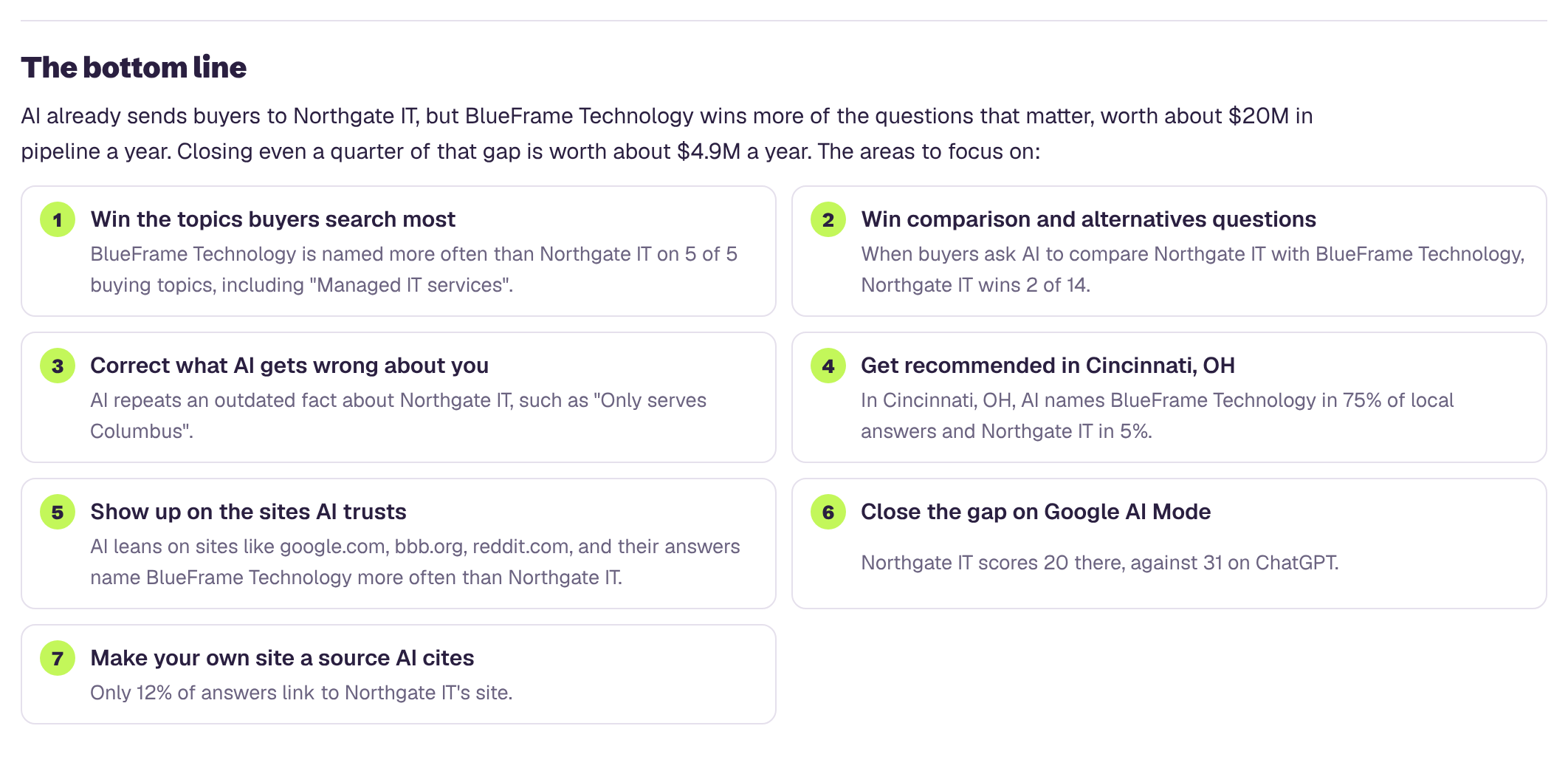
What to fix: A page for every city and region you serve, with on-site support details, local clients and local reviews.
Co-managed IT
Companies with an internal IT person or small team ask about co-managed IT: "MSP that works with our internal IT team." If you offer it, explain how it works, what you handle and what they handle.
Switching providers
Many buyers already have an MSP and are unhappy. They ask AI how to switch, what to watch for in contracts and how onboarding works. Publish your onboarding process, timelines and how you handle transitions from previous providers.
What the sample report shows
Here's what a Visible Queries report looks like for Northgate IT, the sample managed IT provider in Ohio from our guide. The questions are different for managed IT providers, but the patterns are the same.
For a business that serves more than one city, the report checks each one separately:
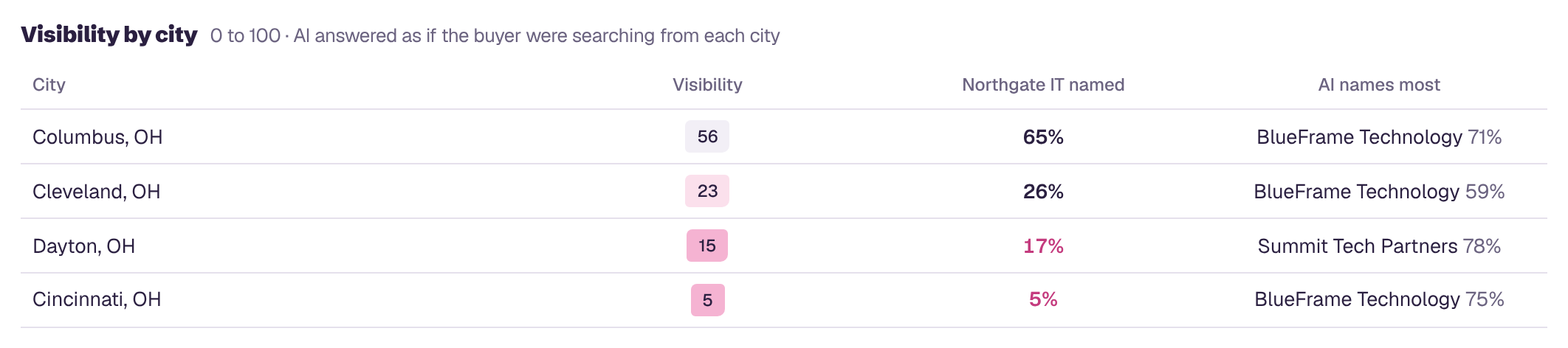
The gap is clearest side by side:
If you only fix three things
- Publish what's included and how you price.
- Explain your security approach and how you help with cyber insurance.
- Give every industry and city you serve its own page.
Business owners are asking AI who can take IT off their plate. The provider AI names will be the one that explains its services and security most clearly.
Part of our guide: Why AI visibility matters for business services firms
See what AI tells businesses about your IT firm
Enter your website and get a free AI visibility report. It takes a few minutes, and you'll see:
- Your AI visibility score, overall and for ChatGPT, Gemini, Claude, Perplexity and Google's AI Overviews and AI Mode
- Which providers AI recommends instead of you, and how often
- Your visibility in every city you serve, and the competitor AI names most in each one
- What AI gets wrong about you, and what to fix first
- Your biggest gaps: the buyer questions where AI leaves you out, and who it recommends instead
- A downloadable PDF you can share with your partners