We need people yesterday: how companies and candidates choose a staffing or recruiting firm through AI
Hiring managers now ask AI which staffing agencies fill roles fast, what recruiting fees look like and who specializes in their industry. Candidates ask too. Here's what AI tells them, and how staffing and recruiting firms get named.
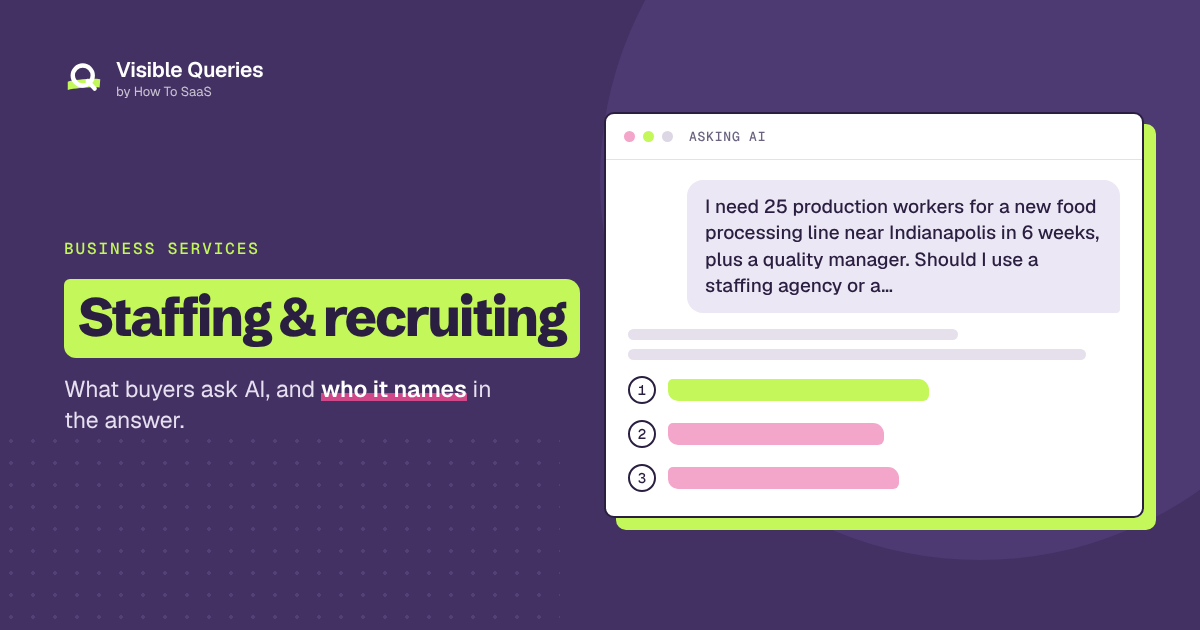
The plant manager at a food processing company outside Indianapolis needs 25 production workers for a new line starting in six weeks, plus a quality manager. Their HR team is two people. They ask ChatGPT:
"I need 25 production workers for a new food processing line near Indianapolis in 6 weeks, plus a quality manager. Should I use a staffing agency or a recruiting firm? What do temp-to-hire and direct hire fees usually look like? Which agencies in Indianapolis specialize in manufacturing and food production?"
AI explains the difference between staffing agencies and recruiting firms, temporary, temp-to-hire and direct hire models, typical markup and fee structures, questions to ask about screening, safety training, fill rates and replacement guarantees, and why industry specialization matters. Then it names three agencies. The plant manager calls two the next morning.
Staffing and recruiting firms have two audiences: employers who need people and candidates who need jobs. Both are asking AI now. Employers ask who can fill roles fast and well. Candidates ask which agencies are worth working with.
Our business services guide covers how businesses choose service firms in general. This one goes through the questions that decide staffing and recruiting clients, what AI usually says, and what firms can publish so AI names them.
Here are the questions at a glance:
| The question | What gets you named |
|---|---|
| "Staffing agency or recruiting firm?" | What you do, in plain words |
| "Agencies for [industry or role]?" | Pages for the roles you fill |
| "What do staffing agencies charge?" | Your fee models |
| "How fast can they fill roles?" | Typical time to fill, by role |
"Staffing agency or recruiting firm?"
What AI usually says: It explains temporary staffing, temp-to-hire, direct hire, contingency recruiting, retained search and RPO, and who each suits.
What to publish: Which models you offer, who they're for and how each works.
"Which agencies specialize in [industry or role]?"
This is the defining question for the category.
What AI usually says: It names agencies that clearly specialize: light industrial, healthcare, IT, accounting and finance, legal, executive search, engineering, hospitality.
What to publish: A page for every industry and role type you fill, with the positions, the screening and training you do, and examples of placements.
"What do staffing agencies charge?"
What AI usually says: It explains markups for temporary staff, percentage fees for direct hire and retained search pricing.
What to publish: How you price, typical ranges, guarantees and replacement policies.
"How fast can they fill roles?"
What to publish: Typical time to fill by role type, your candidate pipeline, and how you handle urgent and high-volume needs.
Visibility by city
Staffing is local for many roles, and AI's answers change by city:
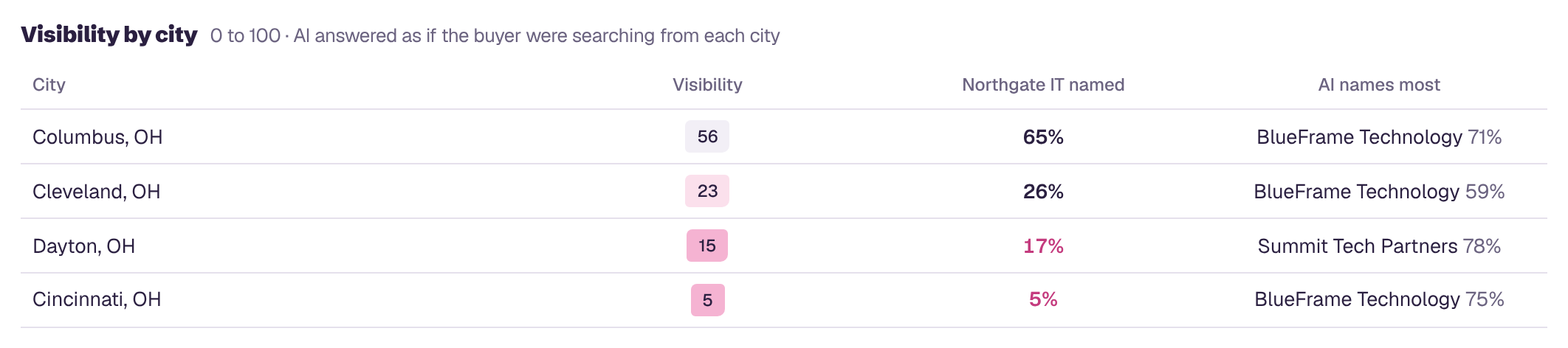
Every branch office or market you serve needs its own page, with the industries you staff there and local contacts.
Candidates are asking too
Job seekers ask AI "best staffing agencies for warehouse jobs in Indianapolis," "are temp agencies worth it?" or "recruiters for nursing jobs." Pages for candidates, explaining open roles, pay, benefits, how placement works and what working with you is like, bring in the talent that employers pay you for.
Compliance and safety
Employers in regulated industries ask about background checks, drug testing, safety training, licensing and worker classification. Explain how you handle each.
What the sample report shows
Here's what a Visible Queries report looks like for Northgate IT, the sample managed IT provider in Ohio from our guide. The questions are different for staffing and recruiting firms, but the patterns are the same.
The report starts with one score out of 100, a score for each AI platform, and the competitor AI names most:
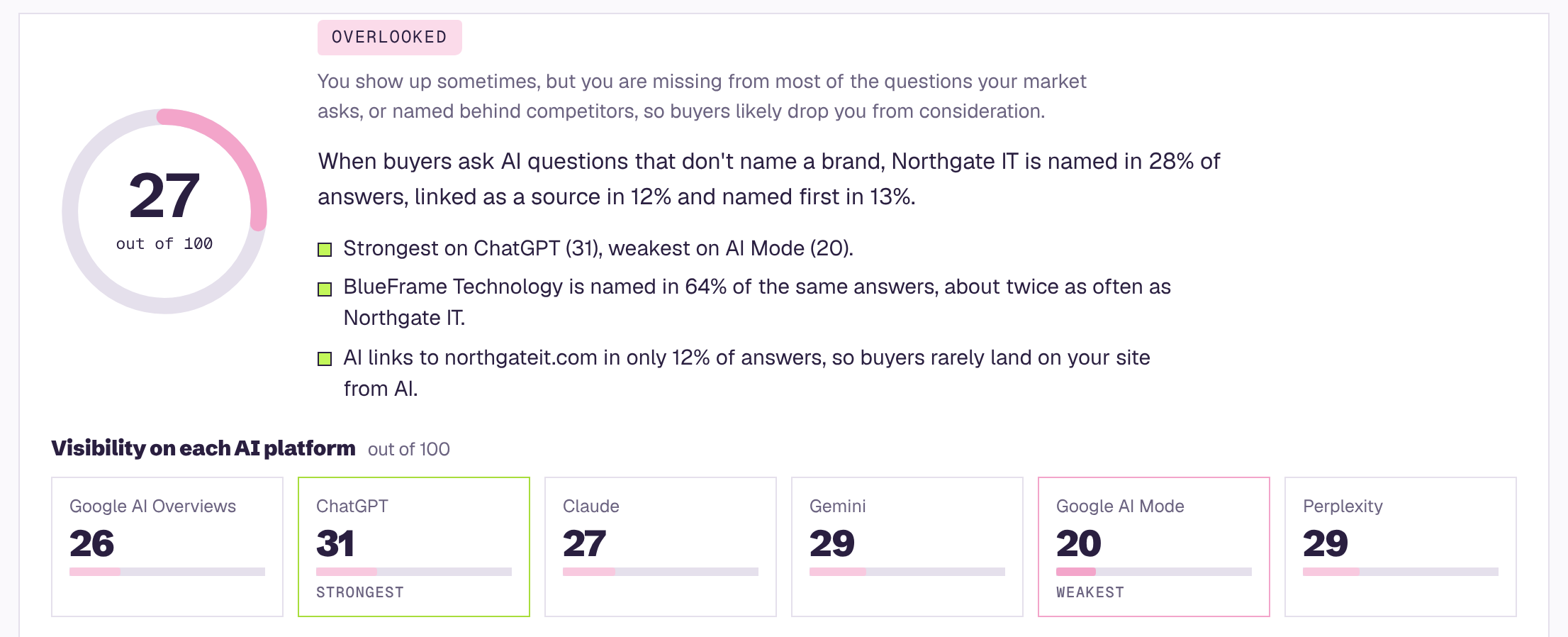
The gap is clearest side by side:
If you only fix three things
- Give every industry and role type its own page.
- Explain your models, pricing and time to fill.
- Write for candidates too. Open roles, pay and what working with you is like.
Hiring managers are asking AI who can find them people fast. The firm AI names will be the one that's clearest about who it places and how.
Part of our guide: Why AI visibility matters for business services firms
See what AI tells employers about your firm
Enter your website and get a free AI visibility report. It takes a few minutes, and you'll see:
- Your AI visibility score, overall and for ChatGPT, Gemini, Claude, Perplexity and Google's AI Overviews and AI Mode
- Which firms AI recommends instead of you, and how often
- Your visibility in every city you serve, and the competitor AI names most in each one
- What AI gets wrong about you, and what to fix first
- Your biggest gaps: the buyer questions where AI leaves you out, and who it recommends instead
- A downloadable PDF you can share with your partners