Outgrowing the spreadsheet: how businesses choose an accounting or bookkeeping firm through AI
Business owners now ask AI when they need an accountant, what bookkeeping should cost and whether a fractional CFO makes sense. Here's what AI tells them, and how accounting and bookkeeping firms get named.
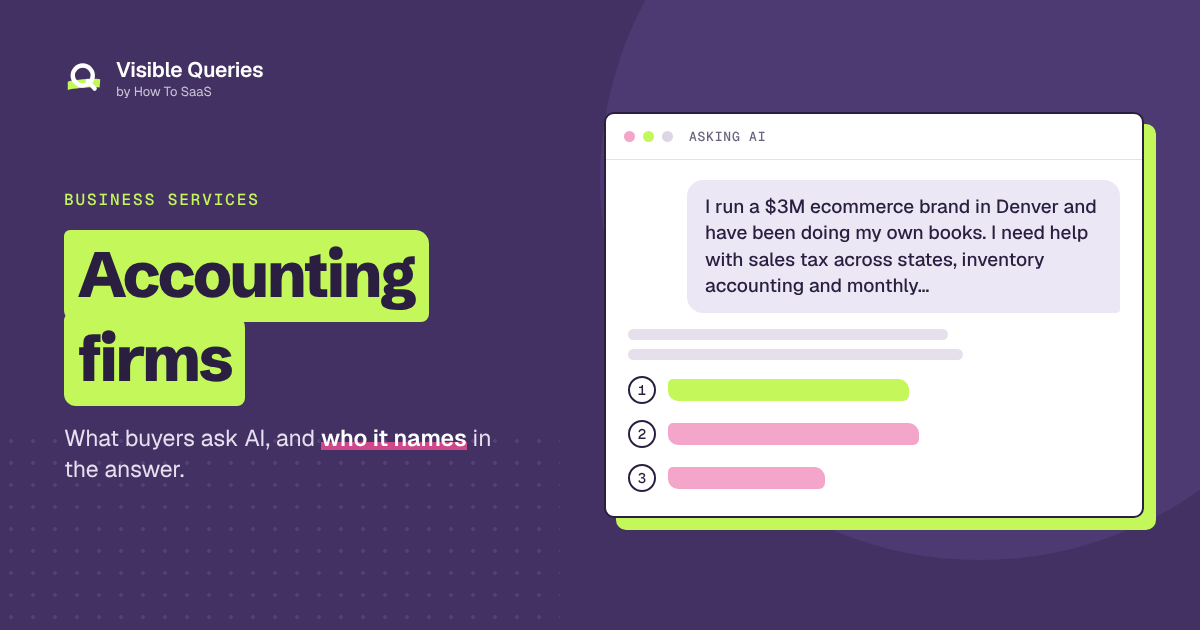
The founder of a fast-growing ecommerce brand in Denver has been doing the books themselves. Revenue just passed $3 million. Sales tax in multiple states is confusing, inventory accounting is a mess, and an investor wants monthly financial statements. They ask ChatGPT:
"I run a $3M ecommerce brand in Denver and have been doing my own books. I need help with sales tax across states, inventory accounting and monthly financials for investors. Do I need a bookkeeper, a CPA firm or a fractional CFO? What does each cost, and which firms specialize in ecommerce?"
AI explains the differences between bookkeepers, accountants and CPAs, and fractional CFOs, what each typically does, common pricing models (monthly retainers, hourly and project fees), specific challenges for ecommerce companies, and what to look for in a firm. Then it names several firms that work with ecommerce brands. The founder books calls with two.
Accounting firms sell expertise and reliability. Their best clients often find them through referrals, but more and more of those referrals get checked with AI, and many business owners start with AI directly.
Our business services guide covers how businesses choose service firms in general. This one goes through the questions that decide accounting clients, what AI usually says, and what firms can publish so AI names them.
Here are the questions at a glance:
| The question | What gets you named |
|---|---|
| "Bookkeeper, CPA or fractional CFO?" | Which you offer and who each suits |
| "How much does it cost?" | Fee ranges and packages |
| "Accountant for [industry]?" | Pages for the industries you serve |
| "Which accounting software should we use?" | The software you support and recommend |
"Bookkeeper, CPA or fractional CFO?"
This is the defining question for the category.
What AI usually says: It explains the roles and suggests what businesses typically need at different stages.
What to publish: A clear explanation of what you do, who you serve, and when businesses typically need you. Many owners don't know the difference, and firms that explain it get the call.
"How much does it cost?"
What AI usually says: It gives typical ranges for monthly bookkeeping, tax preparation and advisory services, and explains what drives cost.
What to publish: Your packages and pricing, at least starting prices, and what's included. Fixed monthly pricing is easy for AI to understand and repeat.
"Accountant for [industry]?"
What AI usually says: It suggests firms with experience in the buyer's industry.
What to publish: A page for every industry you serve well, like ecommerce, restaurants, construction, real estate, medical practices, nonprofits, agencies and startups, with the specific issues you handle.
"Which accounting software should we use?"
What AI usually says: It compares popular accounting platforms and often suggests asking an accountant.
What to publish: Which platforms and tools you work with, certifications, and how you help clients choose and set up systems. Firms that publish this are named when owners ask about software.
Which topics AI gives to competitors
Here's how the report shows which topics a firm wins and loses:
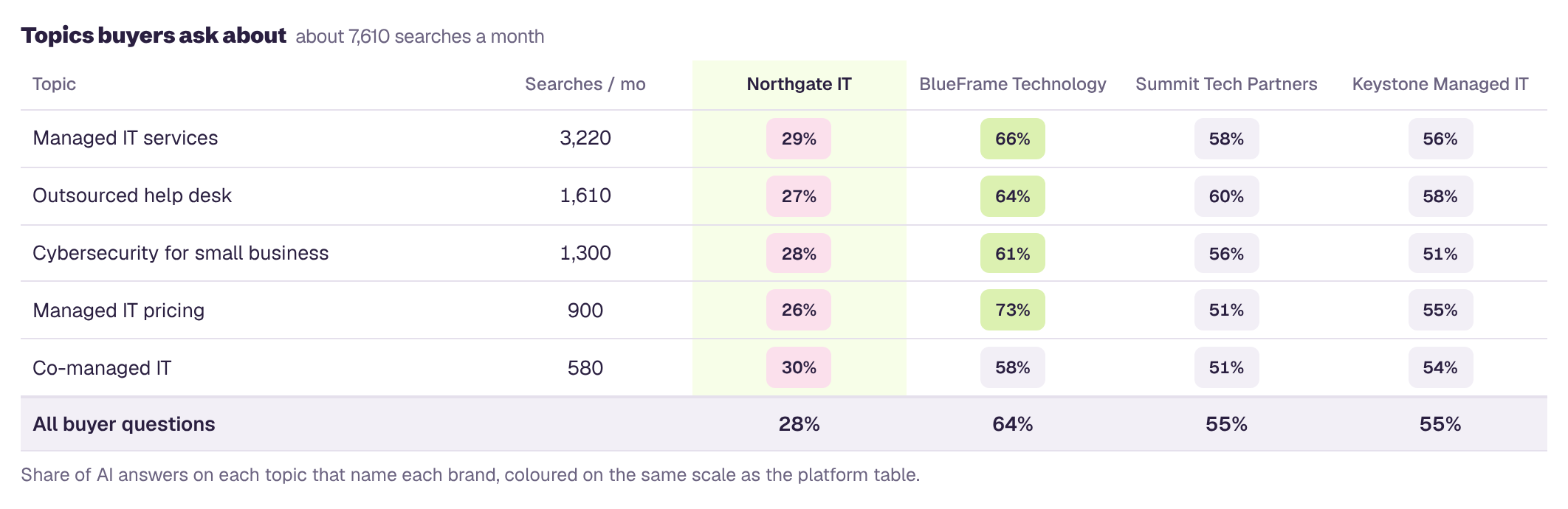
For accounting firms, the topics to watch are usually industry-specific questions, like "accountant for ecommerce businesses" or "CPA for construction companies." That's where specialized firms win.
Here's more from the same kind of report, for Northgate IT, a fictional managed IT provider in Ohio.
It also shows visibility city by city, with the competitor AI names most in each:
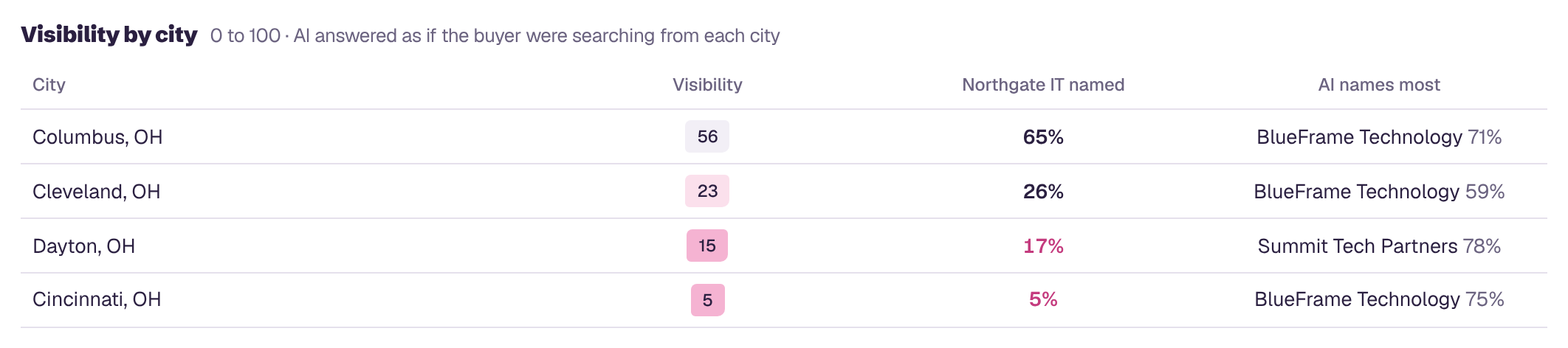
The gap is clearest side by side:
Remote and local
Many firms now work with clients anywhere, while some business owners still want someone local. Be clear about both: the cities you serve in person, and whether you work remotely across states or provinces.
Tax season and year-end
Business owners ask AI about tax deadlines, year-end planning and entity choices at predictable times of year. Publish timely content before those moments.
If you only fix three things
- Explain what you do and who you serve.
- Publish packages and pricing.
- Give every industry you serve its own page.
Business owners are asking AI who can finally get their numbers right. The firm AI names will be the one that explains its expertise most clearly.
Part of our guide: Why AI visibility matters for business services firms
See what AI tells business owners about your firm
Enter your website and get a free AI visibility report. It takes a few minutes, and you'll see:
- Your AI visibility score, overall and for ChatGPT, Gemini, Claude, Perplexity and Google's AI Overviews and AI Mode
- Which firms AI recommends instead of you, and how often
- Your visibility in every city you serve, and the competitor AI names most in each one
- What AI gets wrong about you, and what to fix first
- Your biggest gaps: the buyer questions where AI leaves you out, and who it recommends instead
- A downloadable PDF you can share with your partners