Big firm or boutique? How companies choose a management consulting firm through AI
Executives now ask AI which consulting firms fit their problem and budget, how boutiques compare with big names and what engagements cost. Here's what AI tells them, and how management consulting firms get named.
The CEO of a $150 million family-owned distribution company in Milwaukee is preparing for the founder to step back. Margins have slipped, the leadership team has never done formal strategic planning, and the board wants an outside view. They ask ChatGPT:
"I'm CEO of a $150M family-owned distributor in Milwaukee. We need help with strategy, margin improvement and leadership succession. Should we hire a big consulting firm or a boutique? What do engagements cost? Which firms are good with mid-sized family businesses and distribution?"
AI explains what large firms and boutiques typically offer, how engagements are usually priced, what to look for in industry and company-size experience, how to structure a project, and questions to ask about who will actually do the work. Then it names several boutique firms and one larger firm. The CEO contacts two boutiques.
Management consulting is sold on expertise, reputation and relationships. Big firms have name recognition. Boutiques and independents compete on specialization and senior attention. When executives ask AI for help, specialization is what gets boutiques named.
Our business services guide covers how businesses choose service firms in general. This one goes through the questions that decide consulting clients, what AI usually says, and what firms can publish so AI names them.
Here are the questions at a glance:
| The question | What gets you named |
|---|---|
| "Big firm or boutique?" | Where you fit and why |
| "Firms for [problem] in [industry]?" | Pages for each problem you solve |
| "How much does consulting cost?" | Engagement models and ranges |
| "Who will do the work?" | The team, with bios |
"Big firm or boutique?"
What AI usually says: It compares brand, breadth, cost, senior involvement and specialization.
What to publish: What you do differently: who works on engagements, your specialization, and the size of companies you serve.
"Which firms specialize in [problem] for [industry]?"
This is the defining question for the category.
What AI usually says: It names firms that clearly focus on the problem and industry.
What to publish: Pages for each problem you solve, like strategy, operations, pricing, succession, M&A integration, turnaround or digital transformation, and each industry you know. Include case studies described within your confidentiality obligations.
"How much does consulting cost?"
What AI usually says: It explains fixed-fee, time-and-materials and retainer models, and gives broad ranges.
What to publish: How you price engagements, typical project scopes and ranges, and how you structure work for mid-sized companies.
"Who will actually do the work?"
What to publish: Bios for your partners and consultants, with their industry backgrounds, operating experience and the problems they solve.
What the report's headline shows
For many consulting firms, the report's headline shows a familiar pattern:
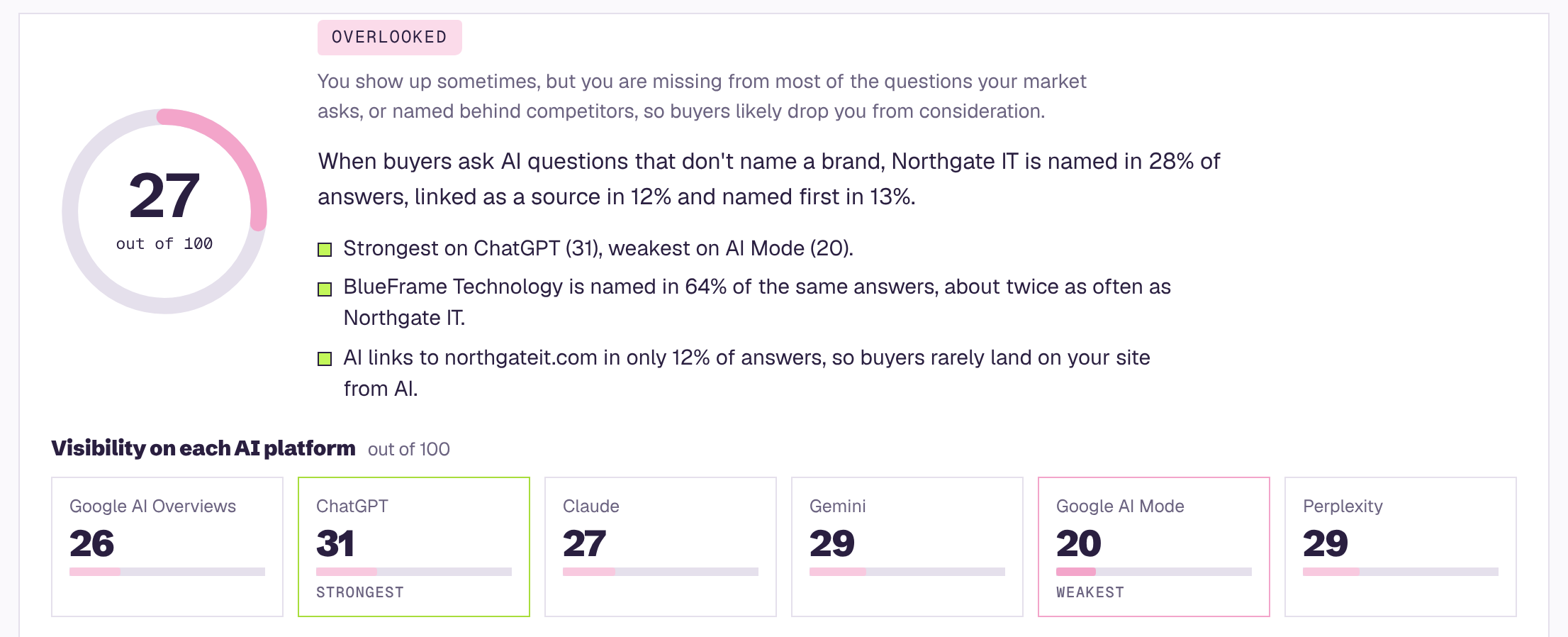
The usual pattern is that AI knows the firm when asked by name, but rarely recommends it when executives ask open questions like "consulting firms for family-owned distributors." Problem and industry pages close that gap.
Here's more from the same kind of report, for Northgate IT, a fictional managed IT provider in Ohio.
And it shows the actual questions, platform by platform, with who was named:
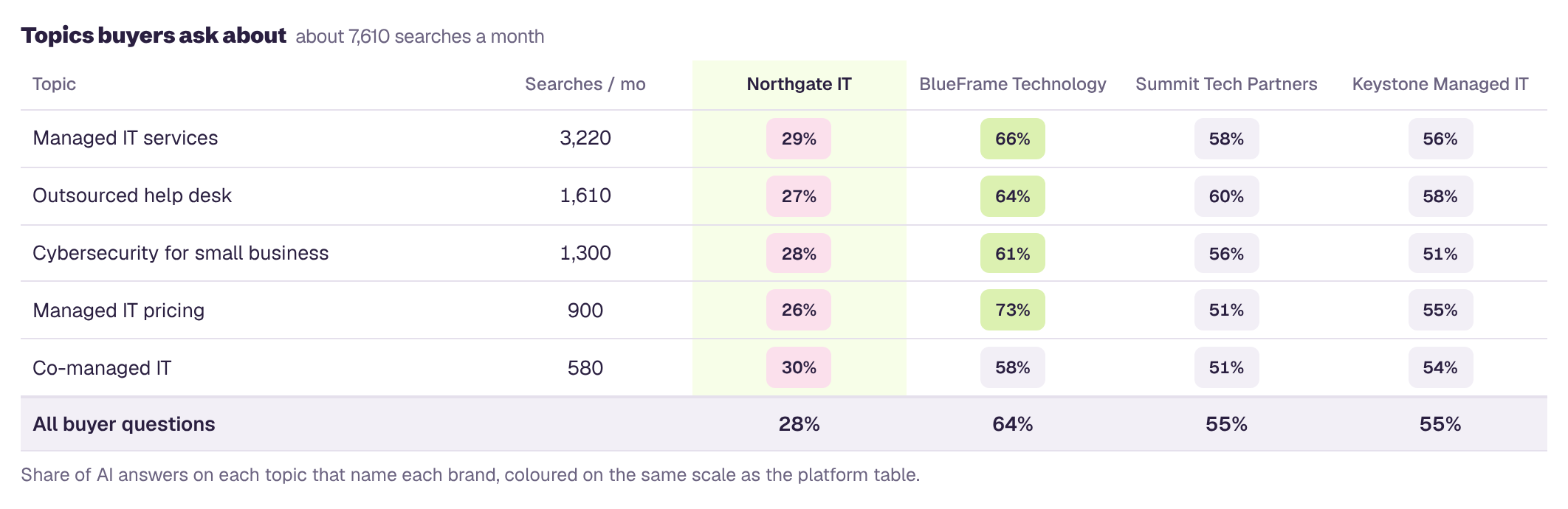
The gap is clearest side by side:
Thought leadership that AI uses
Consulting firms publish a lot of thought leadership, but much of it is generic. AI cites content that answers specific questions with specific frameworks and examples, like "how to run a pricing study for a distributor." Original research and clear frameworks earn citations.
Private equity and other referral sources
Private equity firms, banks, attorneys and accountants refer consulting work. They also ask AI for recommendations. Explain how you work with portfolio companies and referral partners.
If you only fix three things
- Give every problem and industry you serve its own page.
- Show who does the work. Bios and operating experience.
- Publish specific frameworks and research. Not generic thought leadership.
Executives are asking AI who can help them solve their biggest problems. The firm AI names will be the one that specializes most clearly.
Part of our guide: Why AI visibility matters for business services firms
See what AI tells executives about your firm
Enter your website and get a free AI visibility report. It takes a few minutes, and you'll see:
- Your AI visibility score, overall and for ChatGPT, Gemini, Claude, Perplexity and Google's AI Overviews and AI Mode
- Which firms AI recommends instead of you, and how often
- Your visibility in every city you serve, and the competitor AI names most in each one
- What AI gets wrong about you, and what to fix first
- Your biggest gaps: the buyer questions where AI leaves you out, and who it recommends instead
- A downloadable PDF you can share with your partners