Fees, rates and switching: how people choose a bank or credit union through AI
People now ask AI whether a credit union is better than a bank, where to get the best savings rate and how hard it is to switch. Here's what AI tells them, and how community banks and credit unions get named.
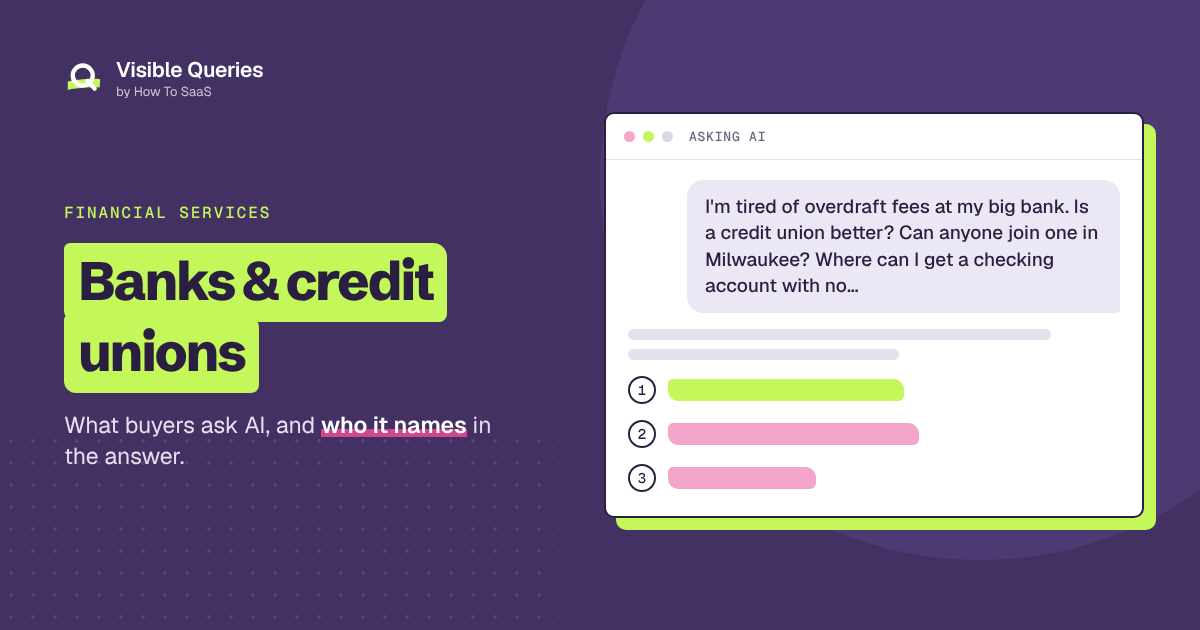
A nurse in Milwaukee just got hit with a third overdraft fee in two months from their big national bank. They're tired of it. A coworker loves their credit union. They also want a better rate on their savings and, eventually, a car loan. They ask ChatGPT:
"I'm tired of overdraft fees at my big bank. Is a credit union better? Can anyone join one in Milwaukee? Where can I get a checking account with no fees, a good savings rate and good car loan rates? And how hard is it to switch banks?"
AI explains how credit unions differ from banks, membership eligibility, the kinds of fees to compare, how savings rates and loan rates vary between institutions, the trade-offs between local institutions and online banks, and a step-by-step plan for switching. Then it names three local credit unions and a community bank. The nurse opens an account at one that weekend.
Banking is one of the stickiest relationships people have. Most people stay with the same bank for years, and switching feels like a hassle. But fees, rates and life events, a new job, a move, a first home or a business, push people to look around. When they do, AI is increasingly where they start.
Our financial services guide covers how people choose financial firms in general. This one goes through the questions that decide new members and customers, what AI usually says, and what banks and credit unions can publish so AI names them.
Here are the questions at a glance:
| The question | What gets you named |
|---|---|
| "Credit union or bank?" | A plain explanation of what you are and who can join |
| "Which bank has the lowest fees?" | A complete, current fee schedule |
| "Best savings or loan rates?" | Current rates, kept up to date |
| "How hard is it to switch?" | A step-by-step switching guide |
| "Bank for [specific need]" | Pages for newcomers, students, businesses and more |
"Credit union or bank?"
This is the defining question for credit unions.
What AI usually says: It explains that credit unions are member-owned and often offer lower fees and better rates, while banks may offer more locations, technology or products. It notes that membership rules vary.
What to publish: A clear explanation of who can join, how to join, and what membership means. Many people assume they aren't eligible. Make it easy to see that they are.
"Which bank has the lowest fees?"
What AI usually says: It lists fees to compare (monthly maintenance, overdraft, ATM, wire, minimum balance) and suggests looking for accounts without them.
What to publish: A plain fee schedule for every account, overdraft policies and options, ATM network details and fee waivers. Fee transparency is a reason people switch.
"Where can I get the best savings, CD or loan rates?"
What AI usually says: It explains that rates vary widely, that online banks often pay more on savings, and that credit unions are often competitive on loans.
What to publish: Current rates for savings, CDs, auto loans, mortgages and personal loans, with dates and terms. Rates change, so keep them current. Out-of-date rates hurt trust.
"How hard is it to switch banks?"
What AI usually says: It gives a step-by-step guide: open the new account, move direct deposits and automatic payments, keep the old account open for a while, then close it.
What to publish: Your own switching guide, plus any help you offer, like switch kits or staff who will help move payments. Making switching easy is a competitive advantage.
"Bank for [specific need]"
People search for specific needs: "bank for small business near me," "credit union with good auto loan rates," "bank for newcomers to Canada," "second chance checking account," "bank with Spanish-speaking staff," "bank for farmers." Each one you truly serve deserves its own page.
How often AI names you, and how early
Community banks and credit unions often find they're named less often than big national brands, even in their own towns:

The usual fix is local specificity: branch pages, local lending stories, community involvement and products built for local needs.
Branches still matter
Despite digital banking, many people want a branch nearby. Every branch should have its own page with its address, hours, services, ATM availability, staff who speak other languages, and drive-through or appointment options.
Business banking
Small business owners ask AI about business checking, merchant services, lines of credit, equipment loans and SBA or government-backed loans. Community banks and credit unions often serve them better than big banks, but AI doesn't know unless they explain it. See our small business lenders guide for the lending side.
What the sample report shows
Here's what a Visible Queries report looks like for Harborview Wealth Partners, the sample independent wealth management firm in the Seattle area from our guide. The questions are different for banks and credit unions, but the patterns are the same.
The report starts with one score out of 100, a score for each AI platform, and the competitor AI names most:
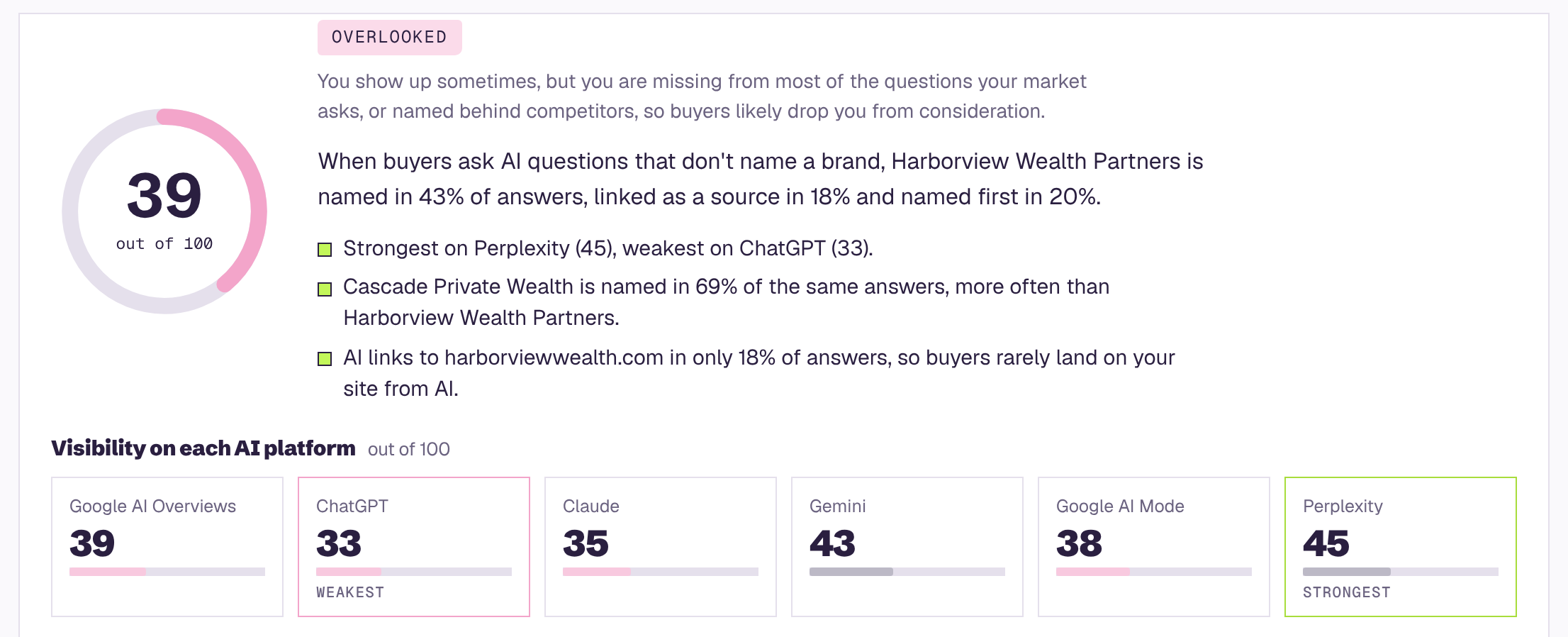
The gap is clearest side by side:
If you only fix three things
- Explain who can join and why it's worth it. For credit unions, especially.
- Publish fees and current rates clearly. For every account and loan.
- Give every branch and specific need its own page. Small business, newcomers, auto loans and more.
People are asking AI where to bank without getting nickel-and-dimed. The bank or credit union AI names will be the one that answers most clearly.
Part of our guide: Why AI visibility matters for financial services
See what AI tells people about your bank or credit union
Enter your website and get a free AI visibility report. It takes a few minutes, and you'll see:
- Your AI visibility score, overall and for ChatGPT, Gemini, Claude, Perplexity and Google's AI Overviews and AI Mode
- Which banks and credit unions AI recommends instead of you, and how often
- Your visibility in every city you serve, and the competitor AI names most in each one
- What AI gets wrong about you, and what to fix first
- Your biggest gaps: the buyer questions where AI leaves you out, and who it recommends instead
- A downloadable PDF you can share with your team