How people choose a financial advisor, insurer or lender now, and why AI visibility decides who gets the client
People now ask AI which advisor, insurance agency, mortgage broker or bank to trust with their money. Here's how their journey works, what they ask at each step, and how to build a firm AI recommends.
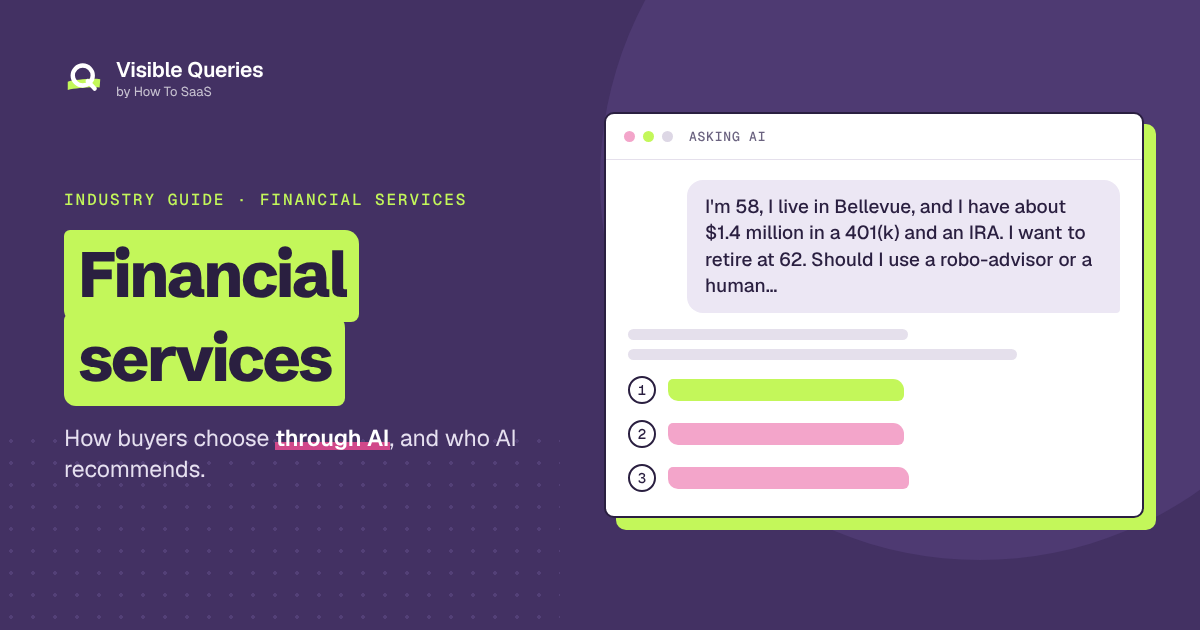
It's 10:15 on a Thursday night in Bellevue. A 58-year-old engineer has just finished reading the annual statement from the retirement account they've been managing themselves for 25 years. The balance is bigger than they ever expected. That's the problem. They have no idea whether they can retire at 62, how to turn the balance into a paycheck, what to do about taxes, or whether they're taking too much risk.
A few years ago, they would have asked a coworker who their advisor was, searched "financial advisor Bellevue," and spent an awkward Saturday on the phone with whoever had the nicest website.
Tonight, they open ChatGPT and type:
"I'm 58, I live in Bellevue, and I have about $1.4 million in a 401(k) and an IRA. I want to retire at 62. Should I use a robo-advisor or a human financial advisor? How do I find one who isn't just selling me products, and what should it cost?"
The answer explains the difference between robo-advisors, commission-based advisors and fee-only fiduciaries. It covers typical fee structures, the questions to ask in a first meeting, and how to look an advisor up on FINRA's BrokerCheck. Then it names three local firms that specialize in retirement income planning, with a sentence on each.
They book an intro call with the first one the next morning.
That's how a growing share of people now choose financial advisors, insurance agents, mortgage brokers, banks, credit unions, tax preparers and small business lenders. They describe their situation, their goal and their worries, and AI hands them a short list. The firms on that list get the meeting. The rest never get the chance to show what they can do.
This article walks through how people choose a financial services firm today, step by step, with examples from financial advisors and wealth managers, insurance agencies, mortgage lenders and brokers, banks and credit unions, tax preparation services and small business lenders. It covers what people ask AI at each step, what makes AI recommend one firm over another, and what the firms that keep getting recommended tend to do differently. Most of it comes down to being a firm that's clear, transparent and easy to trust.
Along the way you'll see screenshots from a Visible Queries report for Harborview Wealth Partners, a sample independent wealth management firm in the Seattle area. The firm and its competitors are made up, but the report is real. It's exactly what any firm sees when it runs its own.
Why the old playbook isn't enough anymore
Financial firms have always grown on referrals and relationships: a happy client who tells a friend, a CPA or estate attorney who sends business your way, a community presence, and a reputation built over years. Marketing filled in with a website, seminars, local sponsorships and maybe some search ads.
All of that still matters. But more and more, the first conversation someone has about their money isn't with a friend or a professional. It's with an AI assistant, and it's a surprisingly candid one. People will tell AI things about their finances they'd never say at a dinner party.
Three things follow from that:
- People describe their situation, not a product. "Five years from retirement with a big 401(k) and no plan" or "self-employed and need a mortgage" gets firms that clearly match. Generic "comprehensive financial solutions" copy matches nothing.
- The shortlist is tiny. A search shows dozens of firms. An AI answer names three. Those three get the calls.
- Your reputation is summarized, including how you get paid. People ask "Is [firm] a fiduciary? How do they charge?" and get a short answer drawn from your website, regulatory filings, reviews and whatever else AI can find.
None of this replaces referrals or relationships. They're the raw material AI reads. What changes is that your reputation, your fees and your specialty now have to be written down clearly enough for AI to repeat them correctly.
The client's journey, step by step
Whether it's a $1,200-a-year auto policy, a mortgage, a business line of credit or a lifetime wealth management relationship, the path looks similar. What changes is how much is at stake and how long the decision takes.
- Something prompts the search. A life event, a windfall, a worry, a deadline or a bad experience.
- They try to understand their options. What kind of help they need, how it works and what it costs.
- They build a shortlist. Which firms nearby, or online, fit their situation.
- They check who to trust. Credentials, licenses, conflicts of interest, reviews and regulatory records.
- They choose. Intro meetings, quotes, rates, fees and fit.
- They stay, or they don't. Service, communication, results and referrals.
AI now shows up at every one of these steps. Here's what that looks like.
Step 1: Something prompts the search
People rarely shop for financial services for fun. Something happens first.
- Retirement getting close, or a job change with a 401(k) to roll over.
- An inheritance, a business sale, stock options vesting or a bonus.
- A marriage, a divorce, a new baby or the death of a spouse.
- A home purchase, a refinance, or rates moving.
- A renewal notice with a much higher insurance premium.
- Tax season, an IRS letter, or a first year of self-employment.
- A business that needs working capital, equipment or a bigger line of credit.
The first questions people ask AI are about the situation, not about you. "Can I retire at 62 with $1.4 million?" "Why did my home insurance go up 30%?" "Should I refinance now or wait?" "Do I need a CPA or can I use tax software for my side business?"
This is where your next client first meets an answer, and that answer shapes what they think they need. If AI tells the 58-year-old that people in their situation often benefit from a fee-only planner who specializes in retirement income, they now want a fee-only planner who specializes in retirement income. If it tells them a robo-advisor is enough, the advisor never gets the call.
The firms that do well at this step publish honest, useful answers to the questions people ask before they're ready to hire anyone. An advisor with a clear guide to "how to turn a 401(k) into retirement income." An insurance agency with a plain explanation of why premiums are rising in their state and what homeowners can do about it. A mortgage broker with a page on what self-employed borrowers need to qualify.
AI leans on content like that because it's specific, practical and written by people who do the work. Once your explanation shapes the answer, your name tends to follow.
What good firms do at this step:
- Write about the moments that start the search: retirement, inheritance, renewal shock, refinancing, tax letters, cash-flow crunches.
- Answer the real question honestly, even when the answer is "you may not need us yet."
- Use plain language. "How to make your savings last" beats "decumulation strategies."
Step 2: They try to understand their options
Next, people try to understand the landscape. This is where they're most open, and where AI does most of the teaching.
- "Is a robo-advisor enough to plan for retirement?"
- "Fee-only vs fee-based vs commission advisors: what's the difference?"
- "Independent insurance agent or buy direct from the insurer?"
- "Mortgage broker vs going straight to my bank?"
- "Credit union vs bank for a small business account?"
- "SBA loan vs online lender for equipment financing?"
This is where people decide what kind of help they want, and that decides which firms are even considered.
Here's what this step looks like in a real report. These are questions AI was asked about financial advisors in the Seattle area, and who each platform named in its answer:
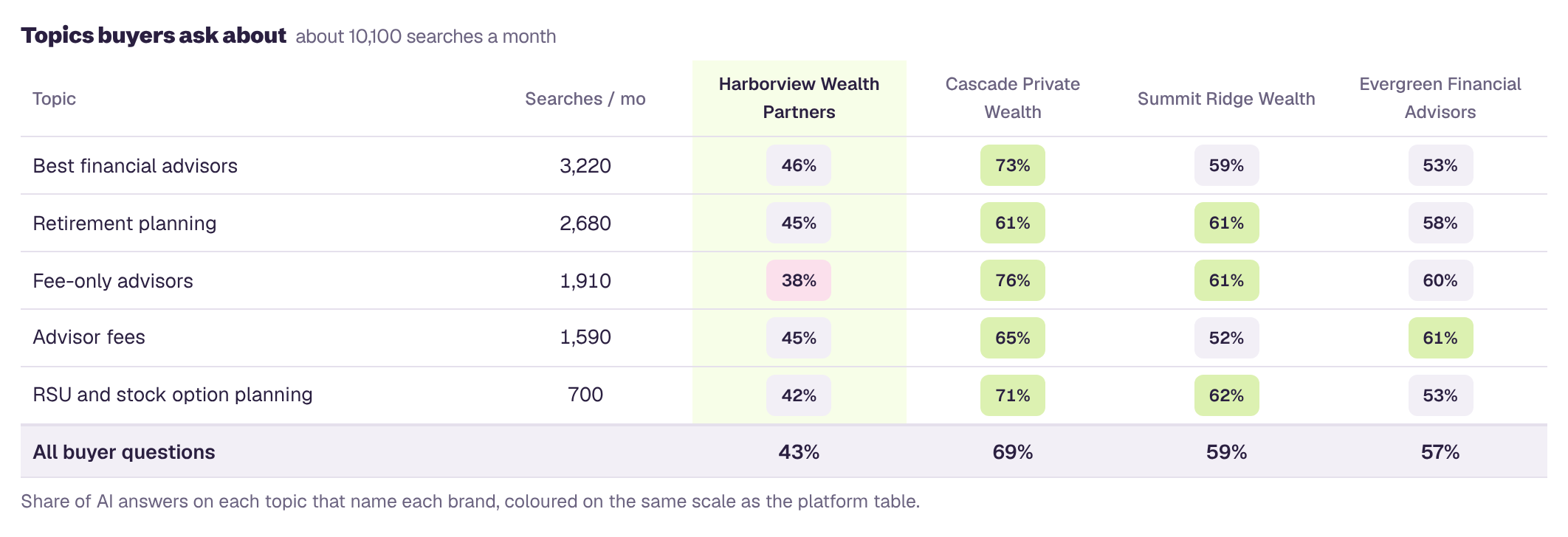
Look at the pattern. "Is a robo-advisor enough to plan for retirement?" Every platform named a competitor. "What's better than a robo-advisor when you're five years from retiring?" Only Gemini mentioned Harborview. "How much do hidden investment fees really cost over a lifetime?" Cascade Private Wealth on three platforms and Evergreen Financial Advisors on the fourth.
These questions come from exactly the clients a wealth management firm wants: people with real assets who are starting to feel that doing it themselves, or using a robo-advisor, isn't enough anymore. They haven't chosen an advisor yet. They're asking AI whether they need one and what good looks like. The firm that shows up in that answer often gets the first meeting without any competition.
What moves a firm into these answers is the same thing that helps a person understand the choice:
- Clear explanations of how you work compared with the alternatives, including robo-advisors, banks, brokers and doing it yourself.
- Plain, published fees. People ask about cost in almost every financial conversation, and AI favors firms it can say something concrete about.
- Who you serve best. "Pre-retirees and retirees in the Seattle area with $1 million to $5 million" is much easier to recommend than "individuals and families."
What good firms do at this step:
- Explain how you're paid, and how that compares with other options, in plain words.
- Publish fees, minimums, rates or price ranges wherever you can.
- Say exactly who you're best for, and who you're not.
Step 3: They build a shortlist
Once people know what kind of help they want, they look for specific firms. Financial services can be national or online, but many people still want someone local: someone who knows the state's tax rules, the local housing market, or the local business community, and who they can sit across the table from.
The questions get specific:
- "Fee-only fiduciary advisor in Bellevue who specializes in tech employees with RSUs."
- "Independent insurance agency in Tacoma that shops multiple carriers for homeowners."
- "Mortgage broker in Seattle for self-employed borrowers."
- "Credit union in Kirkland with good small business accounts."
- "CPA in Seattle who does taxes for real estate investors."
For firms with several offices, this is where gaps show. AI can recommend you in one city and barely mention you in the next. Here's the sample firm across the four cities it serves:
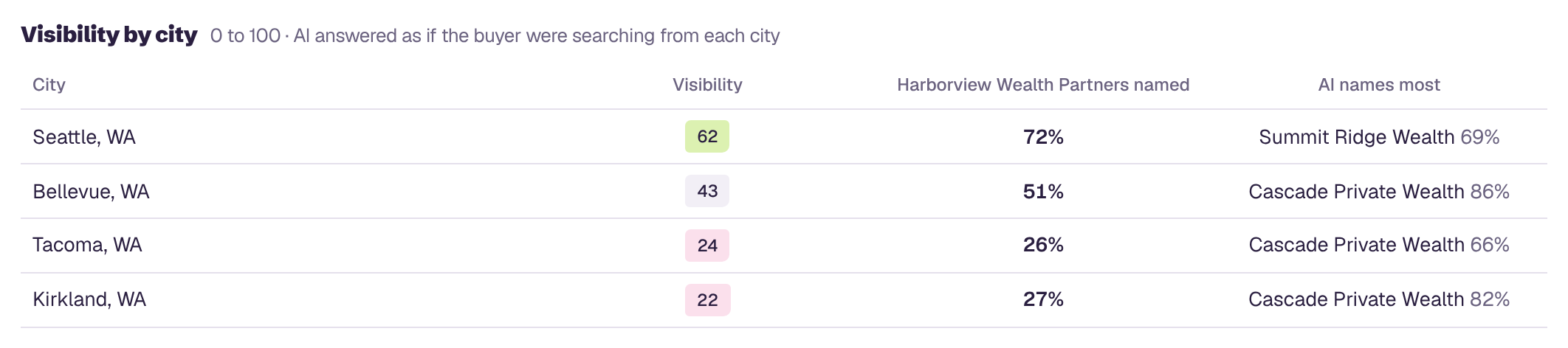
In Seattle, Harborview scores 62 and is named in 72% of answers. In Bellevue it scores 43 and is named in half of them, but Cascade Private Wealth is named in 86%. In Kirkland and Tacoma it scores 22 and 24, named in about a quarter of answers, while Cascade is named in 82% and 66%.
That's typical. A firm's founding office has decades of referrals, community presence and local press. Its other offices have an address on the contact page. AI can't recommend an office it knows nothing about.
What good firms do at this step:
- Give each office a real page: the advisors or agents who work there, who they serve, the local specialties and reviews from local clients.
- Build a local presence: community events, local media, partnerships with local CPAs and attorneys, and chamber or industry involvement.
- Make your specialties obvious. Tech equity compensation, business owners, physicians, retirees, first-time buyers, self-employed borrowers. Specific firms get recommended for specific questions.
Step 4: They check who to trust
Trust is the whole product in financial services. People are handing you their savings, their family's security, their home or their business. So they check carefully.
- "Is [firm] a fiduciary?"
- "How does [advisor] get paid? Any conflicts of interest?"
- "Does [advisor] have any complaints on BrokerCheck?"
- "Is [insurance agency] independent or captive?"
- "What do customers say about [lender]'s closing process?"
AI answers these in a couple of sentences, summarizing what it's found. When it's accurate, that's powerful: a nervous prospect hears a clear, confident summary from a source they trust. When it's wrong, the damage is quiet and complete.
Here's what that looks like in the sample report:
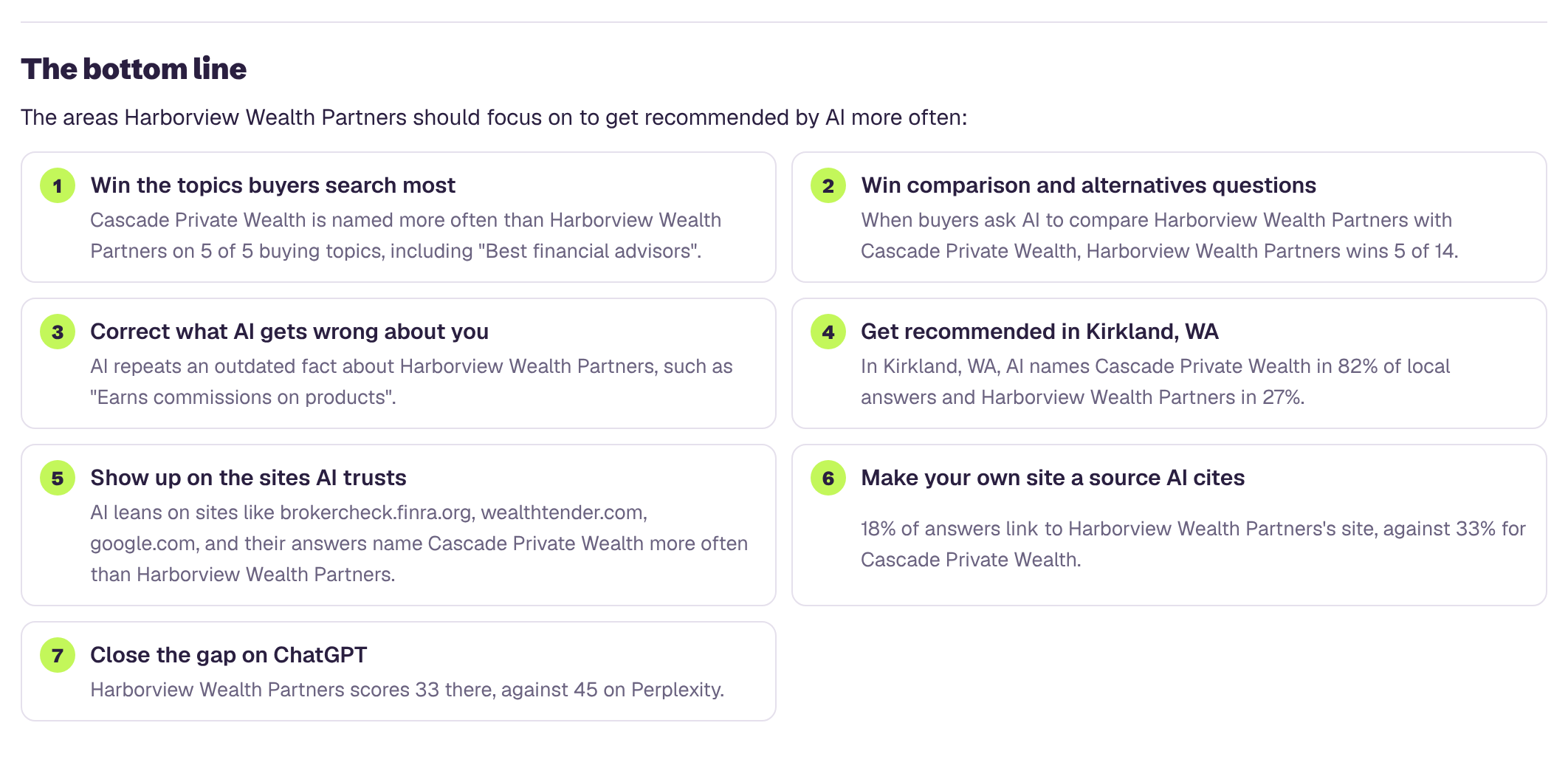
The first gap is about the worst error a wealth management firm can face. AI tells people that Harborview "earns commissions on products." In reality, Harborview is fee-only and takes no commissions. For the exact clients asking how to avoid conflicts of interest, that one wrong sentence takes Harborview off the list.
The report also shows Harborview named in only 44% of "best financial advisors" answers, and Cascade Private Wealth named instead in 41% of buyer questions, including "Why do I keep finding hidden fees in my investment accounts?" That's precisely the question a fee-only firm should own. Overall accuracy is 88%, but the 12% that's wrong includes the one fact that matters most.
Wrong facts about financial firms usually come from a few places:
- History. A firm that used to be commission-based, used to be part of a broker-dealer, or used to have a different name.
- Directory and comparison sites that describe you with old or generic information.
- Confusing language on your own site. "Fee-based" and "fee-only" mean very different things, and AI may not tell them apart if you don't say it clearly.
- Silence. If you never state how you're paid, who regulates you and what your minimums are, AI fills the gap with whatever it can find.
What good firms do at this step:
- Publish one clear page on how you're paid, your fiduciary status, your regulators, your minimums and your conflicts of interest.
- Make sure every directory, profile and regulatory filing tells the same story as your website.
- Show credentials and experience clearly: certifications, licenses, years in practice and specialties.
- Encourage happy clients to leave reviews where your industry allows it, mentioning specifics like the situation and the outcome.
Step 5: They choose
By now, a prospect usually has two or three firms in mind. They're comparing the details that decide it:
- "Harborview vs Cascade Private Wealth for retirement income planning?"
- "What's the typical fee for a $1.5 million portfolio in Seattle?"
- "Which local mortgage brokers have the best rates this week?"
- "Will an independent agent find me a better homeowners rate than going direct?"
- "How fast can [lender] fund an equipment loan?"
Head-to-head questions are where share of voice matters most. If someone asks AI to compare you with a competitor and AI has much more to say about the competitor, the competitor tends to win.
In the sample report, Cascade Private Wealth is named in 69% of answers, Summit Ridge Wealth in 59% and Evergreen Financial Advisors in 57%. Harborview is named in 43%. Harborview scores 39 overall, in the Overlooked band, and is the fourth name in most conversations about advisors in the region.
The firms that win at this step make the decision easy:
- The first step is clear and low-pressure. A free intro call, a quote request, a rate check or a pre-approval, with online booking.
- Pricing and terms are visible. Fee schedules, typical rates, closing timelines, policy options, minimums.
- The process is explained. What happens in the first meeting, what documents to bring, how long onboarding or closing takes.
- The differences are named. Fee-only, independent, local underwriting, same-week closings, a dedicated advisor. Say so plainly.
What good firms do at this step:
- Publish a fair comparison of your approach with the main alternatives. People are already asking AI to make that comparison.
- Make the first step easy to book and free of pressure.
- Keep rates, fees and availability current, so AI never tells someone you're more expensive or slower than you are.
Step 6: They stay, or they don't
Financial relationships are meant to last. An advisory client might stay for 30 years and introduce their children. A homeowner with a good insurance agent might stay for a lifetime and move their auto, umbrella and business policies too. A business with a good bank or lender keeps coming back as it grows. Lifetime value is the business model.
Clients ask AI questions after they hire you, too:
- "Is a 1% advisory fee too much?"
- "Should I switch insurance agents if my premium went up again?"
- "Is it worth refinancing with a different lender?"
- "How do I know if my advisor is doing a good job?"
If those answers make clients doubt the relationship, or point them to a competitor, you lose people you've already won. The firms that keep clients publish for them too: what clients should expect each year, how fees compare with the value delivered, how reviews and renewals work, and how to think about switching.
And when clients stay and feel well served, they refer. Reviews, referrals from CPAs and attorneys, community reputation and word of mouth are all part of what AI reads when it decides who to recommend.
What good firms do at this step:
- Explain the value of the relationship in writing: what clients get each year, not just what they pay.
- Make reviews, renewals and check-ins proactive, so clients never have to wonder.
- Ask for referrals and reviews, where your industry allows, at natural moments like a successful retirement, a closed loan or a claim handled well.
How the journey plays out across financial services
The six steps are the same everywhere, but what people ask, and what decides the choice, varies a lot by type of firm.
Financial advisors and wealth managers
This is the long, high-trust journey in the example above. People research for weeks or months, often with a spouse. They ask: "Do I need a financial advisor?" "Fee-only vs fee-based," "what does a financial advisor cost," "best retirement planner near me," "advisor who understands RSUs and ESPP."
Firms that get recommended are clear about how they're paid, who they serve, their minimums and their specialties. They publish helpful planning content and make it easy to see the people behind the firm. Advisors who niche down, by profession, life stage or situation, tend to get recommended far more often for the questions that matter to them.
Full guide: AI visibility for financial advisors and wealth managers
Insurance agencies, personal and commercial
Insurance searches are often triggered by a price jump, a new home, a new car, a new business or a claim that went badly. People ask: "Why did my home insurance go up?" "Best insurance agent in Tacoma for homeowners," "independent agent vs going direct," "what insurance does a small contractor need?"
AI recommends agencies that explain coverage clearly, say which carriers they work with, specialize in particular customers (homeowners, high-value homes, contractors, restaurants, trucking), and have reviews that mention how claims were handled. Commercial agencies do especially well when they publish clear guides to coverage for specific industries.
Full guide: AI visibility for insurance agencies
Mortgage lenders and brokers
Mortgage journeys are driven by rates, timing and stress. Questions include: "How much house can I afford in Seattle?" "Mortgage broker vs bank," "best lender for self-employed borrowers," "how long does it take to close a mortgage?" "Is now a good time to refinance?"
Lenders and brokers that get recommended explain the process step by step, are clear about the borrowers they help (first-time buyers, self-employed, veterans, investors, jumbo loans), publish realistic timelines, and have reviews that mention communication and closing on time. Clear, honest content about rates and fees beats big promises every time.
Full guide: AI visibility for mortgage lenders and brokers
Banks and credit unions
People switch banks rarely, but when they do, it's often because of fees, a bad experience or a business need. They ask: "Credit union vs bank," "best credit union in Kirkland," "banks with no monthly fees," "best local bank for a small business."
Community banks and credit unions often have a real advantage: local decision-making, better rates and personal service. But AI can only say that if it's written down. Institutions that get recommended are clear about membership eligibility, fees, rates, branch and ATM access, digital banking, and how they serve local businesses.
Full guide: AI visibility for banks and credit unions
Tax preparation services
Tax searches are seasonal and deadline-driven, with a steady year-round stream of people who just got a letter from the IRS or the CRA. People ask: "Do I need a CPA or can I use software?" "Tax preparer for freelancers near me," "how much does it cost to have taxes done," "help with an IRS notice."
Firms that get recommended publish who they serve (freelancers, small businesses, real estate investors, expats), what they charge or a price range, their credentials (CPA, EA), and how they handle notices and audits. Clear seasonal content, like deadlines, checklists and what to bring, helps a lot.
Full guide: AI visibility for tax preparation services
Small business lenders
Business owners usually look for financing under pressure: a big order, a cash-flow gap, equipment that broke down, or a growth opportunity. They ask: "SBA loan vs online lender," "how fast can I get a business line of credit," "equipment financing for a restaurant," "best lenders for businesses with less than two years in business."
AI recommends lenders that are transparent about rates, terms, fees, speed, qualification requirements and the types of businesses they serve. Lenders that are vague about cost, or have reviews about surprise fees, tend to get warnings instead of recommendations.
Full guide: AI visibility for small business lenders
Building a financial firm AI recommends
Across every type of financial firm, the ones AI keeps recommending share the same habits. None of them are tricks. They're what trustworthy firms already do, written down clearly enough for a client, or an AI, to understand.
- Say exactly who you serve. Life stages, professions, business types, asset levels and situations. Specific firms get recommended for specific questions.
- Be transparent about how you're paid. Fees, commissions, rates, minimums and conflicts of interest, stated plainly on one page.
- Explain your approach in plain language. What working with you looks like, step by step.
- Answer the questions that start the search. Retirement, renewals, refinancing, tax letters and cash-flow crunches, honestly and helpfully.
- Show the trust facts. Credentials, licenses, regulators and experience, all current and easy to find.
- Give every office its own page. People, specialties and local reviews, so AI can recommend you in every city you serve.
- Keep every listing consistent. Website, directories, profiles and filings should tell the same story, especially about fees and status.
- Fix wrong facts fast. One wrong line about how you're paid can cost you every client who cares about conflicts of interest.
- Make the first step easy. A clear, low-pressure way to book an intro call, request a quote or check a rate.
- Build reputation on purpose. Referral relationships, reviews where allowed, community presence and local media.
You can see how much these habits matter in the full report. Here's the sample firm's overall score and the metrics behind it:
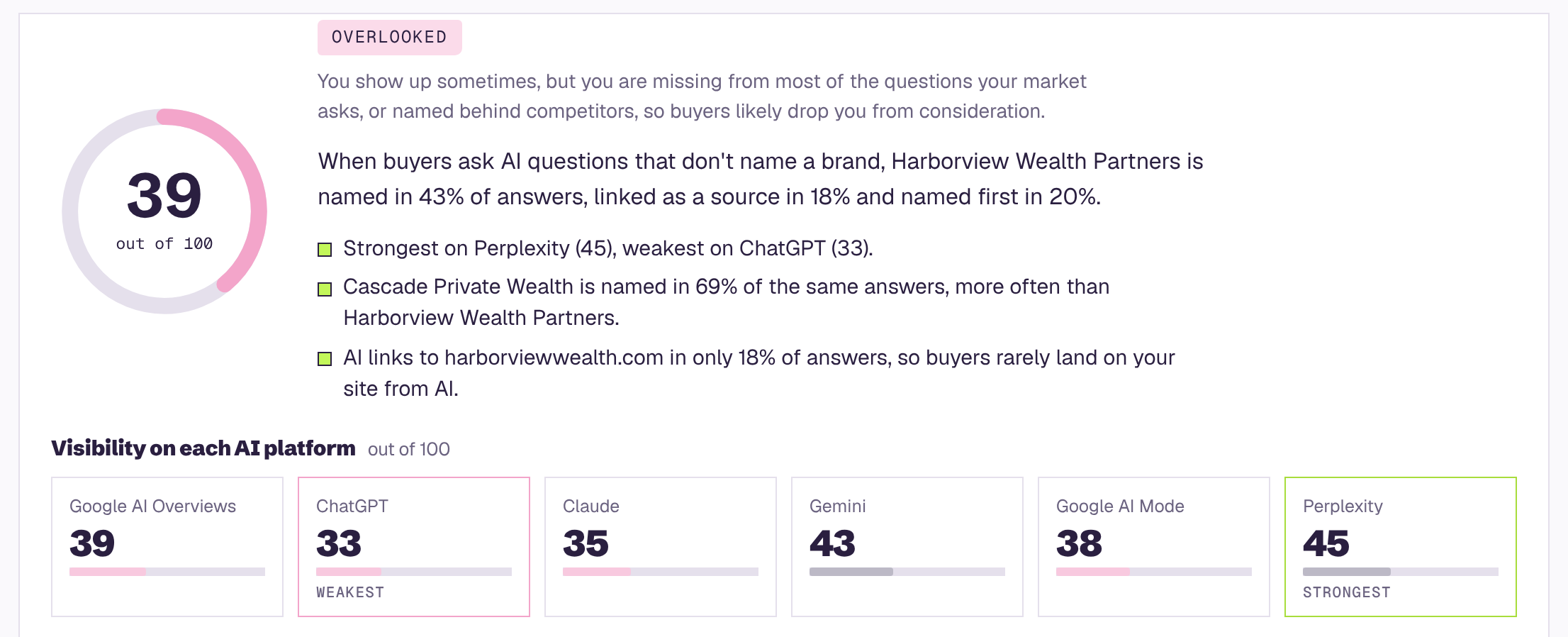

An Overlooked score with a 20% first-mention rate tells a clear story. AI knows Harborview and describes it fairly well, but it rarely leads with it. Competitors are named first and more often, and one wrong fact about commissions undercuts the firm's biggest selling point. The fixes are concrete: correct the fee-only fact everywhere it appears, build real pages and local presence for each office, and own the questions about hidden fees and conflicts of interest.
People still want someone they can trust with their money
People have always chosen financial firms on trust, expertise and referrals. That hasn't changed. What's changed is who they ask first. More and more, it's an AI assistant, and it recommends the firms it understands best.
The firms that win this shift aren't doing anything exotic. They're clear about who they serve and how they're paid. They answer real questions honestly. They keep their facts consistent everywhere. And they make sure what AI says about them is true.
The first step is knowing where you stand today.
Keep learning
- What is AI visibility?
- How to get your business recommended by AI, with guides for ChatGPT, Google AI Overviews, Perplexity, Gemini and Claude
- AI visibility benchmark 2026
- The AI visibility glossary
See what AI tells clients about your firm
Enter your website and get a free AI visibility report. It takes a few minutes, and you'll see:
- Your AI visibility score, overall and for ChatGPT, Gemini, Claude, Perplexity and Google's AI Overviews and AI Mode
- Which firms AI recommends instead of you, and how often
- Your visibility in every city you serve, and the competitor AI names most in each one
- What AI gets wrong about you, and what to fix first
- Your biggest gaps: the buyer questions where AI leaves you out, and who it recommends instead
- A downloadable PDF you can share with your team