Fee-only, fiduciary or commission: how people choose a financial advisor through AI
People now ask AI how advisors get paid, whether they need one and how to find someone they can trust with their savings. Here's what AI tells them, and how financial advisors and wealth managers get named.
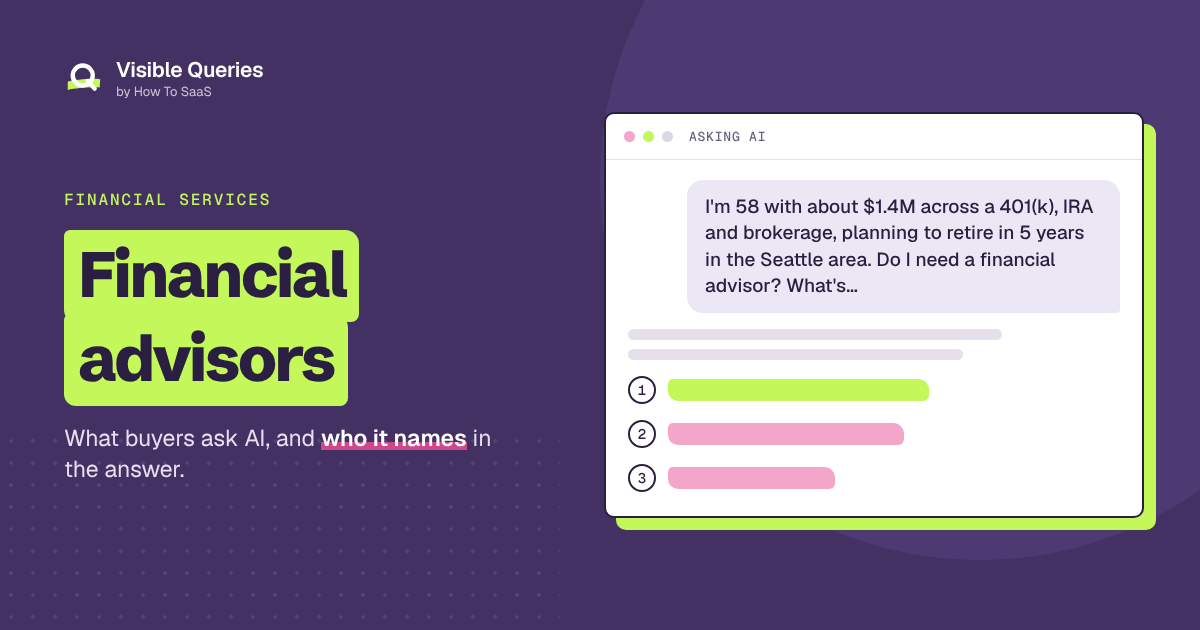
A 58-year-old engineer in Bellevue just sold a share of their company stock and has $1.4 million in savings spread across a 401(k), an IRA and a brokerage account. They want to retire in five years, and they've never worked with an advisor. A coworker's advisor charges 1% of assets. Another friend says "never pay commissions." They ask ChatGPT:
"I'm 58 with about $1.4M across a 401(k), IRA and brokerage, planning to retire in 5 years in the Seattle area. Do I need a financial advisor? What's the difference between fee-only, fee-based and commission advisors? What's a fair fee, and how do I find a fiduciary near Bellevue I can trust?"
AI explains what a fiduciary is, how advisors are paid, typical fee structures (percentage of assets, flat fees, hourly and commissions), what retirement income planning usually includes, how to check an advisor's registration and disciplinary history, and questions to ask in a first meeting. Then it names three firms. One of them gets a discovery call the next morning.
People choosing a financial advisor are trusting someone with their life's savings. They worry about fees, conflicts of interest and being sold products they don't need. That makes them careful researchers, and AI is now one of the first places they look.
Our financial services guide covers how people choose financial firms in general. This one goes through the questions that decide advisory clients, what AI usually says, and what firms can publish so AI names them.
Here are the questions at a glance:
| The question | What gets you named |
|---|---|
| "How do advisors get paid?" | How you're paid, in plain words |
| "What's a fair fee?" | Your fees, with examples |
| "Do I need an advisor?" | Honest guidance on when an advisor helps |
| "How do I check an advisor's background?" | Registrations and how to look you up |
| "Advisor for [specific situation]" | A page for each kind of client you serve |
"How do advisors get paid?"
This is the defining question for the category.
What AI usually says: It explains fee-only, fee-based and commission compensation, the conflicts each can create, and what a fiduciary duty means. It often suggests that people ask advisors directly how they're paid.
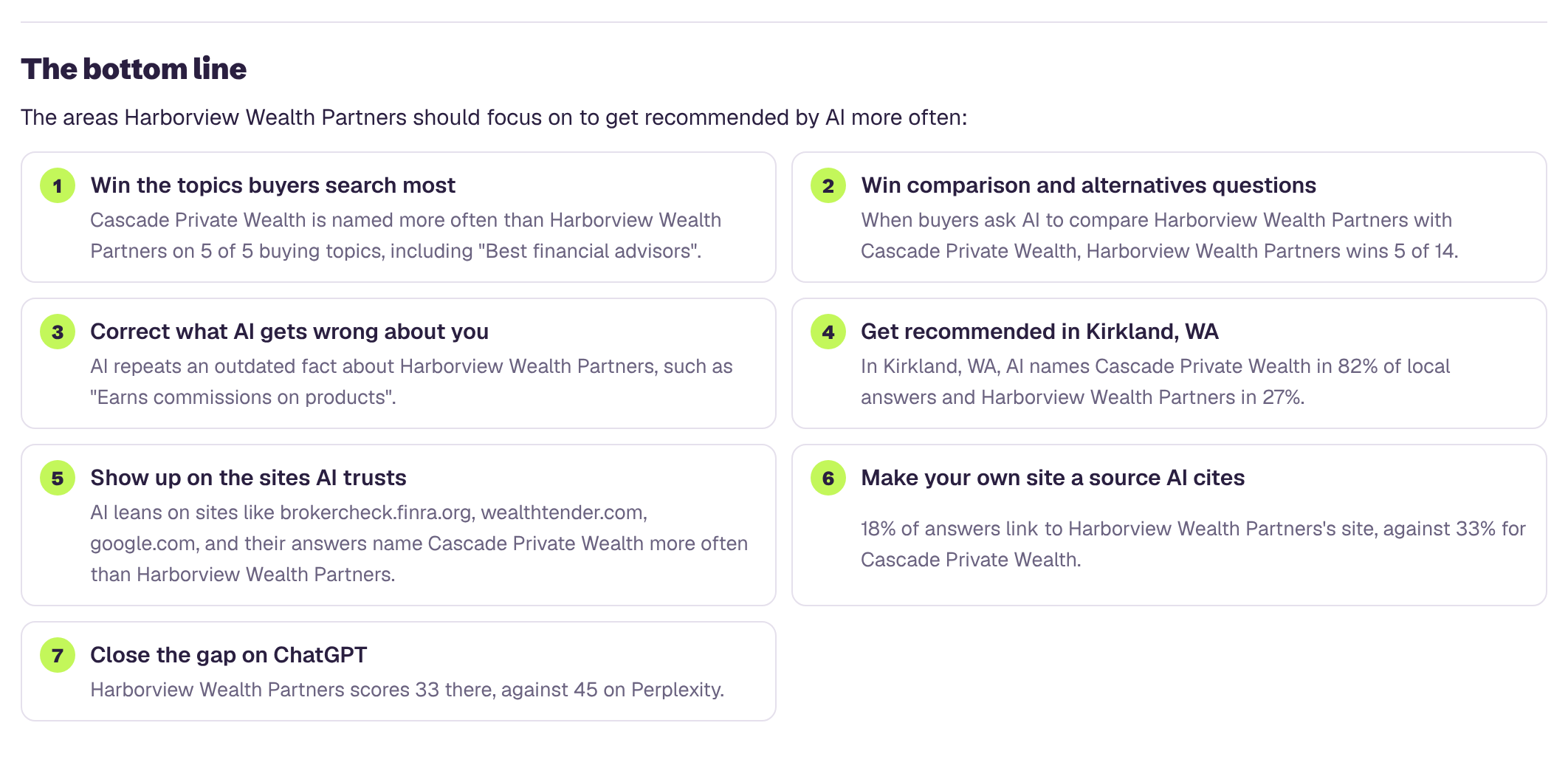
Why it matters: If AI gets your compensation model wrong, it can send away exactly the clients who'd choose you. Here's how a wrong fact like that shows up in the report:
What to publish: A plain-language page on how you're paid, whether you act as a fiduciary, and how you handle conflicts of interest. Use the exact terms people search for, like "fee-only" and "fiduciary," and make sure your listings and profiles match.
"What's a fair fee?"
What AI usually says: Typical ranges for percentage-of-assets fees, flat-fee planning and hourly advice, with a note that fees often decline at higher asset levels.
What to publish: Your fee schedule, minimums, and what's included: planning, investment management, tax coordination, estate planning coordination, and how often you meet. Firms that publish fees appear more trustworthy than those that don't.
"Do I need an advisor?"
What AI usually says: It explains when people often benefit from advice (retirement transitions, windfalls, business sales, complex taxes, inheritances, divorce) and when low-cost options may be enough.
What to publish: Honest guides to the moments when advice matters most, and who you serve best. Firms that admit some people don't need them earn more trust from those who do.
"How do I check an advisor's background?"
What AI usually says: It points people to official registration and disciplinary databases and suggests reviewing an advisor's disclosure documents.
What to publish: Your registrations, credentials (CFP, CFA, CPA and others), links to your public disclosures, and your team's experience. Making due diligence easy signals confidence.
"Advisor for [specific situation]"
The most valuable searches are specific:
- "Financial advisor for tech employees with RSUs."
- "Retirement planner for teachers with pensions."
- "Advisor for physicians starting their careers."
- "Wealth manager for business owners planning a sale."
- "Advisor who specializes in divorce."
Each niche you truly serve deserves its own page: the issues those clients face, how you help, and examples. AI matches people to firms that clearly specialize.
Wealth management for high-net-worth families
Families with significant wealth ask different questions: about multi-generational planning, trusts, family offices, philanthropy, and coordinating with attorneys and accountants. If you serve them, explain your services, team, minimums and how you coordinate with other professionals.
Content that compliance can approve
Advisors often worry that publishing is risky. But the content AI rewards is usually educational and factual: how fees work, what retirement planning involves, what to ask an advisor, how you work. That's the kind of content most compliance teams can approve, and it's also what earns trust.
What the sample report shows
Here's what a Visible Queries report looks like for Harborview Wealth Partners, the sample independent wealth management firm in the Seattle area from our guide. The questions are different for advisory firms, but the patterns are the same.
For a business that serves more than one city, the report checks each one separately:
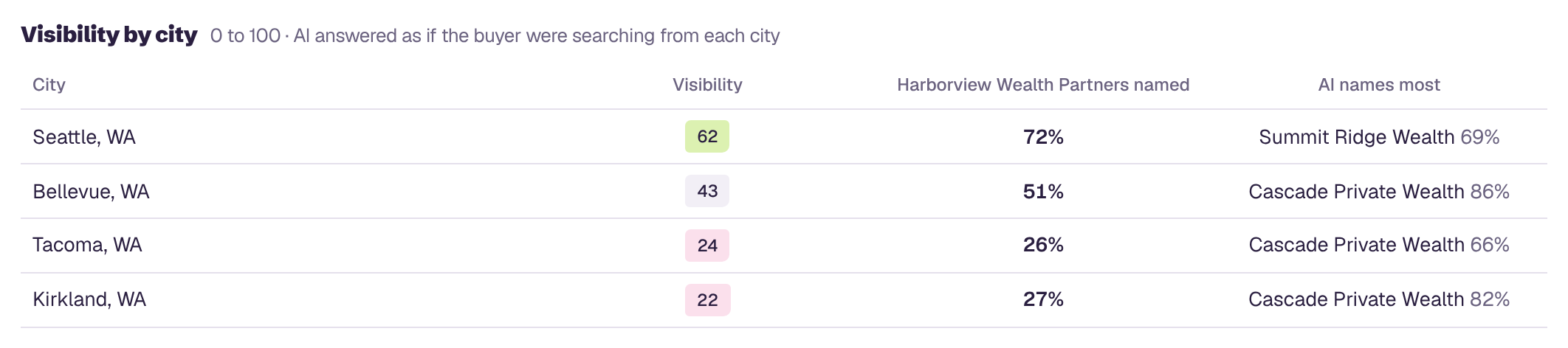
The gap is clearest side by side:
If you only fix three things
- Explain how you're paid, clearly. Fee-only, fiduciary and conflicts, in plain words.
- Publish fees, minimums and what's included.
- Give each client niche its own page. Tech employees, physicians, business owners, retirees and more.
People are asking AI who they can trust with their savings. The firm AI names will be the one that's clearest about how it works and who it serves.
Part of our guide: Why AI visibility matters for financial services
See what AI tells investors about your firm
Enter your website and get a free AI visibility report. It takes a few minutes, and you'll see:
- Your AI visibility score, overall and for ChatGPT, Gemini, Claude, Perplexity and Google's AI Overviews and AI Mode
- Which firms AI recommends instead of you, and how often
- Your visibility in every city you serve, and the competitor AI names most in each one
- What AI gets wrong about you, and what to fix first
- Your biggest gaps: the buyer questions where AI leaves you out, and who it recommends instead
- A downloadable PDF you can share with your team