How much house can I afford? How homebuyers choose a mortgage lender or broker through AI
Homebuyers now ask AI how much they can borrow, whether to use a broker or a bank and how to get the best rate. Here's what AI tells them, and how mortgage lenders and brokers get named.
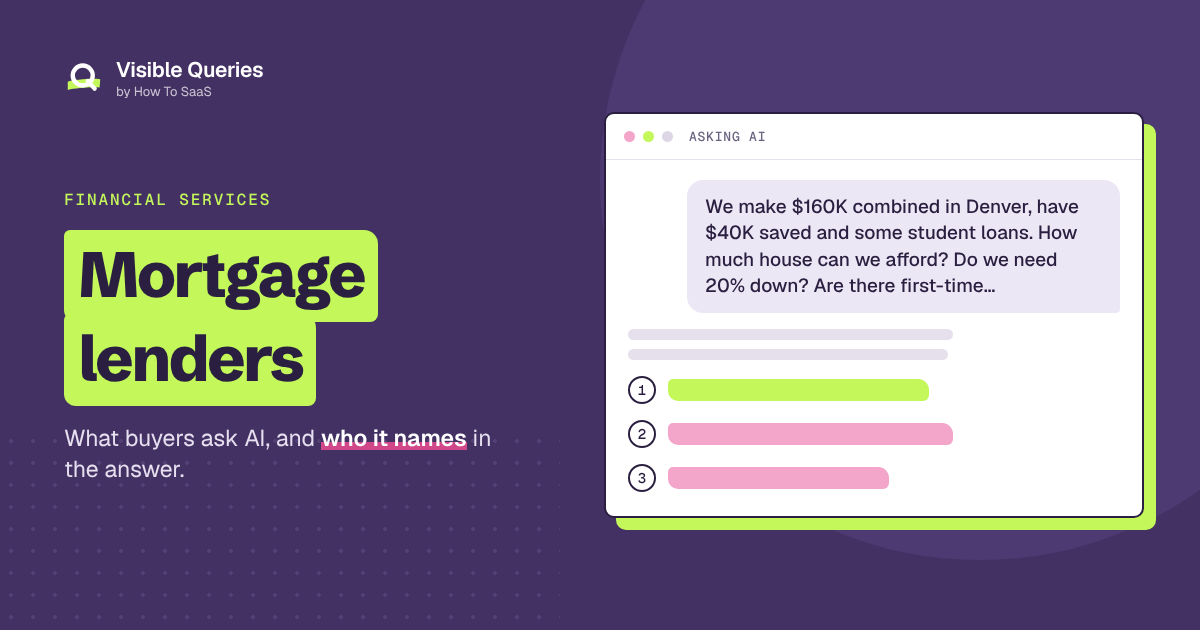
A couple in Denver is renting a two-bedroom apartment and wants to buy their first home this spring. They make about $160,000 combined, have $40,000 saved and some student loans. They have no idea how much they can borrow or how to start. They ask ChatGPT:
"We make $160K combined in Denver, have $40K saved and some student loans. How much house can we afford? Do we need 20% down? Are there first-time buyer programs in Colorado? Should we use a mortgage broker or our bank, and which local lenders are good for first-time buyers?"
AI explains how lenders look at income, debts and credit, what debt-to-income ratios mean, that many loan types allow less than 20% down, the general idea of down payment assistance programs, the costs beyond the down payment, the difference between brokers, banks and online lenders, and why getting pre-approved early helps. Then it names three lenders and brokers. The couple starts a pre-approval with one of them that week.
A mortgage is the biggest financial product most people ever buy, and they usually understand it the least. Buyers are nervous, rates feel confusing, and the process is full of jargon. AI has become one of the first places they ask.
Our financial services guide covers how people choose financial firms in general. This one goes through the questions that decide mortgage clients, what AI usually says, and what lenders and brokers can publish so AI names them.
Here are the questions at a glance:
| The question | What gets you named |
|---|---|
| "How much house can I afford?" | Plain affordability guides for your market |
| "Broker, bank or online lender?" | An honest comparison and how you work |
| "How do I get the best rate?" | What moves rates, and how you shop them |
| "First-time buyer programs?" | Every program you offer, explained |
| "Mortgage for [specific situation]" | A page for self-employed, newcomer and other situations |
"How much house can I afford?"
What AI usually says: It explains how lenders calculate affordability, the difference between what a lender approves and what's comfortable, and the costs beyond the mortgage payment: taxes, insurance, HOA fees and maintenance.
What to publish: Local affordability guides with real examples for your market, plus calculators that explain their assumptions in text. AI can't use a calculator, but it can use a clear explanation.
"Broker, bank or online lender?"
This is the defining question for the category.
What AI usually says: It explains that brokers shop multiple lenders, banks lend their own money and may offer relationship discounts, and online lenders can be fast and competitive. It suggests comparing loan estimates.
What to publish: How you work, the lenders or programs you have access to, how you compare options, your turnaround times and how you communicate during the process.
"What are today's rates? How do I get the best rate?"
What AI usually says: It explains what drives rates, like credit, down payment, loan type, points and the market, and suggests comparing several offers.
What to publish: Clear explanations of how you price loans and what borrowers can do to get better terms. If you publish rates, date them and explain the assumptions.
"First-time buyer programs?" "Low down payment loans?"
What AI usually says: It describes general loan types and assistance programs, and suggests checking with local lenders for current eligibility.
What to publish: Current guides to the programs you offer and work with in your state or province, with eligibility, limits and how to apply. These programs change often, so keep your pages current.
"Mortgage for [specific situation]"
Specific searches are where independent lenders and brokers win:
- "Mortgage for self-employed borrowers."
- "Mortgage for doctors and dentists."
- "VA loan lender near me."
- "Mortgage for new immigrants in Canada."
- "Jumbo loans in Denver."
- "Mortgage for buying a rental property."
Each one you truly serve deserves its own page.
Visibility by city
Buyers often search by city or neighborhood, and AI's answers change by place:
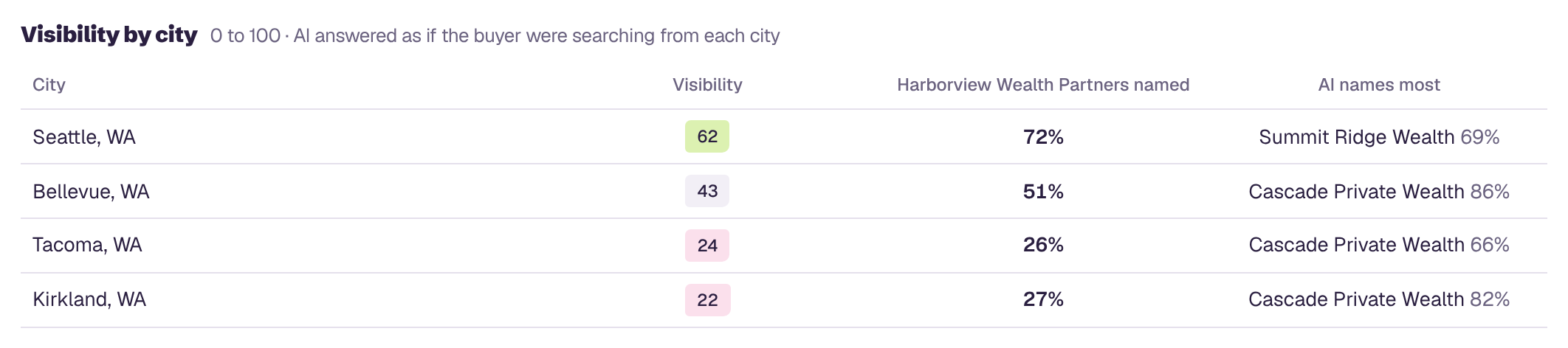
If you lend across a metro area or a whole state or province, publish guides for the markets you serve, with local prices, programs and examples.
Refinancing and renewals
Existing homeowners ask AI whether they should refinance, take a home equity loan or line of credit, or, in Canada, how to handle their mortgage renewal. These are valuable clients who often don't realize they can shop. Publish clear guides for each, and explain how you help.
Real estate agents and referrals
Many buyers are referred by agents, but they still check lenders with AI. Agents also ask AI about lenders who close on time. Make your closing times, communication process and agent partnerships visible.
What the sample report shows
Here's what a Visible Queries report looks like for Harborview Wealth Partners, the sample independent wealth management firm in the Seattle area from our guide. The questions are different for mortgage brokers and lenders, but the patterns are the same.
The gap is clearest side by side:
If you only fix three things
- Publish local affordability and program guides. Kept current, with real examples.
- Explain how you work and how you price loans. Broker, bank or direct, and how borrowers get better terms.
- Give every borrower type its own page. First-time, self-employed, veterans, newcomers, investors and more.
Homebuyers are asking AI how to afford their first home. The lender or broker AI names will be the one that explains it most clearly.
Part of our guide: Why AI visibility matters for financial services
See what AI tells homebuyers about your mortgage business
Enter your website and get a free AI visibility report. It takes a few minutes, and you'll see:
- Your AI visibility score, overall and for ChatGPT, Gemini, Claude, Perplexity and Google's AI Overviews and AI Mode
- Which lenders and brokers AI recommends instead of you, and how often
- Your visibility in every city you serve, and the competitor AI names most in each one
- What AI gets wrong about you, and what to fix first
- Your biggest gaps: the buyer questions where AI leaves you out, and who it recommends instead
- A downloadable PDF you can share with your team