Will this get me a job? How students choose a college, trade school or bootcamp through AI
Students and career changers now ask AI which programs lead to good jobs, what they cost and whether a school is legitimate. Here's what AI tells them, and how colleges, trade schools and bootcamps get named.
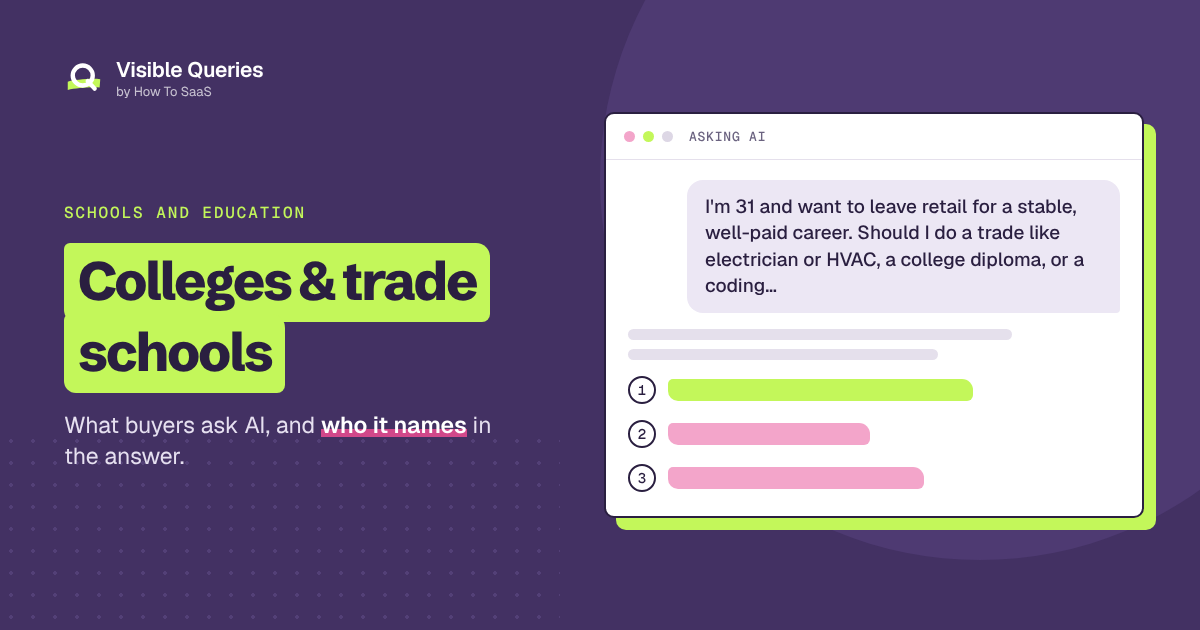
A 31-year-old in Calgary has worked in retail for ten years and wants out. They're good with their hands, like problem-solving, and want a career with steady pay. A cousin became an electrician. A friend did a coding bootcamp. They ask ChatGPT:
"I'm 31 and want to leave retail for a stable, well-paid career. Should I do a trade like electrician or HVAC, a college diploma, or a coding bootcamp? How long does each take, what do they cost, can I get funding, and which schools in Calgary have good job placement?"
AI explains how apprenticeships work for trades, what college diplomas typically involve, the realities of bootcamps today, typical timelines and costs, funding options like student loans, grants and employer sponsorship, and how to judge a school's job outcomes. Then it names several programs. The person signs up for two information sessions.
Post-secondary and career training decisions are big and expensive, and the buyer's main question is simple: will this lead to a good job? Students and career changers compare programs carefully, and AI is now one of the first places they look.
Our education guide covers how families choose schools and programs in general. This one goes through the questions that decide college, trade school and bootcamp enrollment, what AI usually says, and what schools can publish so AI names them.
Here are the questions at a glance:
| The question | What gets you named |
|---|---|
| "Will this lead to a job?" | Program outcomes and employer connections |
| "How long does it take? What does it cost?" | Length and full cost for each program |
| "Can I get funding?" | Aid, grants and payment options |
| "Is this school accredited?" | Accreditation and licensing, stated plainly |
| "Trade, college or bootcamp?" | An honest comparison of the paths |
"Will this lead to a job?"
This is the defining question for the category.
What AI usually says: It suggests looking at program outcomes, employer partnerships, work placements and co-ops, licensing exam pass rates, and talking to graduates. It's skeptical of vague job placement claims.
What to publish: Honest outcomes data, with how you measure it, employer partners, co-op and placement programs, licensing pathways and graduate stories with specific roles. Clear, credible outcomes are the single biggest reason AI recommends a program.
"How long does it take? What does it cost?"
What AI usually says: Typical program lengths and cost ranges, with notes about books, tools, equipment and living costs.
What to publish: Full costs for every program, including tuition, fees, tools and materials, along with program length, schedules, part-time and evening options, and start dates.
"Can I get funding?"
What AI usually says: It explains student loans, grants, scholarships, apprenticeship funding, employer sponsorship, veterans' benefits and income share agreements where relevant.
What to publish: Every funding option your students use, with how to apply and who's eligible. Career changers often assume they can't afford school, and clear funding information changes that.
"Is this school legitimate? Is it accredited?"
What AI usually says: It suggests checking accreditation or provincial or state registration, whether credentials are recognized by employers and licensing bodies, and reviews from graduates. It warns about high-pressure enrollment and unrealistic promises.
What to publish: Your accreditation and registrations, what credential students receive, which licensing exams it prepares for, and how credits transfer. In a category with some bad actors, being clear about legitimacy matters a lot.
"Trade, college or bootcamp?"
What AI usually says: It compares the paths by time, cost, earnings, job demand, physical demands and the kind of person who thrives in each.
What to publish: Honest guides to the careers you train for: what the work is like, typical pathways, licensing, demand in your region and what graduates do. Career content helps people decide, and AI uses it.
What the report's headline shows
For many schools, the report's headline shows a familiar pattern:
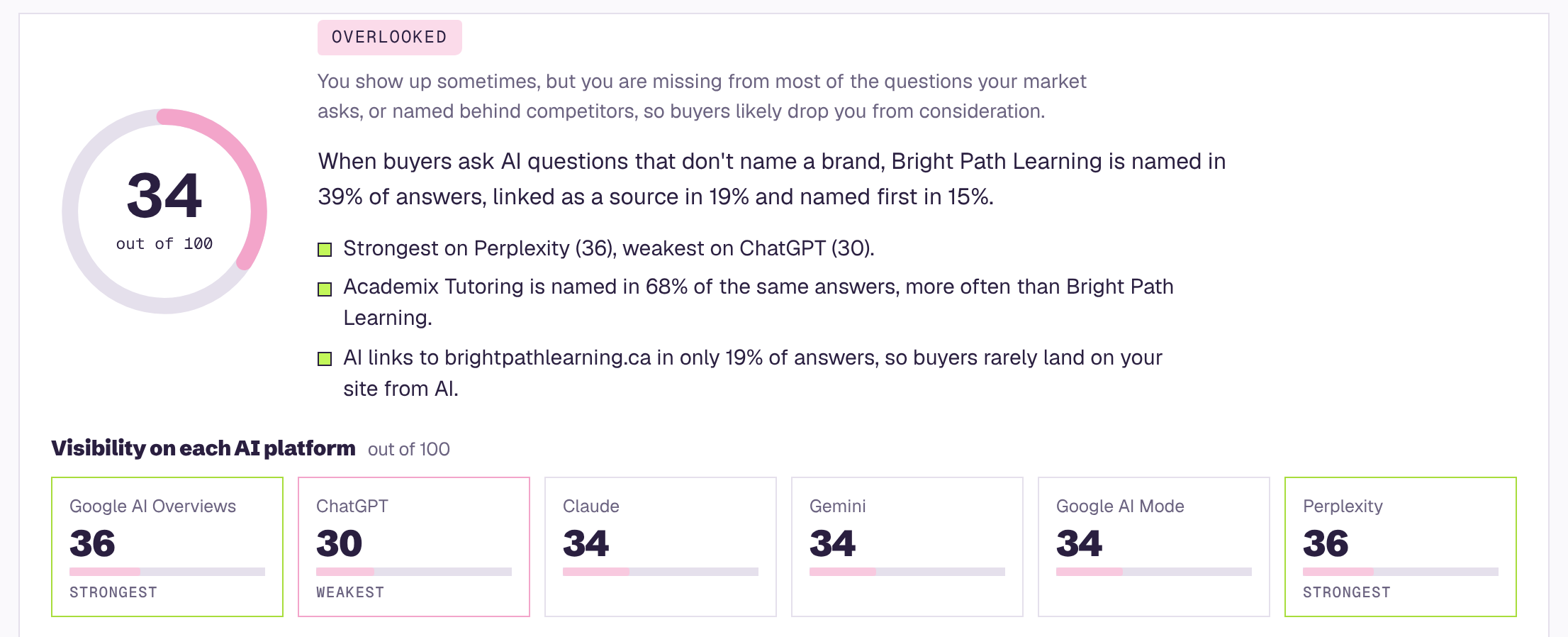
The usual pattern is that AI knows the school by name but rarely recommends it for open questions like "best HVAC program in Calgary" or "coding bootcamps with job guarantees." Specific program pages with outcomes close that gap.
Here's more from the same kind of report, for Bright Path, a fictional tutoring and learning centre in the Greater Toronto Area.
And it shows the actual questions, platform by platform, with who was named:
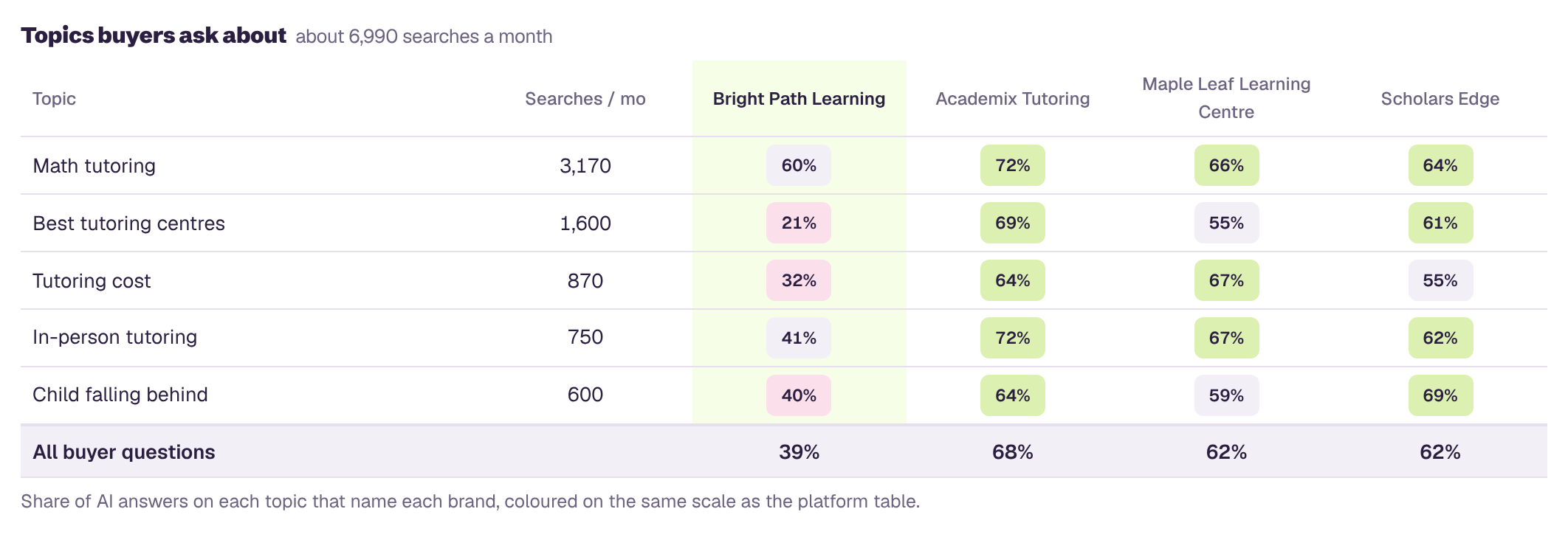
The gap is clearest side by side:
Each program is its own search
People rarely search for a school. They search for a program: "dental hygiene program in Ontario," "welding school near me," "UX design bootcamp part time," "practical nursing diploma with evening classes." Every program you offer needs its own detailed page, with admission requirements, curriculum, schedule, cost, outcomes and start dates.
International students
International students ask AI about study permits, work rights during and after study, program eligibility for post-graduation work permits, and cost of living. If you enroll international students, give them dedicated, current pages. Rules change often, and outdated information hurts.
If you only fix three things
- Publish credible outcomes for every program. How you measure them, employer partners and graduate stories.
- Show full costs and every funding option.
- Make each program its own detailed page. Requirements, schedule, cost, start dates and credentials.
Students and career changers are asking AI which program will change their life. The school AI names will be the one that proves it most clearly.
Part of our guide: Why AI visibility matters for schools and education
See what AI tells students about your school
Enter your website and get a free AI visibility report. It takes a few minutes, and you'll see:
- Your AI visibility score, overall and for ChatGPT, Gemini, Claude, Perplexity and Google's AI Overviews and AI Mode
- Which schools AI recommends instead of you, and how often
- Your visibility in every city you serve, and the competitor AI names most in each one
- What AI gets wrong about you, and what to fix first
- Your biggest gaps: the buyer questions where AI leaves you out, and who it recommends instead
- A downloadable PDF you can share with your team