SAT, LSAT or MCAT: how students choose a test prep company through AI
Students and parents now ask AI how to prepare for the SAT, LSAT, MCAT or GMAT, whether a course is worth it and which test prep company to choose. Here's what AI tells them, and how test prep companies get named.
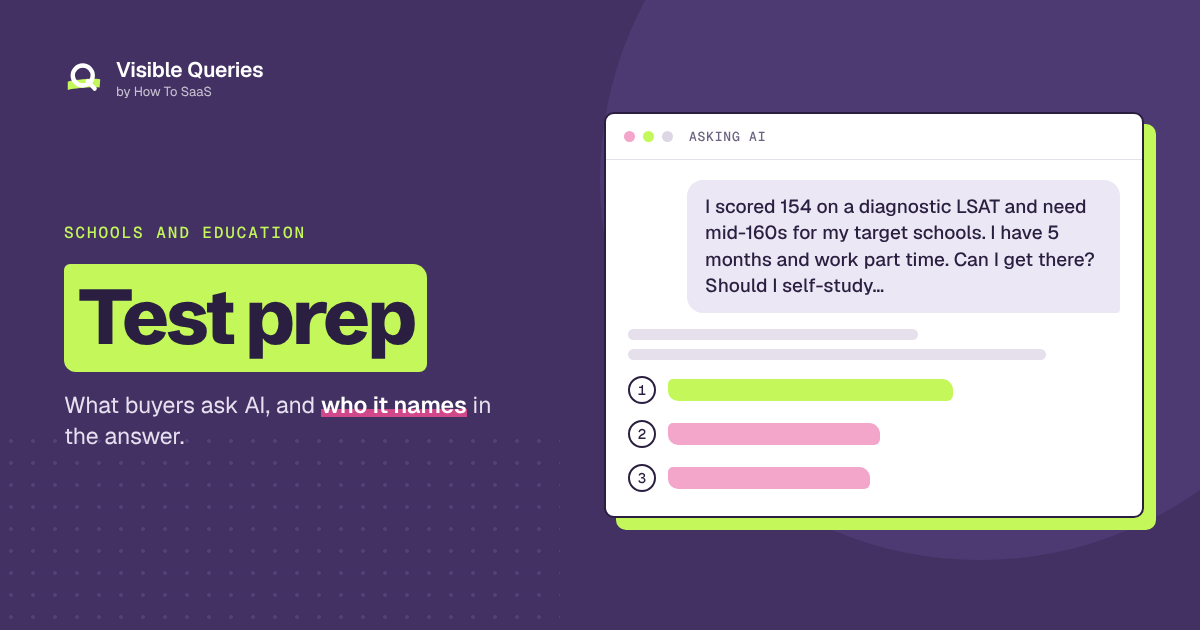
A university junior in Boston has a 3.6 GPA and wants to go to law school. They took a diagnostic LSAT practice test and scored 154. The schools they want usually admit students in the mid-160s. The test is in five months, and they have a part-time job. They ask ChatGPT:
"I scored 154 on a diagnostic LSAT and need mid-160s for my target schools. I have 5 months and work part time. Can I get there? Should I self-study, take a course or get a private tutor? What do LSAT courses cost, and which test prep options in Boston or online are actually worth it?"
AI explains how much improvement is realistic with consistent study, how to structure a five-month plan, which sections usually improve fastest, the trade-offs between self-study, live courses, on-demand courses and private tutoring, typical costs, and what to look for: instructor scores, practice materials, analytics and flexibility. Then it names several options. The student books a free trial class.
Test prep is bought by motivated students and their parents. The stakes feel high: admission to a school, a scholarship or a career path. They compare options carefully, and they want evidence that the prep works. AI is now one of their first stops.
Our education guide covers how families choose schools and programs in general. This one goes through the questions that decide test prep customers, what AI usually says, and what test prep companies can publish so AI names them.
Here are the questions at a glance:
| The question | What gets you named |
|---|---|
| "How much can I improve?" | Honest score-improvement expectations and how you measure them |
| "Course, tutor or self-study?" | Who each option suits |
| "How much does test prep cost?" | Prices for every format |
| "Who are the instructors?" | Instructor bios with scores and experience |
| "Which prep is best for [test]?" | A page for each test you teach |
"How much can I improve?"
What AI usually says: It gives a general sense of what's possible with consistent preparation, and emphasizes that it depends on starting point, time and study quality.
What to publish: Honest guides to realistic improvement and how to plan for it, by test and timeline. Avoid guarantees you can't back up. AI is cautious about score claims and favors companies that are careful with them.
"Course, tutor or self-study?"
This is the defining question for the category.
What AI usually says: It compares cost, structure, personalization, accountability and flexibility, and matches each option to different students.
What to publish: An honest comparison of your formats, who each suits, and when self-study might be enough. Companies that are fair about this earn trust with students who need more help.
"How much does test prep cost?"
What AI usually says: Ranges for self-paced courses, live courses and private tutoring by test, plus notes about score guarantees and refund policies.
What to publish: Every price, package, guarantee and refund policy, written clearly, including the conditions on any guarantee.
"Who are the instructors?"
What AI usually says: It suggests checking instructors' scores, teaching experience and training.
What to publish: Instructor bios with their scores, experience and specialties. For private tutoring, explain how you match tutors to students.
"Which test prep is best for [test]?"
What AI usually says: It names several companies, often big national brands, sometimes alongside free resources.
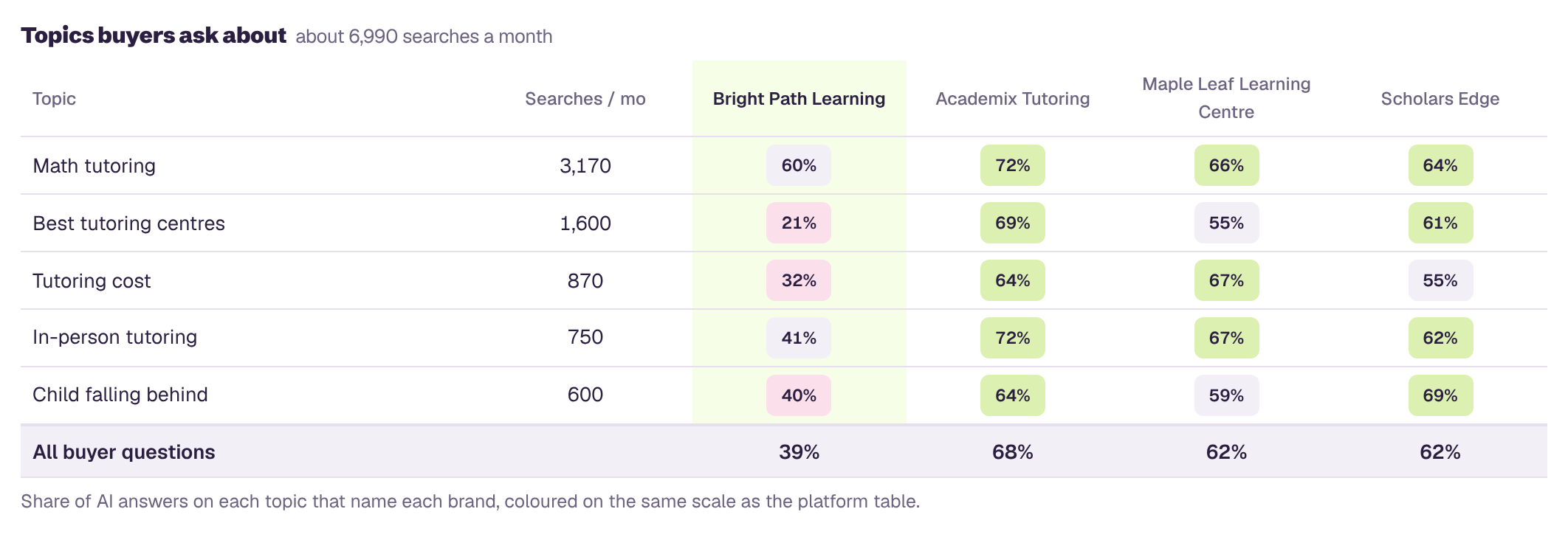
Why it matters: This is the shortlist. Here's how the report shows which questions you win and lose:
Smaller and local test prep companies tend to win when the question is specific, like "LSAT tutor in Boston for logical reasoning," "SAT prep for students with test anxiety" or "MCAT CARS tutor." Give each specialty its own page.
Each test is its own world
SAT and ACT, LSAT, MCAT, GMAT and GRE, bar exams, nursing and medical licensing exams, professional certifications, and language tests like IELTS each have their own audience, timelines and questions. Each test you support deserves its own hub of content: what's on it, how scoring works, test dates, study plans and how your prep works. AI uses this kind of content to answer questions, and links to the companies that publish it.
Parents and students ask differently
For high school tests, parents often research first. They ask about cost, scheduling, results and whether prep is worth it. Students ask about study strategies and specific sections. Write for both.
What the sample report shows
Here's what a Visible Queries report looks like for Bright Path, the sample tutoring and learning centre in the Greater Toronto Area from our guide. The questions are different for test prep providers, but the patterns are the same.
It also shows visibility city by city, with the competitor AI names most in each:
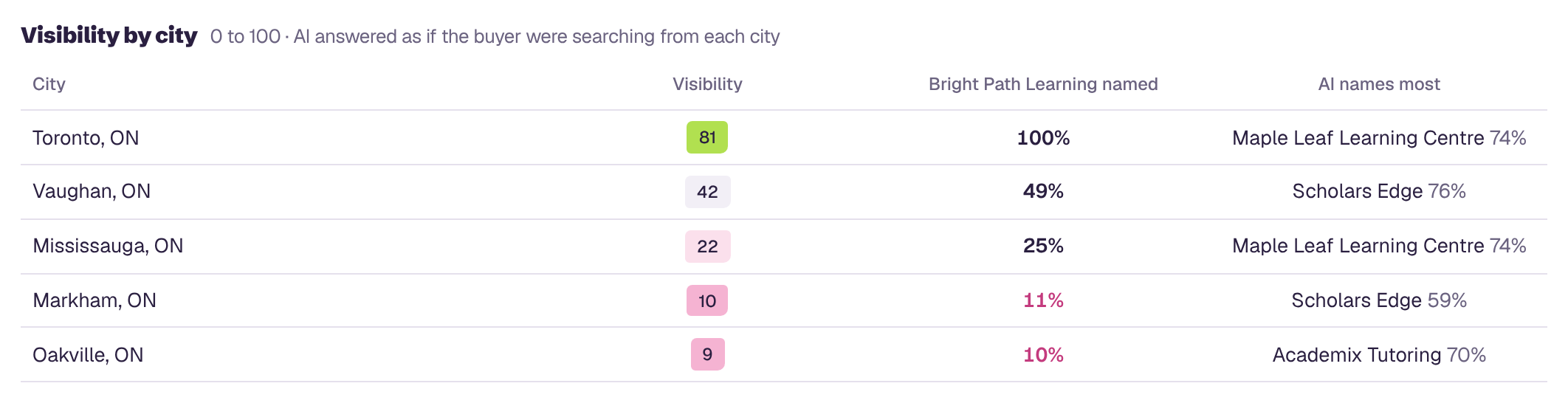
The gap is clearest side by side:
If you only fix three things
- Publish honest guides to each test and realistic improvement.
- Explain your formats, prices, guarantees and instructors clearly.
- Give each test and specialty its own page. By test, section and type of student.
Students are asking AI how to get the score they need. The test prep company AI names will be the one with the clearest, most honest answers.
Part of our guide: Why AI visibility matters for schools and education
See what AI tells students about your test prep company
Enter your website and get a free AI visibility report. It takes a few minutes, and you'll see:
- Your AI visibility score, overall and for ChatGPT, Gemini, Claude, Perplexity and Google's AI Overviews and AI Mode
- Which test prep companies AI recommends instead of you, and how often
- Your visibility in every city you serve, and the competitor AI names most in each one
- What AI gets wrong about you, and what to fix first
- Your biggest gaps: the buyer questions where AI leaves you out, and who it recommends instead
- A downloadable PDF you can share with your team