How families choose schools, tutors and programs now, and why AI visibility decides who gets the enrollment
Parents and students now ask AI which tutoring center, private school, daycare or program to choose. Here's how their journey works, what they ask at each step, and how to build an education business AI recommends.
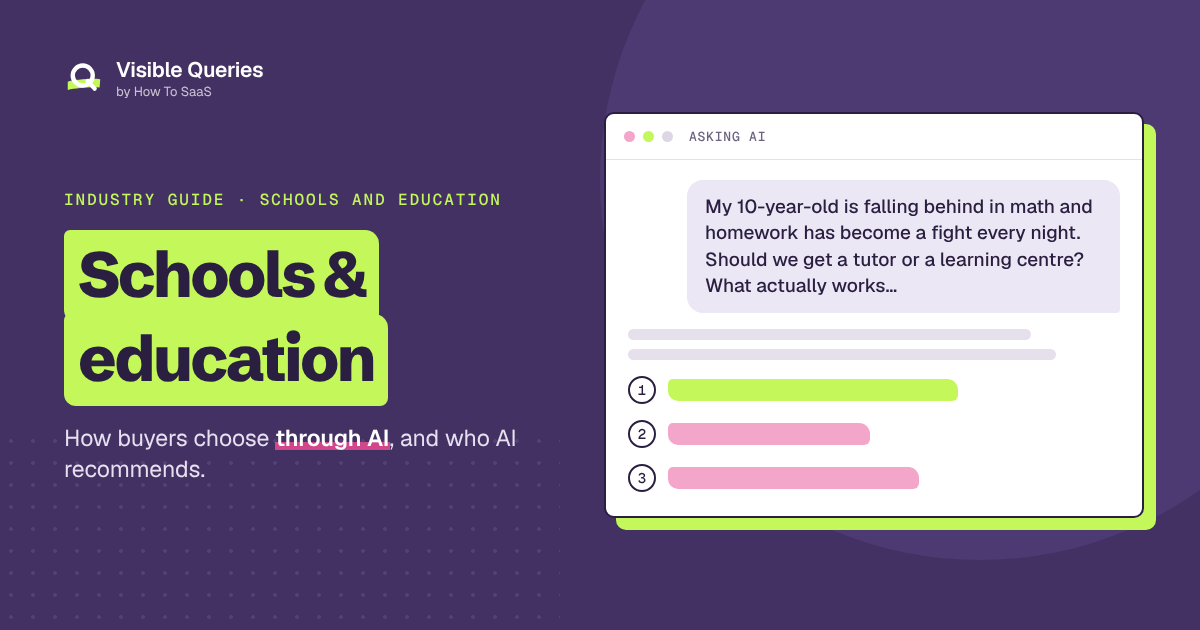
It's 9:30 on a Tuesday night in Mississauga. A Grade 5 report card is sitting on the kitchen table, and the math mark has dropped again. Homework time has turned into a nightly argument. Both parents work, neither remembers how to do long division the way the school teaches it, and they're starting to worry that their daughter is falling behind in a way that will follow her into high school.
A few years ago, one of them would have searched "math tutor Mississauga," clicked a couple of franchise websites, asked in the school parents' WhatsApp group, and booked whoever called back first.
Tonight, one of them opens ChatGPT and types it all out:
"My 10-year-old is falling behind in math and homework has become a fight every night. Should we get a tutor or a learning centre? What actually works for kids this age, and what are good options in Mississauga?"
The answer explains the difference between one-on-one tutoring and learning centres, why gaps in foundational skills compound, what to look for in a program, and roughly what each option costs per month. Then it names three local options, with a line on each one's approach.
They book a free assessment at the first one the next morning.
That's how a growing share of families now choose tutoring, private schools, daycares, preschools, test prep, music and dance lessons, and even colleges and trade programs. They describe their child or their goal, their worries and their budget, and AI hands them a short list. The programs on that list get the assessment, the tour or the application. The others never get a chance to show what they can do.
This article walks through how families and students choose education providers today, step by step, with examples from tutoring and learning centers, private and independent schools, test prep, childcare and preschools, music, dance and art lessons, and colleges, trade schools and bootcamps. It covers what families ask AI at each step, what makes AI recommend one program over another, and what the programs that keep getting recommended tend to do differently. Most of it comes down to being a program that's clear about who it helps, how and with what results.
Along the way you'll see screenshots from a Visible Queries report for Bright Path Learning, a sample tutoring and learning center in the Greater Toronto Area. The business and its competitors are made up, but the report is real. It's exactly what any education business sees when it runs its own.
Why the old playbook isn't enough anymore
Education businesses have always grown on reputation and word of mouth: other parents at pickup, a teacher's recommendation, a neighborhood Facebook group, open houses, and a well-placed sign. Marketing filled in with a website, some local ads and listings on directories or franchise locators.
That word of mouth still matters enormously. But more and more, the first "parent at pickup" a family asks is an AI assistant. It answers like a well-informed friend, except it has read every program's website, every review, every forum thread and every local news story it can find.
Three things follow from that:
- Families describe their child, not a category. "My 10-year-old is behind in math and hates homework" or "a Montessori preschool with full-day care near Vaughan" gets programs that clearly match. Generic "we help every student succeed" copy matches nothing.
- The shortlist is tiny. A search shows dozens of tutors and schools. An AI answer names three. The programs on that list get the assessments and tours.
- Your reputation is summarized. Parents ask "Do kids actually improve at [center]?" or "What do parents say about [school]?" AI answers in a couple of sentences, drawn from reviews, forums and what's published about you.
None of this makes word of mouth less important. It's the raw material AI reads. What changes is that your reputation now has to be written down, specific and findable, not just passed along at pickup.
The family's journey, step by step
Whether it's a $30 trial music lesson, a $400-a-month tutoring program, a $1,800-a-month daycare spot or $25,000-a-year private school tuition, the path looks similar. What changes is how long it takes and how many people are involved.
- Something prompts the search. A report card, a move, a new baby, a school that isn't working, or a goal like a university application.
- They try to understand their options. What kind of help or program, what works and what it costs.
- They build a shortlist. Which programs nearby fit their child, schedule and budget.
- They check who to trust. Credentials, safety, results, philosophy and what other parents say.
- They choose. Assessments, tours, trials, pricing, schedules and waitlists.
- They stay, or they don't. Progress, communication, re-enrollment, siblings and referrals.
AI now shows up at every one of these steps. Here's what it looks like at each one.
Step 1: Something prompts the search
Education searches almost always start with a moment. Rarely does anyone wake up and decide to research learning centres for fun.
- A report card with a falling grade, or a teacher's note home.
- A child who's bored and under-challenged, or anxious and overwhelmed.
- A family move to a new city, with a school to pick in six weeks.
- A new baby and a parental leave that ends in nine months.
- A Grade 11 student staring down university applications or an entrance exam.
- An adult who wants a career change and is wondering about a trade or a bootcamp.
- A kid who just watched a piano recital or a dance show and won't stop talking about it.
The first questions families ask AI are about the moment, not about you. "Is it normal for a Grade 5 student to struggle with fractions?" "How early do I need to get on a daycare waitlist in Toronto?" "Is private school worth it for a kid who's bored in public school?" "What age should a child start piano?"
This is where your next family first encounters an answer, and the answer shapes everything after it. If AI tells a worried parent that falling behind in math usually starts with gaps in earlier skills that a structured program can close, the parent now believes in structured programs. If it says a few weeks of online videos usually fix it, your centre has lost before it was considered.
The programs that do well at this step are the ones that have published honest, useful answers to the questions that start the search. A tutoring centre with a clear page on "signs your child has a math gap, and what to do about it." A preschool with a plain explanation of how waitlists work in their city and when to apply. A private school with an honest article on who thrives in a smaller school and who doesn't. A music school with a page on the right starting age for each instrument.
AI leans on content like that when it explains the situation, because it's specific and it reads like an expert rather than a brochure. And once your explanation shapes the answer, your name tends to follow.
What good programs do at this step:
- Write about the moments that start the search: the report card, the move, the waitlist panic, the entrance exam, the career change.
- Answer the parent's real question first, even when the honest answer is "you may not need us yet."
- Use the words families use, not education jargon. "My child hates reading" beats "literacy intervention."
Step 2: They try to understand their options
Next, families learn the landscape. This is the step where they're most open, and where AI does the most teaching.
- "What's the difference between Kumon-style programs and one-on-one tutoring?"
- "Montessori vs play-based preschool: which is better for a shy three-year-old?"
- "Is a private school worth it compared with a good public school and tutoring?"
- "Do I need an SAT prep course or can my kid self-study?"
- "Group music classes or private lessons for a seven-year-old?"
- "Is a coding bootcamp worth it in 2026 or should I go back to college?"
- "How much does tutoring cost per month in the GTA?"
This is where families decide what kind of solution they want, and that decision decides which programs are even in the running. A parent convinced that one-on-one tutoring is the answer won't book a learning centre. A parent convinced that a structured centre builds habits better than a tutor won't call a private tutor.
Here's what this step looks like in a real report. These are the questions AI was asked about tutoring and learning centres in the Toronto area, and who each platform named in its answer:
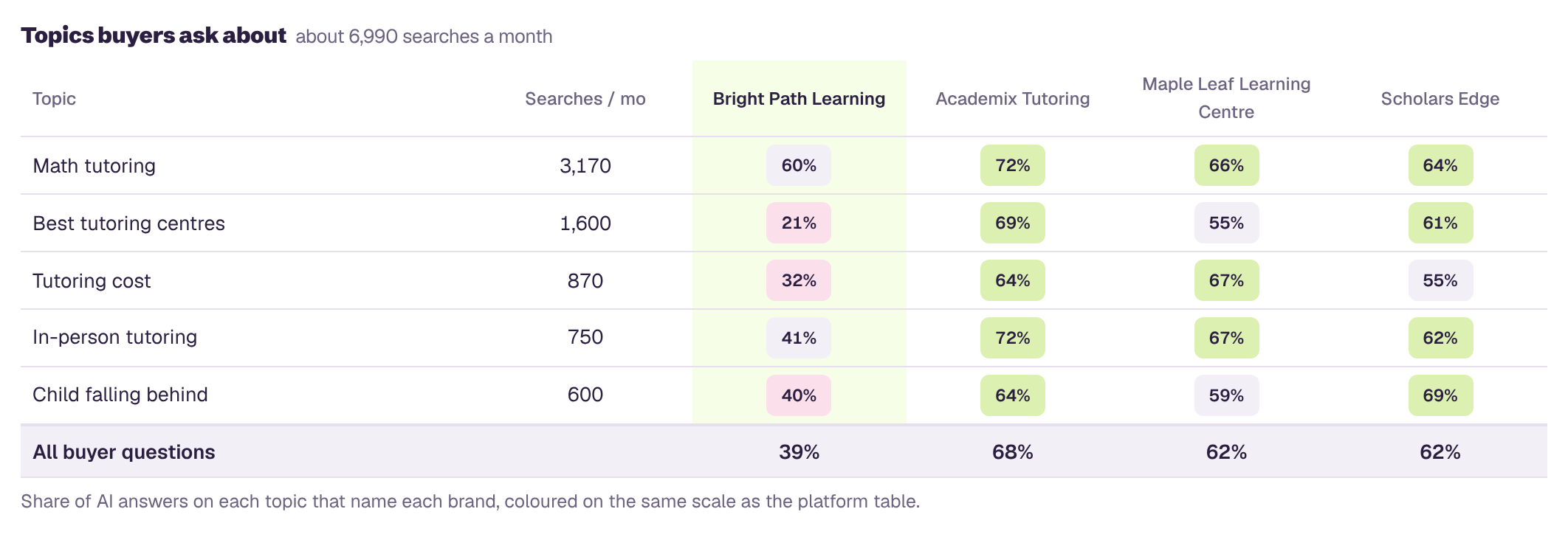
Look at the pattern. On a question like "What's better than homework help at home," which is the exact moment a parent decides that DIY isn't working, the answers named Scholars Edge, Academix and Academix again before one platform finally recommended Bright Path. On another question, three of the four platforms named a competitor and only one mentioned Bright Path. On the first question, Claude mentioned the centre while ChatGPT, Gemini and AI Overviews each named competitors.
That's the most expensive kind of invisibility in education. The parent who asks "what's better than homework help at home" has already decided to pay for help. They just haven't decided who. The program that appears in that answer often gets the assessment without a single competing quote.
What moves a program into these answers is the same thing that helps a parent understand the choice:
- Clear pages that compare your approach with the alternatives, honestly. "How our program differs from one-on-one tutoring" or "Montessori vs play-based: how we blend them."
- Pricing, or at least a price range and what it includes. Families ask about cost constantly, and AI favours programs it can say something concrete about.
- Who your program is for, and who it isn't for. "Best for kids who are one to two grades behind in math and need routine" is much easier for AI to recommend than "for every learner."
What good programs do at this step:
- Explain your method in plain language, and compare it fairly with the options families are weighing.
- Publish pricing or price ranges, session length, frequency and what's included.
- Say exactly which kids, students or goals your program fits best.
Step 3: They build a shortlist
Once a family knows what kind of help they want, they look for specific programs. This is where location matters most, because almost every education decision is local. A parent will drive 15 minutes twice a week, maybe 25. A daycare has to be on the commute. A private school has to work with the bus routes or the carpool.
The questions get specific:
- "Best math tutoring centre in Mississauga for a Grade 5 student."
- "Full-day Montessori preschool near Vaughan with openings this fall."
- "Private schools in Oakville with strong STEM programs and smaller classes."
- "Piano teacher in Markham who teaches adults too."
- "Best SAT prep near North York, in person."
For a multi-location program, this is where the gaps show. AI can recommend you strongly in one city and barely know you exist in the next one over. Here's the sample centre across the five GTA cities it serves:
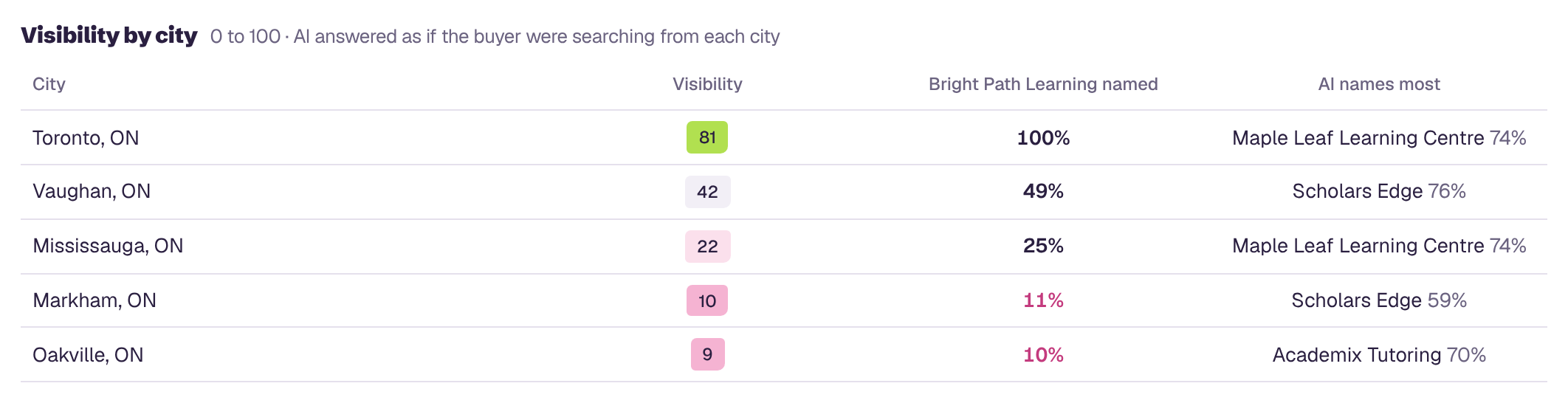
In Toronto, Bright Path scores 81 and is named in every answer. In Vaughan it scores 42 and is named in about half. But in Mississauga it drops to 22 and is named in a quarter of answers, in Markham it scores 10, and in Oakville it scores 9 and is named in just 10% of answers. Same centre, same curriculum, same brand. A parent in Oakville and a parent in Toronto asking the same question get very different answers.
That's typical for education businesses that grew from one flagship location. The first centre has years of reviews, local news mentions, school partnerships and parent forum threads. The newer locations have a page on the website with an address and a phone number. AI can't recommend a location it knows nothing about.
What good programs do at this step:
- Give each location its own real page: who teaches there, the hours, what programs run there, the schools nearby, and reviews from families in that community.
- Build local reputation per location: reviews on that location's profile, partnerships with nearby schools, community events and local news.
- Make availability clear. "Openings for fall in Grades 3 to 8" or "waitlist for infants, openings for toddlers" is the kind of detail that gets you named for "with openings" questions.
Step 4: They check who to trust
Few purchases carry as much emotional weight as education. Families are trusting you with their child's confidence, safety and future, or with their own career and savings. So they check, carefully.
- "Is [centre] legit? Do kids actually improve?"
- "What do parents say about [school]? Any concerns about bullying or class sizes?"
- "Is [daycare] licensed? What's the staff-to-child ratio?"
- "Are [test prep company]'s score guarantees real?"
- "Do graduates of [bootcamp] actually get jobs?"
AI answers these in a couple of sentences, summarizing what it has read. When what it's read is accurate and recent, that's a gift: a parent hears a confident, positive summary from a source they trust. When it's wrong, the damage is quiet. The family simply moves on, and you never know they were looking.
Here's what that looks like in the sample report:
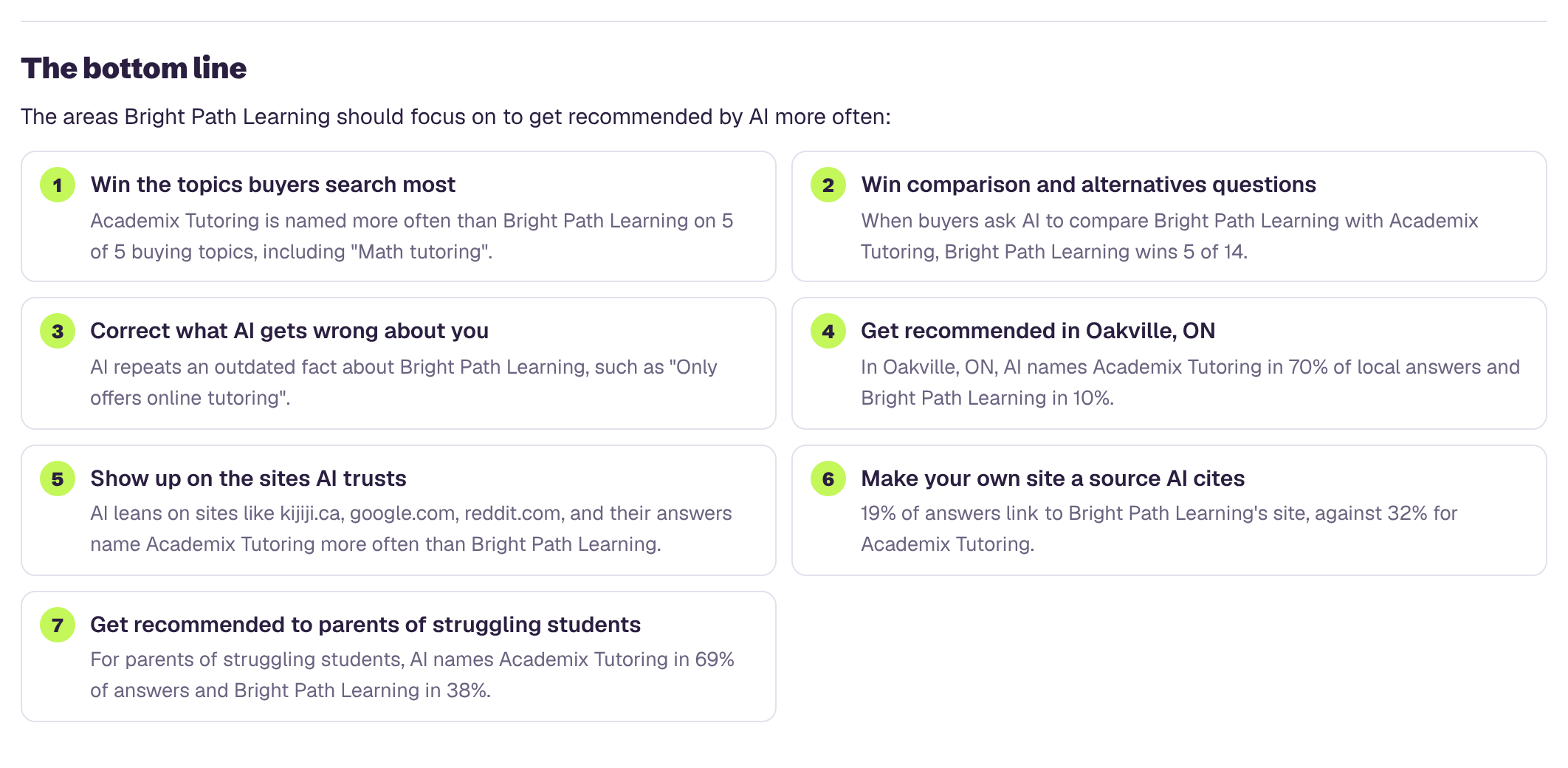
The first gap is the kind that costs enrollments every week. AI tells families that Bright Path "only offers online tutoring." In reality, it runs in-person centres in five cities plus online programs. A parent who specifically wants their child at a table with a teacher, which is most parents of younger kids, hears that answer and crosses Bright Path off the list.
The report also shows Bright Path named in only 38% of answers to category-leader questions, the "best tutoring centre in the GTA" type, and Academix named instead in 38% of answers. Overall accuracy is 83%, which sounds high until you remember that the remaining 17% is what some parents are hearing about you.
Wrong facts in education usually come from a few places:
- Old information that never got updated. A centre that started online during 2020 and later opened physical locations, or a school that added a grade, a program or a campus.
- Directory listings and third-party profiles that describe you in a line someone wrote years ago.
- Confusing naming. A franchise location mixed up with corporate, or a school mixed up with another one that has a similar name.
- Silence on the things families check. If your website never states your licensing, teacher credentials, ratios or safety policies, AI fills the gap with whatever it can find, or with nothing.
What good programs do at this step:
- State the trust facts plainly and in one place: licensing, accreditation, teacher qualifications, background checks, ratios, class sizes and safety policies.
- Publish real outcomes, carefully and honestly: progress stories with parents' permission, how you measure improvement, and what results look like after three or six months.
- Fix outdated descriptions on every directory and profile you can find, and keep your own site the clearest, most current source of truth.
- Ask happy families for reviews that mention specifics: the grade, the subject, the change they saw. Specific reviews are what AI repeats.
Step 5: They choose
By now, a family usually has two or three programs in mind. They're comparing the details that decide it:
- "Bright Path vs Academix for a Grade 5 student who's behind in math?"
- "Which Mississauga daycares have infant spots before September?"
- "Does [school] offer financial aid or sibling discounts?"
- "Is [music school]'s first lesson free?"
- "How long is the waitlist at [preschool]?"
Head-to-head questions are where share of voice matters most. If a parent asks AI to compare you with a competitor, and AI has far more to say about the competitor, the competitor tends to win the comparison.
In the sample report, Academix is named in 68% of answers, Scholars Edge in 62% and Maple Leaf in 62%. Bright Path is named in 39%. Despite a dominant position in Toronto, Bright Path scores 34 overall, in the Overlooked band, and is the fourth voice in a four-way conversation across most of the region. Families hear the others' names first and more often.
The programs that win at this step make the final decision easy:
- The next step is obvious and low-risk. A free assessment, a trial class, a school tour or an open house, with clear dates and an online booking link.
- Pricing is clear. Monthly fees, registration fees, what's included and any discounts. Families compare these directly, and AI can only compare what it can read.
- Availability is honest. Openings by grade or age group, waitlist length, and when spots usually open.
- The differences are named. If your centre has smaller groups, certified teachers, or a curriculum aligned with the provincial or state program, say so in plain words.
What good programs do at this step:
- Publish a clear comparison of your approach against the main alternatives, fairly. Families are already asking AI to make that comparison.
- Make the first step free or low-cost and easy to book.
- Keep schedules, openings and pricing current, so AI never tells a family you're full when you're not.
Step 6: They stay, or they don't
Education is a relationship, not a single sale. A tutoring family might stay for two years, a daycare family for four, and a private school family for twelve. Siblings follow. Referrals follow. That lifetime value is the whole business model for most education companies, and AI plays a part here too.
Current families ask AI things as well:
- "Is it normal for my child to take three months to show progress in tutoring?"
- "Should we switch from [centre] to a private tutor for high school?"
- "What summer programs does [school] offer?"
- "Is it worth continuing piano lessons if my kid wants to quit?"
If the answers to those questions point families to a competitor's summer camp, a competitor's high school program or a different kind of program altogether, you lose families you've already won.
The programs that keep families are the ones that publish for them too: progress expectations, what happens at each level, how they handle a plateau, the next program in the path, and the summer and holiday options. That content helps current families stay confident, and it's the same content that gets you recommended to new ones.
And when families do stay and see results, they talk. Reviews, forum posts, school group chats and local Facebook groups are where AI learns who's worth recommending. Every family that's happy enough to write a specific, honest review is improving the next answer AI gives.
What good programs do at this step:
- Set clear expectations about progress and timelines, in writing, before families start to worry.
- Publish the full path: the next level, the next program, the summer option, the high school track.
- Make reviews and referrals part of how you work, at natural moments like report cards, recitals, graduations and progress milestones.
How the journey plays out across education
The six steps are the same everywhere, but what families ask, and what decides the choice, changes a lot by type of program.
Private and independent schools
This is the longest, highest-stakes journey in education. Families often start a year or more ahead, both parents are involved, and the decision can mean tens of thousands of dollars a year for a decade. The early questions are about fit and philosophy: "Is private school worth it for a gifted but unmotivated kid?" "Single-sex vs co-ed schools: what does the research say?" "IB vs AP: which is better for university admissions?"
Then it gets specific: "Best private schools in Oakville with strong arts programs," "private schools near Vaughan with bus service," "which Toronto private schools offer financial aid?" At the trust step, parents ask about class sizes, university placement, teacher turnover, wellbeing support and how the school handles bullying.
Schools that do well publish what parents actually want to know: the real admissions timeline, tuition and aid, typical class sizes, where graduates go, what a day looks like for a student, and who thrives there. Many schools hide this behind a request-information form. AI can't read what's behind the form, so it recommends the schools that put it in the open.
Full guide: AI visibility for private and independent schools
Tutoring and learning centres
This is the journey in the opening example, and it moves fast. A bad report card on Tuesday can mean an assessment on Saturday. Parents compare structured programs like Kumon and Sylvan with independent centres and private tutors, and ask: "Kumon vs a tutor for a kid who hates worksheets?" "Does Sylvan actually work?" "Best reading tutoring for a Grade 2 student near me."
The biggest risk for independent centres is that AI defaults to the big franchise names when it doesn't know enough about anyone else. The way around that is specificity: subjects and grades taught, method, teacher qualifications, group size, pricing per month, and progress stories by grade and subject. For franchise owners, the risk is the opposite. AI knows the brand but not your location, so your location page needs to be as rich as the corporate site.
Full guide: AI visibility for tutoring and learning centres
Test prep
Test prep families are goal-driven and deadline-driven. They ask about specific tests and specific scores: "How long to raise an SAT score by 150 points?" "Best LSAT prep for someone working full-time?" "Is a private SSAT tutor worth it for a private school application?" "In-person vs online MCAT prep?"
AI is cautious here, because the category is full of big promises. Programs that get recommended are the ones that explain their method, publish honest score-improvement data with how it was measured, and are clear about format, schedule, class size and price. Guarantees can help, but only when the terms are clear and published. Vague "guaranteed results" claims tend to get flagged rather than repeated.
Full guide: AI visibility for test prep companies
Childcare, daycare and preschools
For childcare, the journey starts early and is shaped by scarcity. Parents in many cities start looking during pregnancy and join several waitlists at once. Questions are practical and urgent: "Daycares near Mississauga with infant spots," "how long are daycare waitlists in Toronto," "Montessori vs Reggio Emilia preschool," "is [daycare] part of the $10-a-day program?"
Trust is everything. Parents ask about licensing, ratios, staff qualifications, inspection results, food, outdoor time, and how the centre handles illness and pickup. Centres that publish all of that, plus their real hours, fees, subsidy participation and waitlist process, give AI enough to recommend them confidently. Centres that say "call for availability" leave AI with nothing to say.
Full guide: AI visibility for daycares, childcare and preschools
Music, dance and art lessons
This journey is usually lighter and more emotional. It often starts with a child's excitement after a concert or a recital, or a parent who wants an activity that isn't another screen. Questions sound like: "What age should a child start violin?" "Best ballet school near Markham for a five-year-old," "adult beginner piano lessons in Toronto," "group vs private guitar lessons."
Families care about the teacher, the vibe and the schedule as much as the method. Studios that get recommended show who the teachers are, what a first lesson looks like, which ages and levels they teach, recital and exam options (like RCM in Canada), and pricing per term. Photos and short videos of real classes help families picture it, and reviews that mention a specific teacher by name carry a lot of weight.
Full guide: AI visibility for music, dance and art schools
Colleges, trade schools and bootcamps
Here the buyer is usually the student, often an adult deciding on a career change. The journey is long and very outcome-focused. Questions include: "Is an HVAC trade program worth it compared with an apprenticeship?" "Best coding bootcamps for career changers in 2026," "which Ontario colleges have the best nursing programs?" "Do [bootcamp] graduates actually get hired?"
AI pays close attention to outcomes and to what former students say on forums and review sites. Programs that do well publish clear outcome data with honest methodology, total cost including hidden fees, schedule options for working adults, admissions requirements, financing, and what graduates go on to do. The programs AI warns people about are usually the ones that have been vague about exactly these things.
Full guide: AI visibility for colleges, trade schools and bootcamps
Building an education business AI recommends
Across every type of program, the businesses AI keeps recommending tend to share the same habits. None of them are tricks. They're what good schools and programs already do, written down clearly enough for a parent, or an AI, to understand.
- Be specific about who you help. Ages, grades, subjects, levels and goals. "Grades 3 to 8, math and reading, kids one to two grades behind" gets recommended. "All ages, all subjects" rarely does.
- Explain your method in plain language. What happens in a session, a class or a school day, and why it works for the kids you serve.
- Publish pricing. Monthly fees, tuition ranges, registration costs and what's included. Families ask about cost in almost every conversation.
- Show the trust facts. Licensing, accreditation, teacher qualifications, background checks, ratios and safety policies, all on one clear page.
- Share honest outcomes. Progress stories, how you measure improvement, and what families can expect at three, six and twelve months.
- Give every location its own page. Teachers, hours, programs, nearby schools and local reviews, so AI can recommend you in every city you serve, not just the first one.
- Keep availability current. Openings, waitlists and term start dates, so AI never sends a family away from a spot you have.
- Fix what's wrong everywhere. Outdated directory listings, old descriptions and mixed-up names are where many of AI's wrong facts come from.
- Answer the questions that start the search. Report cards, school moves, waitlists, entrance exams, career changes. Families ask AI about the moment before they ask about you.
- Make reviews part of the rhythm. Ask at the natural high points, like report cards, recitals and graduations, and encourage families to mention specifics.
You can see how much these habits matter by looking at the full report. Here's the sample centre's overall score and the metrics behind it:
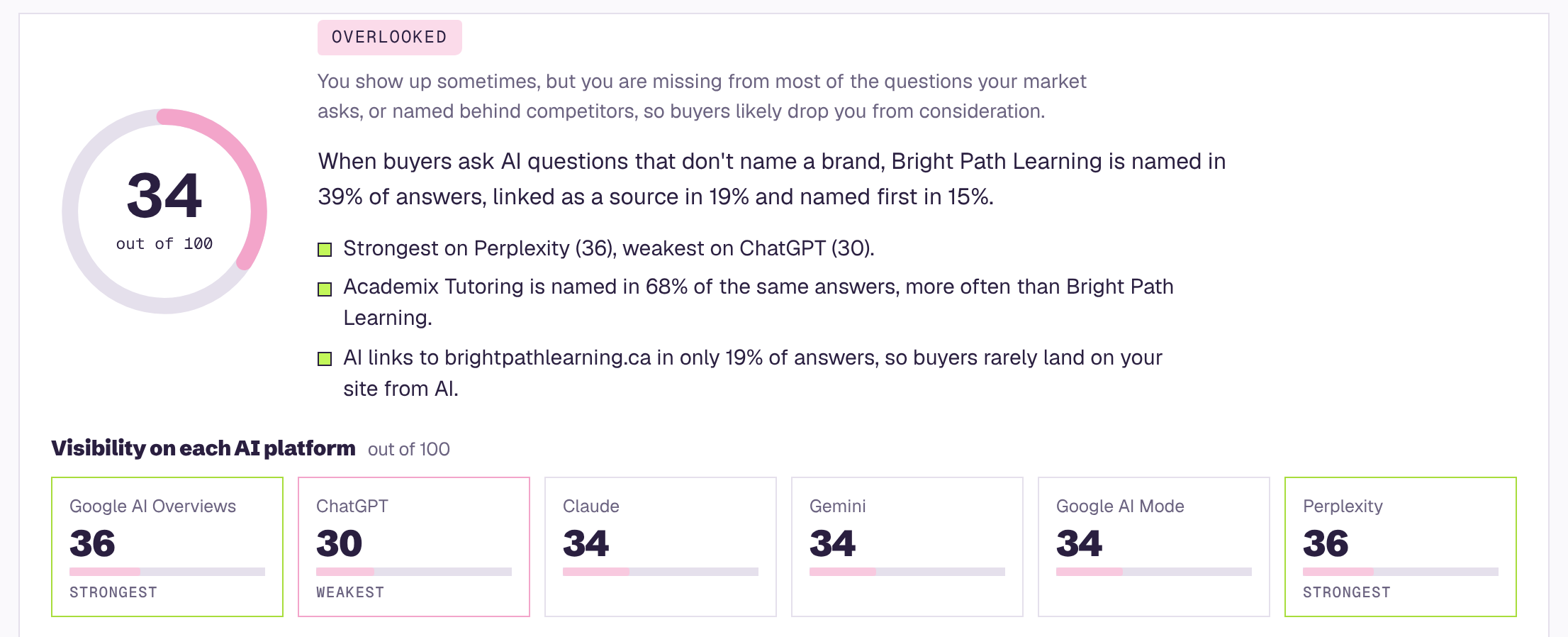

An Overlooked score with a 39% mention rate tells a clear story. Bright Path is doing well where it's known, especially in Toronto, but competitors are named far more often across the rest of the region, and AI rarely points families to its own website. The fixes aren't a mystery: real pages for every location, a clear correction of the "online only" error, and more specific, local reviews.
The short version
Families have always chosen schools and programs on trust and reputation. That hasn't changed. What's changed is who they ask first. More and more, the first voice a parent hears on the subject is an AI assistant, and it recommends the programs it understands best.
The education businesses that win this shift aren't doing anything exotic. They're clear about who they help and how. They publish the facts families need. They build a real reputation in every community they serve. And they make sure what AI says about them is true.
The first step is simply knowing where you stand today.
Keep learning
- What is AI visibility?
- How to get your business recommended by AI, with guides for ChatGPT, Google AI Overviews, Perplexity, Gemini and Claude
- AI visibility benchmark 2026
- The AI visibility glossary
See what AI tells families about your school or program
Enter your website and get a free AI visibility report. It takes a few minutes, and you'll see:
- Your AI visibility score, overall and for ChatGPT, Gemini, Claude, Perplexity and Google's AI Overviews and AI Mode
- Which schools and programs AI recommends instead of you, and how often
- Your visibility in every city you serve, and the competitor AI names most in each one
- What AI gets wrong about you, and what to fix first
- Your biggest gaps: the buyer questions where AI leaves you out, and who it recommends instead
- A downloadable PDF you can share with your team