When AI knows the product but not the brand: how shoppers find Amazon and marketplace sellers through AI
Shoppers ask AI which product to buy, and AI often describes a top-rated Amazon listing without naming the brand behind it. Here's what AI tells shoppers about marketplace brands, and how Amazon, Walmart and Etsy sellers get named.
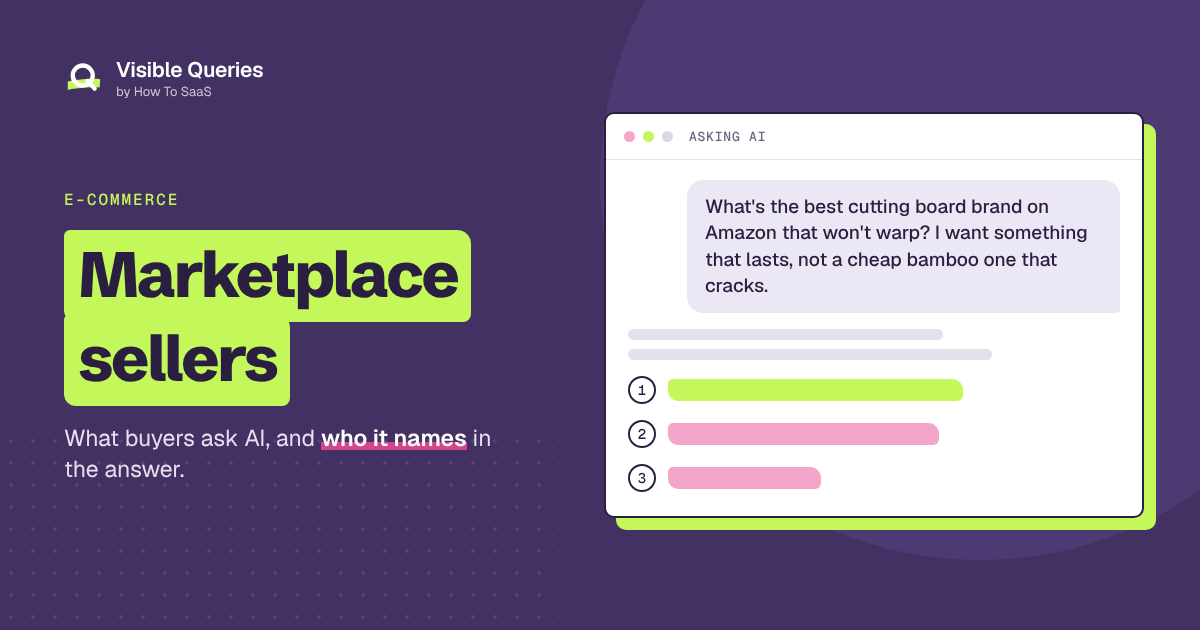
A new homeowner in Columbus wants a set of cutting boards that won't warp, won't dull their knives, and won't fall apart in the dishwasher in six months. They've scrolled Amazon and seen 400 nearly identical listings with 4.6 stars. So they ask ChatGPT:
"What's the best cutting board brand on Amazon that won't warp? I want something that lasts, not a cheap bamboo one that cracks."
AI explains the difference between end-grain and edge-grain boards, why maple and walnut outlast bamboo, and why "dishwasher safe" on a wooden board is a red flag. Then it recommends a few options. Two are named brands with a short line on each. The third is described as "a highly rated walnut board sold on Amazon with thousands of reviews," with no brand name at all.
That third product might be yours. It's the bestseller in its category. And when AI talks about it, the shopper doesn't hear your name, can't search for you later, and has no reason to buy from you a second time.
Our e-commerce guide covers how online shoppers research in general. This one is for brands that sell mostly on Amazon, Walmart Marketplace, Etsy, Target Plus and other marketplaces. It covers what AI usually says about marketplace products, why it so often forgets the brand, and what to publish so AI names you.
Here are the questions at a glance:
| The question | What gets your brand named |
|---|---|
| "Best [product] on Amazon?" | A consistent brand name across every listing and channel |
| "Is [brand] a real brand or a generic import?" | A brand site with a story, people and contact details |
| "Is [brand] good quality?" | Reviews and third-party coverage that use your brand name |
| "[Brand] vs [competitor]?" | Clear, consistent product names and specs |
| "Where should I buy [brand]?" | A deliberate choice about where you want AI to send shoppers |
"What's the best [product] on Amazon?"
What AI usually says: It names a handful of products, mixing well-known brands with "top-rated" listings it describes by features rather than by name.
Why it matters: Marketplaces are full of look-alike products. AI recommends the brands it can tell apart. If your brand name is buried, inconsistent or missing from the places AI reads, you blur into the generic options.
What to publish: Use one brand name, spelled the same way, everywhere: listing titles, packaging, your website, social profiles and press. Make product names memorable and consistent across channels, so "Hartwell Walnut End-Grain Board" means the same thing on Amazon, on your site and in a Reddit thread.
"Is [brand] a real brand, or a generic import?"
Shoppers ask this a lot about marketplace brands, especially ones with unfamiliar names.
What AI usually says: It looks for evidence of a real company: a website, founders, a history, press, consistent reviews over time. Without it, AI often says it "couldn't find much information about this brand," which is enough to send the shopper back to a name they know.
What to publish: A brand website, even if most sales happen elsewhere. An About page with real people, where products are designed and made, how they're tested, and how to reach you. AI treats your own site as the most authoritative source on who you are, and marketplace listings rarely leave room for that story.
"Is [brand] good quality?"
What AI usually says: It summarizes reviews, often from the marketplace itself, plus Reddit, YouTube and any roundups that mention you.
Why it matters: Marketplace reviews talk about the product, but they don't always use your brand name, and AI needs the name to connect the praise to you.
What to publish: Earn coverage outside the marketplace that uses your brand name: reviewer roundups, YouTube demos, niche blogs, Reddit answers from real customers. Inserts and follow-up emails that ask happy customers to mention the brand by name in their review help too.
Where you want AI to send shoppers
This is a decision most marketplace brands never make on purpose. When AI names you, it links somewhere: your Amazon listing, your Walmart listing, your own site, or a reseller. Each has trade-offs.
- Your marketplace listing converts well and uses the reviews you've already built, but you pay fees and don't get the customer's details.
- Your own site gives you full margin and the customer relationship, but only works if your site has the same depth of facts and reviews as your listing.
- A reseller or roundup might be selling a competitor by the time the shopper arrives.
Whatever you choose, make that destination the most complete source of facts about your product. AI tends to link to the page that answers the question best. In the sample report from our e-commerce guide, amazon.com is one of the sites AI leans on most, and the brand's own site is linked in only 14% of answers.
"[Your brand] vs [competitor]?"
What AI usually says: It compares specs, prices, ratings and review themes.
What to publish: Complete, consistent specs on every listing and on your site. If one channel says "18 x 12 inches" and another says "18 x 13," AI may report either, or neither. A simple comparison page on your own site for your main competitors gives AI clean material for these questions.
What the sample report shows
Here's what a Visible Queries report looks like for Ember & Oak Coffee, the sample online coffee brand from our e-commerce guide. It's a direct-to-consumer brand, but the pattern that matters most for marketplace sellers shows up clearly: some brands are named on almost every topic, and others sit in the background.
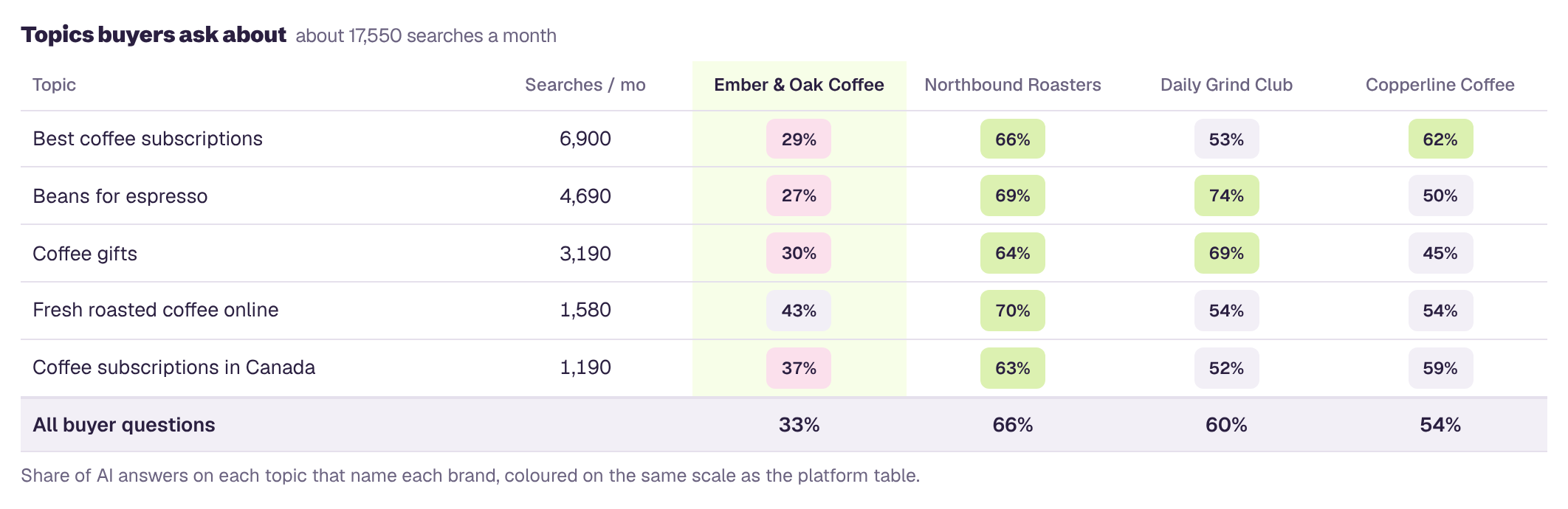
On "Beans for espresso," searched about 4,690 times a month, one competitor is named in 74% of answers and the sample brand in 27%:
Want to know whether AI names your brand or just your product? Get your free AI visibility score from just your website address.
If you only fix three things
- Use one brand name and one set of product names everywhere.
- Build a brand site that proves you're real. People, story, testing, contact details.
- Earn coverage that uses your brand name. Reviews, roundups, videos and community answers.
Shoppers are asking AI what to buy on Amazon. The marketplace brands that win will be the ones AI can name, not just describe.
See what your report covers on our e-commerce page.
Part of our guide: How people shop online now, and why AI visibility decides which store gets the sale
See what AI tells shoppers about your brand
Enter your website and get a free AI visibility report. It takes a few minutes, and you'll see:
- Your AI visibility score, overall and for ChatGPT, Gemini, Claude, Perplexity and Google's AI Overviews and AI Mode
- Which brands AI recommends instead of you, and how often
- Which sites AI sends shoppers to, your own or a marketplace
- What AI gets wrong about you, and what to fix first
- A downloadable PDF you can share with your team