Getting the click to your own store: how shoppers find DTC and Shopify brands through AI
Shoppers now ask AI which brand to buy and where to buy it. Here's what AI tells them about direct-to-consumer brands, why it often sends the click elsewhere, and what DTC and Shopify brands can publish to get named and linked.
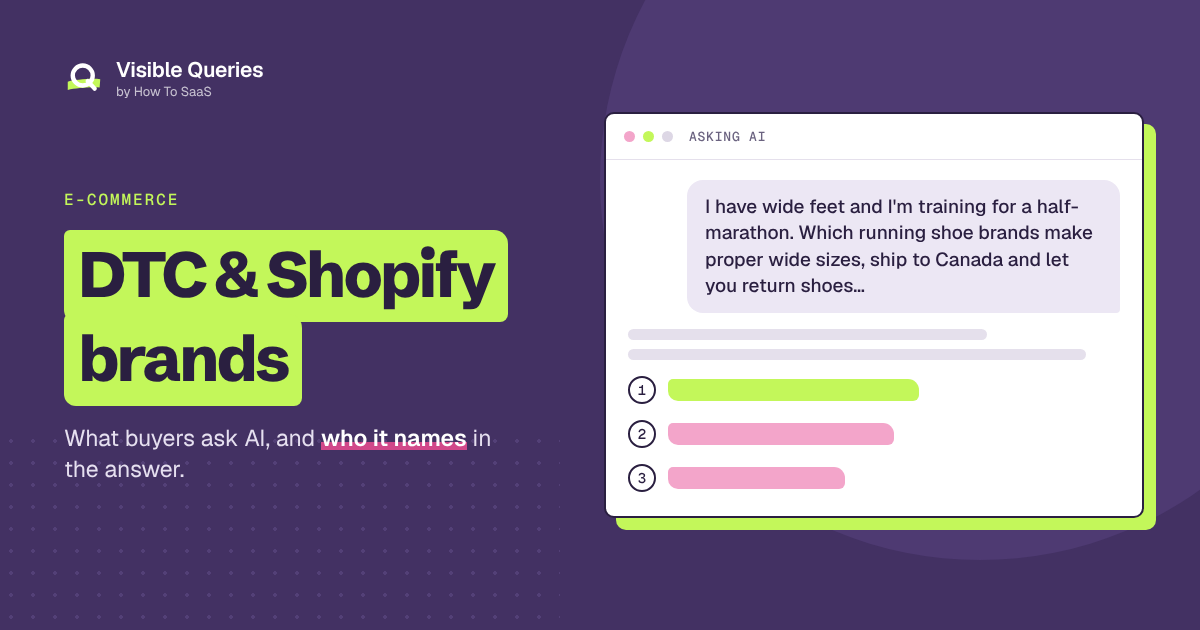
A runner in Calgary has wide feet and a half-marathon in ten weeks. Every pair of shoes they've tried from the big brands pinches at mile six. They've seen ads for a couple of smaller online brands, but ads are ads. So they ask Gemini:
"I have wide feet and I'm training for a half-marathon. Which running shoe brands make proper wide sizes, ship to Canada and let you return shoes you've run in?"
AI explains what "wide" actually means in shoe sizing, why toe box shape matters more than the width letter, and why a generous return policy is worth paying for when you're guessing at fit online. Then it names five options. Two are big brands with wide versions. Three are direct-to-consumer brands, and one of them gets the line every DTC founder wants: "known for a true wide toe box and a 60-day run-tested return policy."
That brand's link goes straight to its own store. The runner orders two sizes to try at home.
Direct-to-consumer brands were built on owning the customer relationship: your store, your email list, your margin. AI can protect that, or quietly take it away. Our e-commerce guide covers how online shoppers research in general. This one goes through the questions that decide whether shoppers find a DTC brand, what AI usually says, and what to publish so AI names you and links to your store.
Here are the questions at a glance:
| The question | What gets you named and linked |
|---|---|
| "Best [product] for [someone like me]?" | Pages for each use, fit and budget you serve |
| "Is [brand] worth it, or just good marketing?" | Specific materials, sourcing and proof |
| "Is [brand] legit?" | A real About page, founders and contact details |
| "[Brand] vs [big brand]?" | Honest comparison pages |
| "Shipping, returns, where do they ship?" | Plain policy pages in text |
| "Is it cheaper on Amazon?" | A clear reason to buy direct |
"What's the best [product] for [someone like me]?"
This is the shortlist question, and it's where DTC brands have their best chance against bigger names.
What AI usually says: It names three to six brands, often grouped by need ("best for wide feet," "best budget pick," "best for trail running"), with a line on each.
Why it matters: Shoppers describe themselves in detail now. A big brand can win "best running shoes" while a focused DTC brand wins "best running shoes for wide feet that ship to Canada." The more specific the question, the better a clear niche brand does.
What to publish: Pages for each use, fit, body type, budget or situation you genuinely serve well, written in the words shoppers use. "Running shoes for wide feet" beats "Comfort collection." Explain who each product suits and who it doesn't.
"Is [brand] worth it, or is it just good marketing?"
DTC brands are often ad-first brands, and shoppers know it. This question is everywhere.
What AI usually says: It summarizes reviews, Reddit opinions and YouTube reviews into a verdict, like "quality is good but you're paying for the branding" or "genuinely well made, sizing runs small."
Why it matters: This is the moment your ad spend either pays off or gets undone. If AI's verdict is lukewarm, the ad that brought the shopper in has just been talked down.
What to publish: Specifics AI can repeat instead of adjectives: materials, where and how it's made, testing, warranty terms, and why it costs what it costs. Then earn third-party opinions by sending product to honest reviewers and taking part in communities where your shoppers talk.
"Is [brand] legit, or is it a dropshipper?"
What AI usually says: It looks for signs of a real company: an address, named founders, press coverage, reviews over time, a real return process. Without them, it hedges.
What to publish: An About page with real people, a real story and where products come from. Contact details. A returns address. Press mentions. These feel basic, but they're the facts AI uses to separate a real brand from a storefront that appeared last month.
"Is it cheaper to buy [brand] on Amazon or direct?"
This is where DTC brands lose sales they've already won.
What AI usually says: It compares prices it can find, mentions any first-order discount or subscription saving, and often links to whichever source it found the price on. If your Amazon listing has a clearer price than your own store, that's where the link goes.
Why it matters: Even when AI names you, the click can go elsewhere. In the sample report from our e-commerce guide, the brand is named in 33% of AI answers but linked in only 14%:

What to publish: A plain reason to buy direct, as a fact on your site: free shipping over a set amount, a longer return window, a subscription discount, exclusive colors or sizes, or fresher stock. Keep prices consistent across channels, and make every product page show the price, sizes and availability in text.
"[Your brand] vs [big brand]?"
What AI usually says: It compares price, quality, fit, materials and policies, usually drawing on reviews and comparison articles.
What to publish: Honest comparison pages for the brands shoppers mention most, including where the bigger brand is the better pick. Balanced comparisons get repeated. One-sided ones get ignored.
Product pages AI can actually read
This is the part most DTC brands haven't caught up with. Shopify themes are built to look good to people: big images, short taglines, details hidden behind tabs or in images. AI reads text. If your size chart is an image, your materials are in a collapsed tab that loads with a script, and your shipping times only appear at checkout, AI may not see any of it.
Check every key product page for:
- The full product name, price and available sizes or variants in plain text
- Materials, ingredients or specs written out, not only in images
- Who it's for, and who it isn't for
- Shipping regions, costs and delivery times on the page or one clear link away
- The return window and process in plain words
- Reviews that load as text, not only inside a widget
None of this needs a redesign. It's mostly moving facts that already exist into text AI can read.
What the sample report shows
Here's what a Visible Queries report looks like for Ember & Oak Coffee, the sample online coffee brand from our e-commerce guide. It sells beans and subscriptions from its own store, which makes it a typical DTC brand. The products are different for your brand, but the patterns are the same.
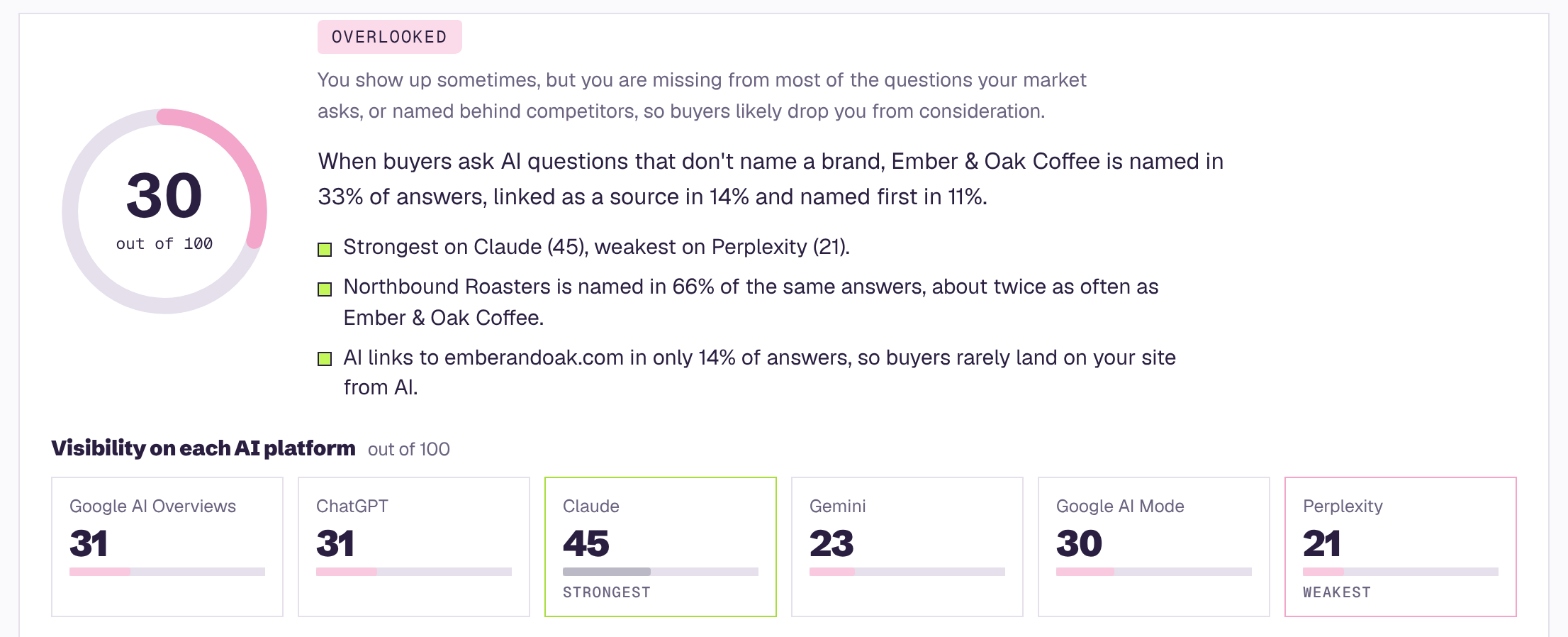
The more telling gap for a DTC brand is where AI sends the shopper once it does name you:
Want to see how often AI links to your store? Get your free AI visibility score from just your store's address.
If you only fix three things
- Build pages for each use, fit and budget you serve. In the words shoppers use.
- Give shoppers a reason to buy direct, and publish it as a fact. Then keep prices consistent across channels.
- Put product facts and policies in plain text. Sizes, materials, shipping, returns and reviews AI can read.
Shoppers are asking AI which brand to buy and where to buy it. The DTC brands that win will be the ones AI can describe clearly and link to with confidence.
See what your report covers on our e-commerce page.
Part of our guide: How people shop online now, and why AI visibility decides which store gets the sale
See if AI sends shoppers to your store
Enter your website and get a free AI visibility report. It takes a few minutes, and you'll see:
- Your AI visibility score, overall and for ChatGPT, Gemini, Claude, Perplexity and Google's AI Overviews and AI Mode
- How often AI links to your own store, not a marketplace or reseller
- Which brands AI recommends instead of you, and how often
- What AI gets wrong about you, like shipping, returns and prices
- A downloadable PDF you can share with your team